

Architecture internships are paid or for-credit roles at firms where students and recent graduates produce real project work under licensed architects. To land one, target firms early, tailor your application to each office, present a focused portfolio, and prepare to talk through your design process in the interview. Most paid internships count toward licensure experience.
Securing one of the available architecture internships is the single most useful step between school and a licensed career. It converts studio skills into firm-ready output, builds the professional network that drives future hiring, and starts the clock on the experience hours you will need for registration. This guide walks through exactly where to look, how to apply, what to put in your portfolio and resume, and how to handle the interview so you finish the process with an offer.
What is an architecture internship?

An architecture internship is a temporary position, usually lasting a summer or a full academic term, where a student or recent graduate works inside an architecture firm on live projects. Interns typically build digital models, draft construction documents, assemble presentation boards, conduct code and site research, and sit in on client and consultant meetings. The role is supervised by a licensed architect who reviews and signs off on the work.
The value goes beyond a line on your resume. According to the U.S. Bureau of Labor Statistics, gaining experience through a paid internship is one of the three core steps to becoming a licensed architect, alongside earning a professional degree and passing the licensing exam. Internships are where abstract studio training meets the realities of budgets, building codes, and coordination with engineers. If you are still mapping out the full path, our guide on how to become an architect lays out the steps, time, and cost in detail.
📌 Did You Know?
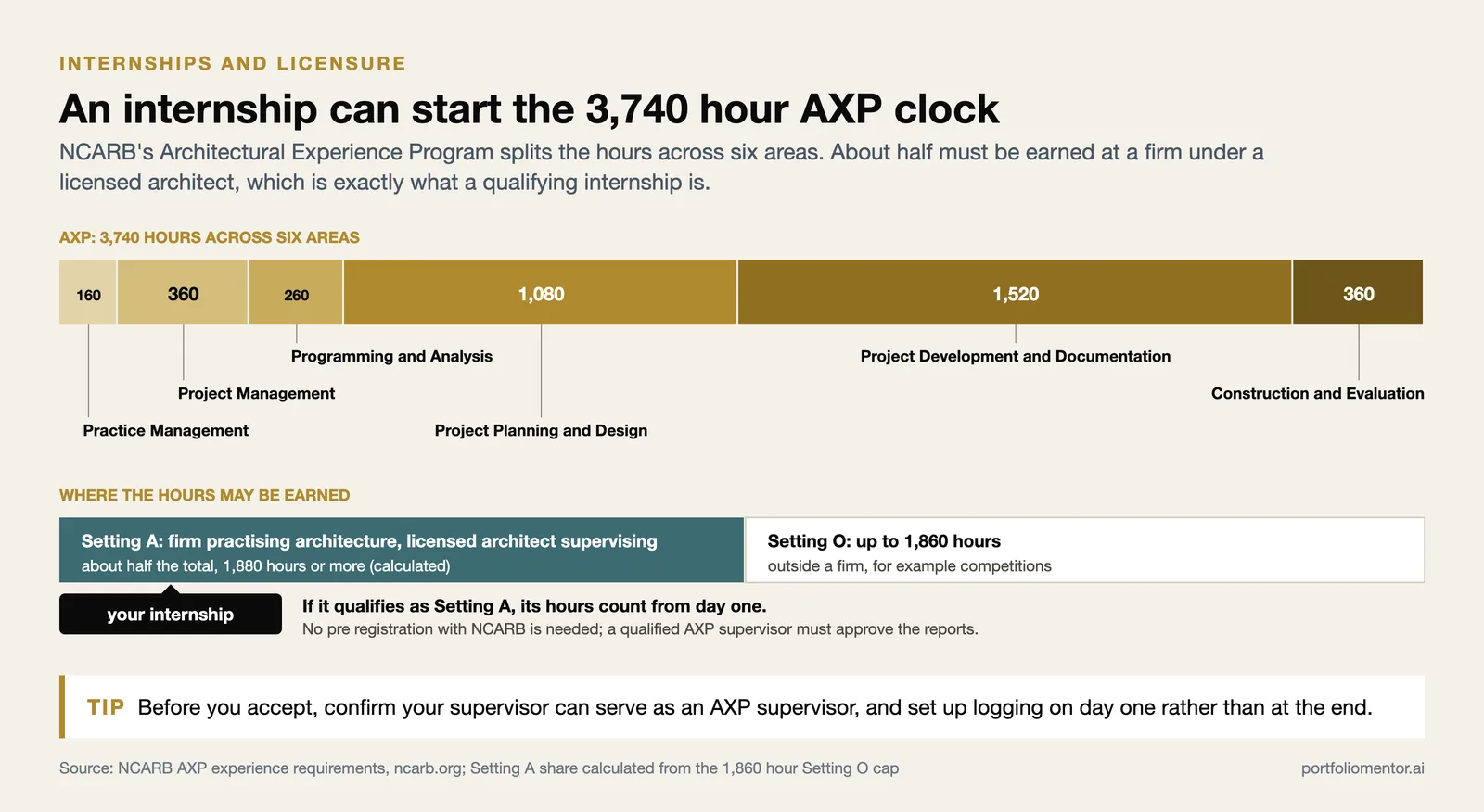
If an academic internship meets the requirements of NCARB’s Experience Setting A, you can report those hours toward the Architectural Experience Program (AXP) the same way you would any firm experience. There is no need to pre-register the internship with NCARB, which means a single well-chosen summer can begin counting toward your license.
How internships count toward licensure

The National Council of Architectural Registration Boards (NCARB) runs the Architectural Experience Program (AXP), which requires a total of 3,740 hours of documented experience across six areas: practice management, project management, programming and analysis, project planning and design, project development and documentation, and construction and evaluation. About half of those hours must be earned at a firm under a licensed architect. A paid internship that qualifies as Setting A is the most direct way to start logging them, so confirm your supervisor can serve as an AXP supervisor before you accept.
Where to find architecture internships

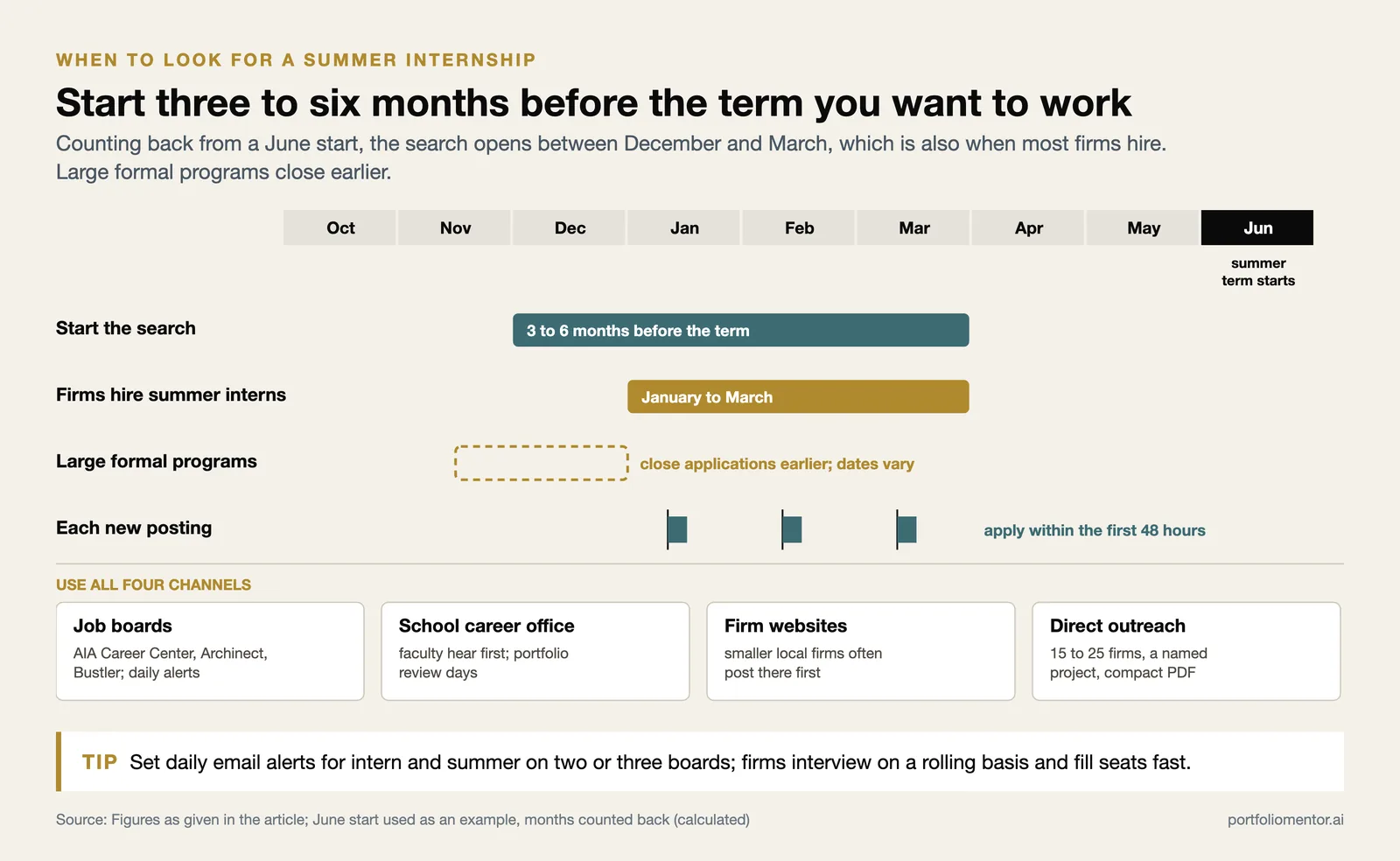
The best architecture internships are found through a mix of dedicated job boards, school career services, firm websites, and direct outreach. Relying on a single channel is the most common reason capable students miss out. Spread your search across all four, start three to six months before the term you want to work, and keep a tracking sheet so nothing slips.
Job boards and professional organizations
Start with industry-specific boards rather than general sites. The AIA Career Center, run by the American Institute of Architects, posts new architecture roles daily, including internships and entry-level positions across the country. Many regional AIA chapters maintain their own job boards as well, which is where smaller local firms often post first. Architecture-focused platforms such as Archinect and Bustler also carry a steady stream of internship listings.
💡 Pro Tip
Set up daily email alerts on two or three architecture job boards using the keywords “intern” and “summer.” Firms often interview on a rolling basis and fill seasonal seats fast, so applying within the first 48 hours of a posting noticeably raises your odds over a batch application sent weeks later.
School career services and faculty
Your program’s career office and studio professors are an underused channel. Firms that hire reliably from a school will often contact faculty directly before posting publicly, and many programs run portfolio review days where local offices recruit on site. Tell your studio instructor you are looking and ask which alumni are at firms you admire. A warm introduction from a professor moves your application out of the general pile.
Direct outreach to firms
Many of the best small and mid-size firms never advertise internships at all. Build a list of 15 to 25 offices whose work genuinely interests you, find the right contact (often a principal or studio director), and send a short, specific email with your portfolio attached as a compact PDF. Reference a particular project of theirs and explain what you would bring. A focused list of well-researched firms beats a mass blast every time.
⚠️ Common Mistake to Avoid
Sending the same generic cover email to 50 firms is the fastest way to get ignored. Principals can spot a template instantly. A short message that names a specific project, explains why that office in particular, and matches your skills to their work will outperform a mass send many times over, even at a fraction of the volume.
How to apply for an architecture internship

A strong application has three parts that work together: a portfolio that shows how you think, a resume that proves you can contribute, and a cover note that connects you to that specific firm. Tailor all three to each office rather than reusing one package. The goal is to make it easy for a busy reviewer to picture you producing useful work in their studio.
Build a portfolio that gets you the interview

Your portfolio is the deciding factor for most internship applications. Reviewers spend very little time on each one, so lead with your three strongest projects and show process, not just final renders. Include sketches, diagrams, and iterations that reveal how you arrived at a design decision. Keep the file small enough to email, usually under 10 MB, and make sure every page reads clearly at screen size. For a step-by-step build, see our guide on creating an architecture portfolio for internships, and run a draft through our free portfolio checklist before you send it.
🎓 Expert Insight
“You can start earning AXP experience after you graduate from high school or the established equivalent, and all of your experience reports must be reviewed and approved by an AXP supervisor.”, NCARB, Architectural Experience Program guidelines
This means even an early internship can count, but only if you confirm upfront that a licensed architect at the firm will sign off on your hours.
Write a resume that fits a firm
Keep your resume to one page and lead with software fluency, since firms screen heavily for tools like Revit, Rhino, AutoCAD, and Adobe Creative Suite. List relevant coursework, studio projects, and any construction, fabrication, or office experience, and quantify what you did where possible. Match the skills you highlight to the language in the job posting. Our architecture resume guide with examples shows how to structure each section for entry-level applicants.
Send a targeted cover note
A cover note should be four to six sentences. Name the firm and a specific project, state when you are available and for how long, list the two or three tools you are strongest in, and attach your portfolio and resume as clearly named PDFs. Skip the generic praise and get to why you and this office are a fit. Brevity and specificity read as professionalism.
How to prepare for the interview
Architecture internship interviews almost always center on a portfolio walkthrough. Be ready to talk through two or three projects in depth: the problem, your concept, the decisions you made, and what you would change. Interviewers care less about polished renders than about how clearly you reason. Practice narrating your work out loud until it sounds natural rather than memorized.
Research the firm’s recent projects and be prepared to say why their work appeals to you. Have a few questions ready about the kind of work an intern does there, mentorship, and team structure, which signals genuine interest. If the role is remote or hybrid, ask how files and reviews are handled. Bring a clean printed or tablet copy of your portfolio even if you already sent a PDF.
💡 Pro Tip
When an interviewer asks about a project, resist the urge to narrate every step chronologically. Lead with the central design problem and your one strongest move to solve it, then offer to go deeper. This shows you can prioritize and communicate like someone who will be useful on a deadline-driven team.
How much do architecture internships pay?
Paid architecture internships in the United States generally pay between $20 and $30 per hour depending on the market, firm size, and your level of education. That places a typical full-time summer well into the low-to-mid five figures on an annualized basis. Compensation rises quickly after licensure: the U.S. Bureau of Labor Statistics reports a median annual wage of $99,280 for architects as of May 2025.
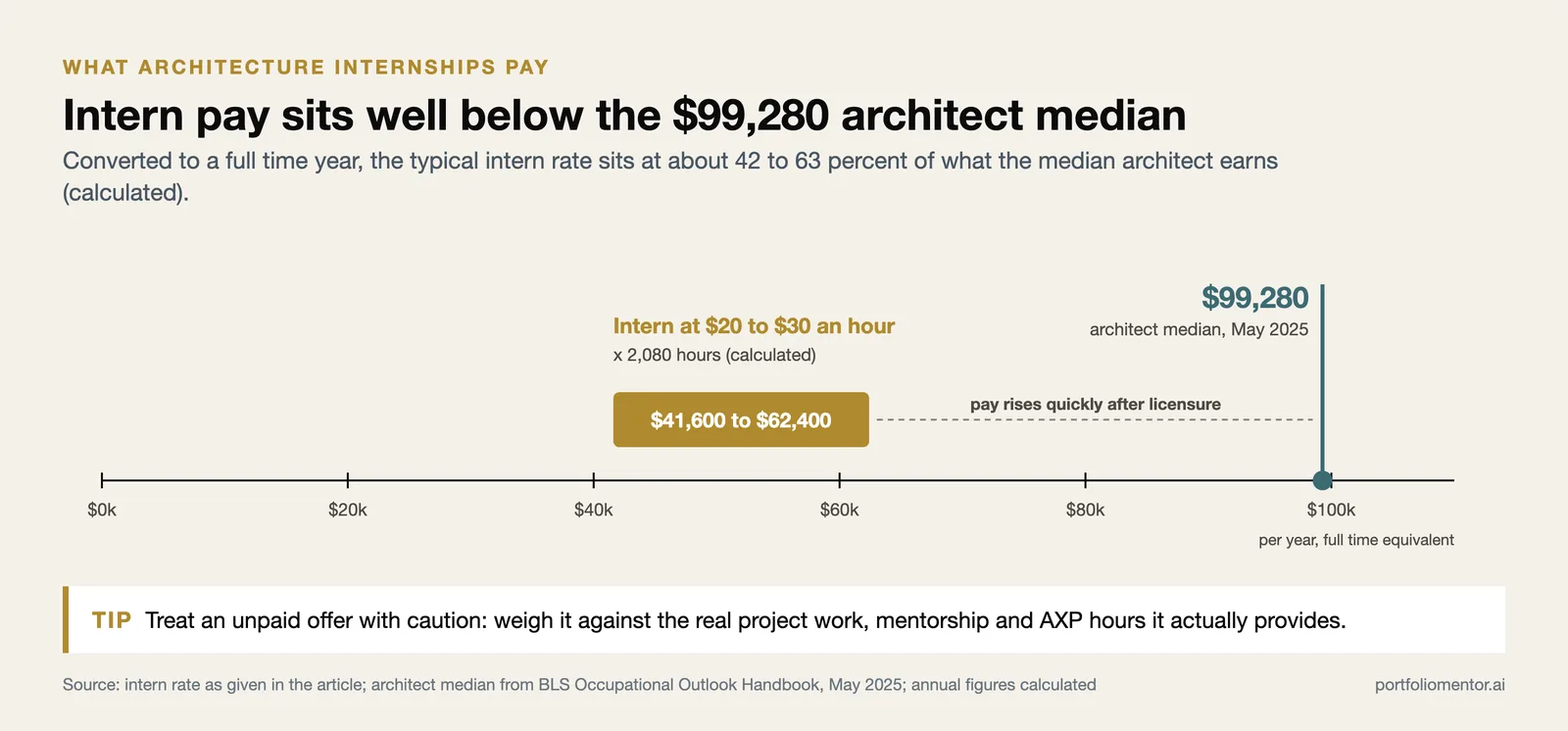
Pay is not the only thing that varies. Some internships are full-time over the summer, others run part-time alongside coursework, and a few are unpaid or offered for academic credit. Treat an unpaid offer with caution and weigh it against the experience, mentorship, and licensure hours it actually provides. The job outlook is steady: BLS projects employment of architects to grow about 4 percent from 2025 to 2035, with roughly 6,900 openings each year on average.
Frequently asked questions
When should I apply for a summer architecture internship?
Start applying three to six months ahead. Many firms recruit summer interns between January and March, and larger offices with formal programs close applications earlier. Applying early, before postings disappear, consistently produces better results than a last-minute push in spring.
Do I need a portfolio for an architecture internship?
Yes. A portfolio is effectively required for nearly every architecture internship, even at the first-year level. It is the primary evidence of your design thinking and software ability. Lead with your strongest two or three projects and show your process, not only finished images.
Can a first-year student get an architecture internship?
It is possible but more competitive. First-year students often start with smaller local firms, fabrication shops, or research assistant roles and use those to build toward a firm internship in later years. Strong software skills and a tidy portfolio of studio work matter more than the number of years completed.
Are unpaid architecture internships worth it?
Sometimes, but evaluate carefully. The value depends on whether the role offers real project work, mentorship from a licensed architect, and hours that count toward AXP. A paid position that qualifies for licensure experience is almost always the stronger choice when both are on the table.
Key Takeaways
- Search across job boards, your school’s career office, firm websites, and direct outreach. Do not rely on one channel.
- Start three to six months early, and apply within the first 48 hours of a posting whenever you can.
- Lead with a focused portfolio of two or three projects that show process, and tailor your resume and cover note to each firm.
- Prepare to walk through your work in the interview by leading with the design problem and your strongest move.
- Confirm a paid internship qualifies as AXP Setting A so your hours count toward licensure from day one.

