

Architecture interview questions usually fall into four groups: questions about your portfolio, your design thinking, your technical and software skills, and your fit with the firm or program. Strong answers connect a specific project to a clear decision and a measurable result, so the interviewer sees how you think, not just what you made.
Whether you are applying to a firm, an M.Arch program, or a first internship, the same pattern holds. The people across the table want evidence that you can carry a design idea from concept to drawing, work with a team, and explain your choices under pressure. Below is a practical breakdown of the most common architecture interview questions, how to answer them, and the questions you should ask back. Use it alongside a polished portfolio, since most of these conversations start with your work on the screen.
What are the most common architecture interview questions?

Most architecture interviews open with a few predictable prompts. Knowing them in advance lets you prepare real examples instead of improvising. According to Indeed’s career advice on architecture interview questions, interviewers tend to move from general background, into experience-based prompts, and finally into in-depth design and technical questions.
- Tell me about yourself and why architecture.
- Walk me through the project you are most proud of.
- What is your design process from brief to final drawing?
- How do you handle feedback or a design you disagree with?
- Which software and tools do you use, and how fluently?
- Tell me about a deadline or site problem you solved.
- Why this firm or this program specifically?
- Where do you see your career in five years?
The trap with these is sounding rehearsed. Prepare the raw material, the projects and decisions, then speak naturally. Interviewers can tell the difference between a memorized script and a person who genuinely understands their own work.
⚠️ Common Mistake to Avoid
Describing what a building looks like instead of why you designed it that way. When asked about a project, candidates often narrate features (“this is the cafe, this is the courtyard”) and skip the reasoning. Lead with the problem and the decision, then the form follows. Interviewers hire for judgment, and judgment lives in the why.
How do you answer architecture interview questions using the STAR method?
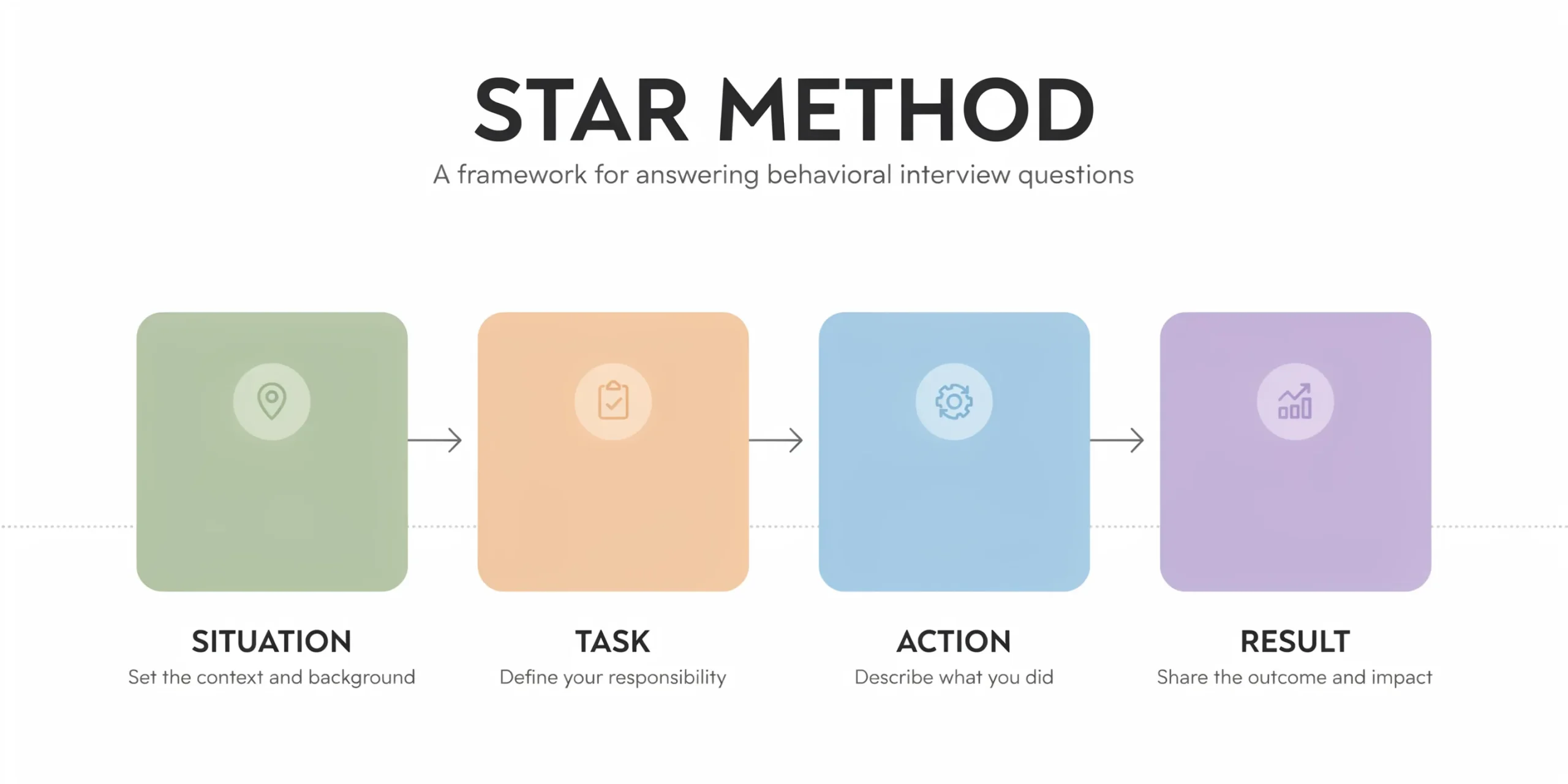
For any behavioral or project question, structure your answer with STAR: Situation, Task, Action, Result. This keeps you from rambling and forces a clear outcome. MIT Career Advising and Professional Development recommends spending roughly 60 percent of your answer on the Action, since that is where you show what you personally did.
- Situation: Set the context in one or two sentences. “In my third-year studio, our brief was a flood-resilient community center on a tight riverside site.”
- Task: Name your specific responsibility. “I led the section strategy and the ground-floor flood detailing.”
- Action: Explain the decisions you made and why. Use “I” statements, not “we.”
- Result: Close with the outcome, ideally measurable. “The raised plinth scheme scored highest in the studio review and became my lead portfolio project.”
The Result line is where most candidates fall short. A jury award, a grade, a client decision, a build that got constructed, or a metric like reduced floor area all work. If you have no hard number, use the qualitative outcome and what you learned.
💡 Pro Tip
Prepare three to four STAR stories before any interview and make each one flexible. A single strong project can answer questions about teamwork, problem solving, software, and design process if you frame it differently each time. This is far more reliable than trying to invent a fresh example for every prompt on the spot.
How do you talk through your portfolio in an interview?
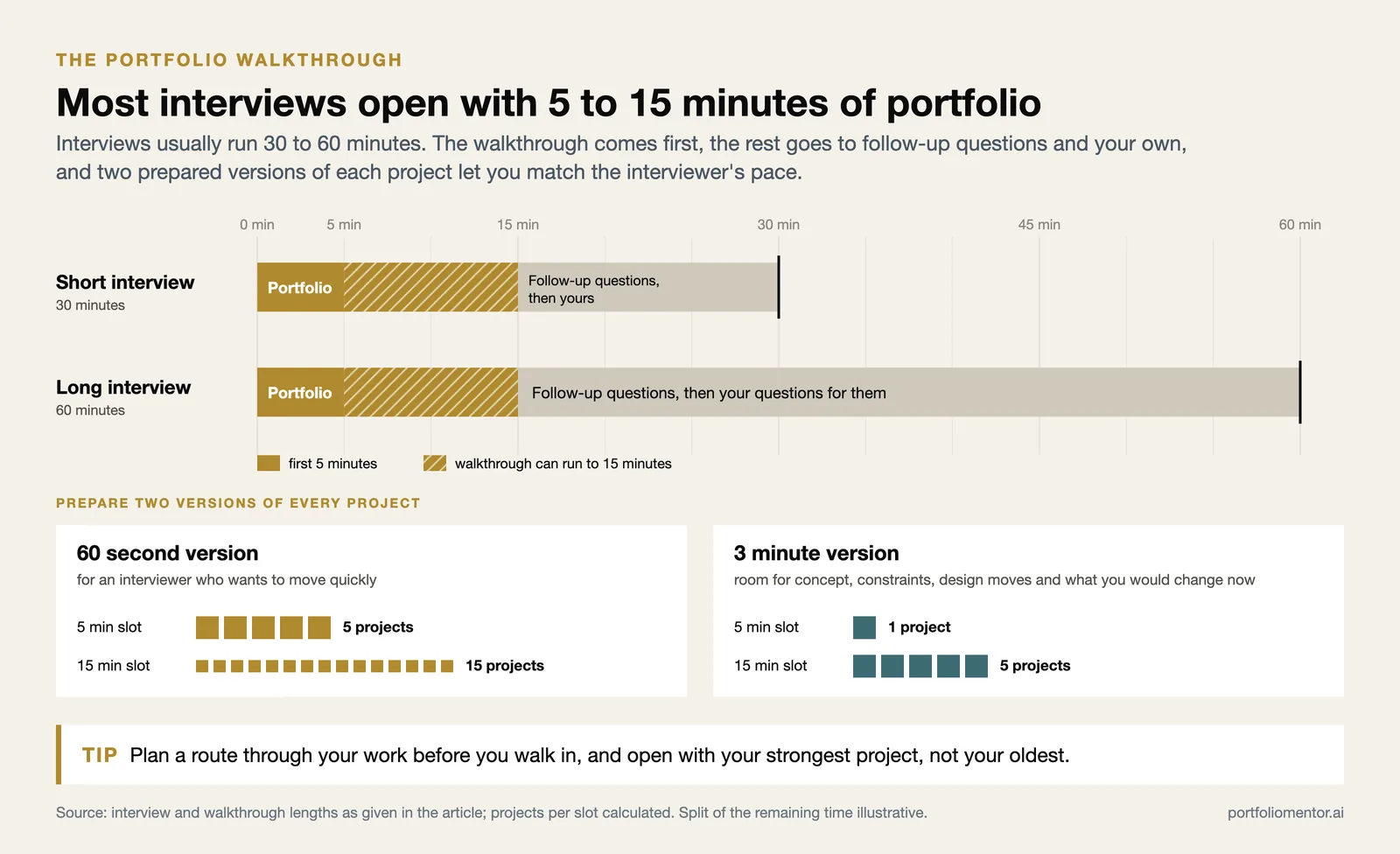
The portfolio walkthrough is the heart of most architecture interviews. For firm roles and university admissions alike, expect to spend the first 5 to 15 minutes presenting your work, followed by follow-up questions. Your portfolio should stand on its own visually, and the interview is your chance to explain the thinking behind it.
Plan a route through your work before you walk in. Open with your strongest project, not your oldest. For each piece, prepare a 60 second version and a 3 minute version so you can adjust to the interviewer’s pace. Be ready to explain your concept, the constraints you worked under, the design moves you made, and what you would change now. Admissions panels in particular look for a sense of progression, so be honest about how your interests and skills shifted from one project to the next.
If your portfolio is not yet interview-ready, fix that first. A clear layout, consistent typography, and a strong project order do half the talking for you. Portfolio Mentor’s review tools score your layout, curation, and presentation against the conventions firms apply, which makes the walkthrough far easier to rehearse once the work itself is tight.
🏗️ Real-World Example
The classic “weakest project” question: many interviewers will point to a less polished page and ask about it on purpose. They want to see how you handle critique. A candidate who says “that scheme had a circulation problem I solved by splitting the core, here is what I learned” reads as far more hireable than one who gets defensive or dismisses the work.
What questions come up in a firm or job interview?

Once you are past entry level, architecture job interviews lean harder into practice realities: software fluency, code and regulatory awareness, sustainability, and how you function inside a project team. The American Institute of Architects and licensure bodies have pushed sustainable design and BIM competence into the standard skill set, so these topics surface often.
Technical and software questions
Be precise about your tools. Saying you “know Revit” is weaker than “I model in Revit, run clash detection in Navisworks, and produce diagrams in Illustrator.” If a firm lists a specific stack in the job post, mirror it honestly. Never claim fluency you cannot back up, since a follow-up question will expose it quickly.
Process and teamwork questions
Expect prompts like “describe a time you disagreed with a senior designer” or “how do you keep a set of drawings coordinated under deadline.” Firms hire people who can take direction, give it, and keep documents clean. Use STAR, and emphasize collaboration over solo heroics.
Licensure and career questions
For roles in the United States, interviewers may ask where you are in the licensure path. Knowing the basics of the NCARB experience and examination process signals that you are serious about a long-term career, even if you are years away from completing it.
🎓 Expert Insight
“When you are preparing for an architecture job interview, you will need to research the firm, practice answers to common questions, and highlight your strongest skills.”, archisoup, architecture education resource
The point that candidates underestimate most is firm research. Knowing a studio’s recent built work lets you tailor every answer and shows genuine interest rather than a mass-application approach.
What do architecture school admission interviews ask?
University and M.Arch interviews are more conversational than firm interviews, but they still center on your portfolio. After the walkthrough, panels often shift into broader questions to gauge curiosity and motivation rather than technical depth.
- Why architecture, and why now?
- Which architect, building, or city has influenced you, and why?
- Talk about a project where you experimented with a new material or method.
- What do you read, watch, or visit outside of school?
- What do you hope to get out of this program specifically?
The best admissions answers are relaxed and specific. Naming a real building you visited and what you noticed about its light or circulation beats a generic answer about loving design. Panels are listening for a mind that observes, not a memorized statement.
Firm interview vs school interview: what differs?
The two formats reward different things. The table below summarizes where to focus your preparation for each.
| Aspect | Firm or Job Interview | University Admission Interview |
|---|---|---|
| Main focus | Skills, software, deliverables, team fit | Potential, curiosity, design thinking |
| Portfolio emphasis | Technical drawings, BIM, execution | Concept, experimentation, progression |
| Tone | Professional, outcome driven | Conversational, exploratory |
| Best question to ask back | About project types and team structure | About studio culture and faculty focus |
| Common closer | Salary and start date expectations | Why this program over others |
What questions should you ask the interviewer?

Almost every interview ends with “do you have any questions for us?” Saying no is a missed opportunity. Thoughtful questions show engagement and help you judge whether the role or program suits you. Prepare three or four in advance.
- What does a typical project lifecycle look like for someone in this role?
- How is design responsibility shared between junior and senior staff here?
- What software and standards does the office rely on day to day?
- How do you support staff working toward licensure or further study?
- For programs: how much studio time is self-directed versus guided?
Avoid leading with salary or holiday in a first interview. Those questions belong, but raising them too early can read as the wrong priority. Save compensation talk for when the firm signals real interest, then negotiate from a position of having shown your value first. To understand what the platform offers across the wider job search, the Portfolio Mentor team page outlines how reviewers from leading firms shape the feedback you can use to prepare.
📌 Did You Know?
In many architecture school admissions interviews, the panel deliberately leaves time at the end to give you live feedback on the work you brought. Treating that feedback well, by listening and responding rather than defending, is itself part of how they assess you.
How should you prepare in the week before the interview?
Preparation turns nerves into confidence. Work through this checklist in the days leading up to your interview.
- Research the firm or program: recent projects, leadership, design ethos.
- Reread the job post or program page and map your skills to each line.
- Prepare three to four STAR stories drawn from your strongest work.
- Plan your portfolio route and rehearse it out loud, timed.
- Write three questions to ask the interviewer.
- Test your tech if the interview is remote: camera, audio, screen share.
- Prepare a short, honest answer for your weakest project.
Rehearse with a friend or mentor if you can. Speaking your answers aloud reveals where you ramble or lose the thread, something silent preparation never catches.
Frequently asked questions
How long does an architecture interview usually last?
Most run 30 to 60 minutes. Portfolio walkthroughs take the first 5 to 15 minutes, with the rest split between follow-up questions and your chance to ask the interviewer. Final-round or panel interviews can run longer.
What should I bring to an architecture interview?
Bring a printed or digital portfolio, extra copies of your resume, a notebook, and any physical models or samples if relevant. For school interviews, bring original sketchbooks or process work if the panel invites it, since they often reveal more than finished boards.
How do I answer “what is your greatest weakness” as an architect?
Name a real, fixable weakness and the steps you are taking to improve it. “I used to over-detail early concepts, so now I sketch fast and loose before committing” shows self-awareness without raising a red flag about your core ability.
Should I talk about salary in the first interview?
Generally no, unless the interviewer raises it. Let the firm establish interest first, then discuss compensation in a later round where you can negotiate based on the value you have already demonstrated.
Putting It All Together
✅ Key Takeaways
- Architecture interview questions cluster around portfolio, design thinking, technical skills, and fit.
- Answer behavioral and project prompts with STAR, spending most of your time on the action and result.
- Plan your portfolio route and prepare an honest answer for your weakest project.
- Firm interviews test execution; school interviews test curiosity and progression.
- Always prepare questions to ask back, and hold salary talk for a later round.
The candidates who do best are rarely the ones with the flashiest renders. They are the ones who can explain a decision, own a mistake, and connect their work to the people interviewing them. Prepare your stories, tighten your portfolio, and walk in ready to have a real conversation about the work you care about.