
Getting an architecture internship with no experience comes down to three things: a portfolio built from your studio work, a short cold email sent to the right firms, and a network you start building before you need it. Small offices hire first-year students far more often than large studios, so that is where most beginners get their first yes.
See archdaily.com.
Almost every architecture student faces the same wall in their first or second year. Firms want experience, but you cannot get experience without a first internship. The good news is that an architecture internship with no experience is a normal starting point, and hiring managers plan for it. An architecture internship no experience candidate can absolutely land an offer with the right approach. What they actually look for is evidence that you can draw, think through a design problem, and show up reliably. This guide breaks down where to apply, how to assemble a student portfolio that works without real projects, how to write a cold email that gets read, and how networking turns a cold list into an offer.
Can you get an architecture internship with no experience?

Yes. Firms hiring interns assume you are early in your education and have no professional projects yet. Your studio drawings, models, and competition entries are the experience they want to see. According to NCARB, you can begin earning credit toward licensure through the Architectural Experience Program (AXP) as soon as you have a high school diploma, which means an internship taken in your first or second year already counts toward your future license.
The barrier most students imagine is bigger than the real one. Firms are not comparing you to licensed architects. They are comparing you to other students, and the ones who get hired are simply the ones who applied to the right places, showed clean work, and made themselves easy to say yes to.
📌 Did You Know?
Any internship built into your degree, whether required or elective, counts as an academic internship under NCARB’s AXP and can be reported for licensure credit the same way as any paid setting A experience, with no pre-approval needed (source: NCARB, Architectural Experience Program Guidelines, 2026).
What goes in a student portfolio with no built work?

Your portfolio carries the entire application when your resume is thin. You do not need completed buildings. You need to show that you can move from a concept to a resolved drawing. Quinn Evans, in its guidance on the intern application process, notes that students should present classroom drawings, renderings, and models rather than apologize for the lack of professional work.
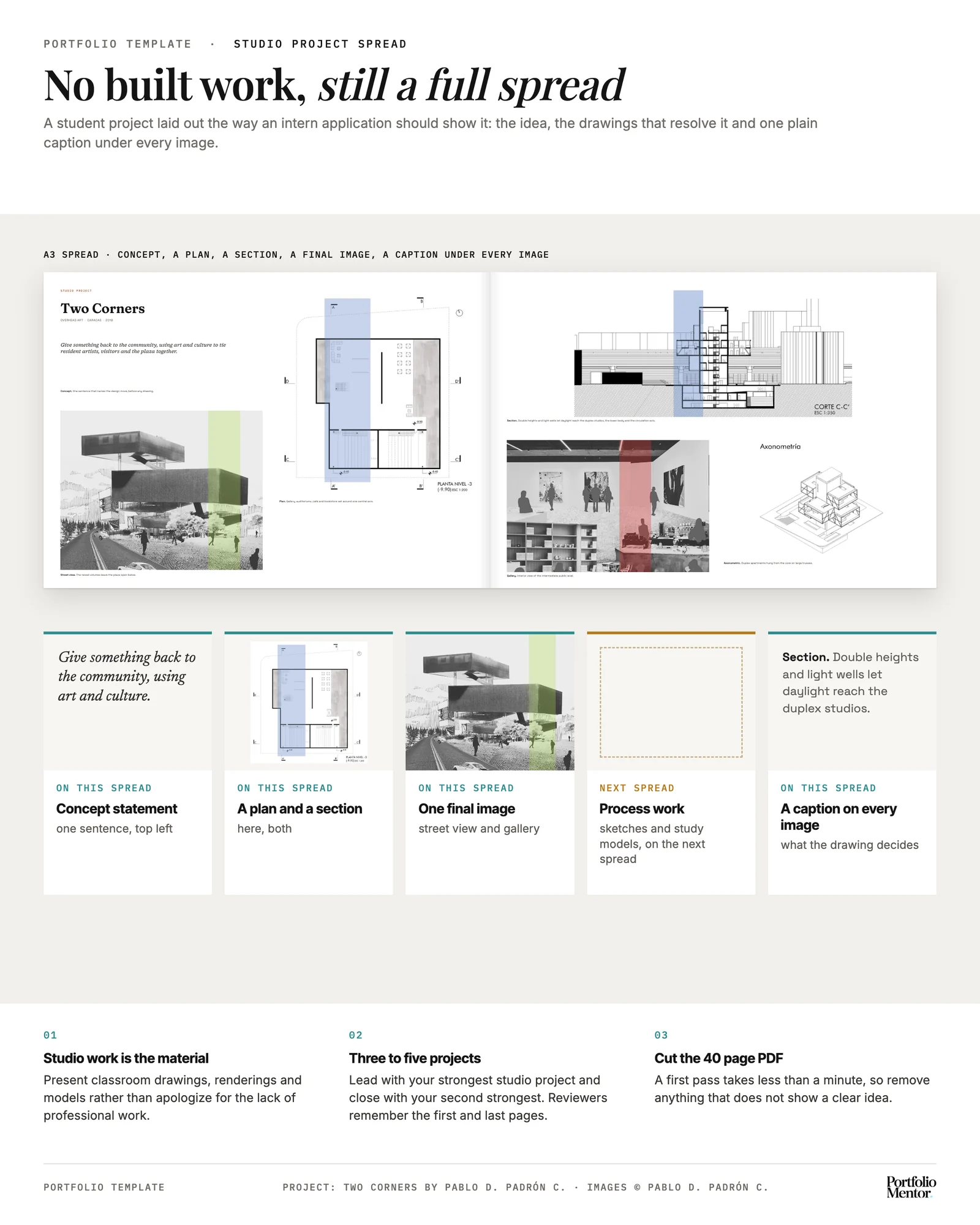
Aim for three to five projects. Lead with your strongest studio project and close with your second strongest, since reviewers remember the first and last pages most. For each project, include a clear concept statement, at least one plan or section, and a final image. Process work such as sketches and study models tells the firm how you think, which matters more at the intern level than polished output.
- Two to three studio projects with plans, sections, and one strong render each
- One competition entry or self-initiated project if you have one
- Hand sketches and physical models to show process and craft
- Any non-studio skills that read on a page: photography, graphic design, fabrication, or coursework in Revit and Rhino
- A short, plain caption under every image explaining the design move
If you want a structured way to check page count, aspect ratio, and curation before you send anything, the portfolio examples on Portfolio Mentor show real before-and-after student cases, and the free portfolio tools include a 50-point checklist you can run against your draft.
⚠️ Common Mistake to Avoid
Many students send a 40-page PDF stuffed with every drawing they ever made. Reviewers spend less than a minute per portfolio on a first pass, so a dense file works against you. Cut to your best three to five projects and remove anything that does not show a clear idea.
Where should you apply for a first internship?

Where you apply matters more than how many places you apply to. Large, well-known firms receive hundreds of intern applications and tend to pick students who already have a summer of experience. Small practices, sole practitioners, and local offices in your hometown are far more open to a first-year student who can help with models, drafting, and renderings.
Build a target list of 20 to 30 firms across these channels rather than relying on a single job board. Spreading your search widens your odds and surfaces the smaller offices that rarely post openings at all.
Where to find architecture internship openings

| Channel | Best for | Effort to access |
|---|---|---|
| University career center and professors | Warm intros to alumni-led firms | Low |
| AIAS career center and conferences | Student-focused listings and networking | Low |
| LinkedIn and Indeed | Posted internships at mid-size firms | Medium |
| Direct cold email to local firms | Hidden roles at small offices | Medium |
| Firm websites and careers pages | Structured summer intern programs | Medium |
Membership organizations are worth the student fee. The American Institute of Architecture Students runs a career center, regional Quad conferences, and networking events, and members roll into free AIA Associate membership for 18 months after graduation. That early access to working architects is exactly the network a first-time applicant lacks.
How do you write a cold email that gets a reply?

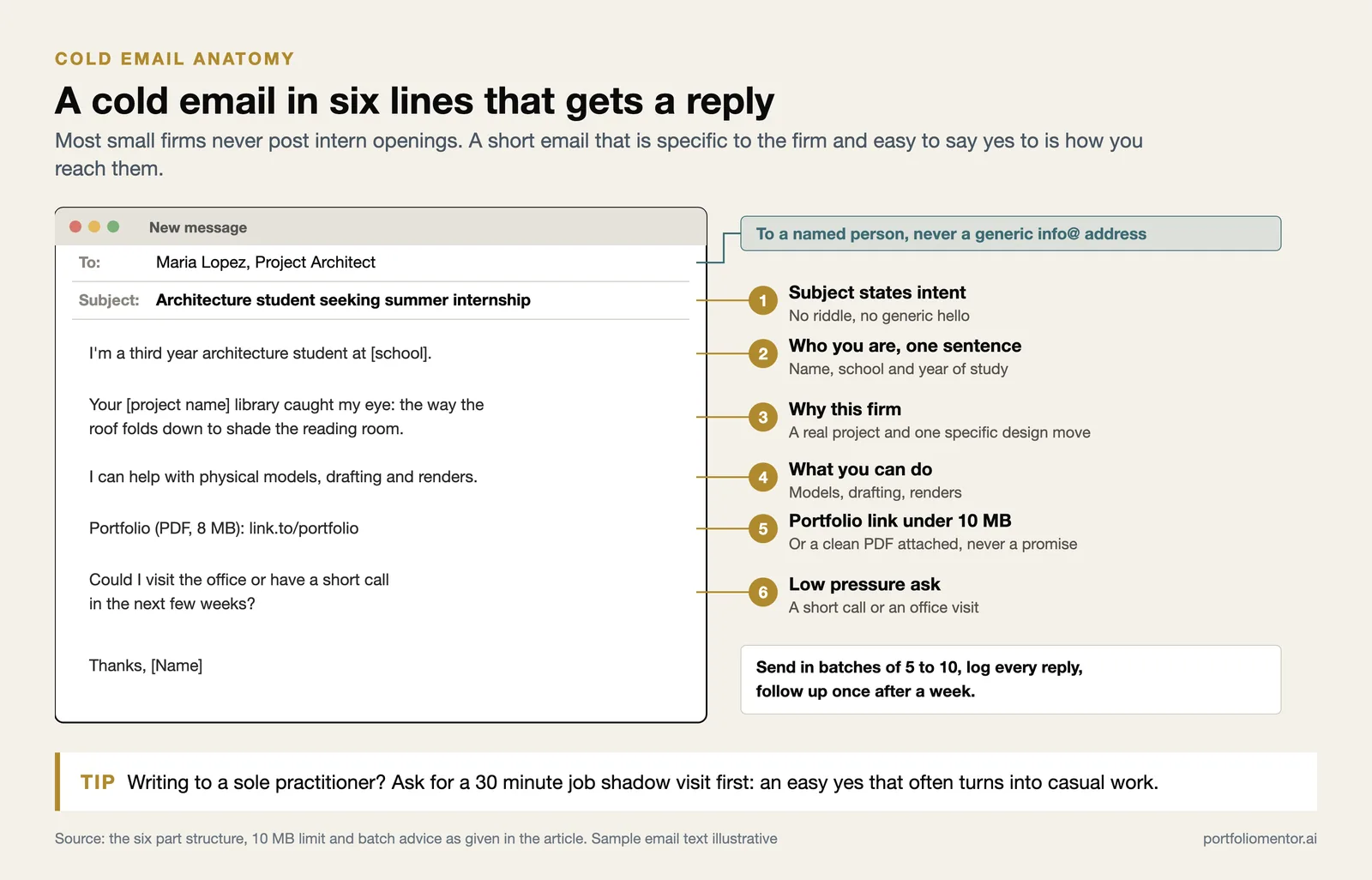
Most small firms never post intern openings, so a direct cold email is how you reach them. The email that works is short, specific to that firm, and easy to act on. Send it to a named person, not a generic info address, and attach or link a tight portfolio rather than promising one later.
- Subject line that states intent: “Architecture student seeking summer internship”
- One sentence on who you are and your year of study
- One specific reason you want to work there, drawn from a real project of theirs
- One sentence on what you can help with: models, drafting, renders
- A link to a portfolio under 10 MB, or a clean PDF
- A clear, low-pressure ask: a short call or a visit to the office
Reference one of the firm’s actual buildings and say what you liked about a specific design move. Generic praise reads as a mass mailing. A line that shows you looked at their work is often the difference between a reply and silence. If you want to sharpen the resume and one-pager that travel with the email, the architecture CV guide covers how to frame coursework and software skills when you have no job history yet.
💡 Pro Tip
When you email a sole practitioner or a hometown firm, ask to visit for a short job shadow instead of leading with an internship request. A 30-minute visit is a low-commitment yes for them, and it often converts into casual work once they see you in person.
💡 Pro Tip
Send cold emails in batches of five to ten and track replies in a simple sheet. Follow up once after a week if you hear nothing. A single polite follow-up recovers a meaningful share of non-responses, since your first email often arrives on a busy day and gets buried.
How does networking turn into an offer?
Networking sounds formal, but for a student it mostly means staying visible to people who already know your work. Professors hear about openings before they reach job boards. Alumni hire students from their own program because the risk feels lower. Volunteering on a committee or at a local design event puts you in the same room as practicing architects without any pressure to pitch yourself.
Treat your professors as your first network. Ask which firms in the area take interns and whether they would introduce you. A warm introduction skips the cold email entirely. Career fairs and AIAS conferences work the same way, turning a name on a list into a face the firm remembers when they have a desk to fill.
Keep an online presence that a hiring manager can find. A clean profile that links to your portfolio lets a firm verify you in seconds after a conversation. The guide to LinkedIn for architects walks through how to set up a profile that surfaces your studio work, and thinking ahead about your architecture career paths helps you target firms whose work matches where you want to head.
A step-by-step plan to land your first internship
Pulling it together, here is a sequence you can run over roughly eight weeks before the summer hiring window.
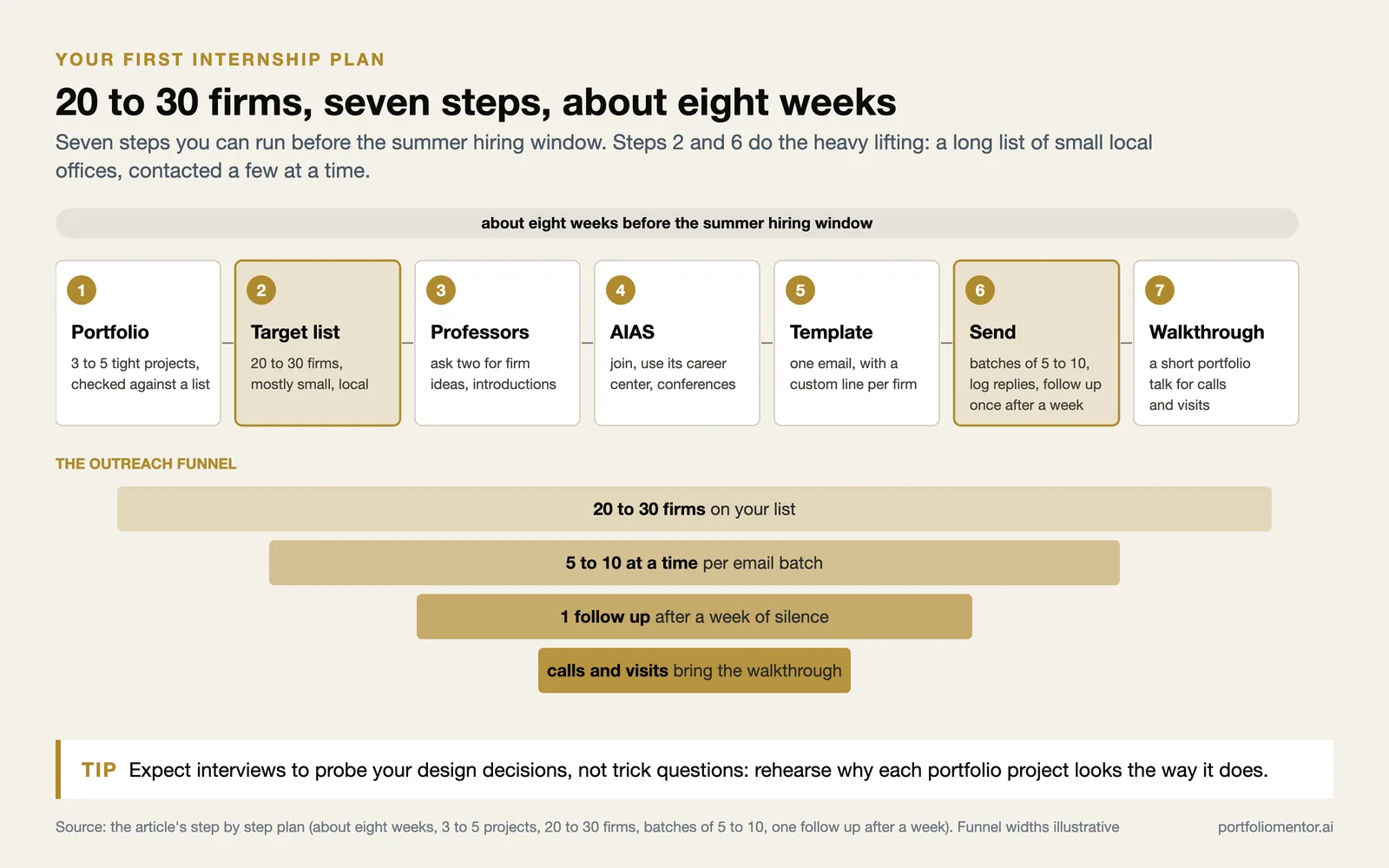
- Build a tight three-to-five project portfolio and run it through a checklist
- List 20 to 30 target firms, weighted toward small and local offices
- Ask two professors for firm suggestions and introductions
- Join AIAS and check its career center and any upcoming conference
- Write one cold email template, then customize the firm-specific line for each
- Send in batches, follow up once after a week, and log every reply
- Prepare a short portfolio walkthrough for calls and visits
When interviews start, expect to talk through your design decisions rather than answer trick questions. Reviewing common architecture interview questions ahead of time helps you explain your projects clearly under pressure.
A first internship is won on the portfolio, not the CV. Upload yours and get a page-by-page read before you send the next cold email.
Score my portfolio free →Frequently asked questions
Do I need a portfolio for an architecture internship if I have no projects?
Yes. Studio drawings, renderings, models, and competition entries are exactly what firms expect from a student. Three to five projects with clear concepts is enough, and process work counts as much as finished images.
Should I apply to big firms or small firms first?
Start with small and local firms. They receive fewer applications, hire first-year students more readily, and often have hidden roles you can only reach through a direct email or a visit.
Does a student internship count toward architecture licensure?
If it is supervised by a licensed architect and meets NCARB’s requirements, yes. The AXP lets you earn credit once you have a high school diploma, and academic internships qualify without separate pre-approval.
How many firms should I contact?
Aim for a list of 20 to 30 targets. Mix posted listings with cold emails to small offices, and send in small batches so you can personalize each message and follow up.
Where to Go From Here
✅ Key Takeaways
- No experience is the normal starting point; firms compare you to other students, not licensed architects
- Build a tight portfolio of three to five studio projects with clear concepts and process work
- Apply to small and local firms first, where first-year students get hired most often
- Cold emails work when they are short, named, firm-specific, and link a clean portfolio
- Professors, alumni, and AIAS turn a cold list into warm introductions and offers
Your Next Step: Open a blank spreadsheet today and list ten small firms within commuting distance of your school or hometown, then find a named contact for each. That list is the foundation every other part of this plan builds on.

