
An architecture CV is a one to two page document that summarises your education, work history, software skills and registration status for a design role, written so that both a hiring architect and an applicant tracking system can read it cleanly. It sits beside your portfolio, not inside it, and its job is to get you onto the shortlist.
Most candidates pour their energy into the portfolio and treat the architecture CV as an afterthought. That order is backwards for the first screening stage. Many studios filter applications through software before a person ever opens your work, and a cluttered or oddly formatted CV can drop you before your best project is seen. This guide covers the format, the difference between a CV and a resume, UK and USA conventions, the sections that matter, and how to keep the whole thing readable by both humans and machines.
🔢 Quick Numbers
- The median annual wage for architects was $99,280 in May 2025, according to the U.S. Bureau of Labor Statistics Occupational Outlook Handbook.
- About 7,800 openings for architects are projected each year through 2034, per the same BLS data, so each posting draws a large applicant pool.
- Reviewers spend roughly 90 seconds on an architecture portfolio at first pass, which means the CV beside it gets even less, often under 30 seconds.
What is the difference between a CV and a resume?
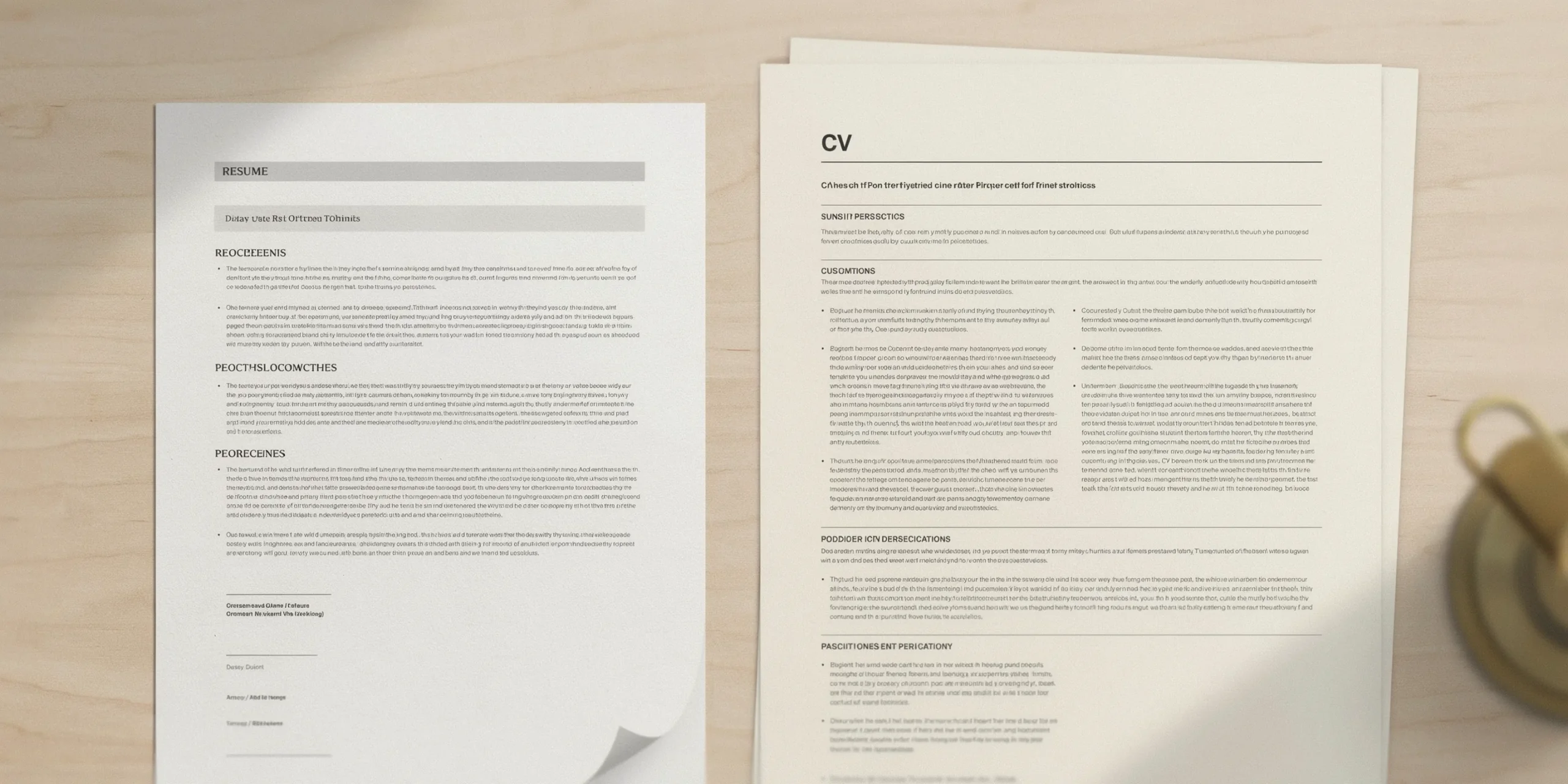
A CV and a resume are not the same document, and using the wrong one for a market costs you. A resume is a short, targeted summary, usually one page, tailored to a specific role. A CV (curriculum vitae) is a fuller record of your academic and professional history that can run longer. The terms also shift by country, which trips up architecture graduates applying internationally.
In the United States, employers ask for a resume for practice roles and reserve the word CV for academic or research posts. In the United Kingdom and most of Europe, CV is the standard term for the everyday job document, and it behaves much like a US resume in length and focus. So a UK “architecture CV” and a US “architecture resume” often describe the same two page file. Career offices such as MIT Career Advising and Professional Development draw this line clearly for design students heading into different markets.
⚠️ Common Mistake to Avoid
Sending a heavily designed, multi-column “creative CV” as your only document. Studios like visual thinking, but the file that passes the first software filter has to be a clean single column. Keep a designed version for direct emails and in-person interviews, and a plain parseable version for online portals and large firms.
What does an ATS-friendly architecture CV look like?
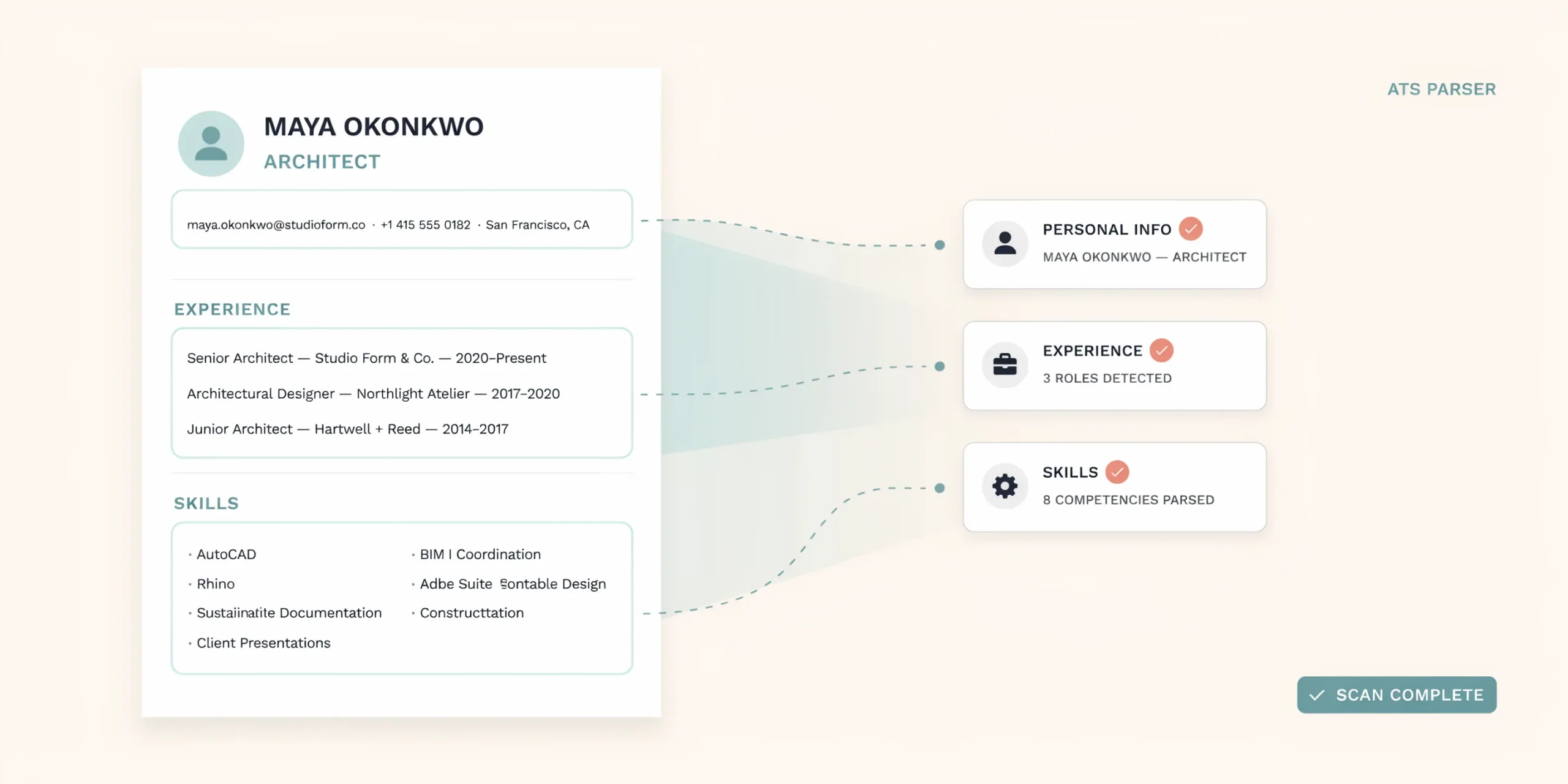
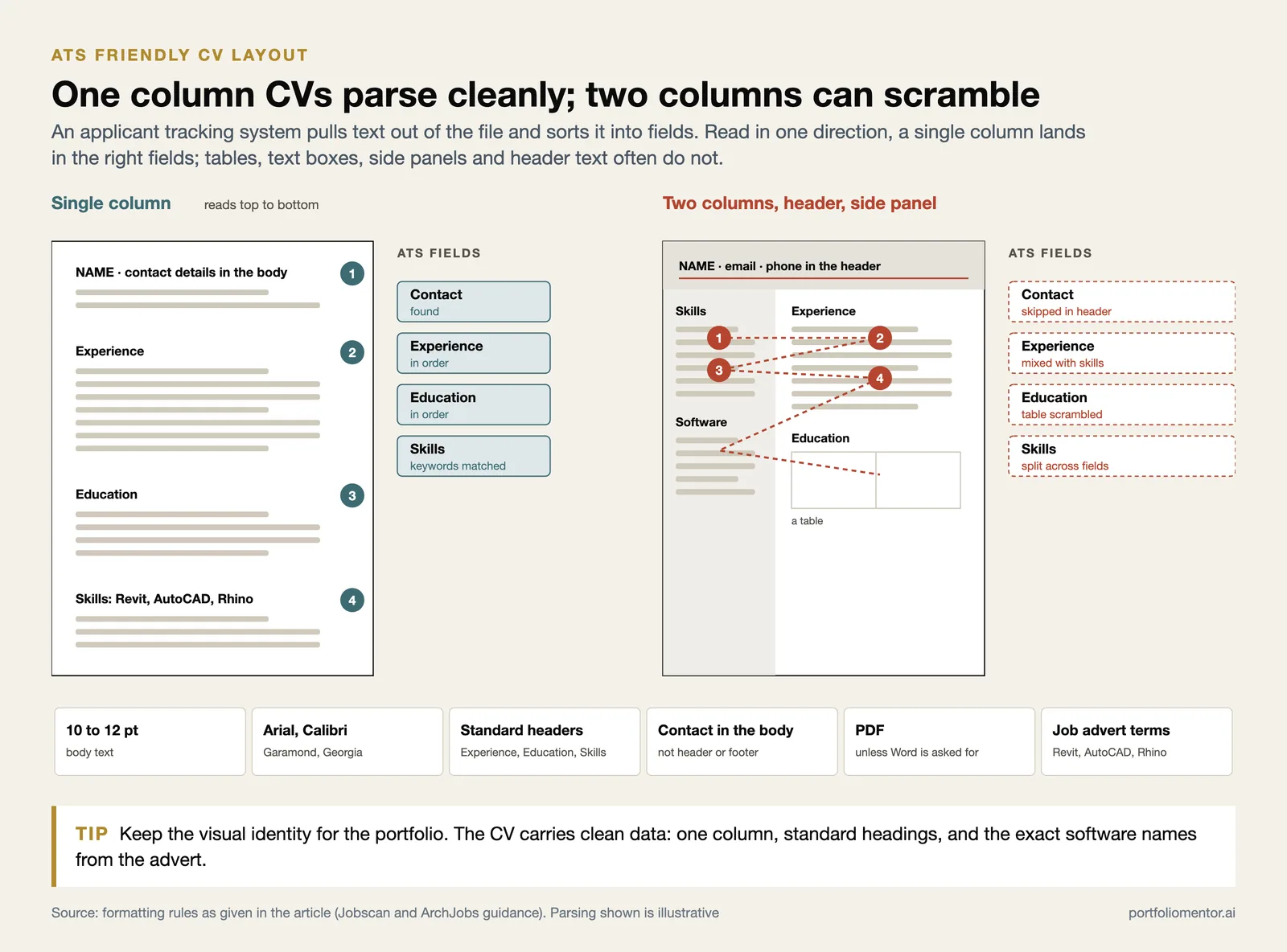
An applicant tracking system (ATS) reads your file, pulls out text, and sorts it into fields like Experience, Education and Skills. If the layout confuses the parser, your details land in the wrong place or vanish. Architecture graduates get hit hard here because the instinct is to make the CV look like a spread from the portfolio. The fix is to separate the two: the portfolio carries the visual identity, the CV carries clean data.
The formatting rules that keep a CV machine-readable are consistent across sources. Guides from Jobscan and the architecture-specific advice at ArchJobs agree on the core points below.
- Use a single-column layout. Tables, text boxes and side panels scramble during parsing.
- Stick to web-safe fonts such as Arial, Calibri, Garamond or Georgia at 10 to 12 point for body text.
- Use standard section headers (Experience, Education, Skills) so the system recognises each block.
- Avoid putting contact details in the header or footer, where some parsers skip them.
- Save and submit as a PDF unless the portal specifically asks for a Word document.
- Mirror the exact software and skill terms from the job advert, such as Revit, AutoCAD, Rhino, InDesign.
💡 Pro Tip
Read the job advert and copy its exact software names into your skills line, matching capitalisation. If the post says “Revit” and your CV says “BIM modelling,” the keyword match is weaker. Naming the specific tools a studio uses is one of the fastest ways to clear a software filter and signal you can start producing right away.
Which sections should an architecture CV include?
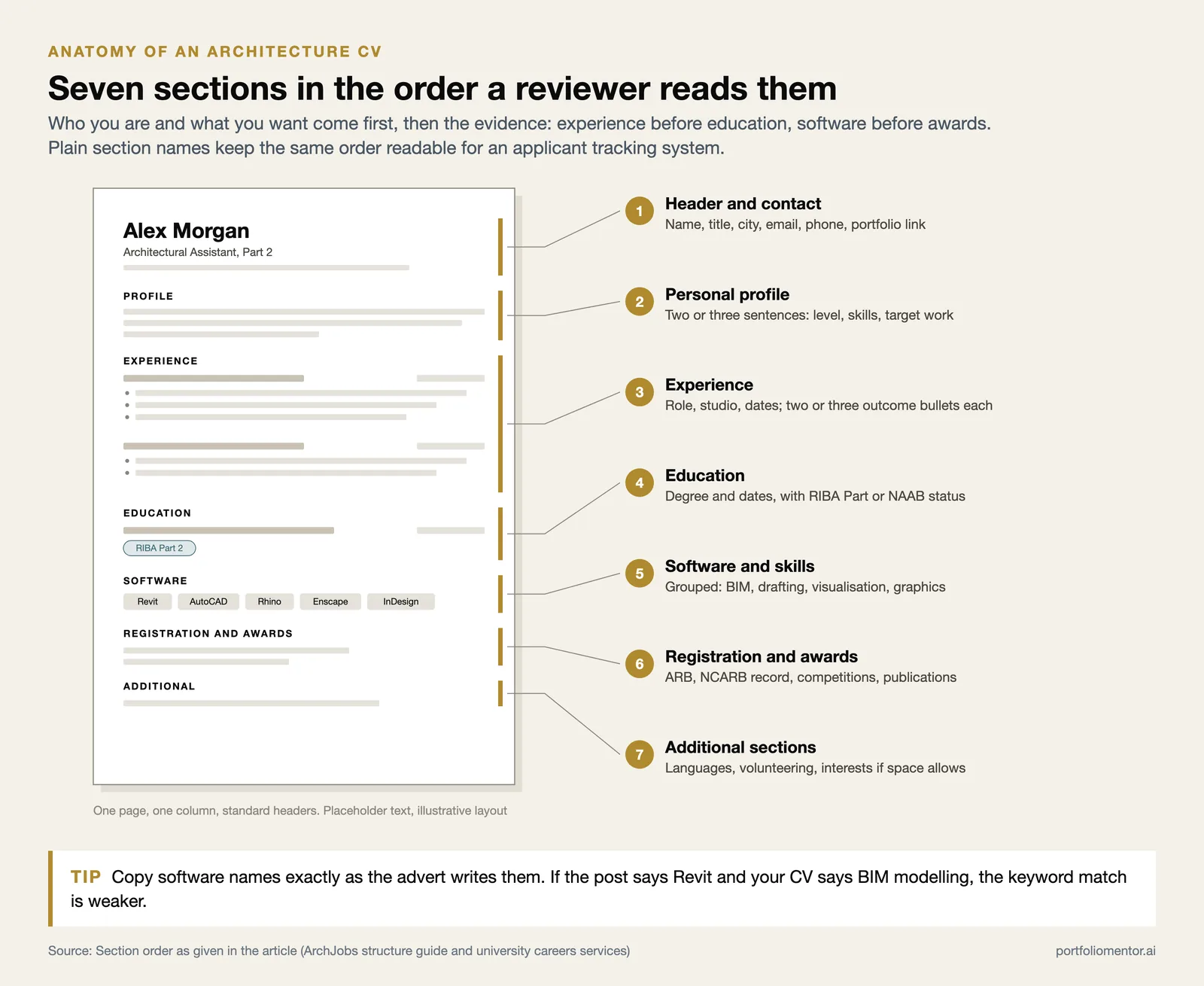
A strong architecture CV follows a predictable order so a reviewer can find what they need fast. The ArchJobs structure guide and most university careers services land on a similar sequence. Build yours from the top down and keep each entry short.
- Header and contact details: name, professional title, city, email, phone and a link to your online portfolio.
- Personal profile: two or three sentences naming your level, strongest skills and the kind of work you want.
- Work and practice experience: role, studio, dates and two or three bullet points each, led by what you actually delivered.
- Education: degree, institution and dates, with your RIBA Part or NAAB status if relevant.
- Software and technical skills: grouped by type, such as BIM, drafting, visualisation and graphics.
- Registration and awards: ARB, NCARB record, competition results or published work.
- Additional sections: languages, volunteering or a short interests line if space allows.
Write experience bullets around outcomes, not duties. “Produced GA drawings and coordinated with structural consultants on a 40-unit residential scheme” tells a reviewer more than “responsible for drawings.” If you want to see how those entries read inside a finished layout, the collection of portfolio and CV examples on Portfolio Mentor show how working candidates frame their experience.
How does an architecture CV differ between the UK and USA?

The country you apply in changes length, content and a few conventions. Sending a UK-style CV to a US firm, or the reverse, signals you have not researched the market. The table below sums up the practical differences drawn from Hireflow’s US versus UK format breakdown and standard practice in each region.
| Feature | UK CV | USA Resume |
|---|---|---|
| Common term | CV for everyday roles | Resume for practice, CV for academia |
| Typical length | Up to 2 pages | 1 page preferred, 2 with experience |
| Photo | Usually omitted | Omitted, can trigger bias filters |
| Registration body | ARB and RIBA Parts 1 to 3 | NCARB record and state licensure |
| Personal data | Date of birth now usually dropped | Never include age or marital status |
How do you write a graduate architecture CV with little experience?

A graduate CV has thin work history, so it leans on academic projects, skills and any practice exposure you do have. The goal is to read as ready, not empty. Lead with a profile that names your degree and strongest software, then put education and key studio projects near the top where a junior reviewer expects them.
- Treat major studio projects like work entries, with the brief, your role and the tools used.
- List internships, site work or summer roles even if short, and describe what you produced.
- Group software clearly so a filter can see Revit, Rhino, AutoCAD and Adobe at a glance.
- Add competitions, volunteering or live build projects to show initiative beyond coursework.
- Keep it to one page until you have two or more years of practice behind you.
A CV and portfolio that pull in the same direction read as one coherent application. If you are still shaping that connection, the portfolio review process and the free career tools can point out where your CV oversells or undersells the work behind it.
Should you use Canva or a template for an architecture CV?
Canva and similar template tools are fine as a starting point, but they often default to two-column, graphic-heavy layouts that parse poorly. If you build in Canva, rebuild the final file as a single column and test it. The simplest test is to open the PDF, select all and copy the text into a blank document. If the order comes out scrambled or pieces go missing, an ATS will struggle too.
🏗️ Real-World Example
Two-version strategy (common studio practice): Many hired graduates keep a clean single-column PDF for online portals and large practices, plus a lightly designed one-page version that echoes their portfolio typography for direct emails and interviews. The same content, two builds, each matched to how it will be read.
When you are happy with the layout, look at how others present similar experience. Reading several real success stories from candidates who landed roles is a fast way to calibrate tone, length and how much technical detail to include for your level.
Frequently asked questions
How long should an architecture CV be?
One page for graduates and early-career applicants, up to two pages once you have several years of practice or notable projects. Beyond two pages, a reviewer stops reading. Cut older roles to a single line and keep the recent, relevant work detailed.
Should I send my architecture CV as a PDF?
Yes, in almost every case. A PDF holds your formatting across devices and is read by most modern tracking systems. Only send a Word document when a portal or recruiter asks for one directly. Name the file with your full name and the word CV so it is easy to find.
Do I need a separate CV and portfolio?
Yes. The CV is a short text document for the first screen, and the portfolio is the visual record of your work. Some firms ask for both as separate files, others want a single combined PDF with the CV as the final page. Read each studio’s instructions and follow them exactly.
What should I write in an architecture CV personal profile?
Two or three sentences naming your level, your strongest technical skills and the type of work you are aiming for. Skip generic phrases like “passionate and hardworking” and instead state something specific, such as the project types or software you are strong in.
Putting It All Together
✅ Key Takeaways
- Treat your architecture CV as the first screen, separate from the portfolio that follows it.
- Know whether your market expects a UK CV or a US resume, and match length and conventions.
- Keep one clean single-column version for tracking systems and one designed version for direct contact.
- Mirror the exact software keywords from each advert to clear automated filters.
- Graduates should treat strong studio projects as experience and stay to one page.
Your Next Step: Open your current CV, copy the text out of the PDF into a blank document, and check whether the sections stay in order. If anything scrambles, rebuild it as a single column before you send your next application.

