
Architect career paths extend well past the licensed studio architect role most students picture. An architecture degree trains you in design thinking, spatial reasoning, and project coordination, skills that map onto licensure, specializations like landscape or healthcare design, and adjacent fields such as urban planning, BIM management, real estate, and computational design.
See also archdaily.com.
Whether you are a graduate weighing your first job or a few years into practice and reconsidering direction, mapping the full range of architect career paths early helps you build a portfolio and resume that point at the right roles. This guide breaks down the traditional track, the main specializations inside the profession, and nine credible options beyond conventional practice, with current salary and licensure data behind each one.
What is the traditional architect career path?
The traditional path runs from an accredited degree, through documented experience, to licensure and senior practice. In the United States, you complete a professional degree accredited by the National Architectural Accrediting Board, then log experience through the Architectural Experience Program (AXP) run by NCARB, and finally pass the Architect Registration Examination.
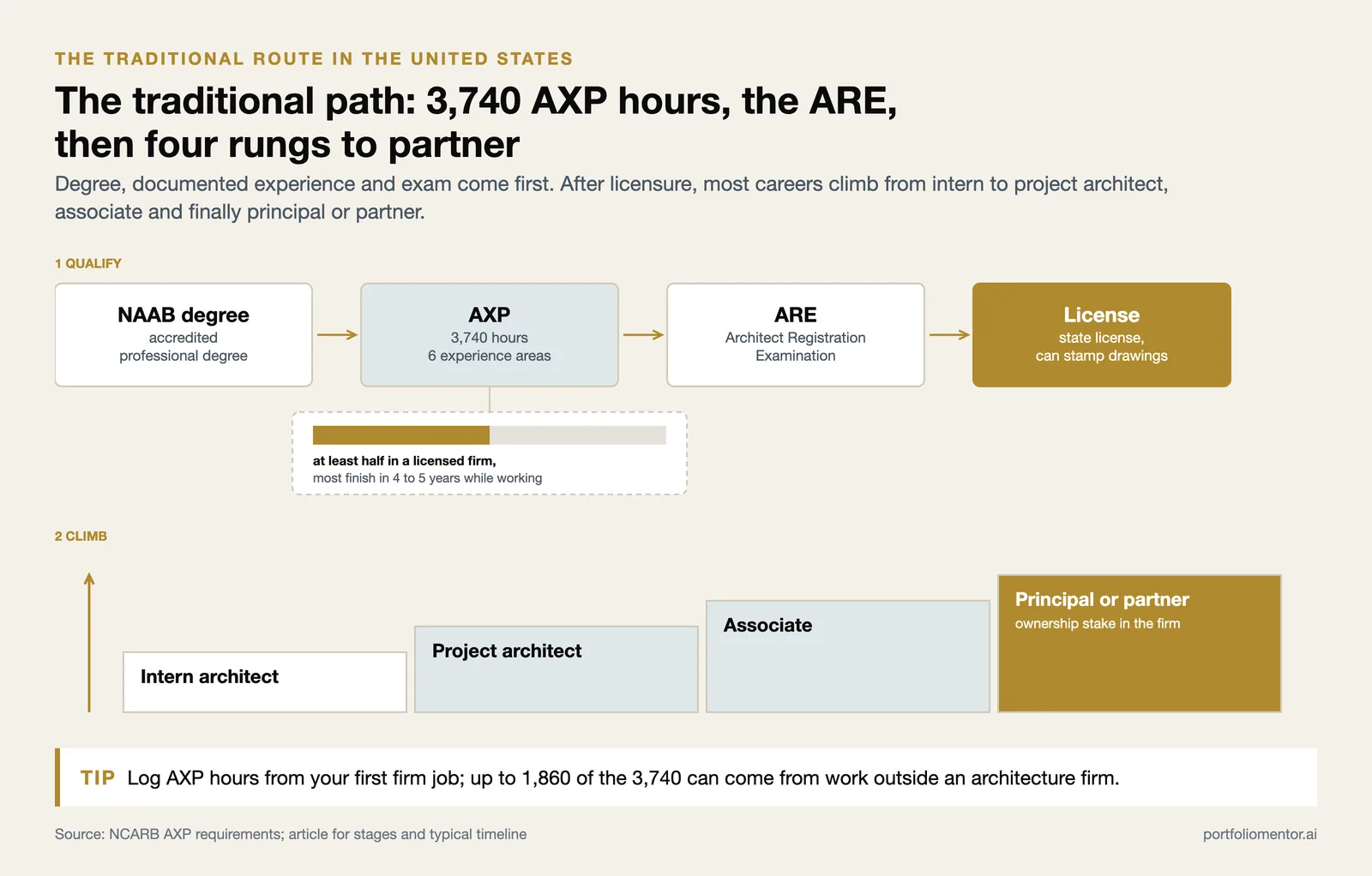
The AXP requires 3,740 hours across six experience areas, with roughly half earned inside a licensed architecture firm. Most candidates spend four to five years completing it alongside paid work. After licensure, a typical progression moves from intern architect to project architect, then associate, and eventually principal or partner with an ownership stake in a firm.
🔢 Quick Numbers
- The median annual wage for architects was $96,690 as of May 2024, per the U.S. Bureau of Labor Statistics.
- The top 10 percent of architects earned more than $159,800, while the bottom 10 percent earned below $60,510 (BLS, 2024).
- Employment of architects is projected to grow 4 percent from 2025 to 2035, per the BLS Occupational Outlook Handbook.
Licensure is the clearest dividing line on pay. Architects who pass the ARE and hold a state license typically earn 15 to 20 percent more than unlicensed staff doing comparable work, which is why finishing the AXP and exam early in your career usually pays off over time.
What are the main specializations within architecture?

Before leaving practice, many architects find their long-term path inside a specialization. Each one rewards a slightly different portfolio focus, so choosing early lets you collect the right project types and drawings.
- Residential architecture, covering single homes, multifamily housing, and renovations, often the entry point for small-practice work.
- Commercial and workplace design, where large firms concentrate, focused on offices, retail, and mixed use.
- Healthcare and laboratory design, a technical field with strong demand and heavy code complexity.
- Sustainable and high-performance design, where the BLS notes especially strong demand for architects fluent in energy and certification work.
- Historic preservation and adaptive reuse, blending conservation knowledge with new design.
- Landscape architecture, a separately licensed track focused on site, ecology, and public space.
Your portfolio should make the target specialization obvious within the first few spreads. If you want healthcare work but lead with conceptual student installations, hiring architects struggle to place you. Our portfolio review examples show how candidates reordered projects to match a specialization and lifted their scores sharply.
⚠️ Common Mistake to Avoid
Treating every job application with the same generalist portfolio. A firm hiring for hospital projects wants technical drawings, code awareness, and complex circulation, not a render-heavy concept deck. Build one master document, then cut and reorder it for each specialization you target.
9 architect career paths beyond traditional practice
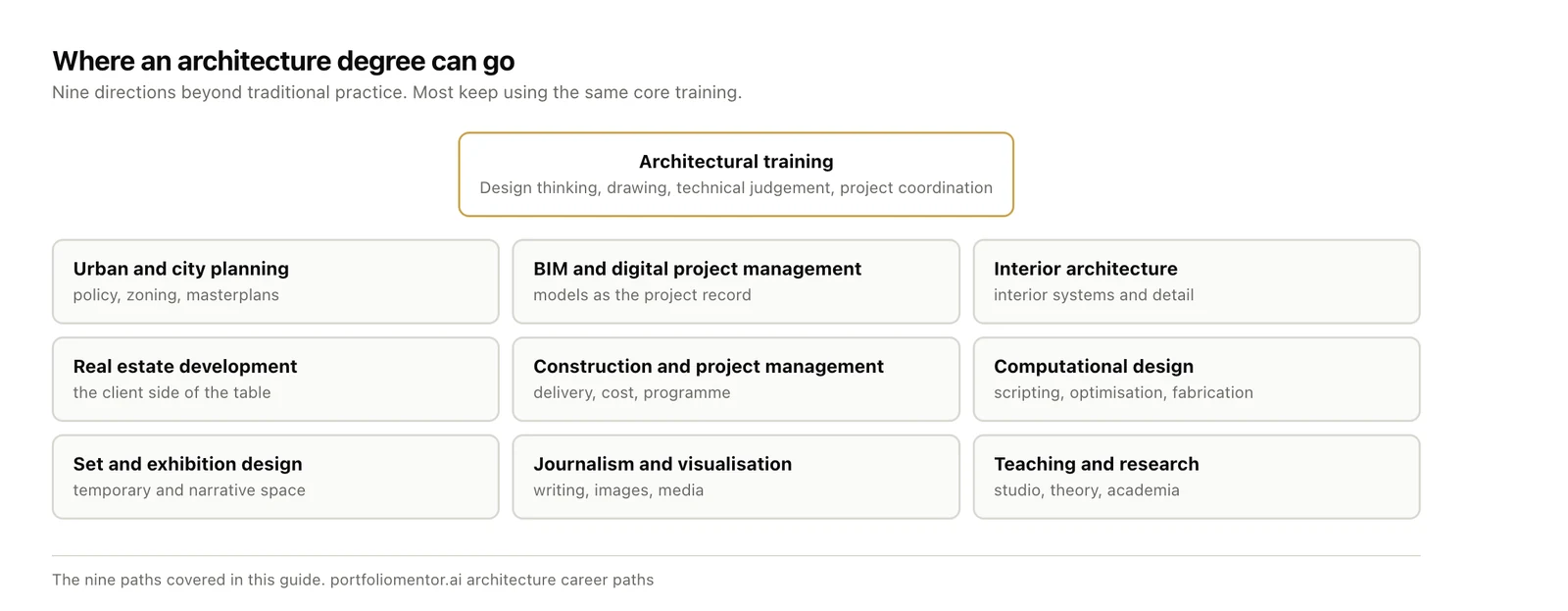
If full studio practice is not your goal, an architecture degree still opens doors. The analytical, visual, and coordination skills you built transfer to several fields that pay well and value design training. Here are nine credible options.
1. Urban and city planning

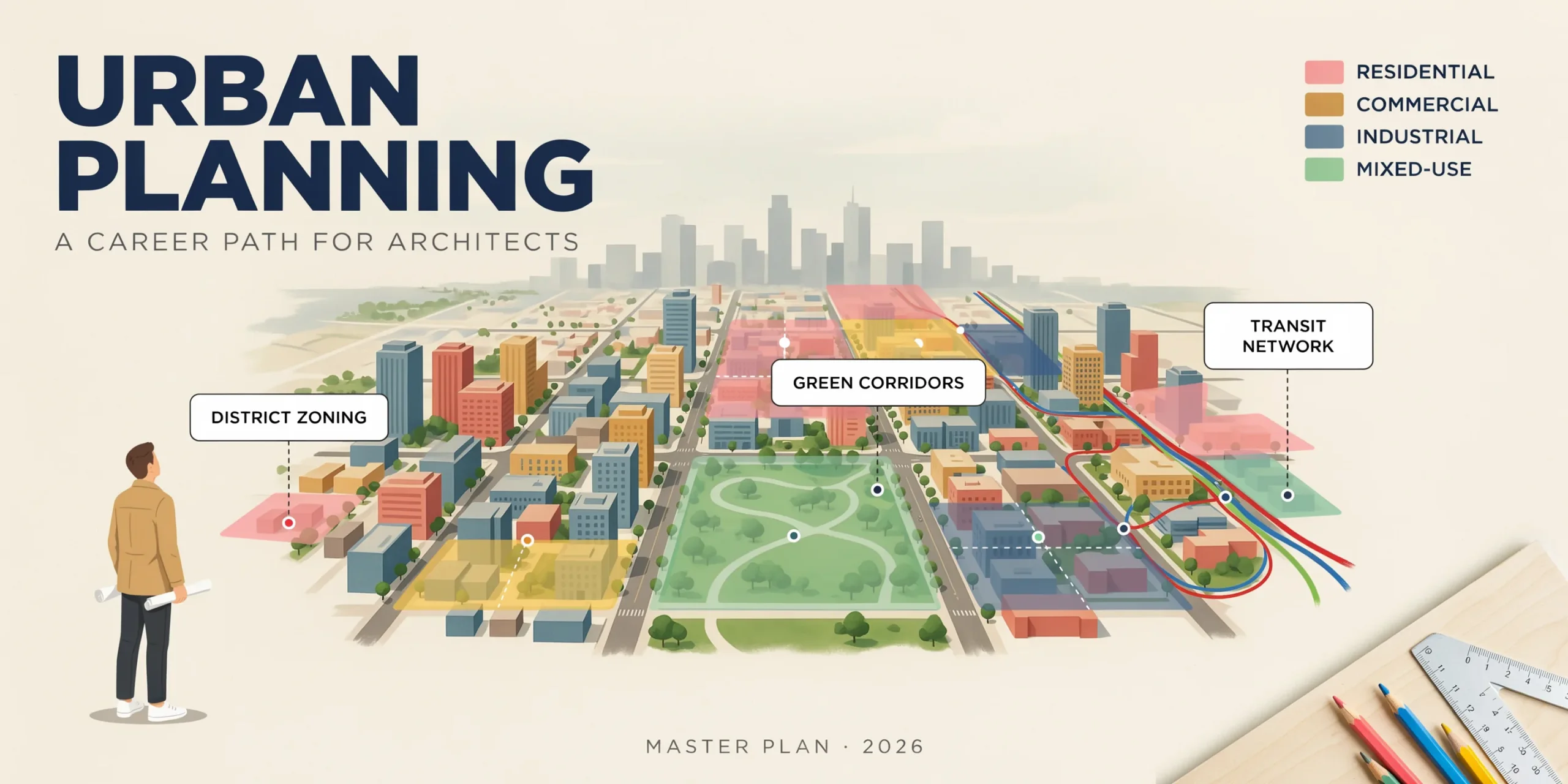
Planners shape zoning, transit, and land use at the city scale. Architects move into this field often, since site analysis and spatial reasoning carry over directly. Public-sector roles add stability, and some positions accept an architecture degree with a planning certificate rather than a second master’s.
2. BIM and digital project management

Building information modeling managers coordinate the 3D model that ties design teams, contractors, and consultants together. Graduates fluent in Revit, Navisworks, and clash detection are in heavy demand, and firms increasingly favor candidates who pair design ability with strong digital production.
3. Interior architecture and design
This path keeps you close to space and detail while shifting focus to interiors, furniture, and material specification. It suits architects who enjoy the human-scale resolution of a project more than its structure and envelope.
4. Real estate development
Developers decide what gets built and why. Architects who understand pro formas, feasibility, and entitlements bridge the design and finance sides of a project, a rare combination that commands strong compensation. Many add a real estate or business credential to move into this role.
5. Construction and project management
Construction managers oversee contractors, schedules, and budgets on site. Reading drawings fluently and anticipating buildability gives former architects a clear edge, and the work tends to pay more than early studio roles.
6. Computational design and architecture technology
Roles here range from Grasshopper and parametric specialists inside firms to software product work at companies building design tools. If you enjoy scripting and automation, this path turns a niche skill into a career, often with technology-sector pay.
7. Set, production, and exhibition design
Production designers in film, theater, and museums build worlds at architectural scale and detail. The brief-research-model-build workflow mirrors studio practice closely, making it a natural creative pivot.
8. Architecture journalism, visualization, and media
Writing, photography, rendering, and editorial work all draw on a designer’s eye. Architectural visualization in particular has grown into a standalone profession, with specialists producing the imagery firms and developers use to sell projects.
9. Teaching and academic research
Some graduates move into teaching, either at the university level after a research degree or in design foundation and software instruction earlier on. It rewards those who enjoy mentoring and articulating design ideas clearly.
💡 Pro Tip
When pivoting to an adjacent field, reframe your existing projects around the new role rather than building from scratch. A studio project shown to a development firm should lead with site economics and program logic, not formal concept. The same drawings, retitled and reordered, can speak to a planner, a developer, or a BIM lead.
How do salaries compare across architecture career paths?
Pay varies widely by path, region, and licensure status. The table below sets rough expectations based on BLS occupational data and general industry ranges, useful for weighing one direction against another.
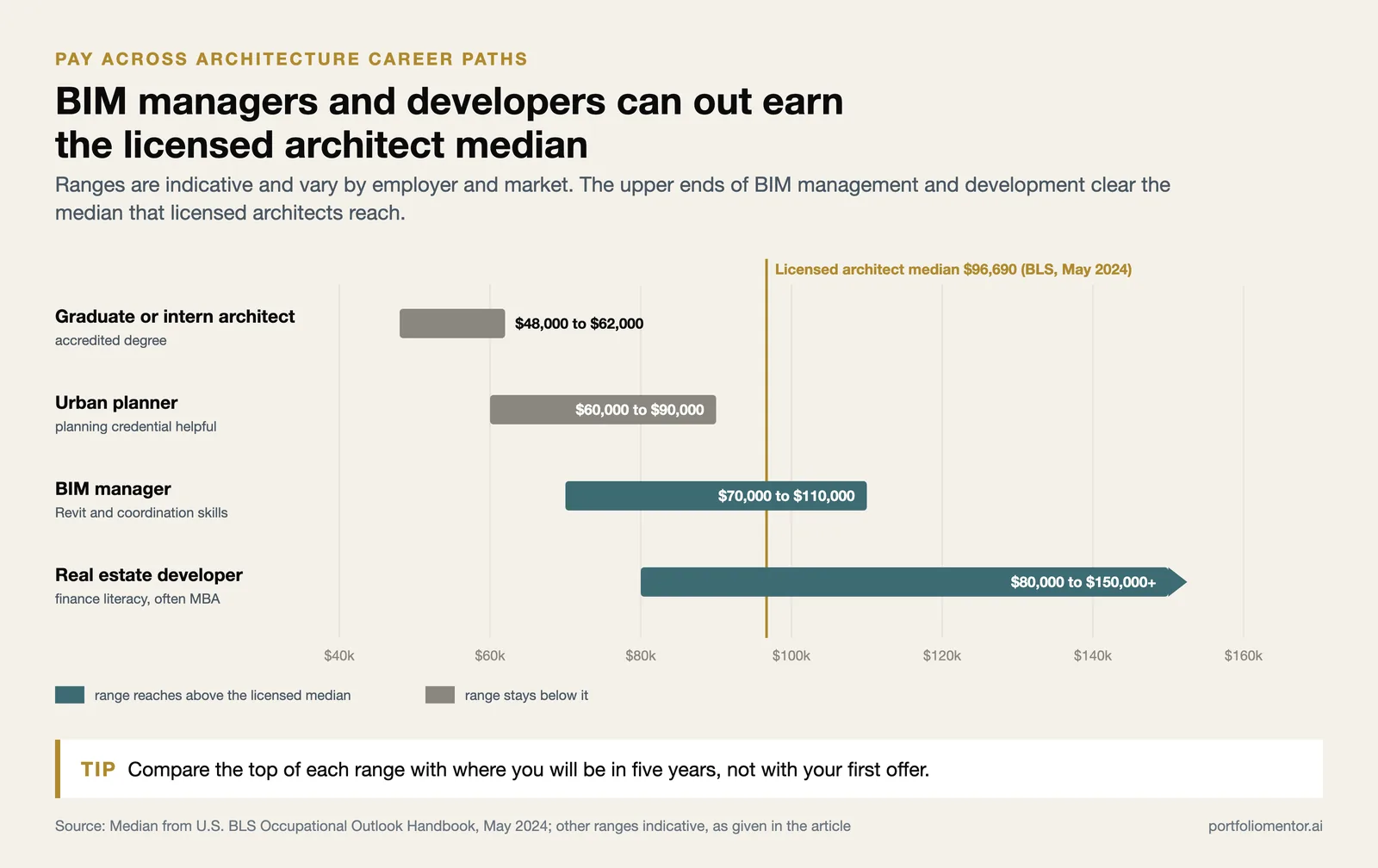
Typical earning ranges by architecture career path
| Career Path | Typical Range (USD) | Key Requirement |
|---|---|---|
| Licensed architect (median) | $96,690 | NAAB degree, AXP, ARE |
| Graduate / intern architect | $48,000 to $62,000 | Accredited degree |
| Urban planner | $60,000 to $90,000 | Planning credential helpful |
| BIM manager | $70,000 to $110,000 | Revit and coordination skills |
| Real estate developer | $80,000 to $150,000+ | Finance literacy, often MBA |
Figures are indicative. The licensed median comes from the BLS, while adjacent roles vary by employer and market. Use them to compare directions, not as fixed quotes. For a closer read on positioning yourself for higher-paying roles, our firm matching and skills gap tools flag the competencies a target role expects.
How do you choose the right architecture career path?
Start by separating what you enjoy from what you assume you should do. Use this short checklist to narrow the field before committing time to retraining or a portfolio rebuild.
- Audit your strongest skills honestly. Are you a better detailer, conceptualizer, communicator, or coordinator?
- Decide how much you value licensure. If a license matters to you long term, prioritize firm roles that count toward the AXP.
- Map three to five target roles and read their actual job postings on platforms like Indeed to see required tools and credentials.
- Identify the gap between your current portfolio and those postings.
- Build or recut a portfolio aimed at one or two paths, not all of them at once.
Reviewing real transformations helps calibrate expectations. Our success stories show how architects at different stages repositioned their work for specific paths, from M.Arch admissions to senior firm roles, and the step-by-step review process explains how scoring against firm criteria works.
🏗️ Real-World Example
Gensler (global, ongoing): As the largest architecture firm in the world, Gensler hires across dozens of practice areas, from workplace and aviation to brand design and consulting. It is a useful reminder that a single firm can hold many distinct architect career paths under one roof, so a target role matters more than a target firm.
Two routes deserve a closer look before you commit. A Master of Architecture reshapes which roles are open to you, and our list of the best architecture grad schools sets out how to judge programmes on accreditation and cost rather than ranking alone. If you would rather work for yourself, becoming a freelance architect covers what changes when you take on clients directly.
Frequently asked questions about architect career paths
Can you work in architecture without a license?
Yes. Many roles in firms, including designer, drafter, BIM specialist, and visualization artist, do not require a license. You cannot legally call yourself an architect or stamp drawings without one, but a large share of design work happens in unlicensed positions, and several alternative paths never require the ARE at all.
Which architecture career path pays the most?
Real estate development and senior firm ownership tend to reach the highest figures, since both tie pay to project value and equity rather than salary alone. Computational design roles at technology companies can also exceed traditional practice. Licensed principals at large firms remain among the better-compensated practitioners inside architecture itself.
Is it hard to switch careers from architecture?
It is more manageable than most graduates fear, because the transferable skills are real. The harder part is repositioning your portfolio and resume so a hiring manager outside pure design immediately sees the fit. Leading with the outcomes that matter to the new field, rather than design concept, makes the switch read as deliberate.
Do alternative careers count toward architecture licensure?
Partly. The NCARB AXP allows a portion of hours under Setting O, which covers experience earned outside a traditional architecture firm. Work in related design or construction settings can count, but roughly half your hours must still come from a licensed firm under architect supervision. Check current NCARB rules before relying on this.
Where to Go From Here
Your Next Step: Pick the two architect career paths that fit your strengths, pull five live job postings for each, and list every tool, drawing type, and credential they ask for. That single list tells you exactly what your next portfolio revision and resume update need to show. You can pressure-test the result with the free portfolio tools before committing to a direction.