An architecture license in the US requires three things: an accredited degree, a documented experience programme, and the Architect Registration Examination. The Architectural Experience Program records hours across six practice areas, the ARE has six divisions, and the median candidate now reaches a licence in 12.3 years.
Most explanations of this process describe it as three neat steps. In practice it is three overlapping timelines run by different bodies, and the thing that slows candidates down is almost never the exams. It is experience hours that were never recorded, or recorded in only one practice area.
This guide covers what each requirement is, how they overlap, where the delays come from, and what the current data says about how long it actually takes.
What are the requirements for an architecture license?
An architecture license is issued by an individual state board, not nationally. Almost all of them ask for the same three components, though the details differ.
Education
An accredited professional degree. The Bureau of Labor Statistics notes that “about two-thirds of states require that architects hold a degree in architecture from an accredited architectural program.” Most architects reach it “through a 5-year Bachelor of Architecture degree program.” Many add a master’s that “can take 1 to 5 additional years.”
Experience
A documented internship. BLS describes it as “a lengthy paid internship, generally lasting 3 years” required by all state boards before a candidate may sit the registration exam. In practice this is recorded through NCARB’s experience programme.
Examination
The ARE, taken division by division. Candidates typically start while working and finish over a period of years rather than in a single sitting.
🔢 Quick Numbers
- Median time to licensure in 2025: 12.3 years, the lowest in nearly a decade (NCARB by the Numbers 2026)
- Average ARE completion: roughly 2 years, four months faster than in 2024 and the lowest in the history of the computerised exam (NCARB, 2026)
- Licensure candidates in 2025: 47 percent women, including 53 percent of new Record holders, and 49 percent identifying as a person of colour (NCARB, 2026)
The six AXP practice areas
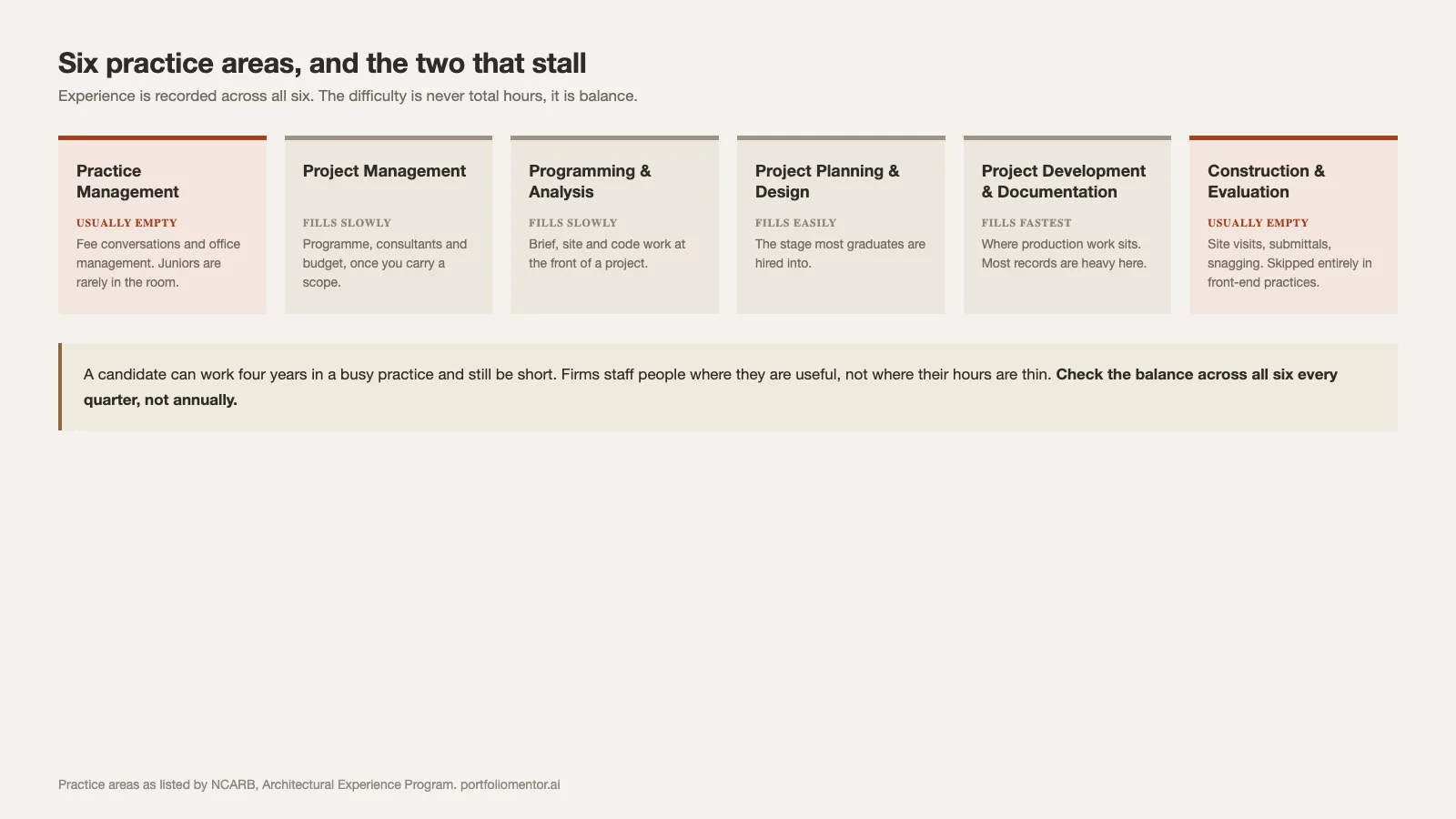
The Architectural Experience Program divides required hours across six areas, each with its own hour requirement. NCARB lists them as:
- Practice Management
- Project Management
- Programming & Analysis
- Project Planning & Design
- Project Development & Documentation
- Construction & Evaluation
The structure matters more than the total. A candidate can work four years in a busy practice and still be short. Firms staff people where they are useful, not where their hours are thin, which is why the choice of firm affects your licence date as much as your salary. Project Development & Documentation fills quickly in most jobs. Practice Management and Construction & Evaluation are the two that stall, because juniors are rarely in fee conversations or on site.
⚠️ Common Mistake to Avoid
Recording hours in a single practice area because that is where the work sits, then discovering the shortfall three years in. Check the balance across all six every quarter, not annually. If two areas are empty, ask a project architect to include you in a site visit or a fee review. That conversation is far easier at year one than at year four.
How the ARE divisions map to practice
The exam covers the same six subject areas as the experience programme, which is deliberate. Studying for a division while working in that area is the cheapest way to pass. The most common reason candidates fail is sitting a division years away from the relevant work.
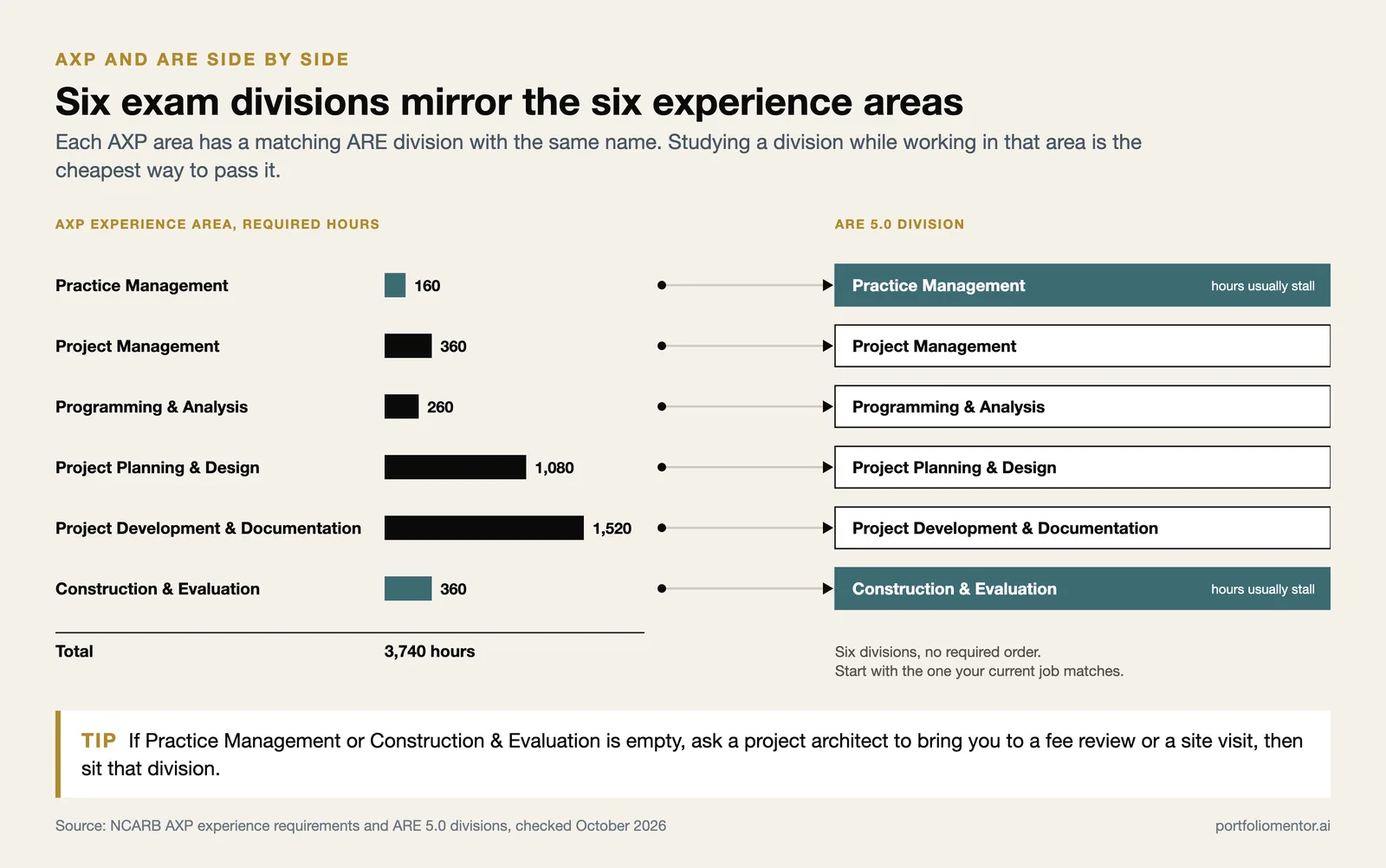
A practical ordering many candidates use: start with the divisions matching your current job, so preparation overlaps with what you already do daily. Leave the areas you have least exposure to until you rotate into that work, or accept that they need dedicated study.
There is no requirement to take them in the published order, and the exam does not reward doing so.
📐 Technical Note
The NCARB Record is not a licence. It is the file that holds your education, experience and exam history, and state boards read it when deciding on registration. NCARB certification, built on that Record, exists to make reciprocity between states workable. You still apply to each state board separately, and a state can impose additional requirements such as a jurisdiction-specific exam.
Why does licensure take 12.3 years?
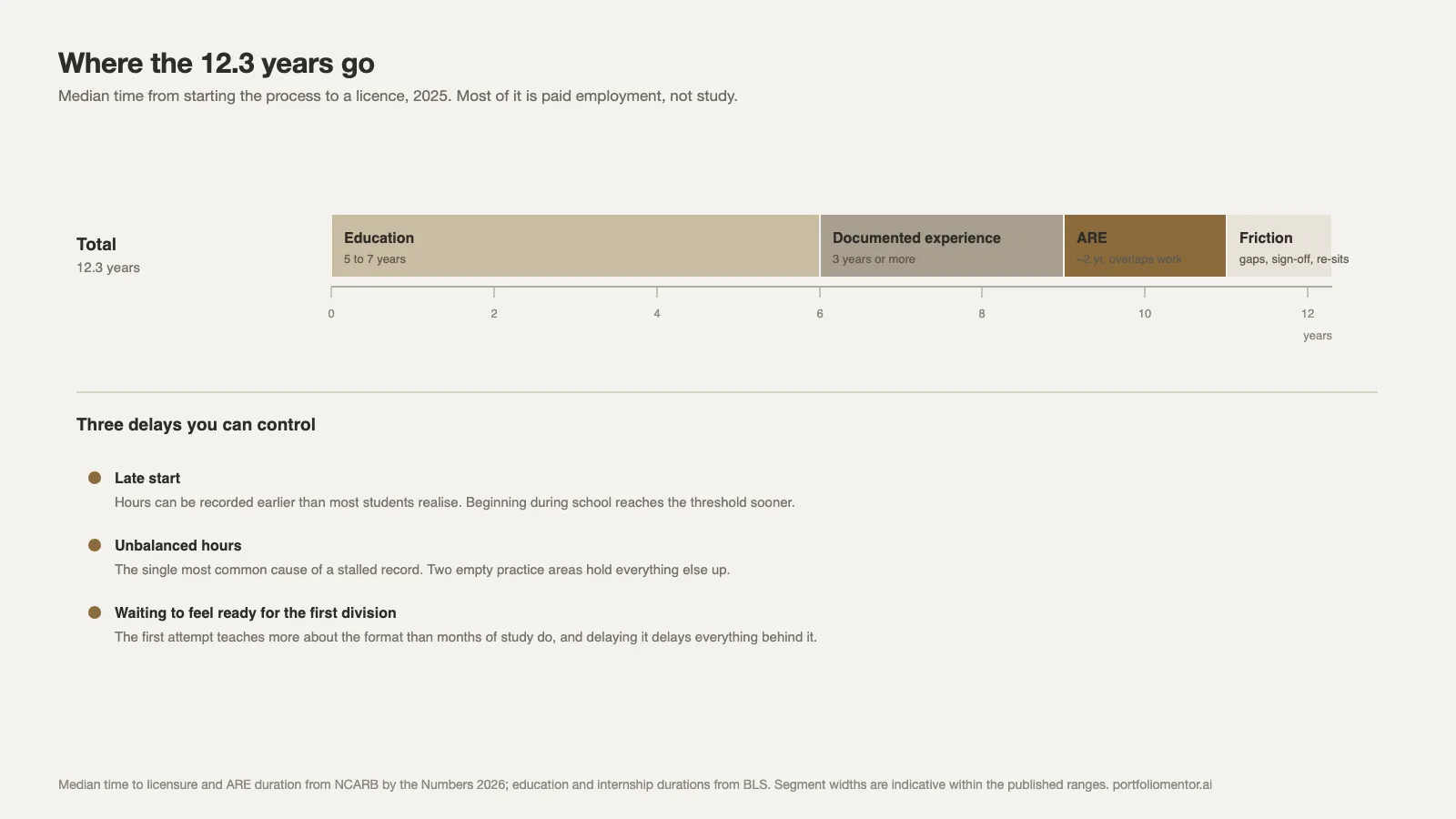
The figure covers the whole path, from the point a candidate begins recording progress to the point a licence is issued. Most of it is paid employment rather than study. Breaking the number down explains why it is so much longer than the sum of its parts.
Five to seven years go to education, and for many that includes graduate school. Three or more go to documented experience, which cannot fully overlap with study for most candidates. Two years go to the exam, run concurrently with work. The remainder is friction. Gaps between graduating and finding a job that generates the right hours, delays in supervisor sign-off, breaks for relocation or parental leave, time lost re-sitting divisions.
The trend is improving. NCARB reports that the 2025 figure was the lowest median in nearly a decade. ARE completion time fell four months year on year, to its lowest level since the exam was computerised.
The three delays you can control
- Late start. Hours can be recorded from eligible experience earlier than most students realise. Candidates who begin recording during school reach the threshold sooner.
- Unbalanced hours. Covered above, and the most common single cause of a stalled record.
- Waiting to feel ready for the first division. The first attempt teaches candidates more about the format than months of study do, and delaying it delays everything behind it.
Costs nobody puts in the plan
The exam is the visible cost and the smallest one. Candidates budget for divisions and are then surprised by the surrounding expenses.
Retakes are the largest variable. A candidate who passes every division first time pays a fraction of what a candidate retaking three divisions pays. Waiting periods between attempts mean the difference is measured in months as well as money. Study material is the second line, and it ranges from free question banks to structured courses costing more than several divisions combined.
Then there are the invisible costs. Study happens in evenings and weekends across roughly two years. That is the real price, and the one that causes people to stall at four divisions and stop. Firms that pay exam fees and give study leave are materially changing the cost of your licence, and that should be weighed against salary when comparing offers.
A reasonable planning assumption: treat the licence as a two-year part-time commitment alongside a full-time job. Begin once your recorded hours are balanced, not once they are complete. The two processes can overlap, and candidates who wait for one to finish before starting the other add a year for no reason.
What happens if you never get licensed
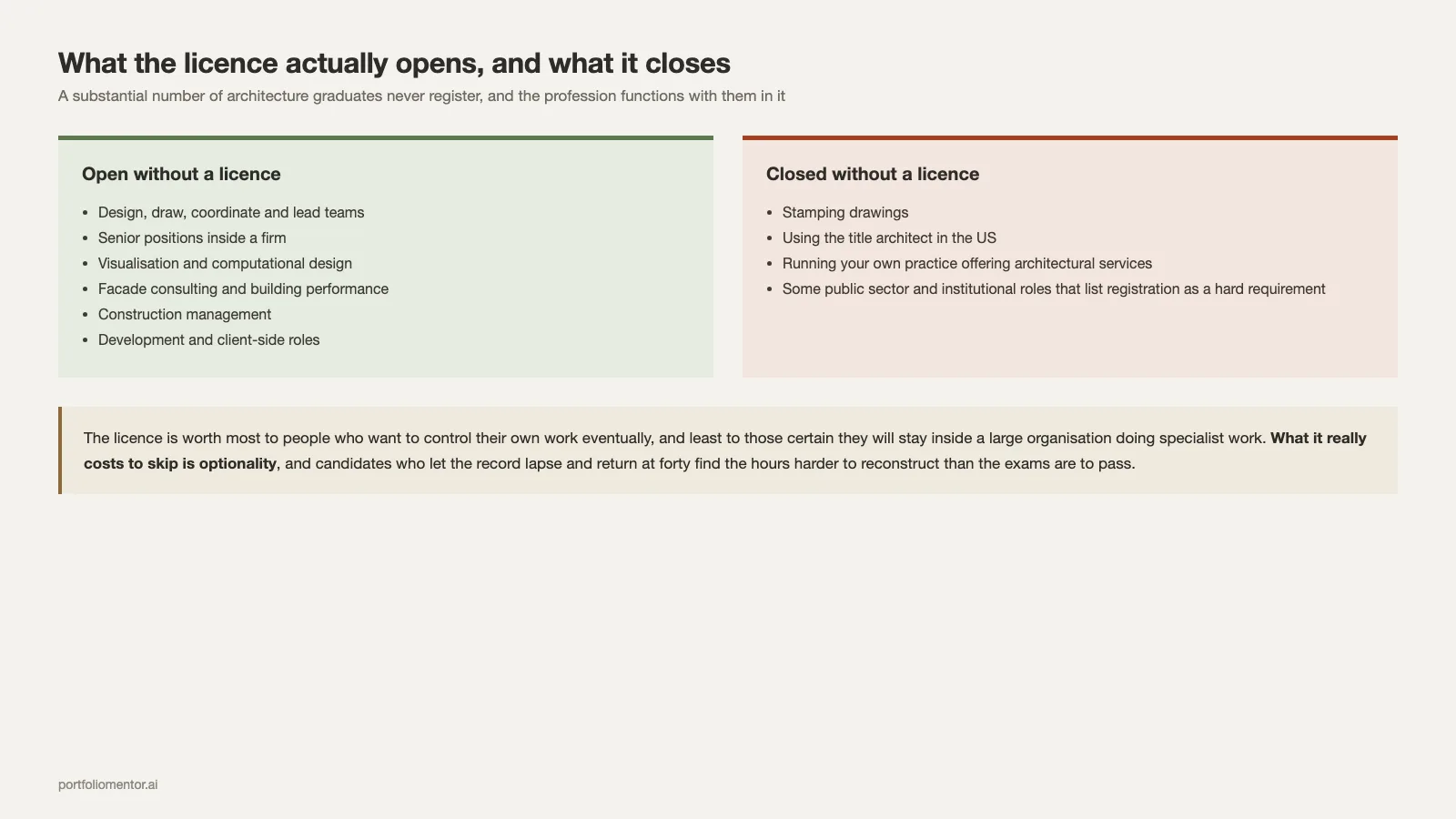
A substantial number of architecture graduates do not register, and the profession functions with them in it. Understanding what the decision actually closes off is more useful than treating it as a failure.
Without a licence you cannot stamp drawings, cannot call yourself an architect in the US, and cannot run your own practice offering architectural services. The routes that stay open without one are wider than most students expect. You can design, draw, coordinate, lead teams and reach senior positions in a firm. In visualisation, computational design, facade consulting, construction management and development, the licence is often irrelevant.
What it costs is optionality. The route from unlicensed senior designer to independent practice is closed, and some public sector and institutional roles list registration as a hard requirement. Candidates who let the Record lapse and return to it at forty find the hours harder to reconstruct than the exams are to pass.
The honest framing is that the licence is worth most to people who want to control their own work eventually. It is worth least to those certain they want to stay inside a large organisation doing specialist work. Which of those roles hires without registration is covered in the internships and entry routes guide.
What licensure changes about your job
An architecture license lets you stamp drawings and take responsibility for a project. Practically, three things change.
The title changes, and with it what you can call yourself on a CV and a business card. Using “architect” without a licence is restricted in every US jurisdiction, which is why unlicensed staff are titled architectural designers. The wording conventions for the pre-licence years are covered in the architecture resume guide.
Pay moves, though less sharply than candidates expect. BLS puts the architect median at $99,280 for May 2025, with the lowest ten percent under $62,300 and the highest ten percent above $161,420. The licence tends to move people from the lower band into the middle rather than to the top; the top is reached through responsibility and ownership. The architect salary guide tracks where the steps fall, and negotiating an architect salary covers using the credential in an offer conversation.
And independent practice becomes possible. Running your own projects requires the licence. It matters more to anyone considering freelance or independent practice than to someone planning a career inside a large firm.
💡 Pro Tip
When comparing job offers as an unlicensed graduate, ask which of the six experience areas the role will actually touch and whether the firm pays exam fees. Two offers at the same salary can differ by eighteen months of licensure time. That is worth more than the few thousand dollars candidates usually negotiate over.
Choosing a firm that does not slow you down
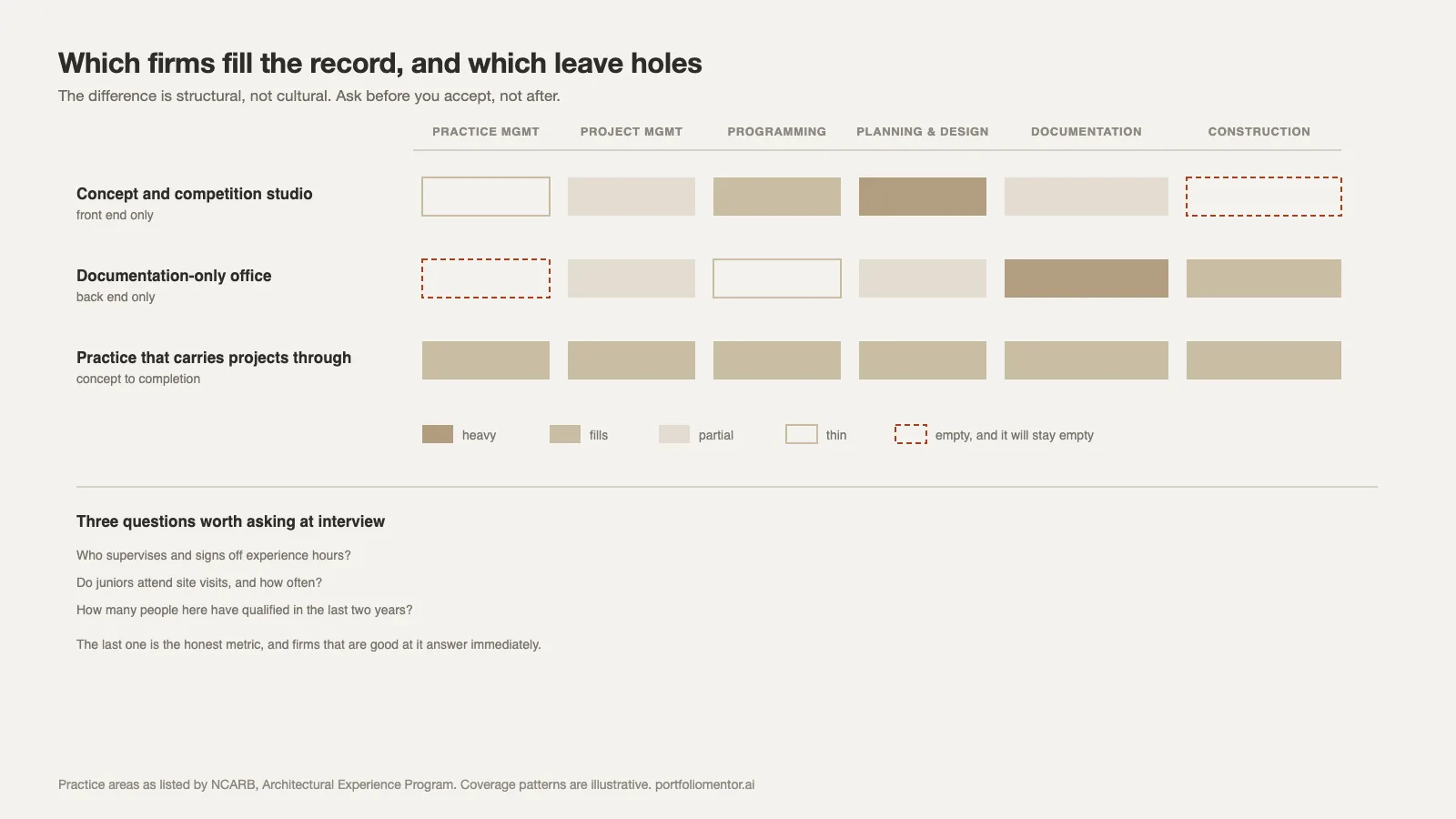
Firms vary widely in how quickly their staff qualify, and the difference is structural rather than cultural.
Practices that carry projects from concept through construction expose staff to all six areas naturally. Practices that specialise in one stage, such as competition and concept studios or documentation-only offices, produce candidates with deep experience in two areas and nothing in the others. Neither is a bad job, but only one of them is a fast route to registration.
Questions worth asking at interview: who supervises and signs off experience hours, whether juniors attend site visits, and how many staff have qualified in the last two years. The last one is the honest metric, and firms that are good at it answer immediately. These fit naturally into the closing part of an interview, alongside the questions collected in architecture interview questions.
Outside the United States
The structure repeats with different names. Most systems combine an accredited degree, a period of recorded professional experience and a final professional examination, administered by a national registration body rather than by states. Names, durations and reciprocity arrangements vary, and a licence in one country does not transfer automatically to another even where the training looks equivalent.
If you intend to practise across borders, check the destination country’s registration body before choosing a degree, since accreditation recognition is decided there and not by your school.
Where to start if you are still studying
Three actions, in order. Open a Record and begin logging eligible hours rather than reconstructing them later from memory. Check the requirements published by the specific state board you expect to register with, because they are not identical. And take the first exam division within a year of starting work, while study habits still exist.
The wider route into the profession, including the degree decision that sits before all of this, is set out in how to become an architect.
What an architecture license does not do
Two expectations are worth correcting before you spend six years on it.
It does not make you a better designer. The exam tests practice knowledge, code and project delivery, not design ability, and passing it changes what you are permitted to do rather than what you can do well.
It also does not guarantee a step change in pay. The move is usually from the lower band into the middle, and the top of the profession is reached through responsibility for fee, staff and clients. Candidates who expect registration alone to transform an offer are often disappointed in the first review after it.
The short version
Degree, six areas of recorded experience, six exam divisions, one state board. The median candidate takes 12.3 years and the exams are not the bottleneck. Balanced experience hours and an early first division are the two levers that actually move the date forward.