Remote architecture jobs exist but are concentrated in specific tasks rather than in whole roles. Visualisation, BIM production, computational design and documentation support hire remotely; project architect roles that require site visits and stamped drawings generally do not. Labor statistics still describe the profession as office-based with construction site visits.
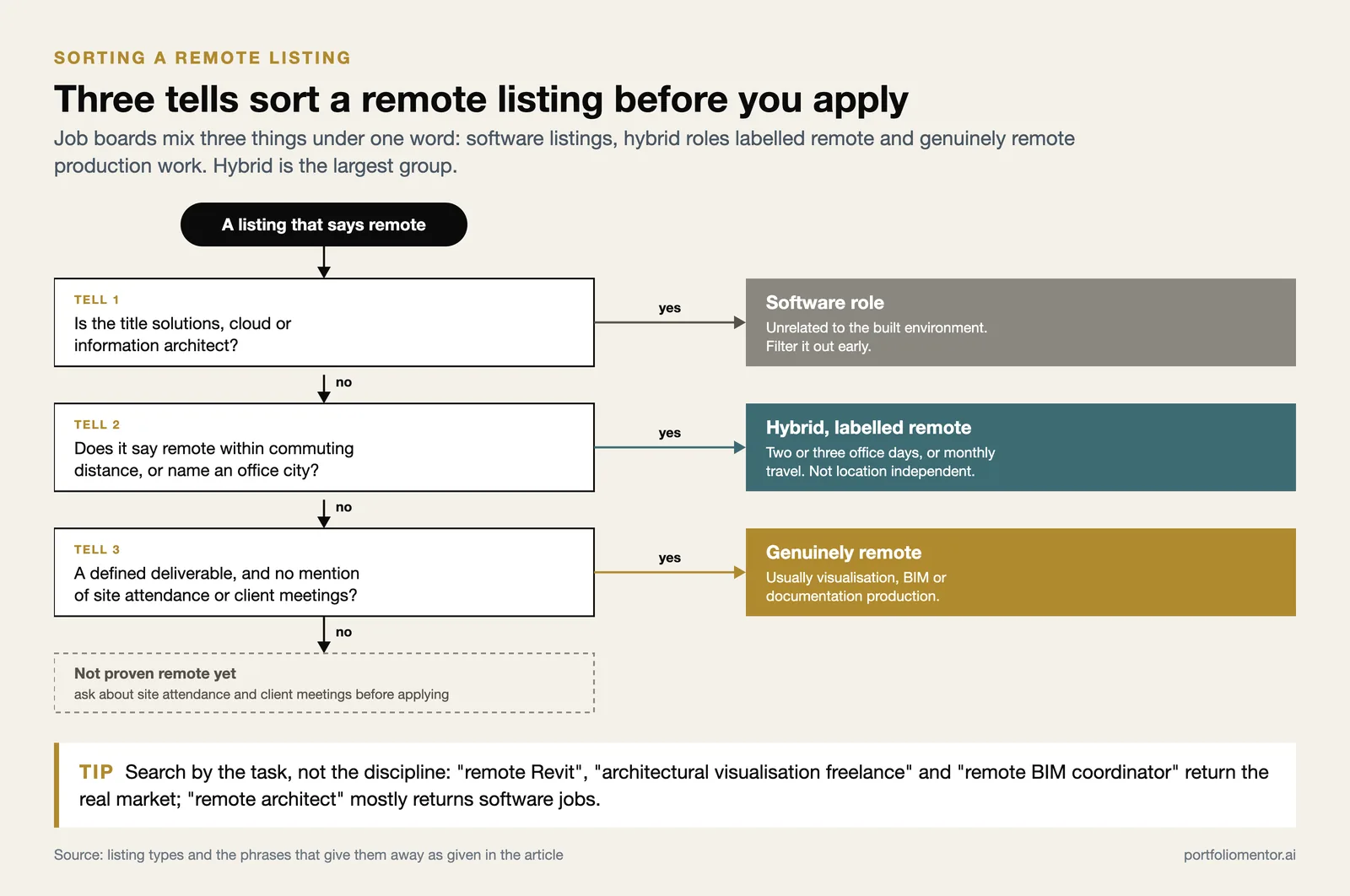
The gap between what the job boards advertise and what the profession actually supports is wide here, and it costs applicants time. A search for remote architecture roles returns three things at once. Genuinely remote production work, hybrid roles labelled remote, and software listings that use the word architect in a different sense entirely.
This guide separates those three. It explains which parts of architectural work travel, and what a portfolio needs to prove when nobody will be sitting next to you.
Which remote architecture jobs actually exist?
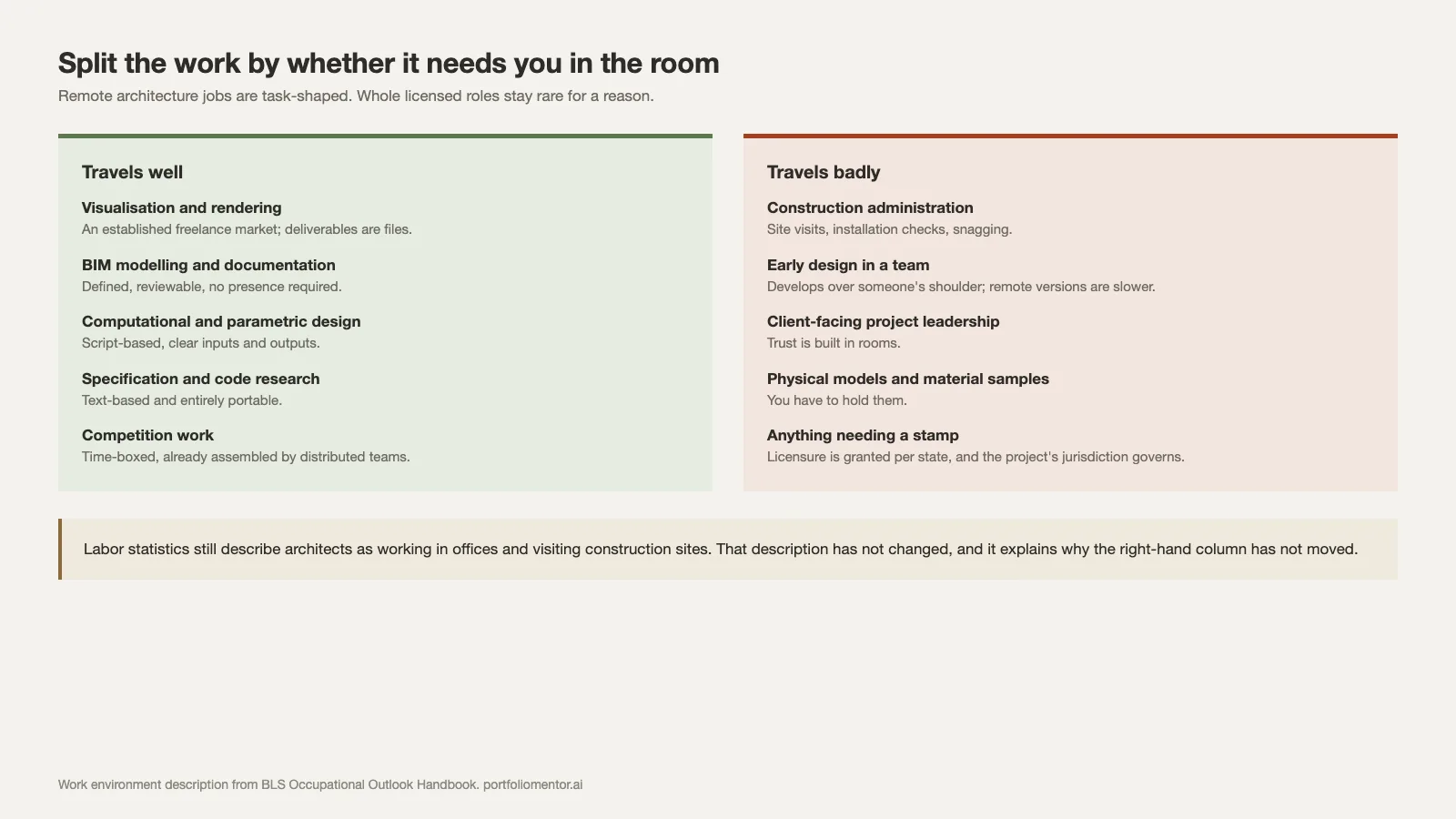
Split the profession by whether a task needs your physical presence and the picture becomes clear. Remote architecture jobs cluster on one side of that line.
Travels well
- Visualisation and rendering. The most established remote discipline in the field, with an existing freelance market and deliverables that are files.
- BIM modelling and documentation production. Firms have outsourced and distributed this for years. The work is defined, reviewable and does not require presence.
- Computational and parametric design. Script-based work with clear inputs and outputs.
- Specification writing and code research. Text-based, deadline-driven, entirely portable.
- Competition work. Time-boxed, output-defined, often assembled by distributed teams already.
Travels badly
- Construction administration. Site visits, installation checks and snagging require being there.
- Early design in a team. The work develops through drawing over someone’s shoulder, and remote versions of it are noticeably slower.
- Client-facing project leadership, where trust is built in rooms.
- Anything involving physical models or material samples.
The Bureau of Labor Statistics still describes architects as spending much of their time in offices, meeting clients and working with engineers. It notes that they “also visit construction sites.” That description has not changed, and it explains why full-remote licensed roles remain uncommon.
🔢 Quick Numbers
- 124,600 architect jobs in the US in 2025, projected to grow 4 percent through 2035 (BLS, May 2025)
- Median pay $99,280, with government at $115,920 and architectural and engineering services at $98,440 (BLS, May 2025)
- Median time to licensure 12.3 years; experience must be documented across six practice areas, several of which are hard to fill remotely (NCARB by the Numbers 2026)
⚠️ Common Mistake to Avoid
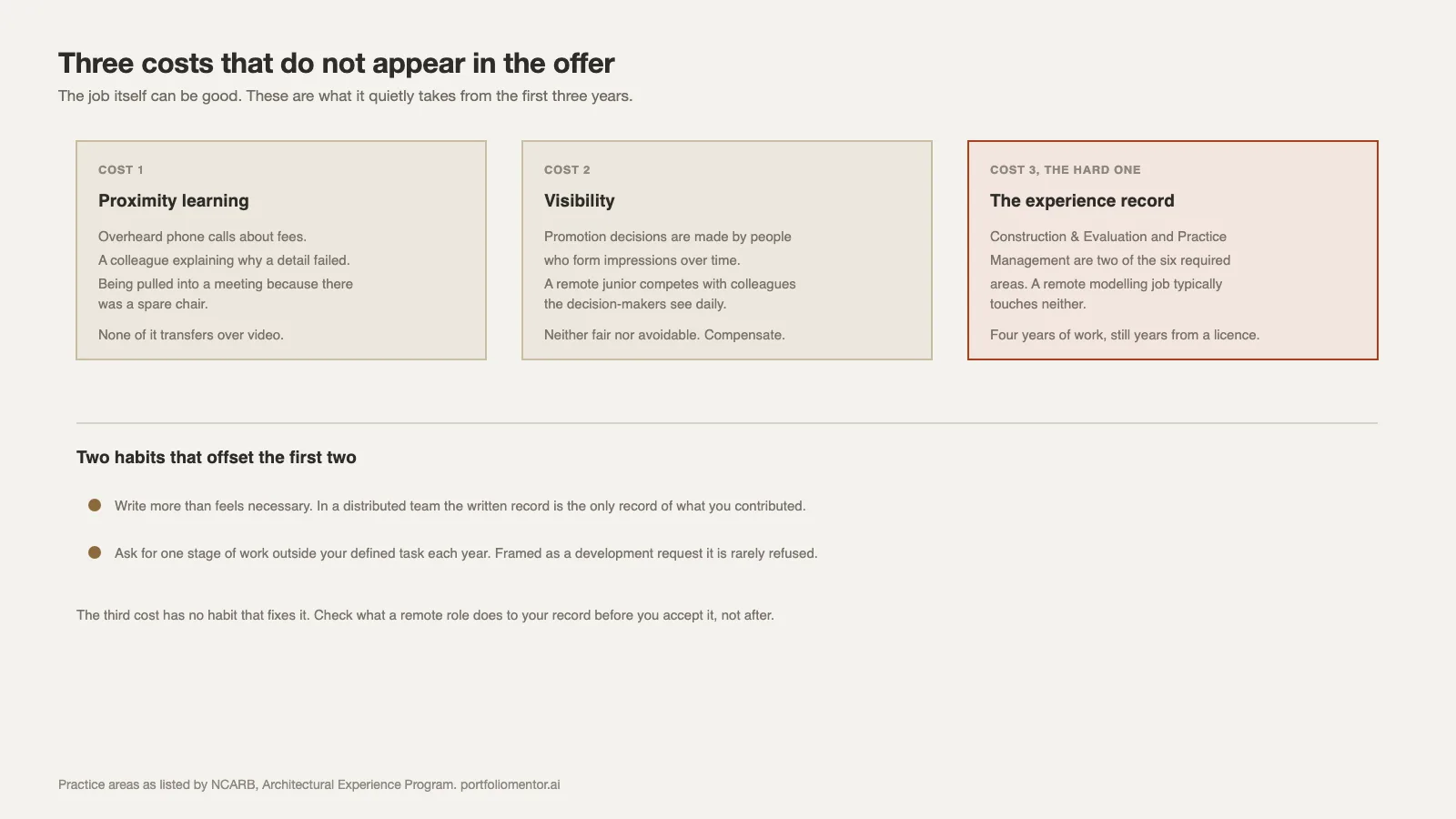
Taking a fully remote production role early and assuming licensure will proceed normally. Construction & Evaluation and Practice Management are two of the six required experience areas, and a remote modelling job typically touches neither. Candidates in this position can work for four years and remain years away from registration. If the licence matters to you, check the experience implications before the salary.
The three kinds of listing you will see
Reading the advert correctly saves most of the wasted applications.
Genuinely remote production roles
Usually visualisation, BIM or documentation, often at studios that were distributed before it was fashionable. The tell is a defined deliverable in the responsibilities section and no mention of site attendance or client meetings.
Hybrid roles labelled remote
The largest category. Two or three days in the office, or remote with monthly travel. Nothing wrong with them, but they are not location independent, and a candidate who relocates on the assumption that they are has a problem.
Look for the phrase “remote within commuting distance”, or a named office city in a supposedly remote listing. Both mean hybrid.
Software roles using the word architect
Solutions architect, cloud architect, information architect. Unrelated to the built environment and heavily represented in remote job board results because that sector genuinely is remote. Filter them out early.
Who is actually hiring remotely?
Three employer types account for most of the genuine remote architecture jobs advertised.
Visualisation studios hire globally and judge on portfolio alone, which makes them the most accessible entry point for anyone without local connections. What that book has to contain is set out in the architecture portfolio guide. Pay varies widely and is often project-based.
Large multi-office practices support distributed staff because they already have the infrastructure. These roles are usually hybrid rather than remote, and are attached to a named office.
Product and technology companies in the construction sector hire architecture-trained staff for content, support, implementation and design roles, and they are typically remote-first. Several of them sit alongside the tools listed in AI tools for architects. The work is adjacent to practice rather than practice itself, and it pays on technology scales rather than studio ones, which is why it draws people away.
💡 Pro Tip
Search by the task rather than by the discipline. “Remote architect” returns mostly software listings; “remote Revit”, “architectural visualisation freelance” and “remote BIM coordinator” return the actual market. The job titles in this corner of the field describe the deliverable, not the profession.
What remote work does to your first three years
The career cost is easy to miss because the job itself can be good.
In an office, a graduate absorbs a great deal by proximity. Overheard phone calls about fees, a colleague explaining why a detail failed, being pulled into a meeting because there was a spare chair. None of that transfers over video. The people who learn fastest remotely replace it deliberately, by asking questions that would otherwise have been answered passively.
The second cost is visibility. Promotion decisions in practices are made by people who form impressions over time, and a remote junior competes with colleagues the decision-makers see daily. Deliberate professional visibility does some of the work proximity would have done. This is neither fair nor avoidable; it is worth knowing so you can compensate by making your output legible and your progress explicit.
The third is the experience record, covered above, and it is the one with a hard consequence rather than a soft one.
None of that argues against remote work. It argues for choosing it with a plan and a review date rather than as a default. Weight the first job toward breadth even when a remote offer pays better.
If you are already in a remote role
Two habits help. Write more than feels necessary, because in a distributed team the written record is the only record of what you contributed. And ask for one stage of work outside your defined task each year. Framed as a development request it is rarely refused, and it keeps both the portfolio and the experience record moving.
Is remote architecture work paid differently?
Usually yes, and not always downward.
Salaried remote roles at practices tend to be benchmarked to the employer’s location rather than yours, which favours candidates in lower-cost areas and penalises nobody. Roles at technology companies in the construction sector typically pay above studio rates for architecture-trained staff, which is the main reason people move.
Freelance visualisation is the widest spread in the field, from rates well below employment to well above it, and the variable is reputation rather than skill. The same quality of work commands very different fees depending on whether the client found you or you found them.
The national benchmarks remain a useful anchor even for remote roles: a median of $99,280 for architects with a tenth percentile under $62,300 and a top decile above $161,420. How that curve behaves by stage is set out in the architect salary guide.
What a remote application has to prove
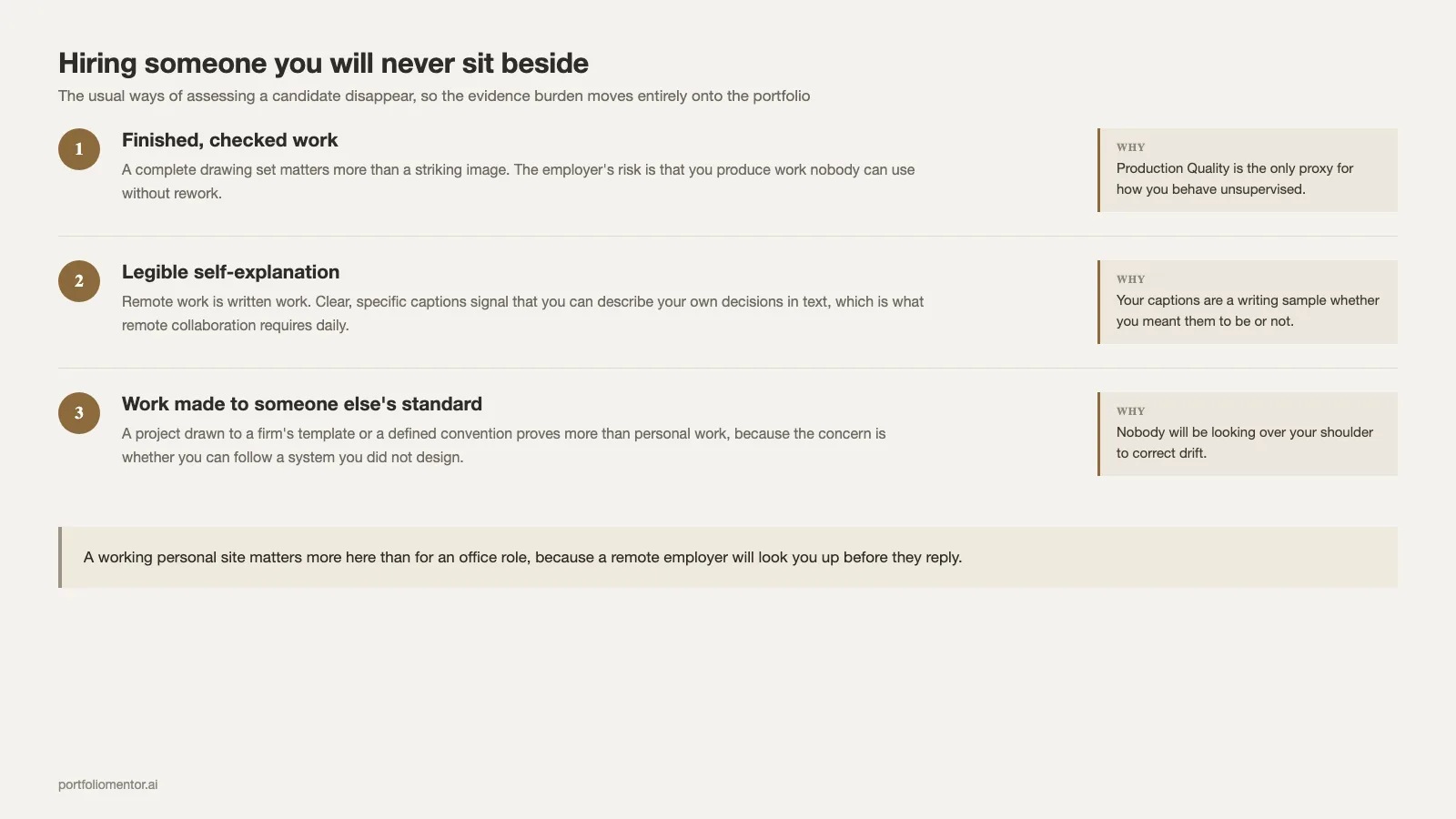
Hiring someone you will never sit beside removes the usual ways of assessing them, so the evidence burden shifts entirely onto the portfolio and the written application.
Three things carry disproportionate weight.
- Finished, checked work. A complete drawing set matters more than a striking image, because the employer’s risk is that you produce work nobody can use without rework.
- Legible self-explanation. Remote work is written work. A portfolio with clear, specific captions signals that you can describe your own decisions in text, which is exactly what remote collaboration requires daily.
- Evidence of working to someone else’s standard. A project drawn to a firm’s template or a defined convention proves more than personal work. The concern is whether you can follow a system you did not design.
Production Quality carries more weight here than in an office hire, since it is the only proxy available for how you will behave unsupervised. What undermines it in practice is collected in common architecture portfolio mistakes.
A functioning personal site also matters more than it does for an office role, because a remote employer will look you up before they reply. Setting one up is covered in the architecture portfolio website guide.
📐 Technical Note
Remote work across state or national borders has practical constraints beyond the job itself. Payroll and tax residency, professional indemnity cover, and in the US the fact that licensure is granted per state. An unlicensed production role is unaffected. A role involving stamped drawings is bound by where the project is, not by where you sit.
Freelance rather than employed
A large share of genuinely remote architectural work is contract rather than salaried, particularly in visualisation and modelling. That changes the arithmetic.
Rates look higher than salaries and are not directly comparable, because they carry no benefits, no paid leave, no employer contributions and no guaranteed pipeline. The usual rule of thumb is that a contract rate needs to be substantially above the equivalent hourly salary to break even. The gap is larger than most people entering contracting assume.
Against that, contracting builds a client base and gives control over what you take. Anyone considering it should read how to become a freelance architect before quoting a rate, since the pricing mistakes are made in the first three months.
Making a remote role work for your career
The risk is narrowing. A remote production role can be excellent for two or three years and limiting after five, because the work stays within one part of practice.
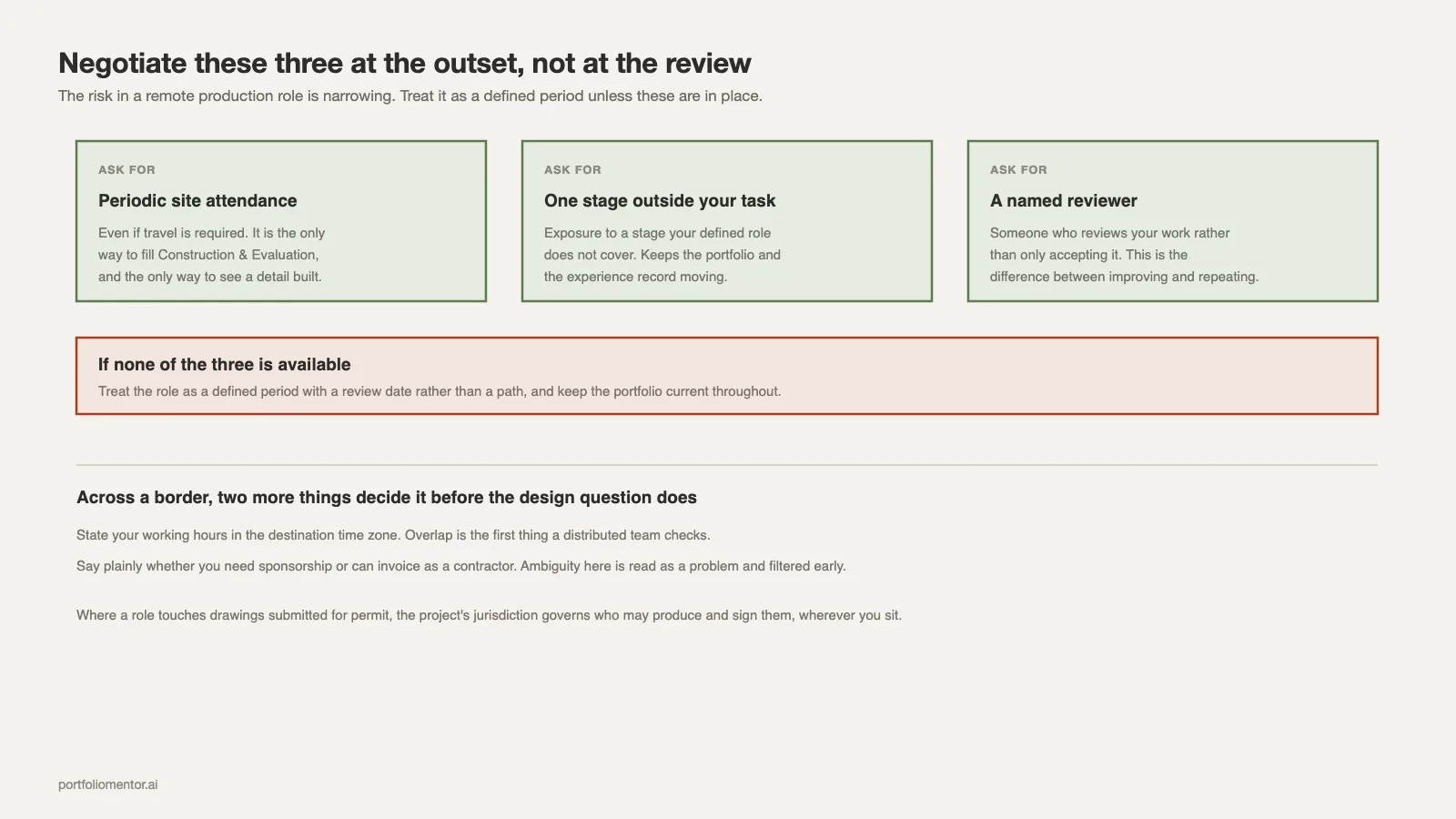
Three things are worth negotiating at the outset. Periodic site attendance even if travel is required; exposure to at least one stage outside your defined task; a named person who reviews your work rather than only accepting it. The last one is the difference between improving and repeating.
If none of the three is available, treat the role as a defined period rather than a path, and keep the portfolio current throughout. What the alternatives look like is set out in architecture career paths.
Applying from another country
Remote listings attract international applicants for obvious reasons, and most of those applications fail on practicalities rather than on merit.
Employers hiring across borders have to solve payroll, tax and sometimes visa questions before they can solve the design question, and a small practice usually will not. That is why the international remote market concentrates in visualisation, where the relationship is contractual rather than employment. The rest sits with larger companies that already have an entity in your country.
The other constraint is professional rather than administrative. Where a role touches drawings that will be submitted for permit, the project’s jurisdiction governs who may produce and sign them. Where you physically sit does not change that. Production support is unaffected; anything closer to the licensed act is not.
Two things improve the odds materially. State your working hours in the destination time zone rather than your own, since overlap is the first thing a distributed team checks. And say plainly whether you need sponsorship or can invoice as a contractor, because ambiguity here is read as a problem and gets filtered early.
The short version
Remote work in architecture is real and task-shaped: visualisation, modelling, documentation, computation and specification. Whole licensed roles are rare because site presence and stamped drawings anchor them. Search by task rather than by title, and read hybrid listings carefully. Check what a remote role does to your experience record before accepting it, and expect the portfolio to carry the hiring decision.