A day in the life of an architect is mostly coordination, drawing and email, carried out in an office with periodic site visits. Labor statistics describe architects as spending much of their time in offices meeting clients and working with engineers, with most working full time and many working additional hours near deadlines.
That description is accurate and tells you almost nothing about what the job feels like, because the day changes completely depending on your stage. A first-year designer, a project architect and a principal share a job title and share almost no tasks.
What follows is a day in the life of an architect at three stages, what fills the calendar, and which parts of the work students consistently underestimate.
What does a day in the life of an architect look like?
The official description is short. According to the Bureau of Labor Statistics, architects “spend much of their time in offices, where they meet with clients, develop reports and drawings, and work with other architects and engineers. They also visit construction sites.” On hours: “Most architects work full time and many work additional hours, especially when facing deadlines.”
Underneath that, the work divides into six areas that NCARB uses to structure the experience requirement for licensure: Practice Management, Project Management, Programming & Analysis, Project Planning & Design, Project Development & Documentation, and Construction & Evaluation. Any given day is some mix of those six, and your seniority determines the mix.
🔢 Quick Numbers
- Architects in the US: 124,600 jobs in 2025, projected to grow 4 percent through 2035 (BLS, May 2025)
- Median pay $99,280; lowest 10 percent under $62,300; highest 10 percent above $161,420 (BLS, May 2025)
- Median time to licensure: 12.3 years in 2025, so most of a career’s first decade is spent in the pre-licence roles described below (NCARB by the Numbers 2026)
Year one: the architectural designer
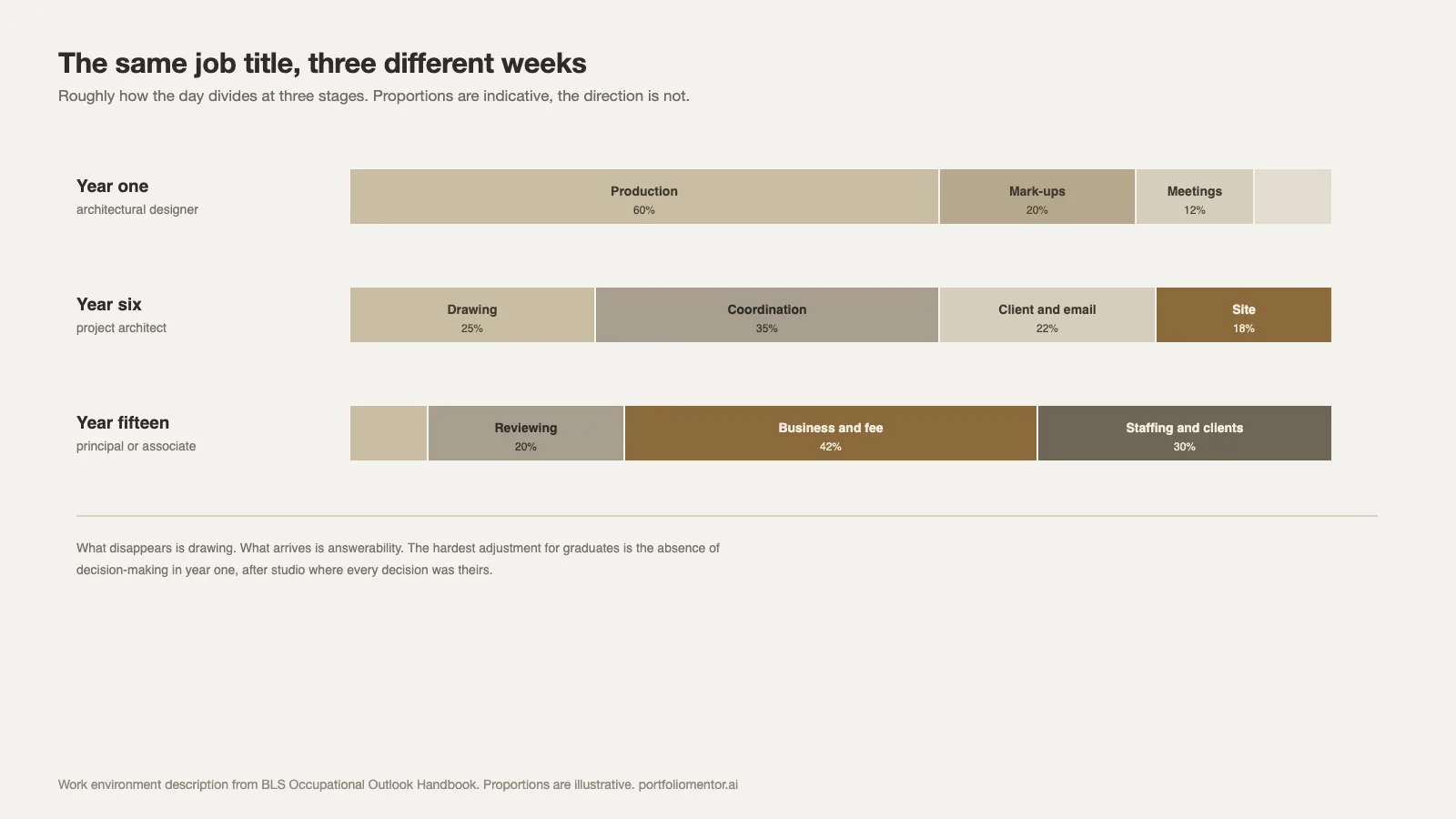
The day is dominated by production. You are given a defined piece of a set and you draw it.
Morning is usually the longest uninterrupted block, and it goes to whatever was marked up the previous day. Someone senior has red-lined your sheets, and working through those marks is both the task and the training. The corrections are where the knowledge transfers, which is why a firm without a strong reviewer is a slow place to learn.
Midday brings a coordination check or a team stand-up. You are mostly listening. Terms you do not know go in a notebook.
Afternoon is more production, punctuated by small requests: a quick plan option, a revised schedule, an area calculation for a fee discussion you are not part of. These interruptions are the actual skill being built, because architecture is a profession of interrupted work.
What is missing from the day is decision-making, and that absence is the hardest adjustment for graduates coming out of studio, where every decision was theirs.
⚠️ Common Mistake to Avoid
Treating the first year as a holding pattern until the interesting work arrives. The people who progress fastest read the whole drawing set rather than only their sheet. They ask why a mark-up was made rather than just making the change. That habit compresses three years of learning into eighteen months, and it costs nothing but attention.
Year six: the project architect
The proportions invert. Drawing becomes something you do in gaps rather than the substance of the day.
The morning starts with the inbox because it contains decisions other people are waiting on. A contractor’s request for information, a structural engineer’s query about a slab edge, a client asking about a change they mentioned in passing. Each one is small and each one blocks somebody.
A consultant coordination call follows, usually an hour, usually resolving conflicts between disciplines that the model has surfaced. Then a client meeting or an internal review, then whatever documentation time survives.
Site visits punch through the week at irregular intervals, and they are the part most architects say they value most. They are also the part that produces the knowledge nobody can learn from drawings: how the detail you specified actually gets installed, and why the installer changed it.
The load shifts from producing work to being answerable for it, which suits some people and exhausts others. Anyone deciding between routes at this stage will find the options compared in architecture career paths.
Year fifteen: the principal or associate
Almost none of the day is architecture in the sense a student would recognise.
Business development, fee negotiation, staffing, reviewing other people’s work, and the design decisions that only you can make, which arrive in bursts of twenty minutes rather than days. The drawing is done by others and your contribution is a red pen and a conversation.
This is the stage the top decile of the wage distribution sits in, above $161,420 according to BLS for May 2025, and the salary guide tracks the steps that lead there. It is reached through responsibility for fee, staff and clients rather than through design ability alone, which is worth knowing early because the skills are different from the ones studio rewards.
📐 Technical Note
Time in most practices is billed to project codes, usually in fifteen or thirty minute increments, and the timesheet is how a firm knows whether a project is profitable. It also means your day is visible in a way it was not at school. Unbilled time, such as internal training or portfolio work, has its own code and is watched, which is one reason firms are careful about how much of it they offer.
How the week is shaped by deadlines
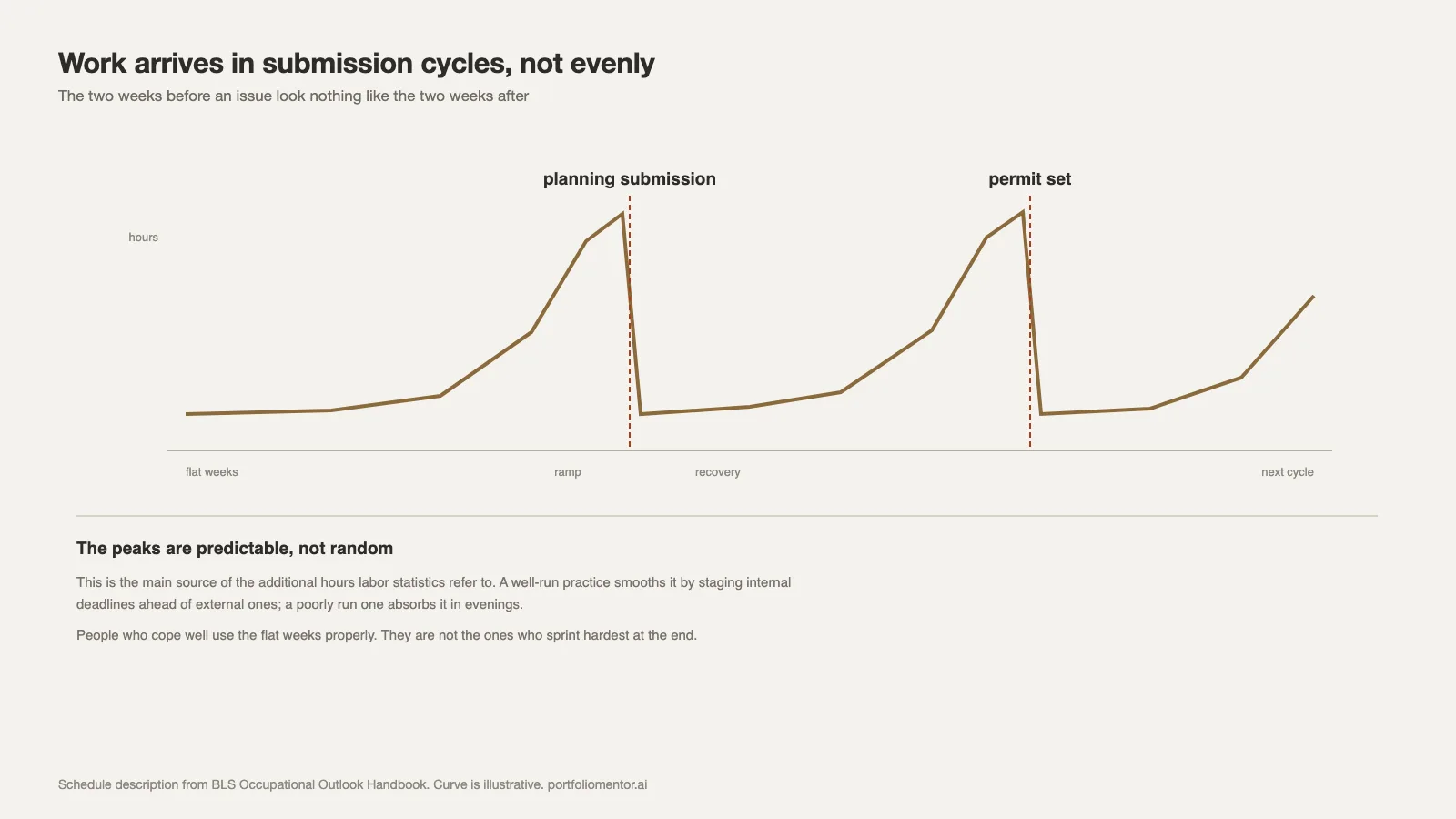
Architecture work is not evenly distributed. It arrives in submission cycles: a planning application, a permit set, a tender issue, a client presentation. The two weeks before an issue look nothing like the two weeks after.
This is the main source of the additional hours BLS refers to. A well-run practice smooths it by staging internal deadlines ahead of external ones; a poorly run one absorbs it in evenings. Which kind you have joined is usually visible before you accept, as the firm guide sets out. The difference is visible before you accept a job if you ask how many issues a project has per year and what happened on the last one.
Students planning around this should know that the peaks are predictable rather than random. People who cope well are the ones who use the flat weeks properly rather than the ones who sprint hardest at the end.
What studio does not prepare you for
Three things, consistently.
- Working on someone else’s idea. Most of your early work develops a concept you did not choose and may not like. Doing that well is a professional skill and it is not taught.
- Writing. Emails, meeting notes, specification clauses, planning statements. A large share of the week is text, and clear writing is a bigger differentiator between juniors than drawing ability.
- Unfinished work. Studio projects end at the review. Real projects run for years, change hands, get shelved and occasionally restart. Very little of what you draw in the first three years gets built, and that is normal rather than a sign of a bad job.
The third one has a practical consequence for your portfolio: if you wait for a completed building to show, you will have nothing for years. Document the stages you worked on as you go, which is the habit described in the architecture portfolio guide.
💡 Pro Tip
Keep a running note of what you personally drew or decided on each project, dated. Three years later, when you are assembling a portfolio and cannot remember which parts were yours, that note is the difference between an accurate claim and a vague one. Interviewers test this by asking what exactly you did, and hesitation reads badly.
The parts of the week nobody photographs
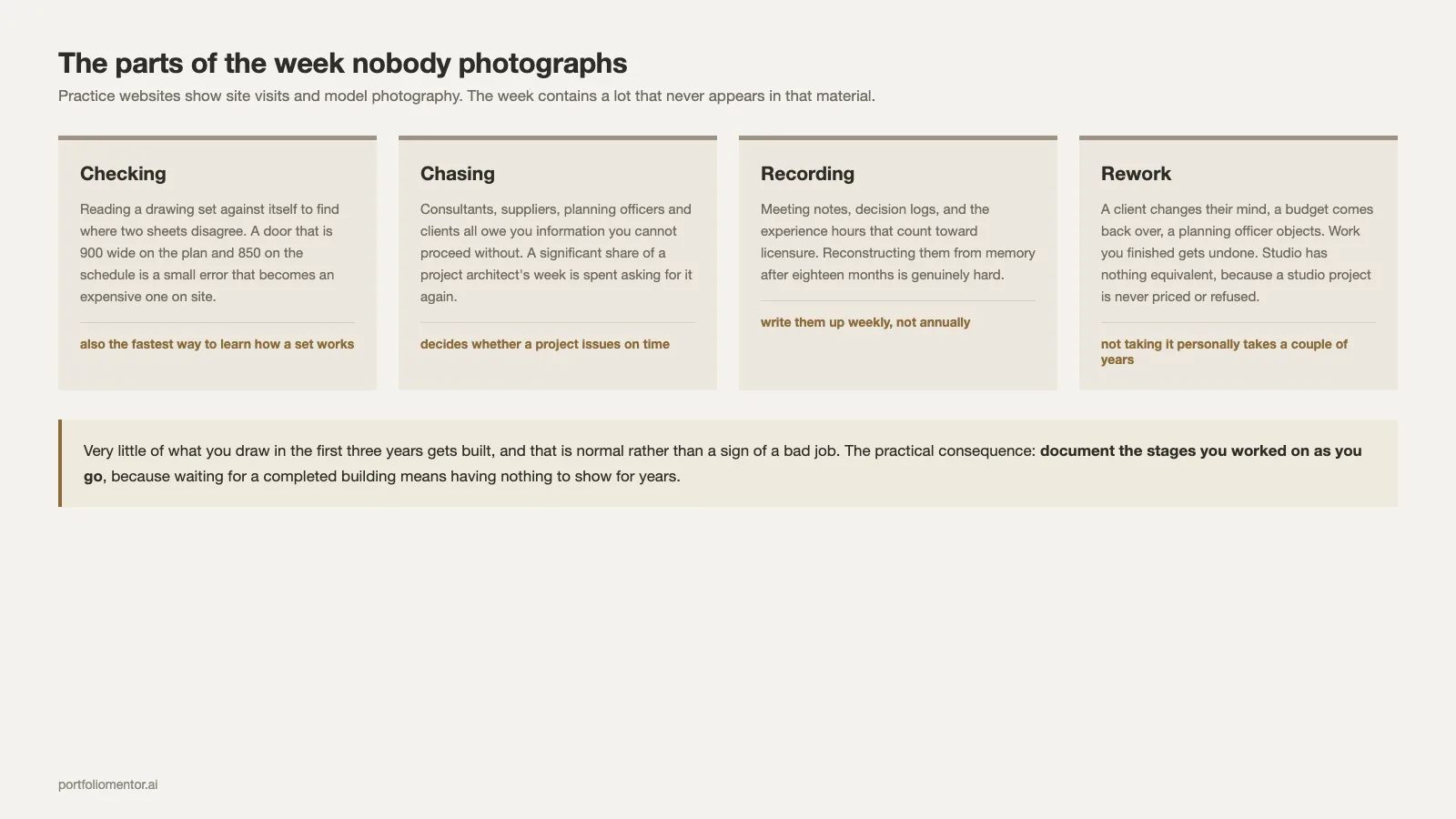
Practice websites show site visits and model photography. The week contains a lot that never appears in that material, and it is worth knowing about before you commit.
Checking
Reading a drawing set against itself to find where two sheets disagree. A door that is 900 wide on the plan and 850 on the schedule is a small error that becomes an expensive one on site, and someone has to find it. Juniors are often given this task and often resent it. It is also the fastest way to learn how a set is put together.
Chasing
Consultants, suppliers, planning officers and clients all owe you information you cannot proceed without. A significant share of a project architect’s week is spent asking for it again. This is unglamorous and it is the difference between a project that issues on time and one that does not.
Recording
Meeting notes, decision logs, and in the US the experience hours that count toward licensure. Candidates who write these up weekly finish the record years earlier than those who reconstruct them from memory, and the reconstruction is genuinely hard after eighteen months.
Rework
A client changes their mind, a budget comes back over, a planning officer objects. Work you finished gets undone, and very little of it ever becomes a portfolio page. Studio has nothing equivalent, because a studio project is never priced by a contractor or refused by an authority. Learning not to take it personally is a real professional skill and takes most people a couple of years.
Does the day change by firm size?
More than by sector, and in a predictable direction.
In a practice under about fifteen people, you will touch every stage within a year, attend client meetings early, and see how a fee is set. You will also work on fewer projects at once, have less formal review of your drawings, and depend heavily on whether the one senior person is a good teacher.
In a large firm you will be given a narrow slice, supervised properly, and exposed to better documentation standards. You may also spend two years in one stage, which slows the experience record and produces a portfolio with gaps.
Neither is better. They fail differently, and the failure mode you can tolerate is a legitimate basis for choosing. The trade is set out further in the internships guide, since the same logic applies when choosing a placement.
Is it a good day-to-day job?
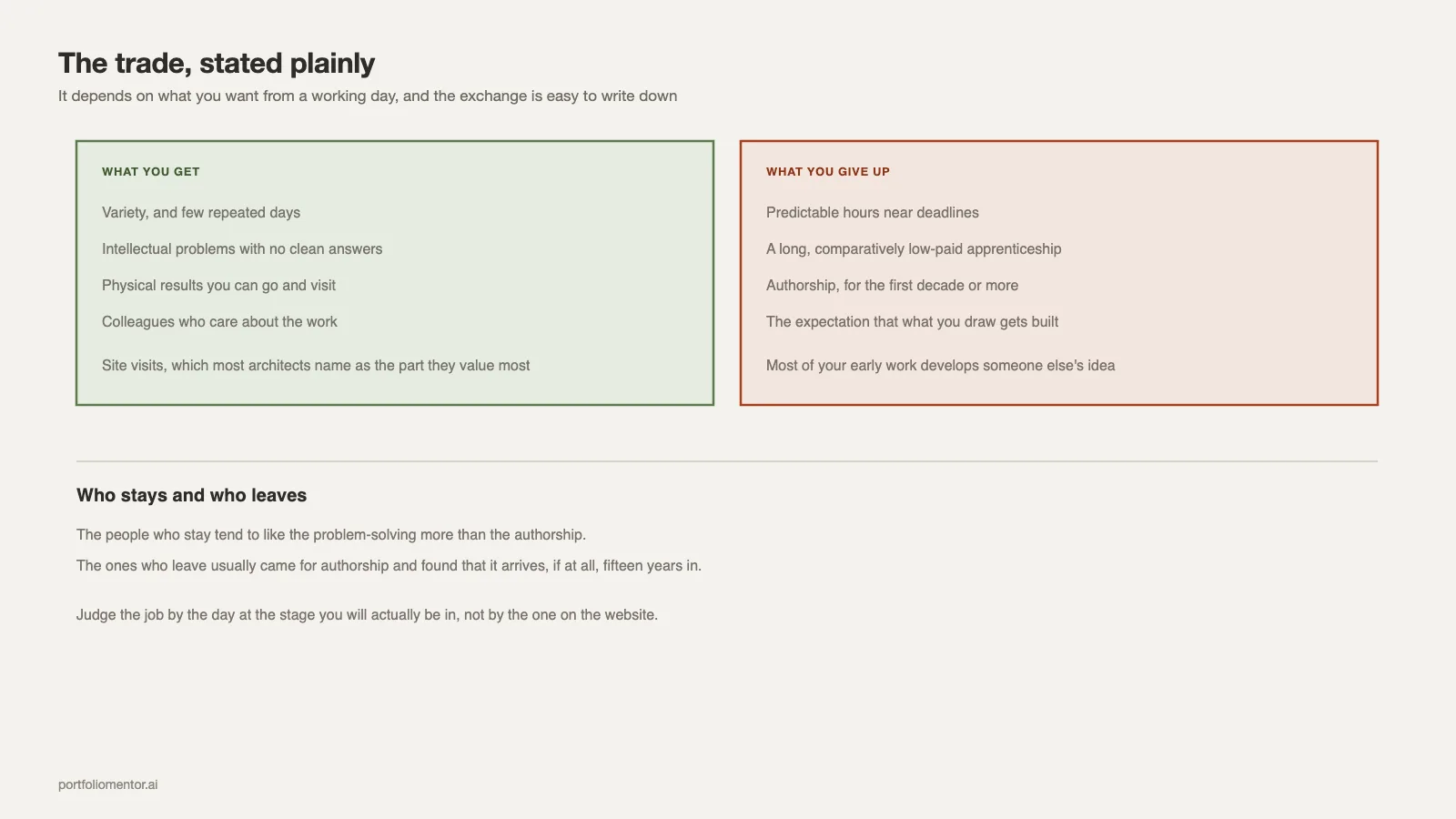
It depends on what you want from a working day, and the honest trade is easy to state.
You get variety, intellectual problems with no clean answers, physical results you can visit, and colleagues who care about the work. You give up predictable hours near deadlines, a long low-paid apprenticeship, and the acceptance that most of what you draw will not be built.
The people who stay tend to be the ones who like the problem-solving more than the authorship. The ones who leave are usually the ones who came for authorship and found it arrives, if at all, fifteen years in.
What to ask before you accept a job
Five questions that reveal the day better than any description.
- Who reviews my drawings, and how often?
- What stages does this role cover, and which stages will I not see?
- How many site visits does a junior get in a year?
- What happened in the last deadline week?
- How many people here have qualified in the last two years?
Firms that answer these quickly and specifically are telling you the day is defensible. Vague answers usually mean the honest answer is unattractive. These fit naturally into the closing part of an interview, alongside the set collected in architecture interview questions. What you should be evaluating in return is covered in choosing a firm to work for.
The short version
Production and mark-ups in year one, coordination and answerability in year six, business and twenty-minute design decisions in year fifteen. Office-based with site visits, uneven hours clustered around submissions, and a long stretch before the work looks like the reason you chose it. Judge the job by the day at the stage you will actually be in, not by the one on the website.