A master of architecture application portfolio is the document that decides most M.Arch admissions. Programmes set their own limits, and they differ sharply: RIT caps the file at 10.0 MB and suggests around 20 pages, while UT Austin and Notre Dame both allow 25 MB. Read the specific programme before you design anything.
Applicants treat the master of architecture application portfolio as a display of everything they have made. Admissions committees read it as evidence of how you think, and they read it fast, in a stack, against a deadline. Those two readings produce very different documents.
This guide covers what the published requirements actually say, what committees are assessing behind them, and how to build an application portfolio that survives the stack.
What does a master of architecture application portfolio require?
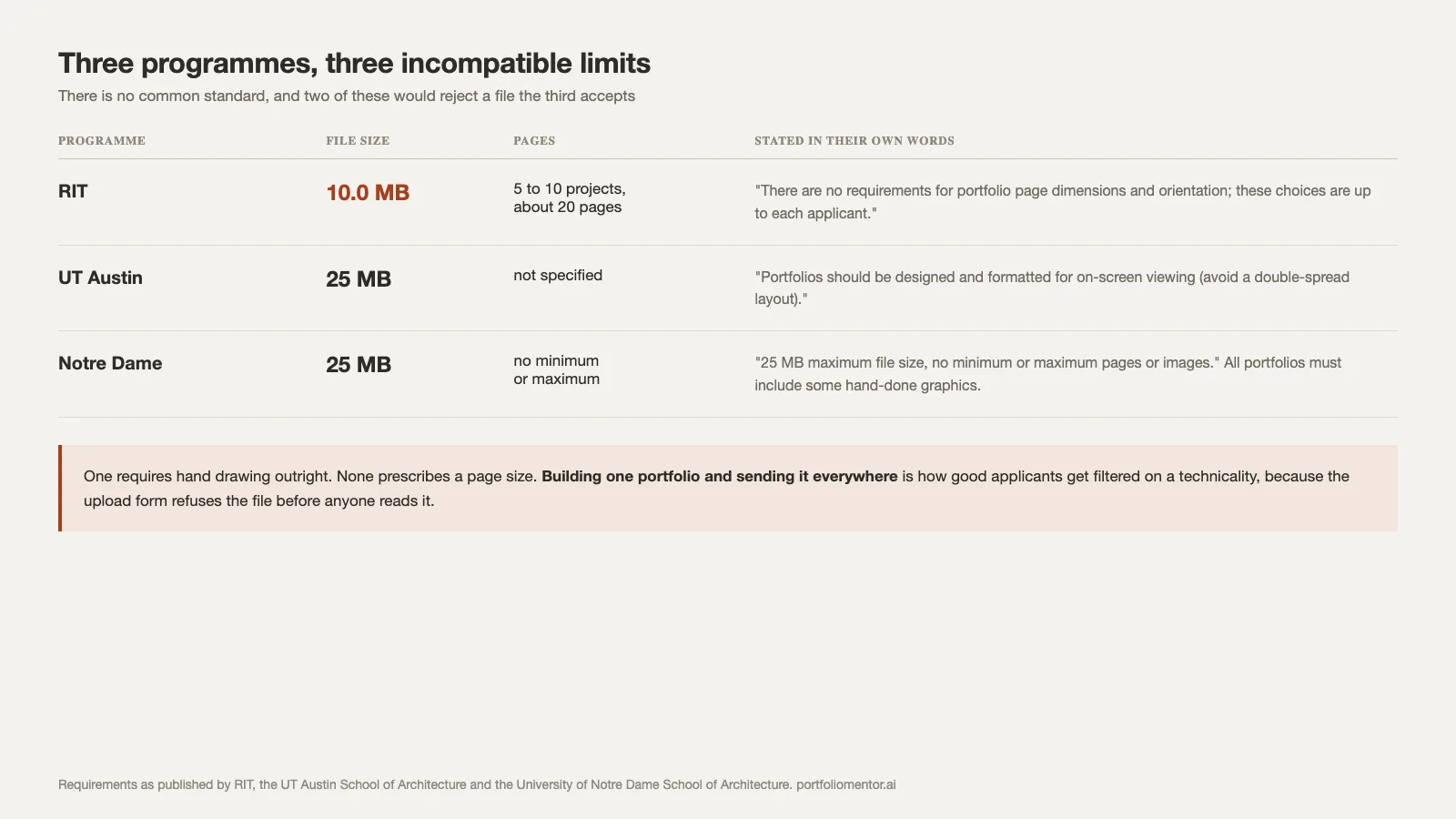
There is no common standard, which is the first thing to accept. Three examples from published requirements show the range.
🔢 Quick Numbers
- RIT: “PDF portfolio file should not exceed 10.0MB”, limit to “5-10 projects and approximately 20 pages”, and “There are no requirements for portfolio page dimensions and orientation” (RIT graduate portfolio requirements)
- UT Austin: single PDF, “designed and formatted for on-screen viewing (avoid a double-spread layout)”, maximum file size 25 MB (UT Austin M.Arch application instructions)
- Notre Dame: “25 MB maximum file size, no minimum or maximum pages or images”, and all portfolios “must include some hand-done graphics” (Notre Dame School of Architecture admissions)
Two of those three would reject a file the third accepts. One requires hand drawing outright. None of them prescribes a page size. Building one portfolio and sending it everywhere is how good applicants get filtered on a technicality.
What the committee is actually reading for
Not finished buildings, and not software skill. Applicants without an architecture background worry about this most and are usually worrying about the wrong thing.
Evidence of spatial and visual thinking
Can you understand and represent three dimensions. Drawing, photography, fabrication, sculpture, set design and well-presented technical work all demonstrate it, and photographing physical work well is its own skill, covered in the model photography guide. Notre Dame’s requirement for hand-done graphics exists precisely because the committee wants to see “an applicant’s sensibility for proportion, form, line” and an ability to draw, or to learn to.
The capacity to develop an idea
One project shown through its development says more than five shown as final images. Committees are selecting students, which means they are betting on how you will work in studio rather than on what you have already finished.
Judgement
What you left out is read as closely as what you included. A portfolio that contains everything you have ever made tells the committee you cannot assess your own work, which is a problem in a programme built on review.
⚠️ Common Mistake to Avoid
Submitting undergraduate coursework unedited because it was graded well. A grade certifies that the work met a brief; it says nothing about whether the drawings communicate to a stranger with no knowledge of the brief. Every project needs two sentences of context and a redraw of anything that only made sense in the room where it was reviewed.
How do you apply without an architecture degree?
The longer M.Arch tracks, compared in the grad school roundup, exist for exactly this, and committees are experienced at reading portfolios from applicants with no studio background. What they are not looking for is imitation studio work.
Material that works: your own photography with an argument about space or light; physical making of any kind; drawing from observation. Technical or engineering work redrawn to explain a spatial consequence counts, as do documented projects from set design, product design or construction.
Material that does not: rendered images from tutorials; floor plans copied from published houses; a portfolio made entirely of software output with no evidence of hand or eye.
An engineering applicant, for example, is better served by one well-drawn analysis of a structure they understand deeply than by three attempts at a building design they have no training to resolve. The first shows thinking; the second shows the gap.
💡 Pro Tip
Make one drawing by hand specifically for the application, even where it is not required. It takes an afternoon, it is the single most distinctive page in most digital-only portfolios, and at least one programme treats it as mandatory. Scan it properly rather than photographing it on a desk.
What separates an accepted portfolio from a rejected one
Committees rarely reject on drawing quality alone. Three patterns account for most of the outcomes at the margin.
The portfolio answers a question
Accepted portfolios usually have a thread, as reading several published portfolios in sequence makes clear. Not a theme imposed afterwards, but a visible interest that shows up across projects: a preoccupation with structure, or with reuse, or with how people occupy a space over time. Committees are assembling a cohort and they select for people who will bring something specific to a studio.
Rejected portfolios are frequently competent and undirected. Four well-drawn projects with nothing in common read as a student who did the coursework, which is not a reason to admit someone over another applicant who did the same.
The work is legible without you present
School reviews happen with you in the room explaining. An application happens without you. Drawings that relied on verbal framing collapse, and the collapse is invisible to the person who made them because they still hear the explanation in their head.
The fix is mechanical: show the file to someone who was not in your studio and ask them to describe each project back. Wherever they hesitate, the drawing is doing less work than you think.
The scale of ambition matches the stage
An applicant who presents a resolved thirty-storey tower invites a comparison they cannot win, because the resolution will not withstand a trained reader. The same applicant presenting a small, thoroughly worked project reads as someone with judgement. Committees are not impressed by scale and are consistently impressed by thoroughness.
That preference runs against the instinct to show the biggest thing you have made, and it is worth overriding.
Structure that survives the stack
Committees read dozens of these in a sitting. The structure that works is the same across programmes.
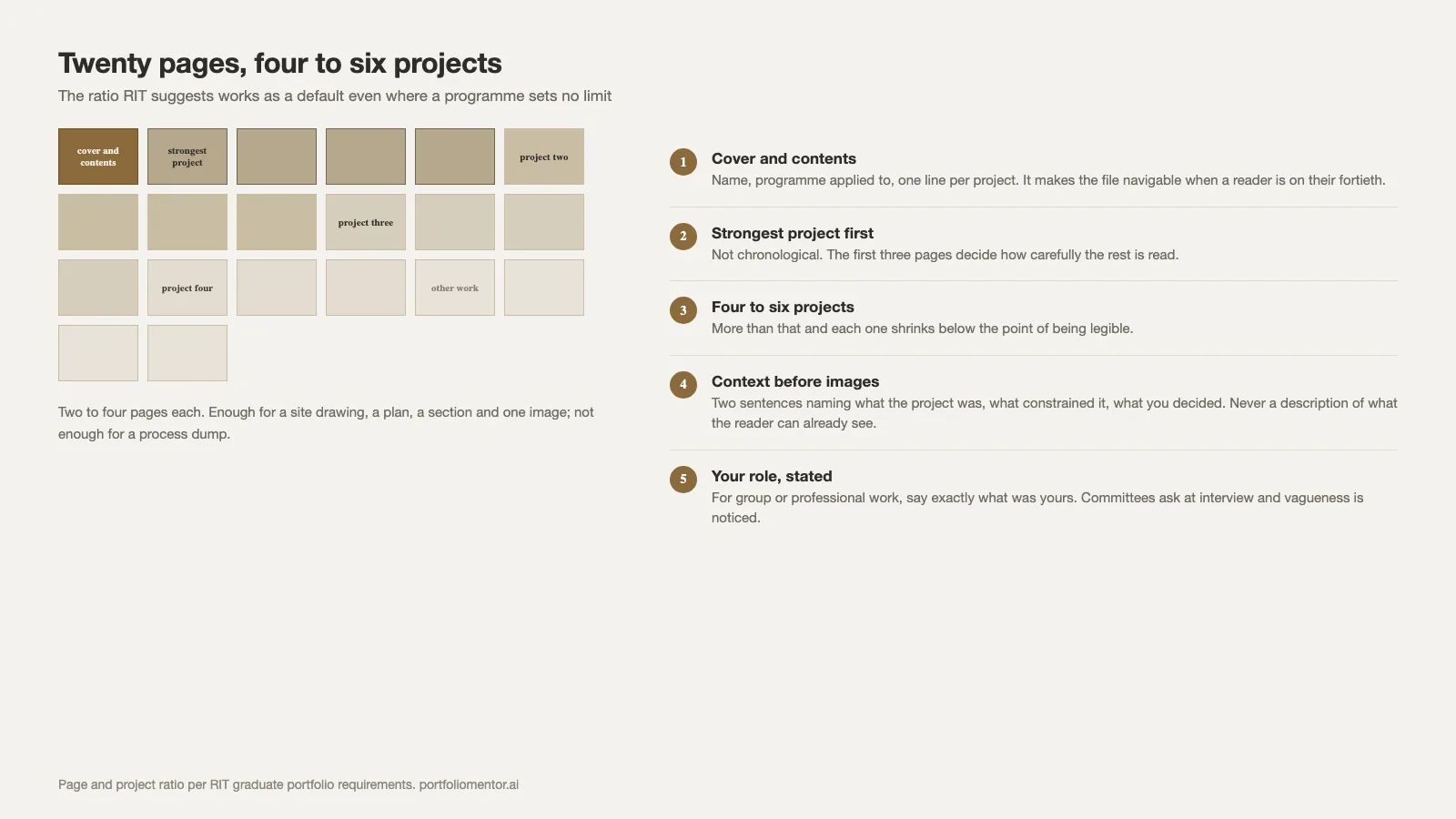
- Cover and contents. Name, programme applied to, one line per project. Sounds bureaucratic; makes the file navigable when a reader is on their fortieth.
- Strongest project first. Not chronological. The first three pages decide how carefully the rest is read.
- Four to six projects. RIT suggests five to ten projects across roughly twenty pages, which works out at two to four pages each. That ratio is a good default even where a programme sets no limit.
- Context before images. Two sentences naming what the project was, what constrained it, and what you decided. Never a paragraph of description of what the reader can already see.
- Your role, stated. For group or professional work, say exactly what was yours. Committees ask about this at interview and vagueness is noticed.
The selection and ordering logic is the same one that applies to job applications. It is covered in the architecture portfolio guide, and the recurring errors in common portfolio mistakes.
Format decisions that get files rejected
These are avoidable and they end applications.
File size is the most common. A 30 MB file cannot be uploaded to a form that caps at 10 MB, and the form will not tell you kindly. Export a screen version at reduced resolution and keep the print version locally.
Spreads are the second. UT Austin asks applicants to avoid double-spread layouts because the file is read on screen, usually one page at a time. A drawing that crosses the gutter arrives split in half.
Third is orientation drift. A file that turns sideways on page fourteen forces the reader to rotate their laptop. Pick landscape or portrait and hold it for the whole document.
Page size itself is usually free, and RIT says so explicitly. The formatting decisions that follow from that freedom are covered alongside layout in portfolio layout and design.
📐 Technical Note
Export at 150 ppi for an application file and 300 ppi only if a programme asks for print quality. At A3 landscape, a twenty-page portfolio at 150 ppi with compressed images generally lands between 6 and 12 MB, which clears the stricter limits. Check the exported size at page ten rather than at page twenty, while the render settings can still be changed.
How the portfolio relates to the rest of the application
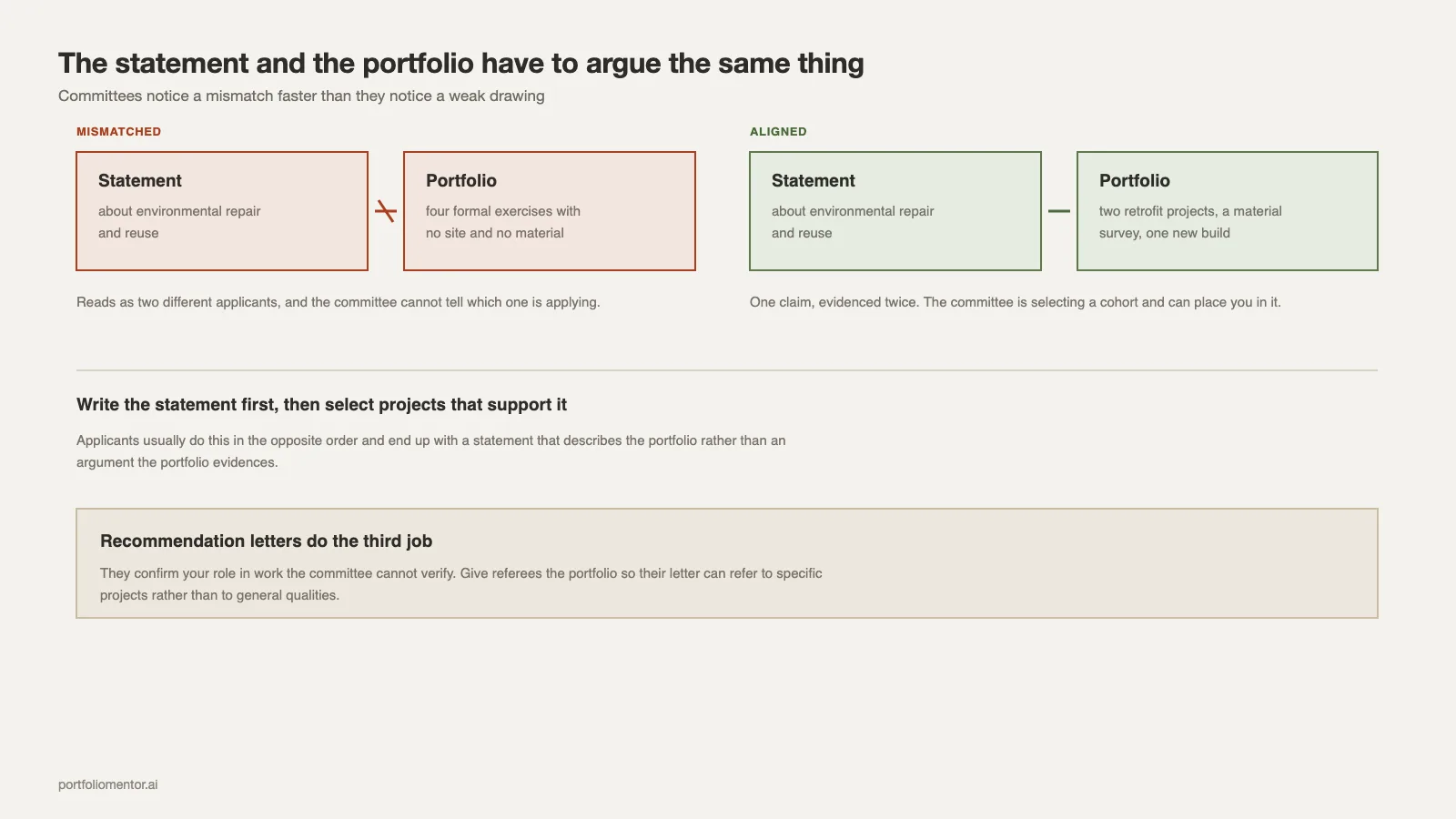
The statement of purpose and the portfolio should argue the same thing. A statement about environmental repair beside a portfolio of formal exercises reads as two different applicants, and committees notice the mismatch faster than they notice a weak drawing.
Practical approach: write the statement first, extract the claim, then select projects that support it. Applicants usually do this in the opposite order and end up with a statement that describes the portfolio rather than an argument the portfolio evidences.
Recommendation letters do the third job, confirming your role in work the committee cannot verify. Give referees the portfolio so their letter can refer to specific projects. Wider application sequencing is covered in the architecture grad school guide, and programme selection in choosing architecture grad schools.
A working timeline
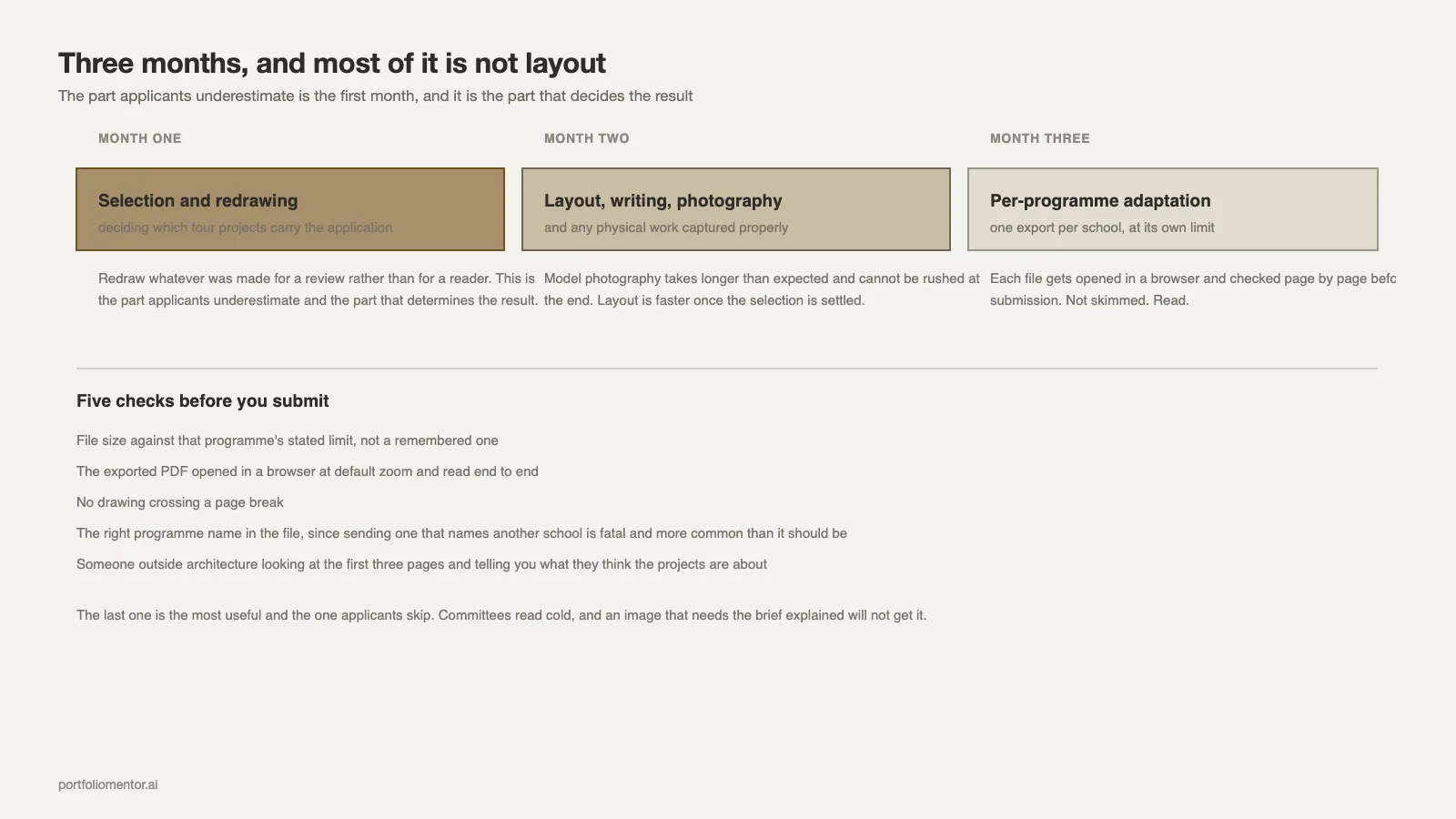
Three months is realistic, and most of it is not layout.
Month one goes to selection and redrawing. Deciding which four projects carry the application, and redrawing whatever was made for a review rather than for a reader. This is the part applicants underestimate and the part that determines the result.
Month two is layout, writing and photography of any physical work, and the layout decisions are faster once the selection is settled. Model photography in particular takes longer than expected and cannot be rushed at the end; the approach is set out in the model photography guide.
Month three is per-programme adaptation and testing. Each school gets its own export at its own limit, and each file gets opened in a browser and checked page by page before submission.
Before you submit
- Check the file size against that programme’s stated limit, not a remembered one.
- Open the exported PDF in a browser at default zoom and read it end to end.
- Confirm no drawing crosses a page break.
- Confirm the programme name in the file is the right one. Sending a file naming another school is more common than it should be and is fatal.
- Have someone outside architecture look at the first three pages and tell you what they think the projects are about.
The last one is the most useful and the one applicants skip. Committees are expert readers, but they are reading cold, and an image that needs the brief explained will not get it.
If you are reapplying after a rejection
Rejections in M.Arch admissions are rarely a verdict on ability, because the deciding margin is usually between applicants who could all do the work. That makes reapplication worth considering, but only with a changed document.
Resubmitting the same portfolio with a year added to the CV is the common error. What moves an application between cycles is new evidence: a project made in the intervening year, a body of drawing, documented making, or work from a job in a related field. One genuinely new project does more than a reorganisation of the old ones.
Where feedback is offered, ask for it and read it literally rather than defensively. Where it is not, the more useful exercise is comparing your file against the published requirements line by line and finding the ones you interpreted generously.
The short version
Read each programme’s published limits and build to the strictest one. Four to six projects, strongest first, two sentences of context each, one page-size and one orientation throughout, hand drawing included, and a statement of purpose arguing the same thing the portfolio shows. The file that gets rejected on upload is the one nobody reads, and that failure is entirely preventable.