

The best architecture schools for a Master of Architecture (M.Arch) combine NAAB accreditation, a strong studio culture, hiring reputation, and a cost that fits your career plan. MIT, Harvard GSD, the Bartlett, TU Delft, and the University of Michigan lead 2026 rankings, but the right program is the one that matches your goals, portfolio, and budget.
Choosing among the best architecture schools is rarely about the highest-ranked name alone. An M.Arch is a two to three and a half year commitment that shapes your design voice, your professional network, and your eligibility for licensure. This guide breaks down how to read the rankings honestly, why accreditation is non-negotiable, what programs actually cost in 2026, and how to weigh location and studio culture so you apply to schools that will accept you and serve your ambitions.
What Makes an Architecture School “the Best” in 2026?
The best architecture schools score well across four practical filters: accreditation, reputation among hiring firms and peers, total cost relative to outcomes, and the fit between studio culture and your design interests. No single ranking captures all four, so treat published lists as a starting point rather than a verdict.
It helps to know how the landscape shifted. The long-dominant DesignIntelligence survey was suspended after deans from more than a dozen leading programs, including Harvard GSD, Rice, and the University of Michigan, signed an open letter criticizing its methodology. In its absence, applicants now triangulate using the QS World University Rankings by Subject, employer reputation data, NAAB accreditation status, and direct conversations with current students.
According to the QS World University Rankings for Architecture and Built Environment 2026, the Bartlett School of Architecture at UCL holds the top global spot, with MIT, TU Delft, ETH Zurich, and Harvard close behind. QS evaluated 262 universities across 20 countries using academic and employer reputation as primary indicators, which is why these results track closely with where major firms actually recruit.
⚠️ Common Mistake to Avoid
Do not pick a program purely by its overall university ranking. A school can sit high on a general world ranking yet have a thin or unaccredited architecture department. Always confirm the specific M.Arch program is NAAB-accredited and check where its recent graduates landed, not just the institution’s brand.
Which Are the Top M.Arch Programs to Consider?

The strongest M.Arch programs in 2026 cluster around a handful of consistently recognized names, though each carries a distinct identity. Below is a working shortlist drawn from QS subject data and long-standing peer reputation. Use it to build a balanced application list of reach, match, and safety schools.
| School | Known For | Type |
|---|---|---|
| MIT (Cambridge, US) | Research, computation, technology | Private |
| Harvard GSD (Cambridge, US) | Theory, urbanism, faculty network | Private |
| The Bartlett, UCL (London, UK) | Experimental design, fabrication | Public |
| TU Delft (Netherlands) | Technical rigor, affordability | Public |
| UC Berkeley (US) | Sustainability, public mission | Public |
| Univ. of Michigan, Taubman (US) | Practice-ready, Midwest value | Public |
| SCI-Arc (Los Angeles, US) | Studio-intensive, experimental | Private |
| RISD (Providence, US) | Art-and-design context | Private |
Notice the spread of public and private institutions. Public programs such as TU Delft, Berkeley, and Michigan often deliver comparable teaching quality at a fraction of private-school tuition, especially for in-state or EU students. The University of Michigan’s Taubman College, for instance, held the top spot in the old DesignIntelligence survey and remains one of the most respected practice-oriented programs in the country at a public-school price. A standout portfolio matters far more than chasing one specific logo, and tools like Portfolio Mentor’s review features can help you benchmark your work against the conventions these programs expect. Treat the shortlist above as a research prompt: investigate each program’s faculty, recent thesis work, and graduate destinations before deciding where it belongs on your own list.
💡 Pro Tip
When researching programs, email two or three current M.Arch students directly and ask about studio workload, critique culture, and how the career office connects them to firms. Admissions pages sell the ideal; students describe the reality, and that gap often decides whether a school is right for you.
Why Is NAAB Accreditation Non-Negotiable?

Accreditation determines whether your degree counts toward becoming a licensed architect. In the United States, only a NAAB-accredited professional degree satisfies the education requirement for licensure in all 55 jurisdictions, so an unaccredited M.Arch can leave you unable to sit for the Architect Registration Examination.
The National Council of Architectural Registration Boards (NCARB) is explicit that a NAAB-accredited program meets the education requirements for licensure. Before you apply anywhere, confirm the exact program name appears on the NAAB list of accredited programs, since accreditation applies to specific degrees, not entire universities.
📌 Did You Know?
There are roughly 180 NAAB-accredited architecture programs offered by about 142 institutions across the U.S. and abroad. That is a far larger pool than the dozen names that dominate ranking headlines, which means strong, license-eligible options exist at many price points and locations.
International applicants face a parallel question. A degree from the Bartlett or TU Delft is excellent within the UK and EU licensure systems, but transferring credentials to U.S. licensure may require an NCARB education evaluation. If you intend to practice in a specific country, map the licensure path backward from that country before you commit to a school abroad.
How Much Does an M.Arch Cost in 2026?
Cost is the filter most applicants underweight and later regret. Tuition for a Master of Architecture varies enormously, from modest public-school rates to elite private-school figures, and the program length multiplies the difference. Build your shortlist with total cost, not the per-year sticker, in mind.
🔢 Quick Numbers
- Average graduate architecture tuition runs about $12,716 for in-state and $30,145 for out-of-state students per year (Research.com, 2026).
- A two-year M.Arch totals roughly $27,600 to $72,580; a three-year program runs $41,300 to $108,900 (Research.com, 2026).
- Reported annual tuition spans from about $6,844 to $77,938 across roughly 100 universities (Research.com, 2026).
M.Arch programs come in two main lengths. A two-year track suits applicants who already hold a pre-professional architecture degree, while a three to three-and-a-half-year track is designed for those entering from an unrelated field. The longer path costs more but opens architecture to career-changers, so factor your starting point into every cost estimate. Remember to budget beyond tuition as well: studio model-making, printing, software, field trips, and a laptop capable of running design software can add several thousand dollars a year, and cost of living in cities like Boston, London, or Los Angeles often exceeds the tuition line itself.
Do not evaluate sticker price in isolation. Many top programs offer substantial fellowships, teaching assistantships, and need-based aid that can cut the effective cost in half. When you compare offers, weigh net cost against likely starting salary; understanding how the profession values early-career talent and what entry-level roles pay will tell you how quickly the investment pays back.
How Should You Choose Between Programs?

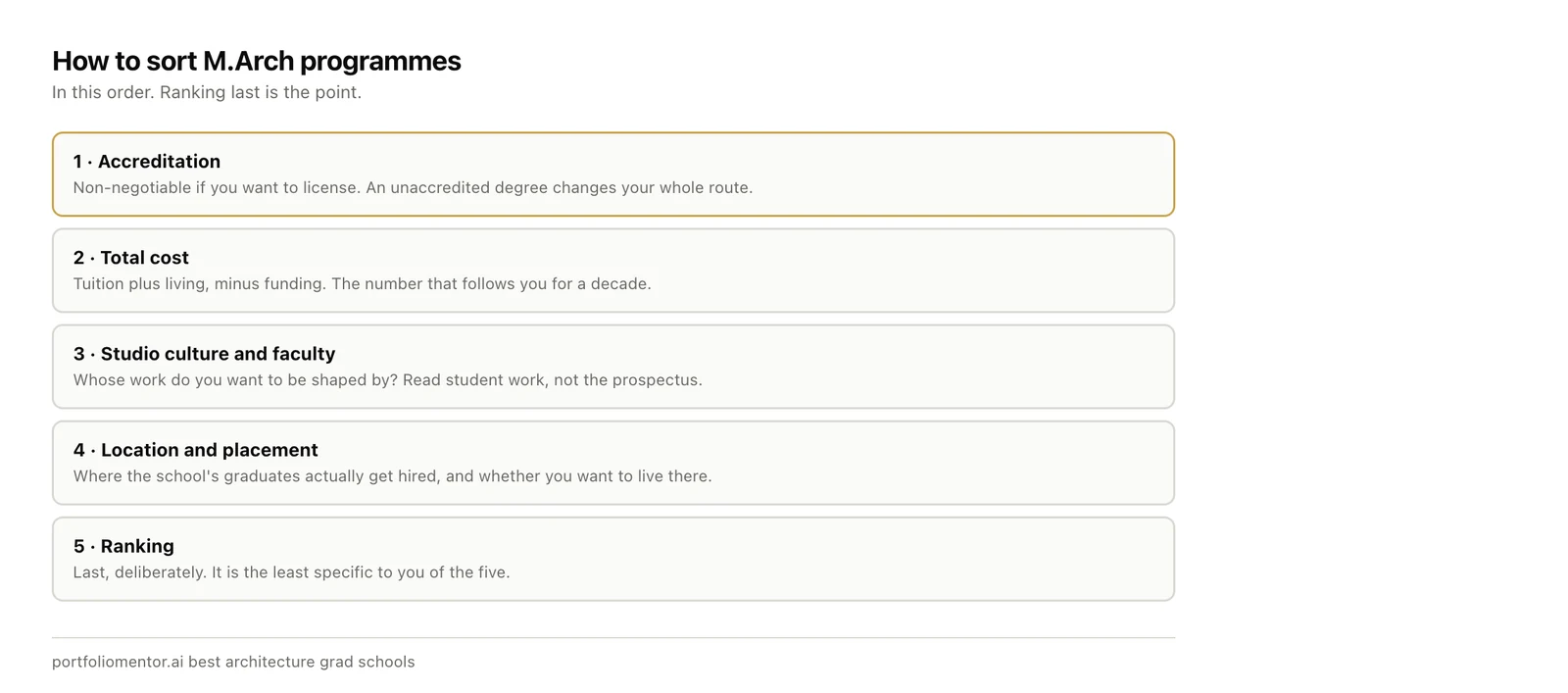
Choosing the best architecture school for you means scoring each program against your own priorities rather than a generic ranking. Two factors that rankings barely capture often matter most day to day: studio culture and location.
Does Studio Culture and Faculty Fit Matter?
Studio culture matters enormously, because you will spend more waking hours in studio than anywhere else. Some programs prize experimental, theory-heavy work; others emphasize buildable, practice-ready design. Read recent student theses and follow faculty whose research excites you, since a single advisor can shape your entire trajectory.
🏗️ Real-World Example
SCI-Arc (Los Angeles, ongoing): SCI-Arc built its reputation on a small, studio-intensive, experimental culture rather than a high overall-university ranking. For students drawn to speculative and computational design, that focused identity outweighs a broader school’s general prestige, which is exactly why fit beats ranking.
How Much Does Location Influence Your Choice?
Location shapes both your education and your job prospects. Studying in a city with a dense architecture economy, such as London, New York, Los Angeles, or Rotterdam, puts you within reach of internships, lectures, and a hiring network you can tap before you graduate. It also affects cost of living, which can rival tuition as a budget line.
Use this checklist to compare any two programs side by side:
- Is the specific M.Arch degree NAAB-accredited (or equivalent in your target country)?
- What is the total tuition, and what aid was actually offered to you?
- Where do recent graduates work, and does the career office have firm relationships?
- Does the studio culture match how you want to design?
- Is the city’s architecture market strong enough to support internships?
- Are there faculty whose research you genuinely want to pursue?
Whatever you decide, your application portfolio is the single biggest lever on which schools accept you. Strengthen it before you apply by studying strong precedents and tightening your narrative; resources on building a competitive architecture portfolio, our architecture grad school guide, and a focused undergraduate portfolio guide will help you present your work the way admissions committees read it.
Every programme on this list decides on the portfolio. Before you shortlist schools, get yours scored against what M.Arch reviewers look for, page by page.
Score my portfolio free →Frequently Asked Questions
What are the best architecture schools for an M.Arch in 2026?
By the 2026 QS subject rankings, the best architecture schools include the Bartlett (UCL), MIT, TU Delft, ETH Zurich, and Harvard, with UC Berkeley, the University of Michigan, SCI-Arc, and RISD also widely respected. The best choice for you depends on accreditation, cost, location, and studio fit, not ranking alone.
How long does a Master of Architecture take?
An M.Arch typically takes two years for students with a pre-professional architecture background, or three to three-and-a-half years for those entering from an unrelated field. Program length directly affects total tuition, so confirm which track you qualify for before estimating cost.
Is ranking or accreditation more important?
Accreditation is more important. Rankings signal reputation, but only a NAAB-accredited degree (or your country’s equivalent) makes you eligible for licensure. A highly ranked but unaccredited program can block your path to becoming a licensed architect, so verify accreditation first, then weigh ranking.
Where to Go From Here
✅ Key Takeaways
- The best architecture schools balance accreditation, reputation, cost, and studio fit, not just ranking position.
- The Bartlett, MIT, TU Delft, ETH Zurich, and Harvard lead 2026 QS subject rankings, with strong public options offering elite teaching at lower cost.
- NAAB accreditation is non-negotiable for U.S. licensure; always confirm the specific degree, not just the university.
- M.Arch tuition varies widely, and total cost depends on whether you take a two-year or three-year track.
- A strong portfolio influences admissions more than chasing one prestigious name.
Your Next Step: Build a shortlist of six to eight programs, verify each one on the NAAB accredited-programs list, then start sharpening the portfolio that will decide which of them say yes.

