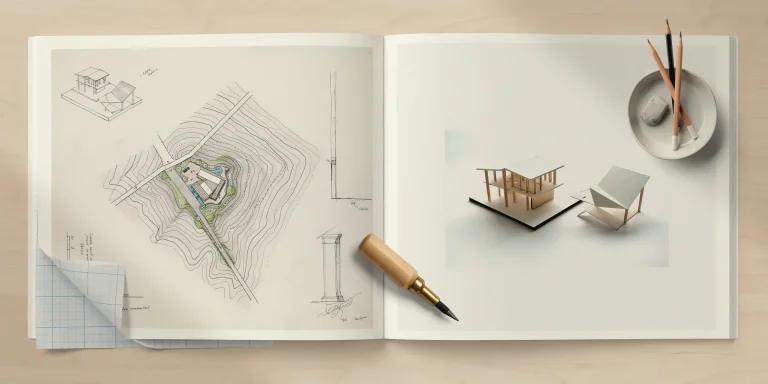
An architecture portfolio is a curated document that presents your design thinking, technical skill, and project work to firms, schools, and clients. A strong architecture portfolio leads with three to six well-chosen projects, shows your process rather than only finished renders, and uses a consistent layout. It is the single most important asset for landing an interview.
Hiring managers spend less than a minute on a first pass. In that window, your architecture portfolio has to communicate who you are as a designer, what you can build, and how you think. This guide walks through everything that goes into a portfolio that gets you hired: what to include, how to structure it, which format to use, how to choose projects, and the mistakes that quietly sink otherwise talented applicants. Each section links to a deeper resource so you can go further on the parts that matter most to you.
What is an architecture portfolio?
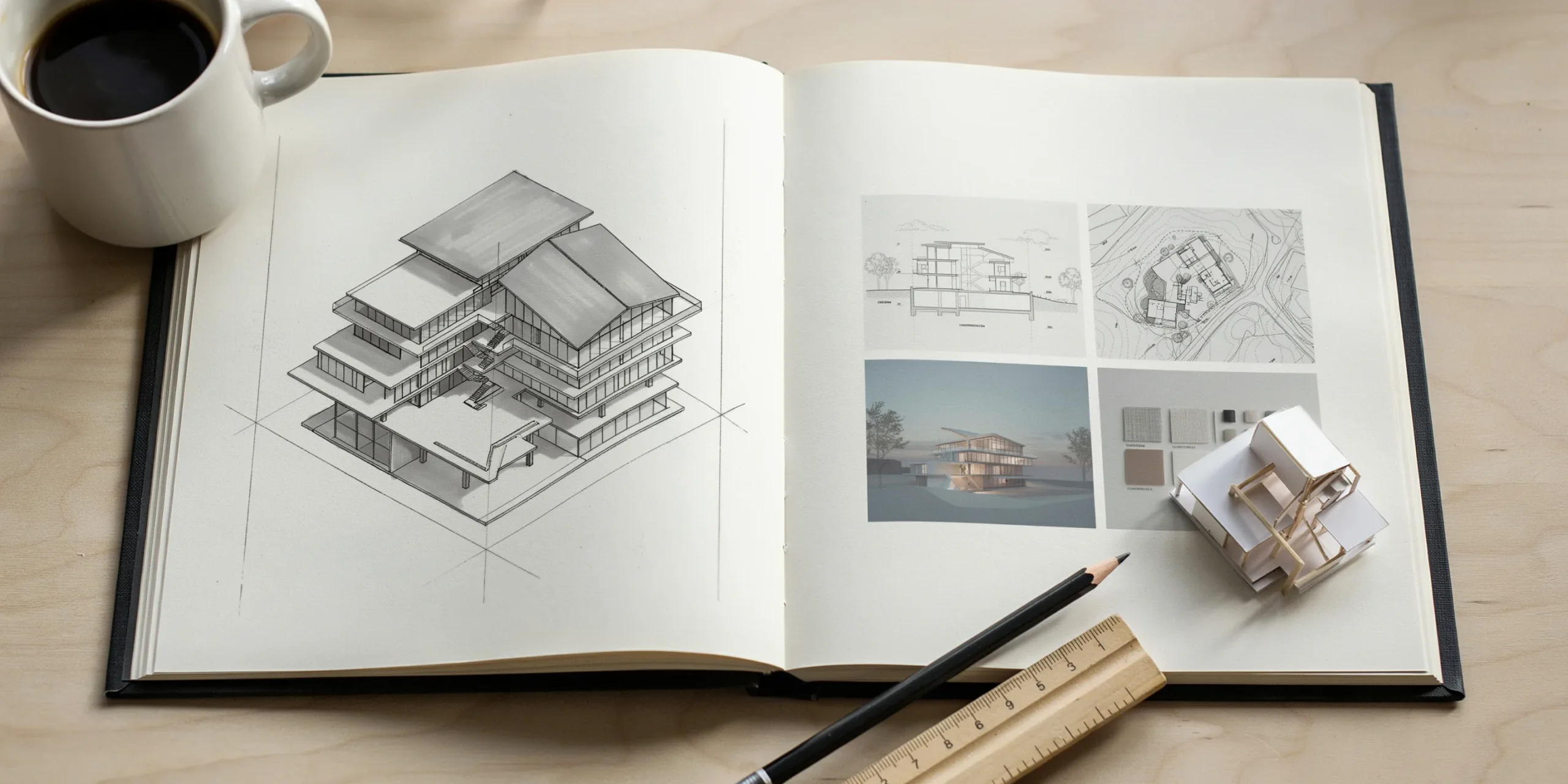
An architecture portfolio is a visual and written record of your best design work, organized to demonstrate your abilities to a specific audience. It typically includes academic projects, professional work, technical drawings, and competition entries, presented in a deliberate sequence with captions that explain your role and intent.
Unlike a resume, which lists what you have done, a portfolio shows it. According to the American Institute of Architects, hiring managers in design prioritize the portfolio above almost everything else, because how the portfolio is made says as much about you as the projects inside it. A portfolio answers two questions at once: can this person design, and can this person communicate?
Most portfolios serve one of three goals: a job or internship application, a graduate school application, or client-facing business development. The audience changes what you emphasize, but the core structure stays the same. If you are still deciding what “good” looks like, study a range of architecture portfolio examples that get applicants hired before you start building your own.
📌 Did You Know?
The path to becoming a licensed architect in the United States takes an average of 12.9 years, according to NCARB’s 2025 report. A portfolio is one of the few assets that travels with you across that entire journey, from your first internship application to partner-level business development.
What to include in an architecture portfolio
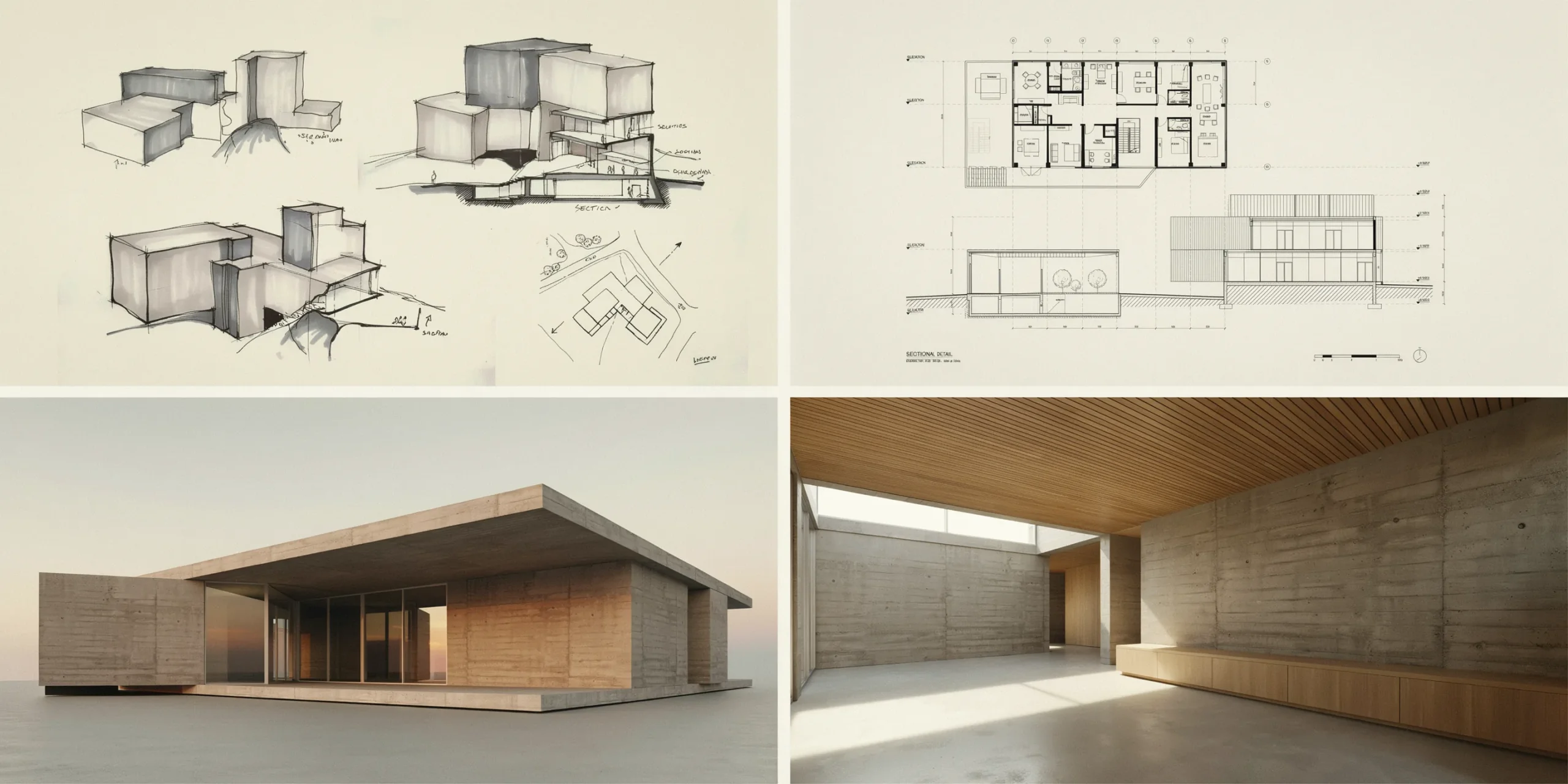
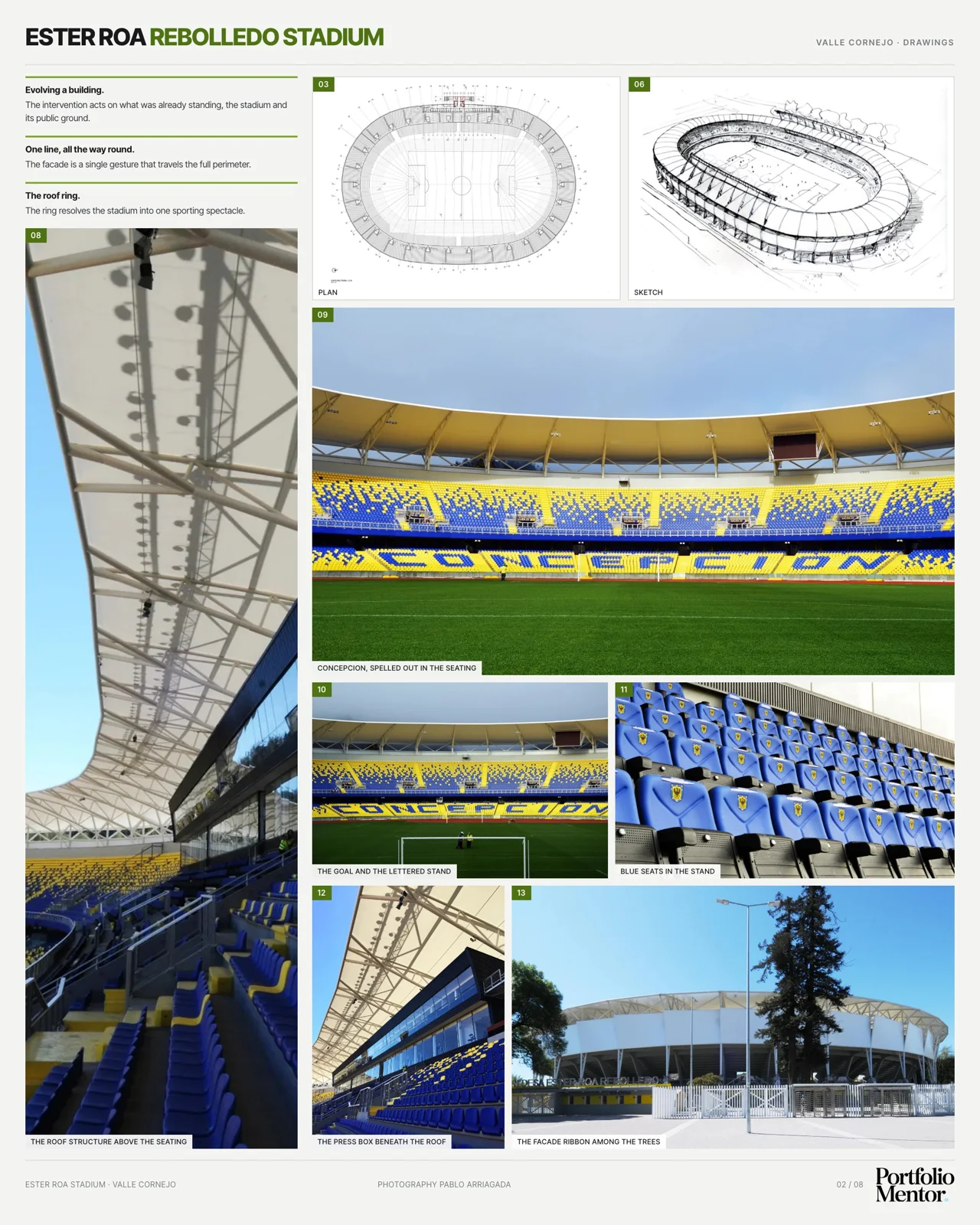

A complete architecture portfolio includes a cover, a brief about or bio page, three to six projects shown in depth, and a closing contact page. Each project should combine concept, drawings, models, and final imagery so reviewers see the full arc of your thinking, not only the polished result.
Here is the content that belongs in a strong portfolio, in roughly the order reviewers expect to see it:
- Cover page: your name, the role you are applying for, and a single strong image. Keep it clean.
- About page: two to three sentences on who you are, your skills, and your software. Add a small photo only if you want to.
- Project pages: the heart of the portfolio. Each project gets a title, location, year, project type, and a one-line description of your specific contribution.
- Process work: sketches, diagrams, study models, and iterations that prove how you arrived at the design.
- Technical drawings: plans, sections, elevations, and at least one construction detail to show you can resolve a building, not only style it.
- Final imagery: renders, model photos, or built photography that present the resolved scheme.
- Contact page: email, phone, and links to your website or relevant profiles.
The most common gap is technical depth. The AIA’s hiring-manager guidance is blunt: showing only attractive renders does not demonstrate your full capability. Reviewers want to see technical drawings and construction details that prove you can design a building that is structurally sound, not just beautiful. Always state what you personally did on each project, especially on team or office work.
⚠️ Common Mistake to Avoid
Including every project you have ever made. A portfolio with ten average projects reads weaker than one with four excellent ones. Reviewers judge you by your weakest included work, not your average. Cut anything you would feel the need to apologize for in an interview.
How to structure and lay out your portfolio

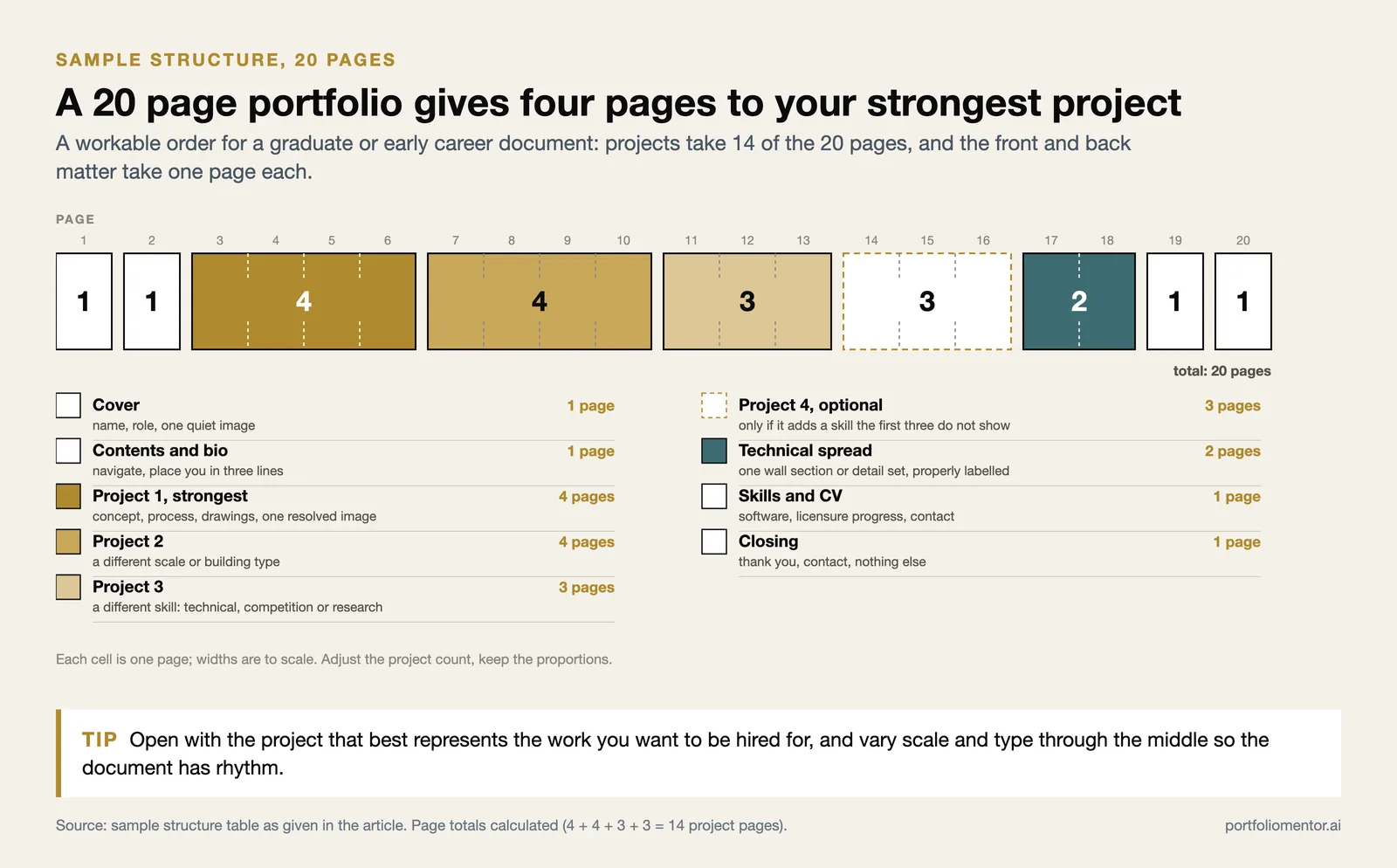
Structure your portfolio so the strongest project comes first, the second strongest comes last, and the remaining projects sit in the middle. Use a consistent grid, a single typeface family, and generous white space so the work, not the template, draws the eye. Aim for one clear idea per spread.
Sample structure for a 20-page portfolio
A workable order for a graduate or early-career document. Adjust the project count, keep the proportions.
| Section | Pages | Purpose |
|---|---|---|
| Cover | 1 | Name, role you are applying for, one quiet image |
| Contents and short bio | 1 | Let the reviewer navigate and place you in three lines |
| Project 1, strongest | 4 | Concept, process, drawings, one resolved image |
| Project 2 | 4 | A different scale or building type |
| Project 3 | 3 | A different skill: technical, competition or research |
| Project 4 (optional) | 3 | Only if it adds a skill the first three do not show |
| Technical spread | 2 | One wall section or detail set, properly labelled |
| Skills and CV | 1 | Software, licensure progress, contact details |
| Closing | 1 | Thank you, contact, nothing else |
Sequence and pacing

Reviewers remember the first and last things they see. Open with the project that best represents the work you want to be hired to do, and close with another strong piece. In between, vary the scale and type of project so the portfolio has rhythm: a large public building, a small intimate space, a competition, a technical study. Each project should earn its place.
Grid, type, and white space
A disciplined layout signals a disciplined designer. Pick a column grid and hold to it across every page. Limit yourself to one or two typefaces, keep body text readable, and let images breathe. The AIA specifically warns applicants to avoid generic word-processor templates, because a careful, custom layout is itself evidence of design ability. For a deeper treatment of grids, typography, and spacing, see our guide to architecture portfolio layout and design.
💡 Pro Tip
Design your spreads at the size they will be viewed. A landscape A4 PDF read on a laptop needs larger captions and bolder hierarchy than a print book held in the hand. Export a test PDF and review it at 100% on the actual screen a hiring manager will use before you finalize anything.
Captions that do work
A caption is not decoration. For each project, name the brief, the site, the key design move, and your role in one or two tight sentences. Reviewers skimming quickly rely on captions to understand what they are looking at. If your contribution to an office project was the facade study, say so plainly. Honesty about scope reads as confidence, not weakness.
Print, PDF, or web: choosing a format
For most job and internship applications, a PDF is the standard format because it is easy to email, opens reliably, and preserves your exact layout. Print books suit in-person interviews and graduate reviews, while a web portfolio works as a public, searchable home for your work. Many architects keep all three in sync.
Each format has a job to do. A PDF is what you attach to an application; keep it under the file-size limit firms specify, usually around 10 to 15 MB. A print portfolio gives you a physical artifact to walk an interviewer through, which is still common in graduate school reviews and senior design roles. A web portfolio is discoverable and easy to update, but it should complement, not replace, the PDF you submit. The trade-offs between formats are worth understanding in detail, which we cover in our breakdown of the digital architecture portfolio: web versus PDF.
⚖️ Pros & Cons at a Glance
✔️ PDF Pros: universal format, exact layout control, easy to email, preferred by hiring managers, works offline.
✖️ PDF Cons: file-size limits force image compression, no interactivity, harder to update across many applications than a single live web link.
How to choose which projects to include
Choose projects that match the work you want to be hired for, show range across scale and program, and demonstrate both design and technical ability. Three to six projects is the right count for most portfolios. Quality and relevance always beat quantity, so cut anything that does not actively make your case.
Start by listing every project you could include, then score each one against the role. A firm known for healthcare work wants to see you can handle complex, code-driven buildings; a boutique residential studio wants craft and detail. Keep the projects that prove the skills the job demands, and set the rest aside. If you are applying for your first role, our guide on how to build an architecture portfolio for internships covers how to present academic work convincingly when you have little or no professional experience.
Tailoring matters more than most applicants think. The same base portfolio can be reordered and lightly re-captioned for different firms in under an hour, and that small effort signals genuine interest. A reviewer can tell the difference between a generic document and one shaped for their studio.
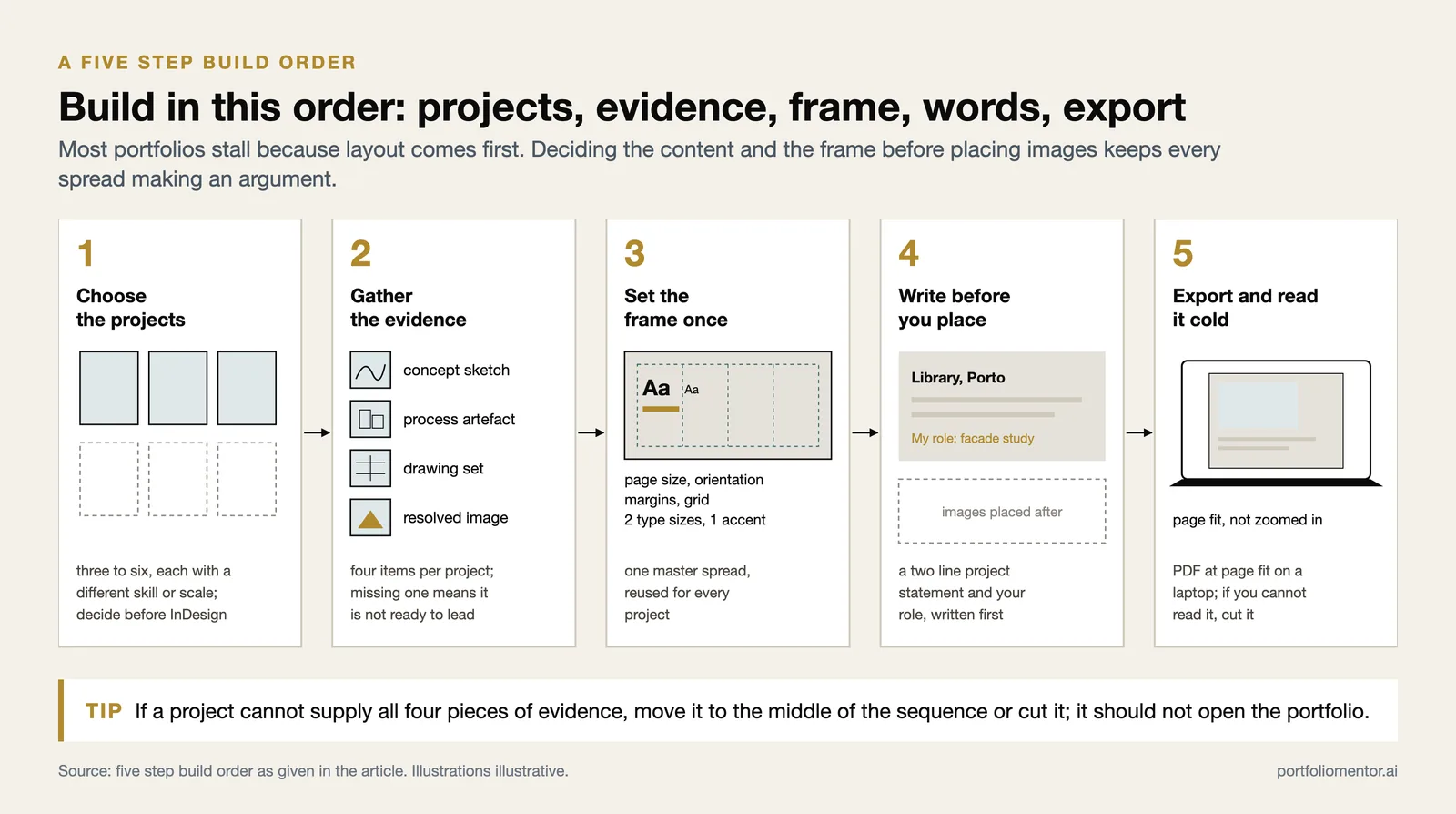
A five-step build order
Most portfolios stall because they are built in the wrong order. Layout first is the usual mistake.
- Choose the projects. Three to six, each earning its place with a different skill or scale. Decide this before opening InDesign.
- Gather the evidence per project. Concept sketch, one process artefact, the drawing set, one resolved image. If a project cannot supply all four, it is not ready to lead.
- Set the frame once. Page size, orientation, margins, grid, two type sizes, one accent. Build a master spread and reuse it for every project.
- Write before you place. A two-line project statement and your role, written first, stops the pages becoming a slideshow of images with no argument.
- Export and read it cold. Open the PDF at page-fit on a laptop, not zoomed in on your design monitor. Anything you cannot read at that size is not on the page.
Tell a story, not just a slideshow
The strongest portfolios read like a narrative. Each project moves from a problem or brief, through investigation and iteration, to a resolved design. When you show the messy middle, the sketches, the failed models, the diagrams, you give reviewers evidence of how you think, which is exactly what they are trying to assess.
A polished render only proves you can operate software. A sequence that shows a concept evolving proves you can design. This is why generalist firms, as the AIA notes, like to see a wide range of work: process and breadth reveal judgment. Treat every project page as a short story with a beginning, a middle, and an end.
Once your portfolio is assembled, get objective feedback before you send it anywhere. Reviewers see things you cannot after weeks of staring at the same spreads. You can run your draft through Portfolio Mentor to see how the review works, or explore the scoring categories that flag weak project pages, layout issues, and missing technical depth before a hiring manager does.
🔢 Quick Numbers
- 116,000 licensed architects in the United States as of 2024 (NCARB, NBTN 2025)
- More than 39,000 candidates were actively pursuing licensure in 2024, up 5% year over year (NCARB)
- Architects earned a median annual wage of about $99,280 in May 2025 (U.S. Bureau of Labor Statistics)
Everything above describes what a strong portfolio does. Upload yours and get it scored on exactly these points, with a page-by-page breakdown.
Score my portfolio free →Common architecture portfolio mistakes

Even talented designers lose interviews to avoidable errors. Watch for these:
- Render-only projects. No drawings, no process, no proof you can resolve a building.
- No stated role. Reviewers cannot tell what you actually did on team projects.
- Too many projects. Volume dilutes your strongest work.
- Inconsistent layout. A different grid on every page signals weak design discipline.
- Oversized files. A 60 MB PDF that bounces back from an inbox never gets seen.
- No tailoring. The same generic document sent to every firm reads as low effort.
- Typos and broken links. Small errors undercut the precision the job demands.
According to the U.S. Bureau of Labor Statistics, employment of architects is projected to grow about as fast as the average for all occupations, which means competition for the best roles stays high. A clean, focused, error-free portfolio is one of the few things fully within your control.
Frequently asked questions
How many projects should an architecture portfolio have?
Three to six projects shown in depth is the right range for most portfolios. Fewer than three can look thin; more than six dilutes your strongest work and tests the reviewer’s patience. Choose depth over breadth.
How long should an architecture portfolio be?
A job-application PDF is usually 20 to 40 pages. Graduate school and senior roles can run longer. Length matters less than pacing: every spread should earn its place, and no project should overstay its welcome.
Should I use a website or a PDF?
Use a PDF for direct applications because it is the format hiring managers expect and it preserves your layout. A website is a useful public complement for discoverability, but it does not replace the document you attach to an application.
Do I need professional experience to have a good portfolio?
No. Academic projects, competitions, and self-directed studies are entirely valid, especially for students and recent graduates. What matters is showing strong design thinking, technical skill, and a clear process, regardless of where the work came from.
🎯 Key Takeaways
- An architecture portfolio shows your design thinking, not just finished images. Lead with process and technical depth.
- Include three to six strong projects, each with concept, drawings, and a clear statement of your role.
- Use a consistent grid, restrained typography, and white space. A clean layout is itself proof of design ability.
- Send a PDF for applications, keep a print book for interviews, and maintain a web portfolio for discoverability.
- Tailor and reorder your projects for each firm, and get objective feedback before you submit.
Where to go from here
Build in the order above: projects, evidence, frame, words, export. If you only have an afternoon, spend it cutting to your strongest three projects and writing the role statements, because those two changes survive every later redesign.
For the frame itself, our guide to portfolio size, format and orientation covers A3 against A4 and landscape against portrait, and the architecture line weight calculator gives you a drawing hierarchy that still reads after a PDF export. To see the patterns in finished documents, work through our architecture portfolio examples.
Confirm format expectations against outside sources too, such as archisoup’s portfolio size guide, and check licensure requirements with NCARB if your portfolio is part of a career move rather than a job application.