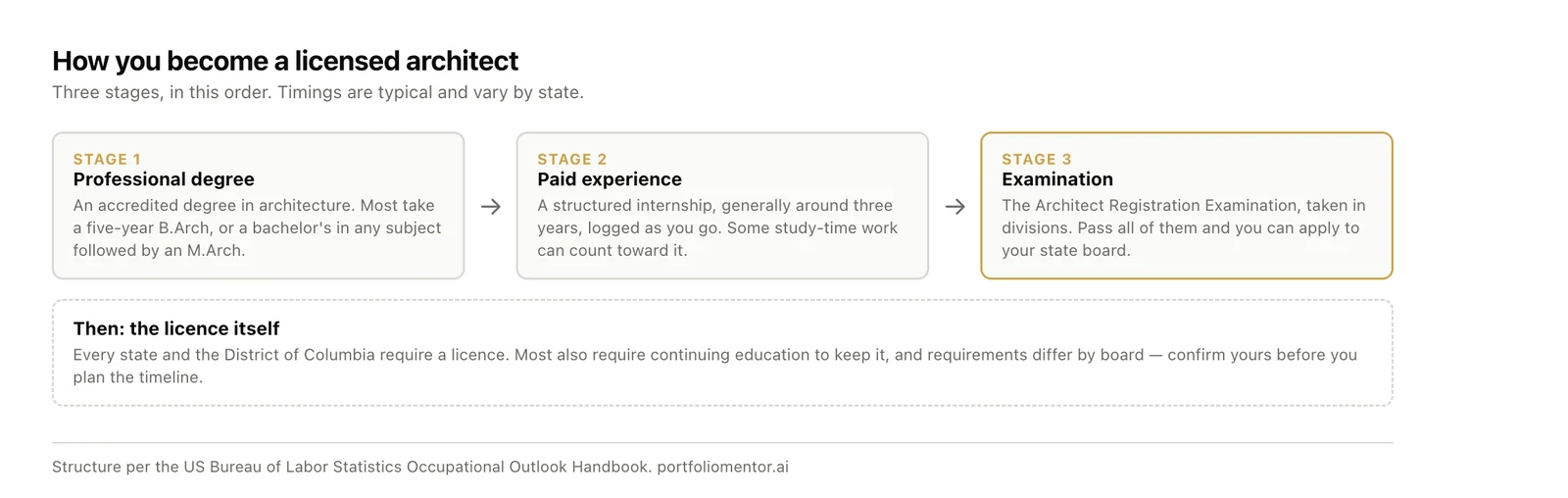
To become an architect in the United States, you complete three core stages: earn a professional degree from a NAAB-accredited program, gain documented work experience through the Architectural Experience Program (AXP), and pass all six divisions of the Architect Registration Examination (ARE). After meeting your state board’s requirements, you receive a license to practice.
Knowing how to become an architect means understanding a regulated, multi-year path rather than a single credential. This guide walks through each step in order, explains how long the full process realistically takes, breaks down the cost, and covers alternative routes so you can plan your career with accurate expectations from the start.
What does it take to become an architect?
Becoming a licensed architect requires three things in nearly every U.S. jurisdiction: an accredited architecture degree, supervised professional experience, and a passing score on a national licensing exam. According to the U.S. Bureau of Labor Statistics, architects typically need a professional degree, completion of an internship-style experience program, and licensure before they can call themselves an architect and stamp drawings.
The word “architect” is legally protected. You cannot use the title or offer architecture services to the public until your state board grants licensure. That legal framework is why the path is so structured: each stage exists to confirm you can design buildings that protect public health, safety, and welfare.
It helps to think of the journey in three overlapping phases rather than a single finish line. Education gives you the design and technical foundation, the AXP turns that foundation into real practice experience, and the ARE confirms you can apply both safely. The sections below cover each phase in the order most candidates encounter it, along with the realistic time and money each one demands.
🔢 Quick Numbers
- Median annual wage for architects: $96,690 (BLS, May 2024)
- Projected job growth 2024-2034: 4%, with about 7,800 openings per year (BLS)
- Median total time from starting college to licensure: 12.3 years (NCARB by the Numbers, 2026 edition)
Step 1: Earn an accredited architecture degree

The first step is a professional degree from a program accredited by the National Architectural Accrediting Board (NAAB). Most jurisdictions accept only NAAB-accredited degrees toward initial licensure, so the accreditation status of your school matters more than its ranking or prestige.
Which degrees qualify

Two NAAB-accredited paths lead to licensure. The Bachelor of Architecture (B.Arch) is a five-year professional undergraduate degree. The Master of Architecture (M.Arch) is a graduate professional degree that takes two to three years and is the standard route for students whose bachelor’s degree was in another field. A four-year pre-professional Bachelor of Science or Bachelor of Arts in Architecture alone does not qualify for licensure; it must be followed by an accredited M.Arch.
Choosing between the two paths usually comes down to where you are now. If you are a high school student certain about architecture, a five-year B.Arch gets you to a professional degree in the shortest total time. If you discovered architecture later or already hold a degree in another field, an M.Arch is the route, and most programs offer a longer three-year track for applicants with no prior architecture background and a shorter track for those who completed a four-year pre-professional degree.
What to look for in a program
Beyond NAAB accreditation, weigh studio culture, faculty who practice professionally, and access to internships near the campus. Programs with strong firm connections in their city tend to feed students into the early AXP roles that shorten the overall timeline. Cost varies widely between public in-state and private out-of-state schools, and because tuition is the largest expense on the entire path, it deserves as much research as the curriculum itself.
⚠️ Common Mistake to Avoid
Many students assume any architecture-related degree counts toward licensure. It does not. A four-year pre-professional degree, an architectural technology associate degree, or a design degree without NAAB accreditation will not satisfy the education requirement in most states. Always confirm a program’s NAAB status before you enroll, not after.
During school, your portfolio becomes the single most important asset for landing your first job. Studio projects, competition entries, and well-presented drawings are what hiring firms actually evaluate. If you want feedback on how your work reads to a reviewer before you apply, our portfolio review tools can flag weak sequencing, unclear diagrams, and presentation gaps early.
Step 2: Complete the AXP experience requirement

After or during your degree, you begin the Architectural Experience Program (AXP), administered by the National Council of Architectural Registration Boards (NCARB). The AXP is the structured internship phase, and you document every hour in an online NCARB Record.
How much experience the AXP requires
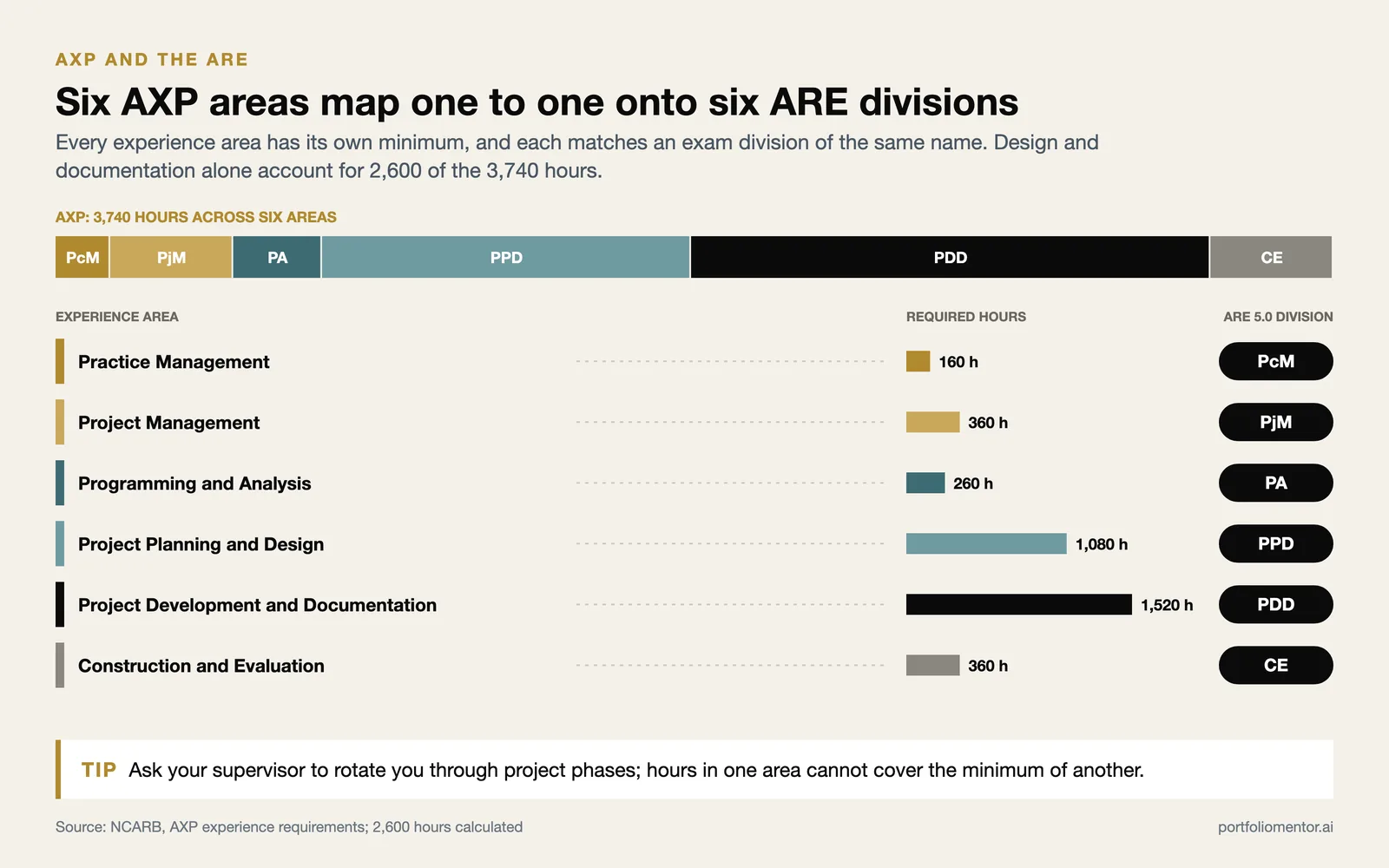
The AXP requires 3,740 hours of experience spread across six practice areas: Practice Management, Project Management, Programming and Analysis, Project Planning and Design, Project Development and Documentation, and Construction and Evaluation. About half of those hours must be earned at an architecture firm under the direct supervision of a licensed architect, while the remainder can come from approved settings outside a traditional firm.
The six AXP areas map directly onto the six divisions of the licensing exam, which is intentional. Logging real experience in construction administration, for example, prepares you for the Construction and Evaluation exam division. Most candidates start the AXP while still in school through summer roles, then continue full-time after graduation.
The hours are not interchangeable. Each of the six areas has a minimum you must hit, so a candidate who spends three years drafting construction documents but never touches programming or project management will still be short in those categories. Talk to your supervisor early about rotating through different project phases, because firms that consciously expose interns to a range of work help them finish the AXP far faster than firms that keep them on one repetitive task.
Finding that first qualifying position is often the hardest practical hurdle. A focused search strategy matters, and our guide to architecture internships and how to land one covers where to look and how to stand out. When you apply, a sharp architecture resume and a tailored architecture cover letter are what get you past the first screen.
💡 Pro Tip
Report your AXP hours every one to two weeks rather than in large batches. NCARB relaxed its reporting deadline in November 2025, so older experience can still count, but supervisors who approve hours promptly are far easier to reach than ones asked to verify months of work at once. Treating reporting as a weekly habit prevents lost hours.
Step 3: Pass the Architect Registration Examination (ARE)

The Architect Registration Examination is the national licensing exam, and every U.S. jurisdiction requires it. The current version, ARE 5.0, is divided into six independent divisions that you can take in any order.
The six ARE 5.0 divisions
You must pass all six ARE divisions to qualify for licensure. They are Practice Management (PcM), Project Management (PjM), Programming and Analysis (PA), Project Planning and Design (PPD), Project Development and Documentation (PDD), and Construction and Evaluation (CE). Each combines multiple-choice, drag-and-place, hotspot, and case study questions built around the progression of a real project.
📌 Did You Know?
NCARB data shows candidates are more likely to pass an ARE division when they take it soon after completing the matching AXP experience area. The exam and the experience program are deliberately aligned, so timing your exams to your recent work is a measurable advantage rather than just study advice.
The divisions can be scheduled independently, which lets you spread the exam over months while you continue working. Many candidates begin testing before finishing all AXP hours, since the two requirements run in parallel rather than strictly back to back.
How to plan your exam order
There is no required sequence, but a common strategy is to start with the management divisions (PcM and PjM), which lean on business and contract knowledge, then move into the design-heavy divisions (PPD and PDD) once you have logged related project experience. Group study, NCARB’s free practice exams, and commercial prep courses all help, though the strongest predictor of passing remains pairing each division with recent, relevant work. Budget several months of consistent study and expect to retake at least one division, since national pass rates leave room for second attempts.
Step 4: Get licensed by your state board
Licensure is granted by individual state architecture boards, not by NCARB. Once you have completed your degree, AXP hours, and all six ARE divisions, you submit your NCARB Record to the board in the state where you want to practice. The board reviews your file against its own rules, which may include extra requirements such as a supplemental exam on local law or a background check.
Because each of the 55 U.S. jurisdictions sets its own rules, the exact final steps vary. The NCARB Certificate, an optional credential earned after licensure, makes it much easier to get licensed in additional states later through reciprocity, which is valuable if you plan to work across state lines.
📐 Technical Note
The order of the three core requirements is not fixed in every state. Some jurisdictions now allow you to begin the AXP and even sit for ARE divisions before completing your degree, an approach NCARB calls integrated or concurrent licensure paths. Check your specific state board, since this can shave a year or more off your total timeline.
How long does it take to become an architect?
As of October 2026, it takes a median of about 12.3 years from the start of college to full licensure, according to the 2026 edition of NCARB by the Numbers. That figure includes roughly five to six years earning the degree, a median of about 4.3 years completing the AXP, and about two years passing all six ARE divisions, with these stages overlapping rather than running strictly in sequence.
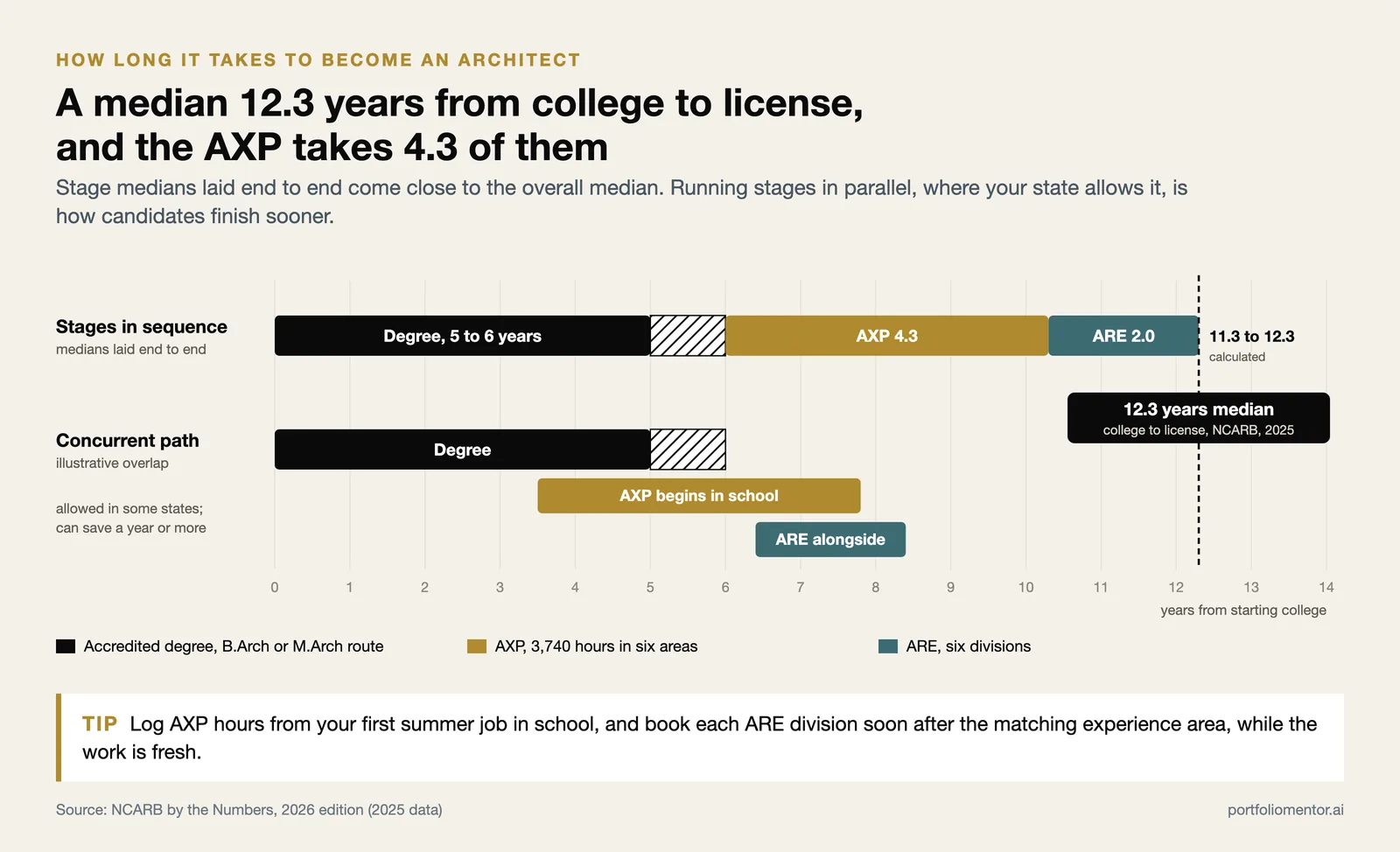
The good news is that the average timeline has been shrinking. NCARB reports that the 12.3 year median is the lowest in nearly a decade, helped by candidates starting the AXP earlier and states allowing concurrent paths. Motivated candidates who begin experience in school and test efficiently can finish well below the average.
Can you become an architect faster?
Yes, within limits. The two biggest levers are starting AXP hours during your undergraduate years through internships and scheduling ARE divisions immediately after the related experience while the material is fresh. You cannot skip the degree or the exam, but you can compress the gaps between stages by running them in parallel instead of one after another.
How much does it cost to become an architect?

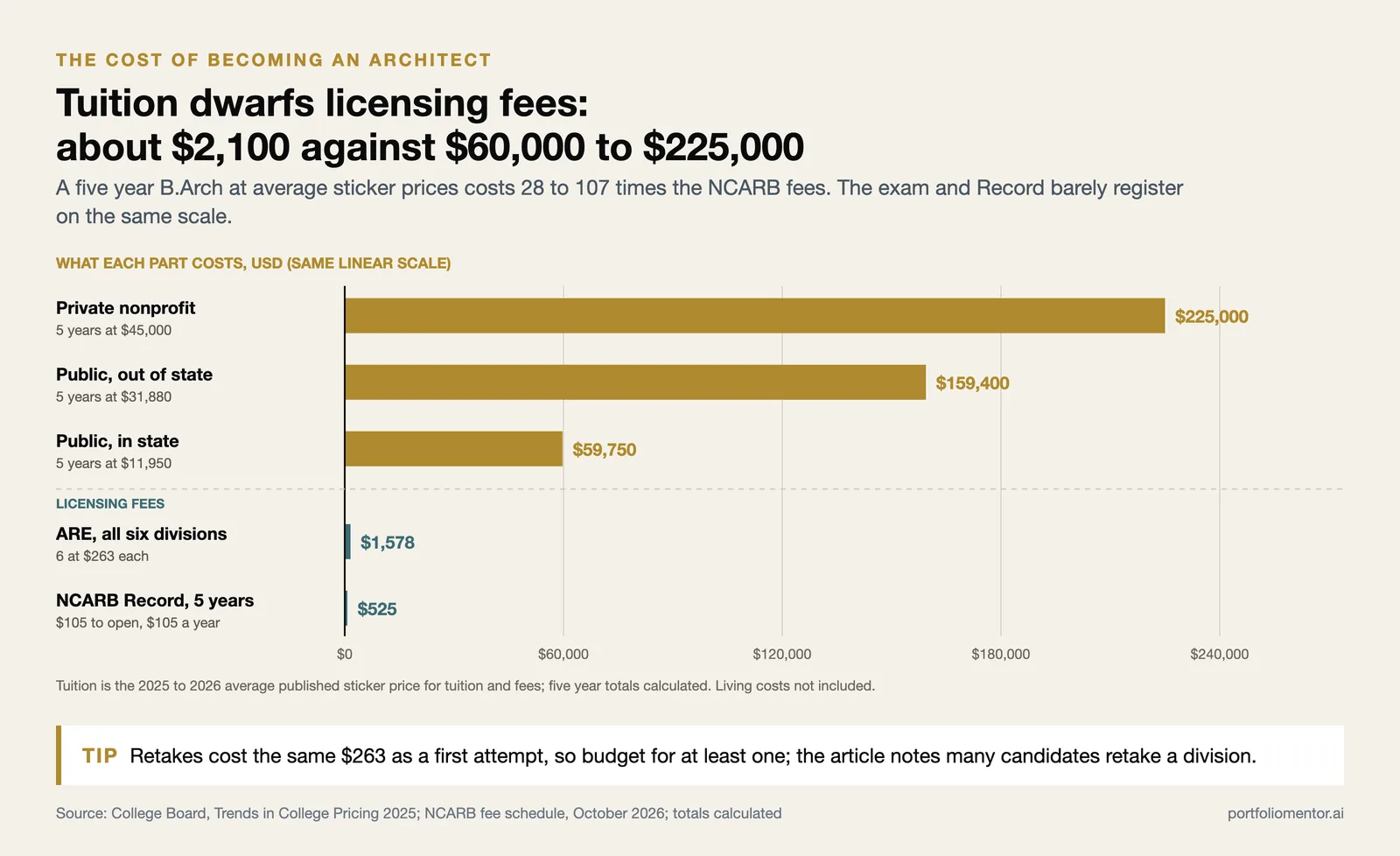
The largest cost by far is tuition. The mandatory post-graduation licensure fees are comparatively modest: the NCARB Record that tracks your AXP hours costs $105 to open and $105 a year to renew (about $525 over five years), and the six ARE divisions total $1,578 in exam fees ($263 per division) as of October 2026. Education is where the real expense lives, with average public in-state tuition and fees near $11,950 per year, out-of-state public programs around $31,880 and private nonprofit programs about $45,000 annually (College Board, 2025 to 2026), across a five-year degree.
Beyond the required fees, plan for exam prep materials and practice software, NCARB Record annual fees, and the cost of retaking any divisions you do not pass on the first attempt. Once licensed, the financial picture improves quickly. For a detailed look at earnings by experience level and region, see our architect salary guide, which breaks down what architects make at each career stage.
Alternative paths and related careers
Not every state requires a NAAB-accredited degree. A handful of jurisdictions offer experience-based or alternative paths to licensure for candidates without a professional degree, though these routes generally demand many more years of documented experience under a licensed architect. They are slower, but they exist for people who enter the field later or through nontraditional backgrounds.
You can also build a strong career in the built environment without full licensure. Architectural designers, BIM specialists, project coordinators, and many roles at architecture firms do not require a license, though you cannot independently stamp drawings or use the protected title “architect.” Related licensed professions such as landscape architecture follow their own parallel education and exam tracks. If you are weighing these options, our review process overview shows how a tailored portfolio review can support whichever direction you choose.
For international candidates, the path can differ further. Architects licensed in another country may qualify through mutual recognition agreements or by completing an education evaluation and the standard AXP and ARE requirements, depending on the state. Because the rules shift between jurisdictions, the safest move is to verify your specific situation with the state board where you intend to practice before committing years to any single route.
If the graduate route is the one you are weighing, our guide to the best architecture grad schools explains what actually separates programmes once accreditation is settled.
Frequently asked questions
Do you need a license to call yourself an architect?
Yes. In the United States the title “architect” is legally protected. You must hold an active license from a state board to use the title or offer architecture services to the public. Unlicensed professionals typically use titles such as “architectural designer” instead.
Is a master’s degree required to become an architect?
No. A five-year Bachelor of Architecture (B.Arch) is a complete professional degree that qualifies you for licensure. A Master of Architecture (M.Arch) is required only if your undergraduate degree was in another field or was a four-year pre-professional architecture degree.
How hard is the ARE exam?
The ARE is demanding, and many candidates retake at least one division. Each of the six divisions covers a broad slice of practice, from contracts to construction documents. Pass rates rise noticeably when candidates test soon after completing the matching AXP experience area, so timing matters as much as study volume.
Can you start working before you are licensed?
Yes, and you should. Working at an architecture firm before licensure is how you earn AXP hours, and many candidates work for several years as designers while completing exams. A license changes your title and legal authority, not your ability to be employed in the field.
Key Takeaways
- Licensure requires three stages: a NAAB-accredited degree, the AXP experience program, and all six ARE 5.0 divisions.
- The AXP requires 3,740 hours across six practice areas that mirror the six exam divisions.
- Expect about 12 years (a median of 12.3 in 2025) from starting college to licensure, though concurrent paths can shorten it.
- Mandatory licensure fees are modest (NCARB Record $105 a year, ARE $1,578); tuition is the real cost.
- A strong portfolio, resume, and internship experience are what move you from student to employed designer to licensed architect.