How long is architecture school depends on the route. Most US architects take a five-year Bachelor of Architecture, and many add a master’s that runs one to five further years. School is only the first stage: the median candidate reaches a licence 12.3 years after starting the process.
The gap between those two numbers is where most of the confusion lives. Students hear “five years” and plan a life around it. Then they discover that the degree is the shortest part, and that the years after graduation decide when the title arrives.
This guide sets out each route and its duration, what happens after the degree, and which parts of the timeline you can actually shorten.
How long is architecture school by route?
Three accredited paths exist in the US, and they suit different starting points.
Five-year Bachelor of Architecture
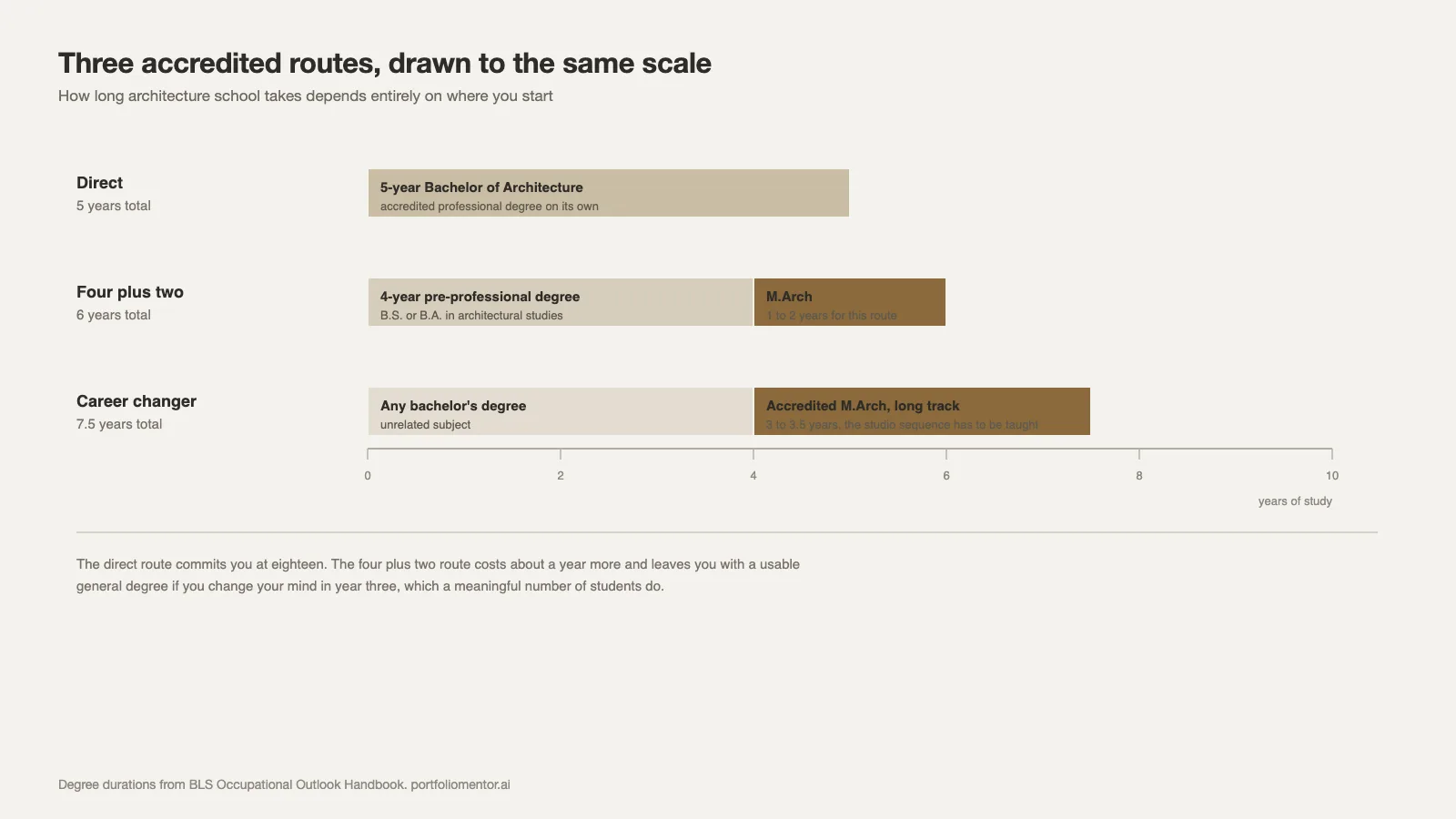
The most direct route. The Bureau of Labor Statistics states that “most architects earn their degree through a 5-year Bachelor of Architecture degree program.” You enter from school, and you graduate with a professional degree that satisfies the education requirement on its own.
The trade is commitment at eighteen. Switching out after two years leaves you with credits toward a degree you no longer want, and switching in later is difficult because the studio sequence is tightly ordered.
Four-year pre-professional degree plus a master’s
A four-year Bachelor of Science or Bachelor of Arts in architectural studies, followed by an accredited Master of Architecture. BLS notes that many architects earn a master’s “which can take 1 to 5 additional years”. The shorter end of that range applies to applicants who already hold the pre-professional degree.
Total is usually six years, occasionally five and a half. It costs more than the B.Arch route in most cases, and buys flexibility. The undergraduate degree is a general one, so leaving architecture after four years still leaves you with something usable.
Any bachelor’s degree plus a longer master’s
For career changers and graduates of unrelated subjects. The accredited M.Arch runs at the long end of the one to five year range, typically three to three and a half years. The missing studio sequence has to be taught.
Total from the start of the first degree is seven years or more, but only the master’s is architecture. For someone who discovered the field at twenty-five, it is the only route.
🔢 Quick Numbers
- Most architects qualify through a 5-year Bachelor of Architecture; a master’s adds 1 to 5 years (BLS Occupational Outlook Handbook)
- All state boards require a paid internship “generally lasting 3 years” before the registration exam (BLS)
- Median total time to licensure in 2025: 12.3 years, the lowest in nearly a decade; the exam itself now averages about 2 years (NCARB by the Numbers 2026)
What happens after the degree
Graduating does not make you an architect. Two requirements remain, and they run for years.
The first is documented experience. BLS describes it as “a lengthy paid internship, generally lasting 3 years” required by every state board before you may sit the registration exam. It is recorded across six practice areas. The difficulty is not accumulating hours but accumulating them in all six, since firms staff people where they are useful.
The second is the exam, taken division by division alongside work. NCARB reports the average completion at roughly two years, four months faster than in 2024 and the lowest in the history of the computerised exam.
Those two overlap with each other but only partly with school, which is why the total lands where it does. The full sequence is set out in how to become an architect.
⚠️ Common Mistake to Avoid
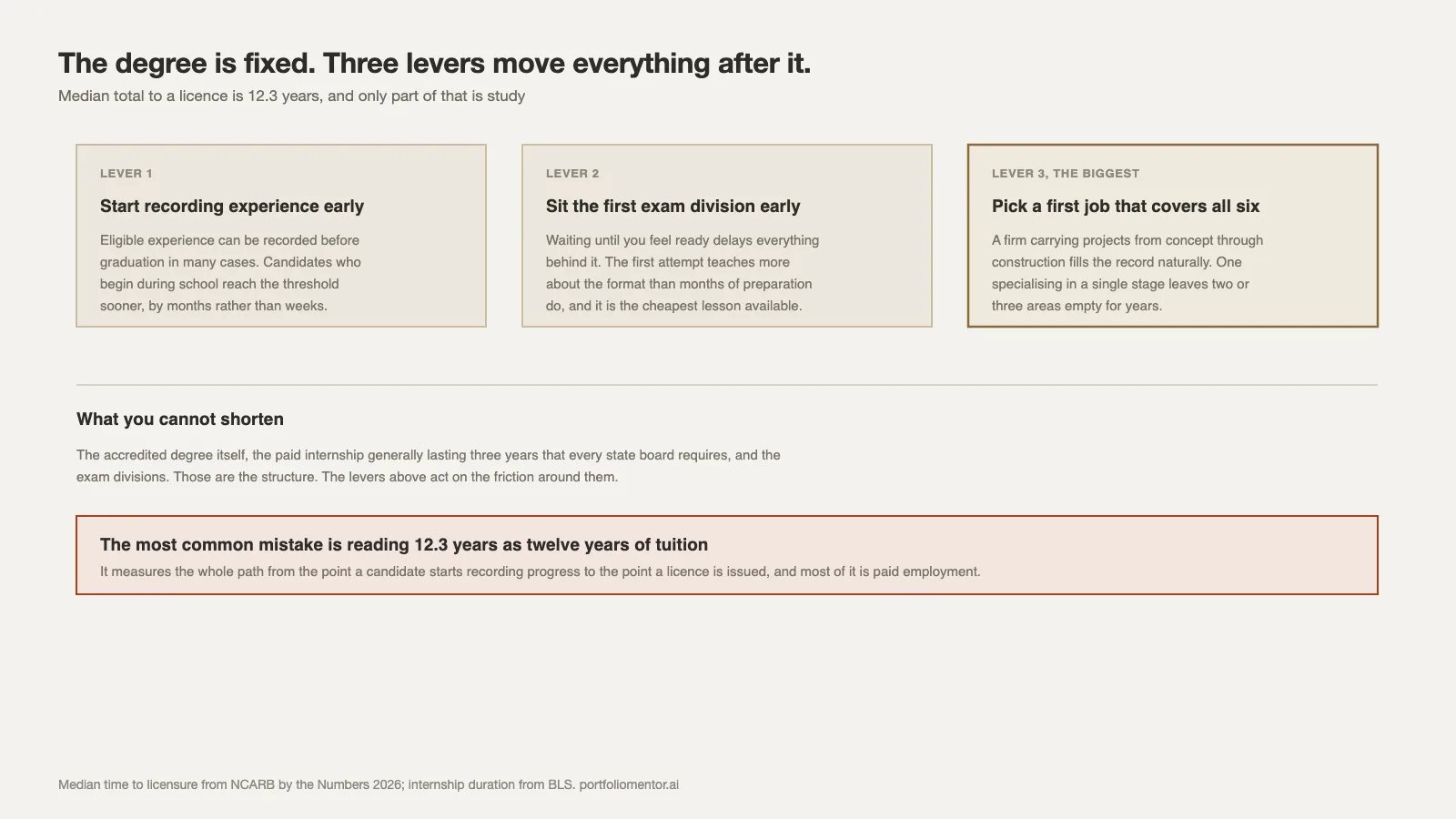
Reading 12.3 years as twelve years of tuition. It is not. The figure measures the whole path from the point a candidate starts recording progress to the point a licence is issued, and the majority of it is paid employment. The number to budget for is the degree; the number to plan a career around is the licence date.
Year by year, what the degree actually contains
Asking how long is architecture school only answers half the question; what the years contain matters as much. Programmes differ, but the sequence is close enough across accredited schools to be useful.
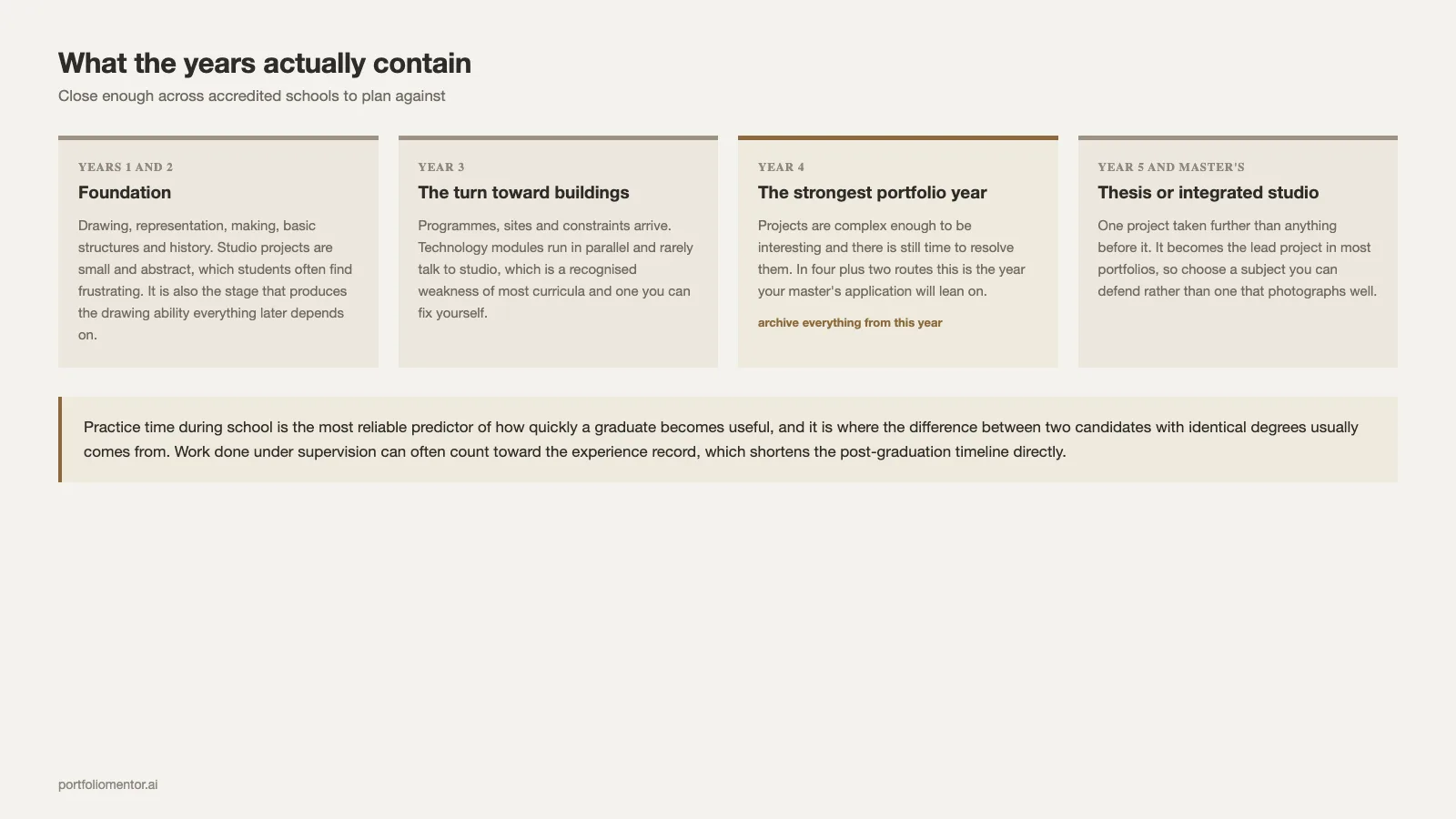
Years one and two are foundation. Drawing, representation, making, basic structures and history, with studio projects that are small and abstract. Students often find this stage frustrating because the projects are not buildings. It is also the stage that produces the drawing ability everything later depends on.
Year three is usually the turn toward buildings with programmes, sites and constraints. Technology modules arrive in parallel, and the two rarely talk to each other. That is a recognised weakness of most curricula, and one you can fix yourself by applying one to the other.
Year four in a five-year programme is often the strongest portfolio year. Projects are complex enough to be interesting and there is still time to resolve them. In four-plus-two routes this is the final undergraduate year and the one your master’s application will lean on.
Year five and the master’s years carry thesis or integrated studio: a single project taken further than anything before it. It becomes the lead project in most portfolios, which is why it is worth choosing a subject you can defend rather than one that photographs well.
Placement and year-out schemes
Some programmes build a year of practice into the sequence, and others expect students to find summer placements. Either way, practice time during school is the most reliable predictor of how quickly a graduate becomes useful. It is where the difference between two candidates with identical degrees usually comes from.
It also front-loads the experience record. Work done under appropriate supervision during school can often count, which directly shortens the post-graduation timeline. Placements are worth choosing on what you will be allowed to draw rather than on the name above the door; the criteria are covered in the architecture internships guide.
Is architecture school harder than other degrees?
The workload is unusual in shape rather than in volume. Studio is a single large module that consumes most of the week and cannot be completed in advance, because the work develops through review. That produces the pattern every architecture student recognises: long flat weeks punctuated by crits that take everything.
Two consequences matter for planning. Part-time work is harder to sustain than on most degrees, particularly in studio-heavy years. And the hours are unevenly distributed across the term, so a schedule built on a weekly average will break at the crit.
The habits that cause trouble later are formed here too. Students who finish drawings the night before a review never learn to produce a checked set, and that shows up in the first job. Evidence of finished, checked work is precisely what employers look for, which is why studio output becomes portfolio material and why the editing matters as much as the making.
Which parts can you shorten?
Three levers, and only one of them is in school.
Start recording experience early
Eligible experience can be recorded before graduation in many cases. Candidates who begin during school reach the threshold sooner than those who start on their first day of work, and the difference is measured in months.
Take the first exam division early
Waiting until you feel ready delays everything behind it, and the first attempt teaches more about the format than months of preparation do. Candidates who begin exams in their first or second year of work finish materially earlier than those who wait until they feel senior enough.
Choose a first job that touches all six practice areas
A firm that carries projects from concept through construction fills the record naturally. A firm specialising in one stage leaves two or three areas empty, and those empty areas are the usual reason a candidate is still unlicensed at year eight. Questions worth asking at interview are collected in architecture interview questions.
💡 Pro Tip
If you are choosing between a five-year B.Arch and a four-plus-two route, ask yourself how certain you are at eighteen rather than which is faster. The difference in duration is about a year. The difference in what you hold if you change your mind in year three is an entire usable degree, and a meaningful number of students do change their minds.
Studying outside the United States
Durations differ and so does the structure. Most systems combine an accredited degree, recorded professional experience and a final examination administered nationally rather than by states. Several split the degree into two parts with a mandatory year of practice between them.
The important point for anyone considering it: accreditation recognition is decided by the destination country’s registration body, not by the school you attend. A degree that satisfies one country’s board may require additional assessment elsewhere even where the training looks equivalent. Check with the board where you intend to practise before you enrol, not after.
What school time is actually for
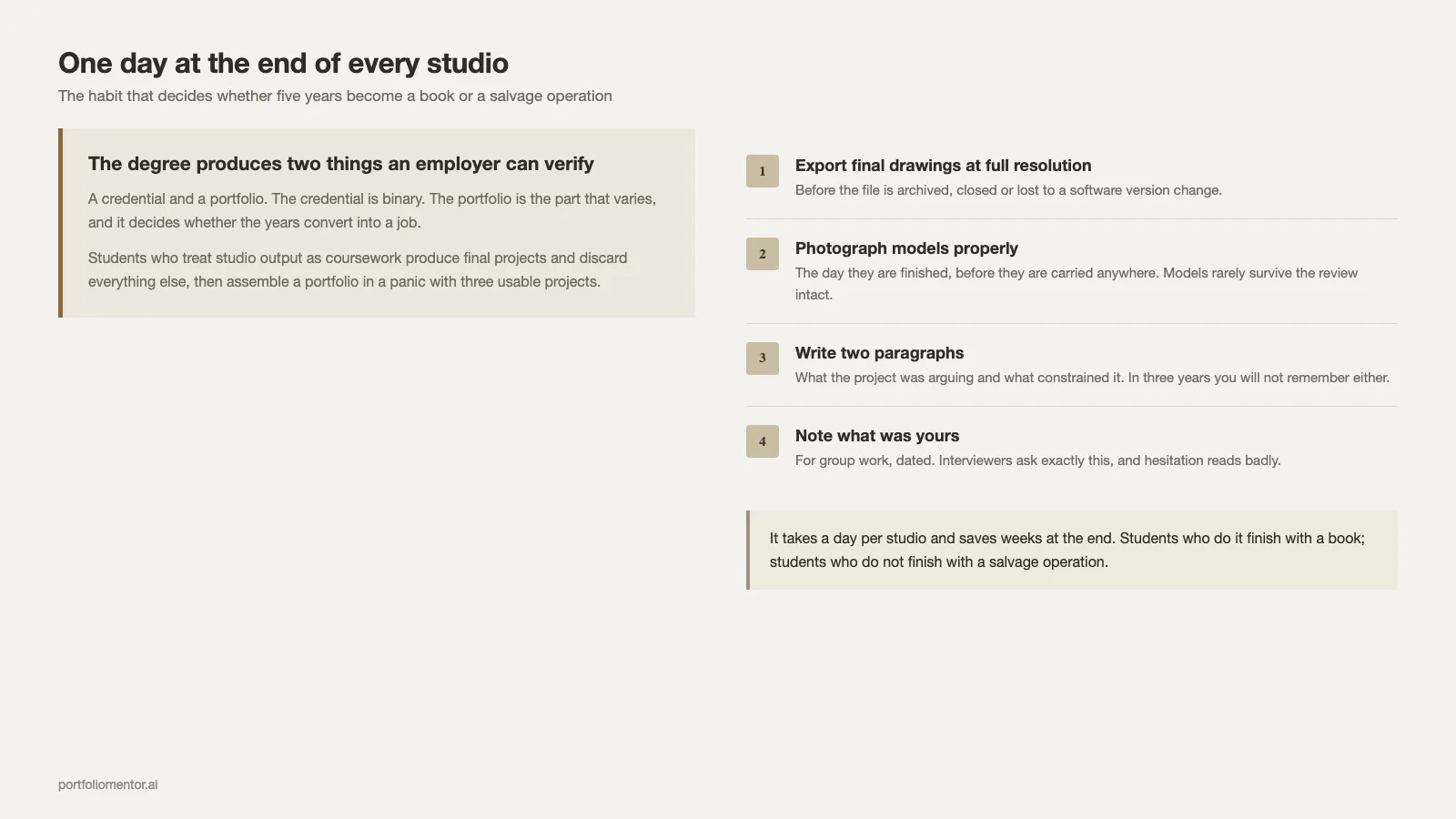
A degree produces two things an employer can verify: a credential and a portfolio. One of them is binary. The portfolio is the part that varies, and it decides whether the years convert into a job.
This is worth knowing in year two rather than year five. Students who treat studio output as coursework produce final projects and discard everything else, then assemble a portfolio in a panic with three usable projects. Students who photograph models, keep drawing files organised and archive process material finish with a book rather than a salvage operation.
Practical habit: at the end of every studio, spend one day exporting final drawings at full resolution, photographing models properly and writing two paragraphs about what the project was arguing. It takes a day and saves weeks later. What that archive turns into is covered in the architecture portfolio guide, and the student-stage version specifically in the undergraduate architecture portfolio guide.
Applying to the master’s stage
If your route includes a graduate degree, the application portfolio becomes the deciding document, and its requirements are set by each school rather than by a common standard. Page limits and file size ceilings vary widely, and they are hard limits enforced by upload forms.
Start the portfolio at least three months before the deadline, because the work of selecting and redrawing takes longer than the layout does. What programmes ask for and how applications are assessed is set out in the architecture grad school guide.
What it costs in time you cannot get back
The honest version of this question is not how many years the degree takes but how many years pass before the work resembles what you imagined.
For most people that is later than expected. School projects are unconstrained by fee, code and client. The first two years of practice are mostly production under supervision, and the point at which you shape a project is usually past year five. Anyone choosing architecture because they want to design buildings should know that the designing starts a long way in.
That is an argument for choosing the profession on the whole of it rather than on one part. People who enjoy drawing, technical problem solving and the arguments around a table tend to find the early years absorbing. People who are waiting for the designing to start tend to leave around year three.
The short version
Five years for a B.Arch, six for four-plus-two, seven or more if you arrive from another field. Then roughly three years of recorded experience and two years of exams, overlapping, for a median total of 12.3 years to a licence. Only the degree is fixed. Everything after it is where the timeline is won or lost, and three levers move it: start the record early, sit the first exam early, and pick a first job that exposes you to the whole of practice.