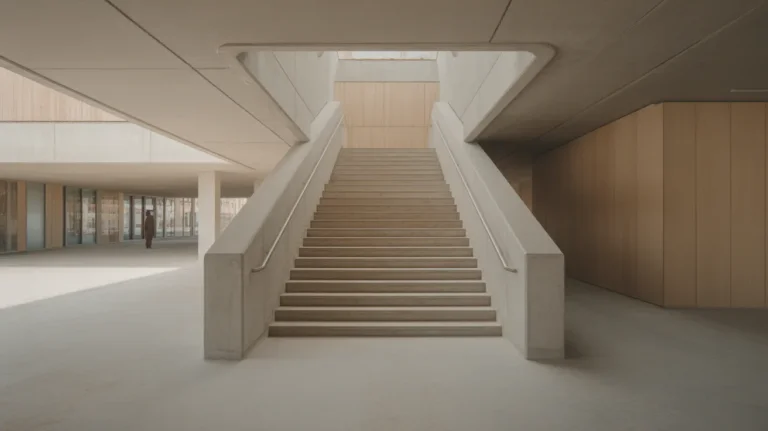
The architect vs engineer question comes down to responsibility, not talent. Architects design how a building is used, organised and experienced, and coordinate the whole. Structural and civil engineers calculate whether it stands and how it connects to infrastructure. Both are licensed, both are liable, and they sign different drawings.
Students ask this question when choosing a degree, and career changers ask it when deciding whether to convert. The honest answer has two halves: what the two professions actually do differently once qualified, and what the two training paths cost in years and money before you find out whether you chose right.
Numbers first, because the usual framing of “creative versus technical” survives about five minutes of contact with either job. The architect vs engineer decision is made on scope and qualification time, and both are measurable.
Architect vs engineer: the measurable differences
🔢 Quick Numbers
- Architects: median $99,280, 124,600 jobs, 4 percent growth 2025 to 2035 (BLS Occupational Outlook Handbook, May 2025)
- Civil engineers: median $100,840, 380,600 jobs, 6 percent growth 2025 to 2035 (BLS, May 2025)
- Median time to an architecture licence: 12.3 years in 2025 (NCARB by the Numbers 2026)
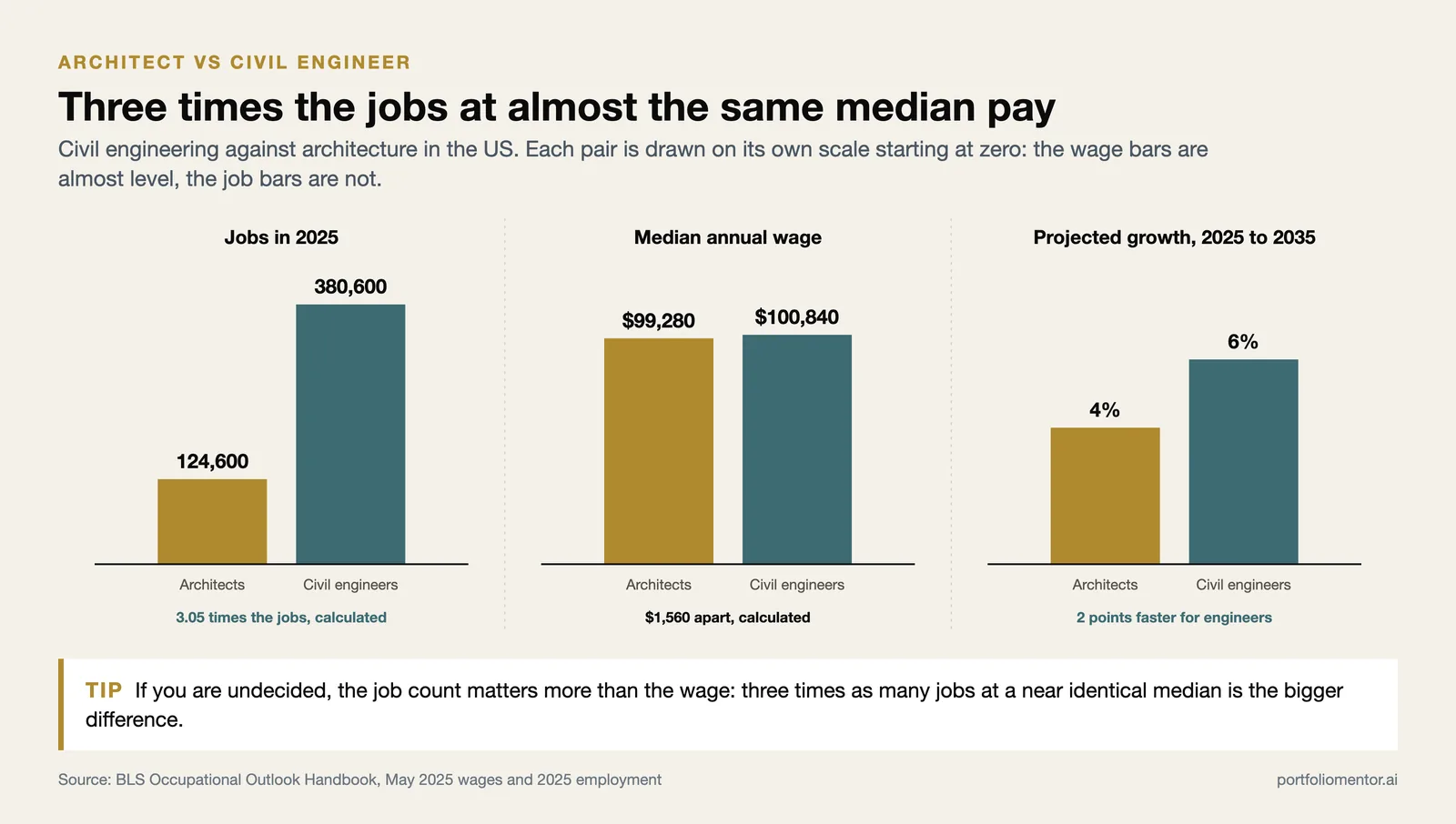
Civil engineering employs three times as many people at a slightly higher median and a faster growth rate. That is the part career advice for architecture students tends to leave out, and it is worth sitting with before the discussion moves to temperament. The narrower question of which routes exist inside architecture is covered in architecture career paths.
What each profession is responsible for
The architect’s scope
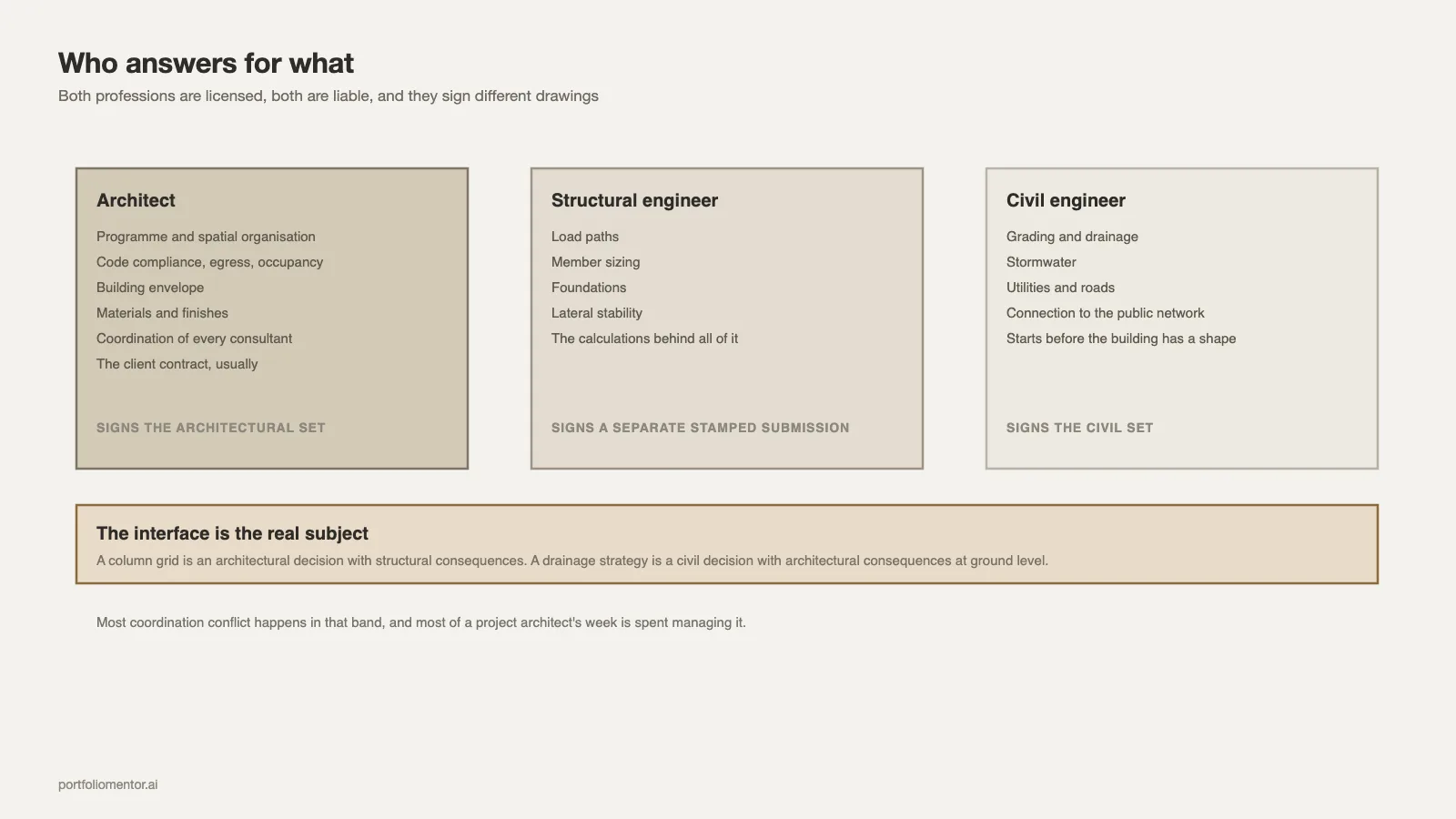
Programme and spatial organisation, code compliance for occupancy and egress, the building envelope, materials and finishes, and the coordination of every consultant on the job. The architect is usually the party holding the contract with the client and the one answering for whether the finished building matches what was agreed.
BLS describes the working pattern as office-based with site visits: architects “meet with clients, develop reports and drawings, and work with other architects and engineers. They also visit construction sites.”
The structural engineer’s scope
Load paths, member sizing, foundations, lateral stability, and the calculations that justify them. The structural engineer’s drawings and calculations are a separate stamped submission from the architect’s. If a beam is undersized, that is the engineer’s liability, not the architect’s.
The civil engineer’s scope
Site infrastructure. Grading, drainage, stormwater, utilities, roads and the connection between a building and the public network. On most projects the civil engineer’s work begins before the building has a shape and continues after it is enclosed.
Where they overlap and argue
The interface is the real subject. A column grid is an architectural decision with structural consequences, and a drainage strategy is a civil decision with architectural consequences at ground level. Showing that you understood one of those negotiations is worth more in a book than another render, which is why published portfolios from technical practices read differently. Most coordination conflict happens in that overlap, and most of a project architect’s week is spent managing it.
🏗️ Real-World Example
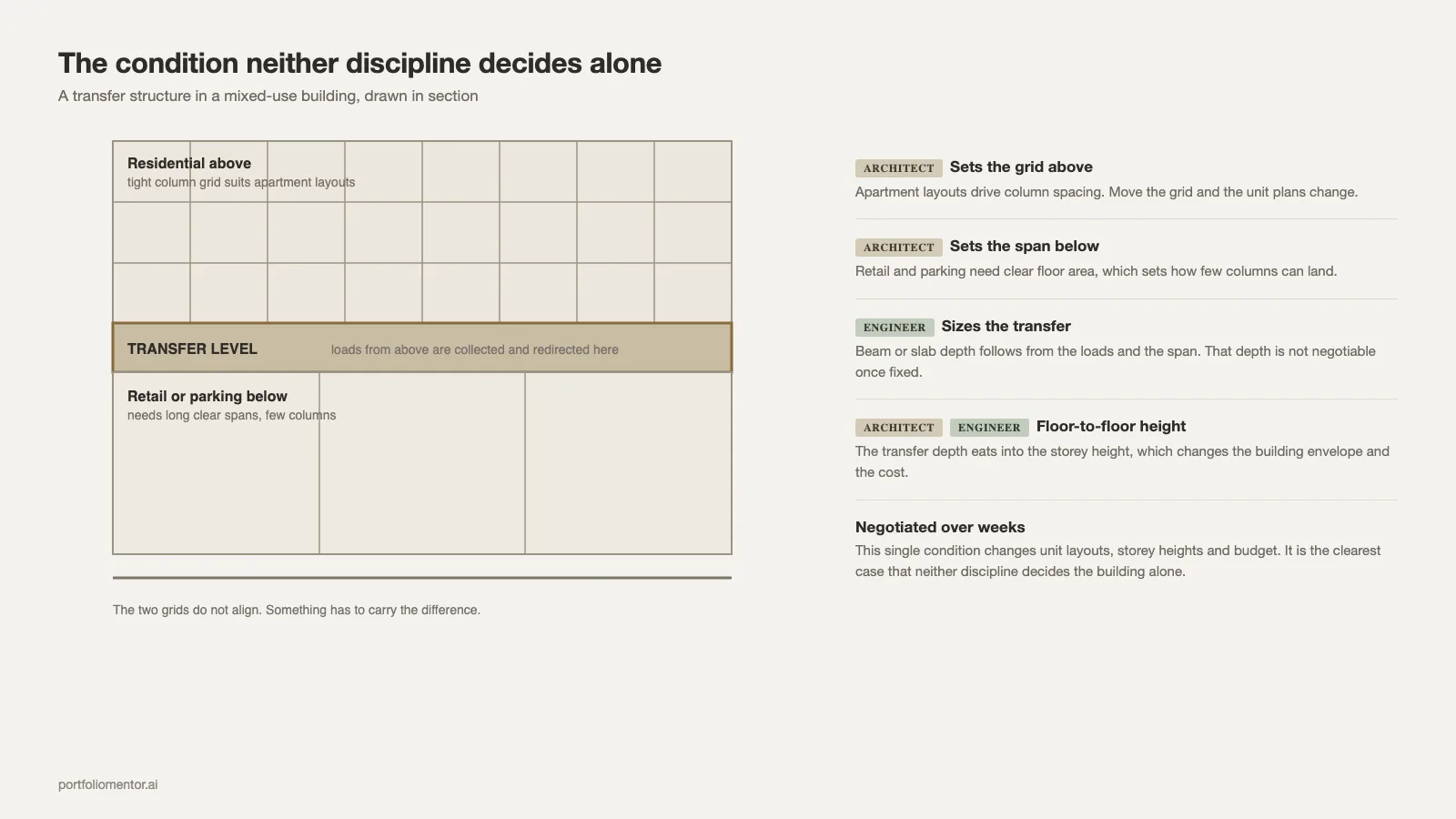
Transfer structures in mixed-use buildings: residential floors with a tight column grid often sit above retail or parking that needs long clear spans. The two grids do not align, so loads are transferred at one level. That single condition is negotiated between architect and structural engineer over weeks, and it changes floor-to-floor heights, unit layouts and cost. It is the clearest illustration that neither discipline decides the building alone.
Side by side
| Architect | Civil / structural engineer | |
|---|---|---|
| Median annual wage (May 2025) | $99,280 | $100,840 (civil) |
| Jobs (2025) | 124,600 | 380,600 (civil) |
| Projected growth 2025 to 2035 | 4% | 6% |
| Typical degree length | 5-year B.Arch, or bachelor’s plus 1 to 5 year master’s | 4-year accredited bachelor’s |
| Required experience before final exam | Paid internship, generally 3 years | Several years after the FE exam |
| Licence | State board registration | Professional Engineer (PE) |
| Signs and stamps | Architectural drawings, permit set | Structural or civil drawings and calculations |
All employment and wage figures from the BLS Occupational Outlook Handbook, May 2025 wage data and 2025 employment counts; education and experience descriptions from the same source.
Read the architect vs engineer comparison as two different bets. Engineering offers a larger, faster-growing job market with a shorter route to the credential. Architecture offers a smaller market, a slower route, and control over a wider part of the project. The wage columns are close enough that they should not decide anything.
Can you switch between them later?
In one direction, routinely. In the other, rarely.
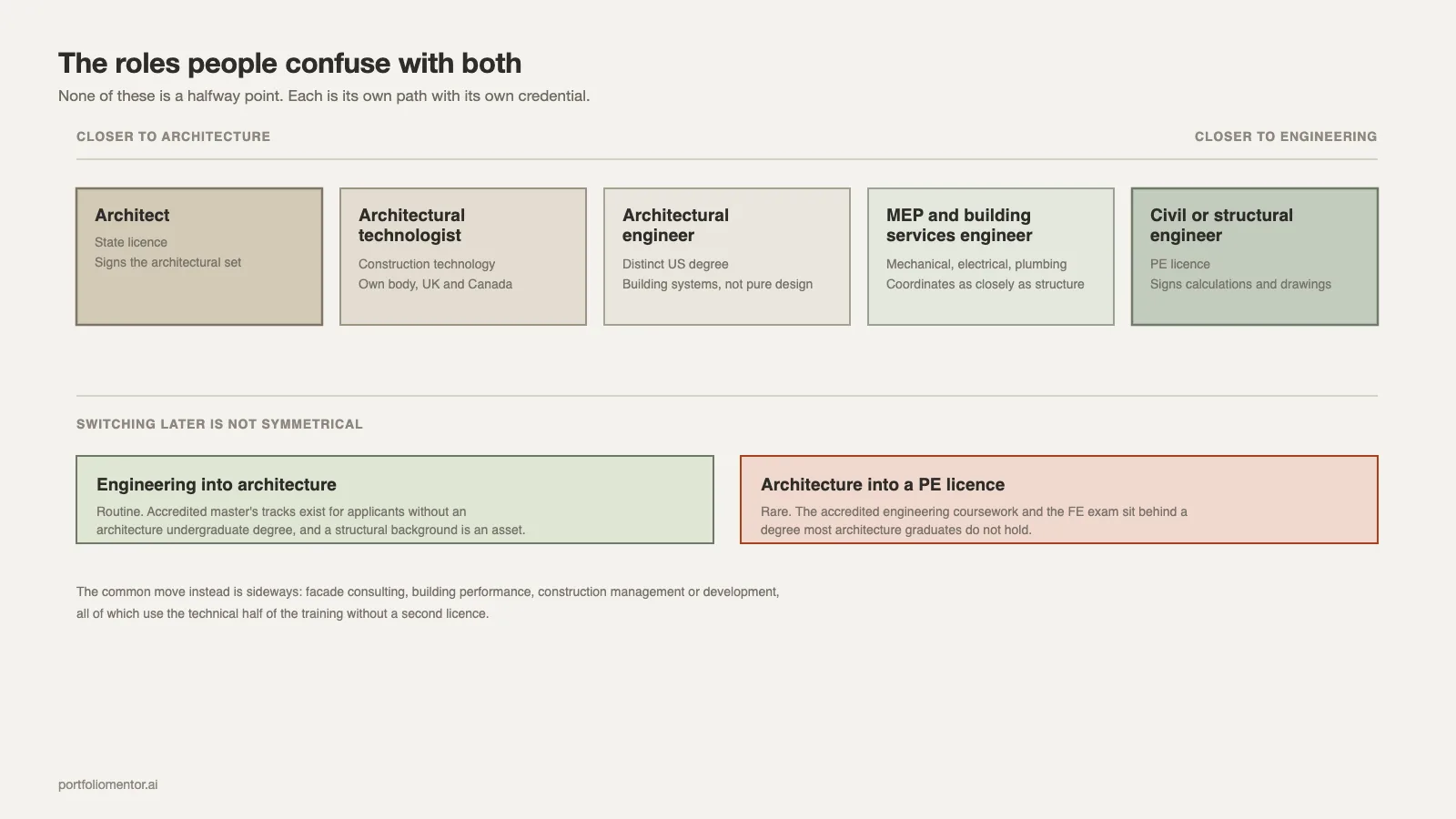
Engineers move into architecture through accredited master’s programmes designed for applicants without an architecture undergraduate degree, the kind compared in the grad school roundup. These are the longer M.Arch tracks, because the missing studio years have to be made up, but the route is well established and schools describe it openly in their admissions material. A structural background is treated as an asset once you arrive.
Architects moving to a PE licence face a harder problem, because the accredited engineering coursework and the FE exam sit behind a degree most architecture graduates do not hold. The more common move is sideways rather than across: architects go into facade consulting, building performance, construction management or development, all of which use the technical half of the training without requiring a second licence.
That asymmetry is the strongest practical argument for engineering first if you are genuinely undecided, and it is rarely mentioned in school open days on either side.
What a conversion application needs
If you are applying to an architecture master’s from an engineering degree, the portfolio is the part that decides it. Admissions committees are not expecting studio work you never did; they are looking for evidence of visual and spatial thinking from whatever you have. Drawing, photography, fabrication, model making and even well-presented technical work all count, and several accredited programmes say so in their requirements.
What sinks these applications is submitting engineering coursework as though it were design work, with no editing and no argument. A calculation sheet reproduced at full size proves you can calculate. A redrawn version that explains a spatial consequence proves you can think architecturally about the same material, and that is what the committee is scoring. What application portfolios are judged on, including page limits and file size ceilings that vary by school, is covered in the architecture grad school guide.
Which path takes longer to qualify?
Architecture, by a wide margin, and the gap surprises most people choosing between them.
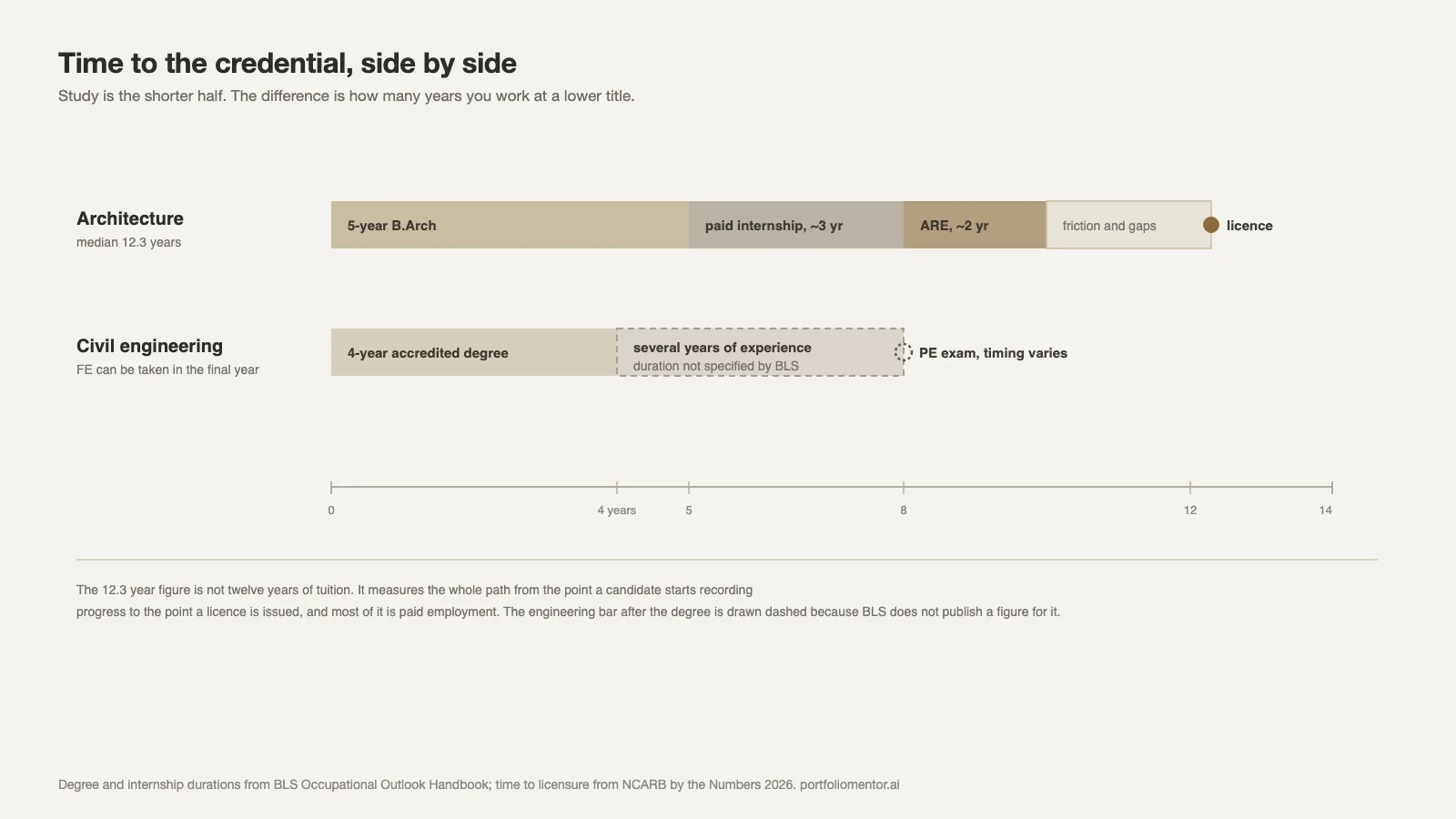
For architecture, BLS states that “most architects earn their degree through a 5-year Bachelor of Architecture degree program.” Many add a master’s “which can take 1 to 5 additional years.” All state boards then require “a lengthy paid internship, generally lasting 3 years” before the registration exam. NCARB’s own data puts the overall median from starting the process to holding a licence at 12.3 years in 2025, and that figure was described as the lowest in nearly a decade.
For civil engineering, BLS describes a four-year accredited bachelor’s degree, the Fundamentals of Engineering exam, “several years of relevant work experience,” and the PE exam. The FE can be taken in the final year of study, which starts the clock earlier.
⚠️ Common Mistake to Avoid
Assuming the 12.3 year figure means twelve years of study. It does not. It measures the whole path from the point a candidate starts recording experience to the point a licence is issued, and most of it is paid employment. The comparison that matters is not study length but how many years you work at a lower title before the credential arrives, which is where architecture is genuinely slower than engineering.
Pay: the medians are almost identical
At the median, engineering is marginally ahead: $100,840 against $99,280 for May 2025. The difference is small enough to ignore when choosing a career.
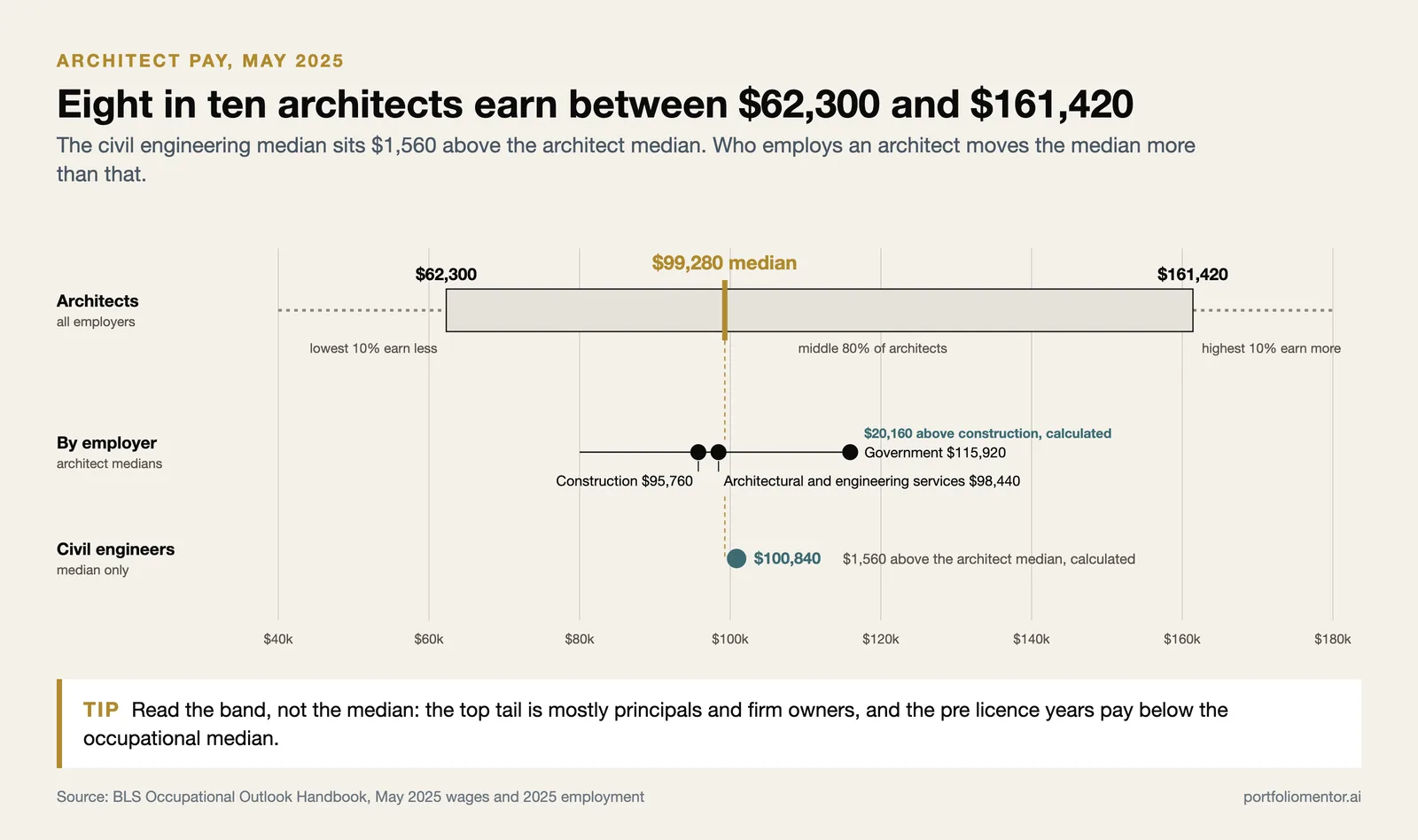
The distribution is the more useful comparison. For architects, BLS reports the lowest ten percent under $62,300 and the highest ten percent above $161,420, with industry medians of $115,920 in government, $98,440 in architectural and engineering services, and $95,760 in construction. Architecture has a long tail at the top for principals and firm owners, and a soft floor early because the pre-licence years pay below the occupational median.
How that curve behaves across a career, and where the steps occur, is set out in the architect salary guide.
Which suits how you actually work?
The creative-versus-analytical split is a poor guide. Both disciplines are heavily analytical, and engineers make design decisions constantly. Three questions separate them more usefully.
- Are you comfortable with problems that have no single correct answer? Architectural decisions are argued and defended; structural decisions are calculated and verified. Some people find the first liberating and others find it exhausting.
- Do you want to hold the client relationship? The architect usually does, with the administrative and emotional load that implies.
- Can you accept a longer, lower-paid qualification period in exchange for a broader scope? That is the trade in plain terms.
💡 Pro Tip
If you are undecided at eighteen, the reversible choice is engineering first. Converting from an engineering degree into an accredited architecture master’s is a recognised route at many schools; converting an architecture degree into a PE track is far harder because the accredited engineering coursework is missing. Keep the harder door open.
Working together: what juniors get wrong
Graduates entering practice often treat engineers as a service to be instructed. That reading costs them, because engineers see more buildings across more firms than any single architect does and will tell you what is buildable if asked early.
Three habits that shorten the learning curve:
- Send options rather than decisions. An engineer given three grid choices at concept stage will steer you to the one that works; the same engineer given a fixed plan at permit stage can only price the problem.
- Learn to read the structural drawings rather than only the model. Sizes, notes and assumptions live in the notes column, not in the geometry.
- Understand which dimensions are yours to change. Floor-to-floor height is negotiated; beam depth usually is not.
This coordination work is a portfolio subject in its own right. Showing that a scheme resolved a real structural or drainage constraint reads as practice experience in a way that another render does not, which places it inside Technical Drawing and Process in a portfolio review. How to present that kind of evidence is covered in the architecture portfolio guide, and interviewers probe it directly with the questions collected in architecture interview questions.
Related roles people confuse with both
Architectural engineer is a distinct degree in the US, focused on building systems rather than on either pure design or pure structure. Building services and MEP engineers handle mechanical, electrical and plumbing, and coordinate with the architect as closely as the structural engineer does. Architectural technologist, common in the UK and Canada, sits on the construction technology side of architecture without the full licence. None of these is a halfway point between the two main professions; each is its own path with its own credential.
If the real question underneath is which employment routes exist once qualified rather than which degree to take, how to become an architect sets out the licensure route in sequence.
The short version
Similar pay, faster qualification and three times the jobs on the engineering side. Broader scope, client ownership and a longer, lower-paid runway on the architecture side. Choose on scope and tolerance for ambiguity, not on a creative-versus-technical split that neither profession recognises from the inside.
One last practical note for anyone still weighing it. The two professions are not separated by how much you enjoy drawing; they are separated by what you are prepared to be answerable for. An architect answers for whether the building works as a place and whether the whole set of drawings agrees with itself. An engineer answers for whether a defined system performs under defined loads. The first responsibility is broader and harder to prove you have discharged; the second is narrower and verifiable.
People who want the question closed before they commit tend to be happier in engineering. People who are willing to defend a decision that cannot be proved right tend to last in architecture. That, rather than any salary table, is the distinction worth testing against yourself before you enrol.