An architect job description sets out what a licensed architect is responsible for: designing buildings, producing the drawings that get them permitted and built, coordinating engineers and consultants, and administering the contract on site. Most postings also separate the licensed role from the unlicensed designer role beneath it.
Job descriptions are written for two readers. The first is the hiring manager, who uses them to define the vacancy. The second is you, and the useful reading is not the bullet list of duties but what the wording reveals about the stage of work you would be doing, the size of firm, and whether the role expects a licence you do not yet have.
This guide breaks an architect job description into its parts, shows what each section actually signals, and gives a template you can read a posting against.
What does an architect do day to day?
Architects plan and design buildings, then stay involved while they are built. The US Bureau of Labor Statistics describes the work environment plainly: architects “spend much of their time in offices, where they meet with clients, develop reports and drawings, and work with other architects and engineers. They also visit construction sites.”
The proportions shift with seniority. A first-year architectural designer spends most of the week in drawing software. A project architect at year eight spends most of it in coordination, with drawing delegated. Neither is described differently in a job advert, which is why the duty list alone rarely tells you what the day looks like.
🔢 Quick Numbers
- Median annual wage for architects: $99,280, May 2025 (BLS Occupational Outlook Handbook)
- Employment: 124,600 jobs in 2025, projected to grow 4 percent through 2035 (BLS)
- Median time from starting the experience programme to licensure: 12.3 years in 2025, the lowest in nearly a decade (NCARB by the Numbers 2026)
The standard sections of an architect job description
Most postings follow the same five-part structure, whatever the firm size.
1. Role summary
Two or three sentences naming the position, the reporting line and the project types. This is the most informative part and the one candidates skim. “Reporting to the project architect” places you below delivery; “reporting to a principal” in a small practice means you are the delivery.
2. Responsibilities
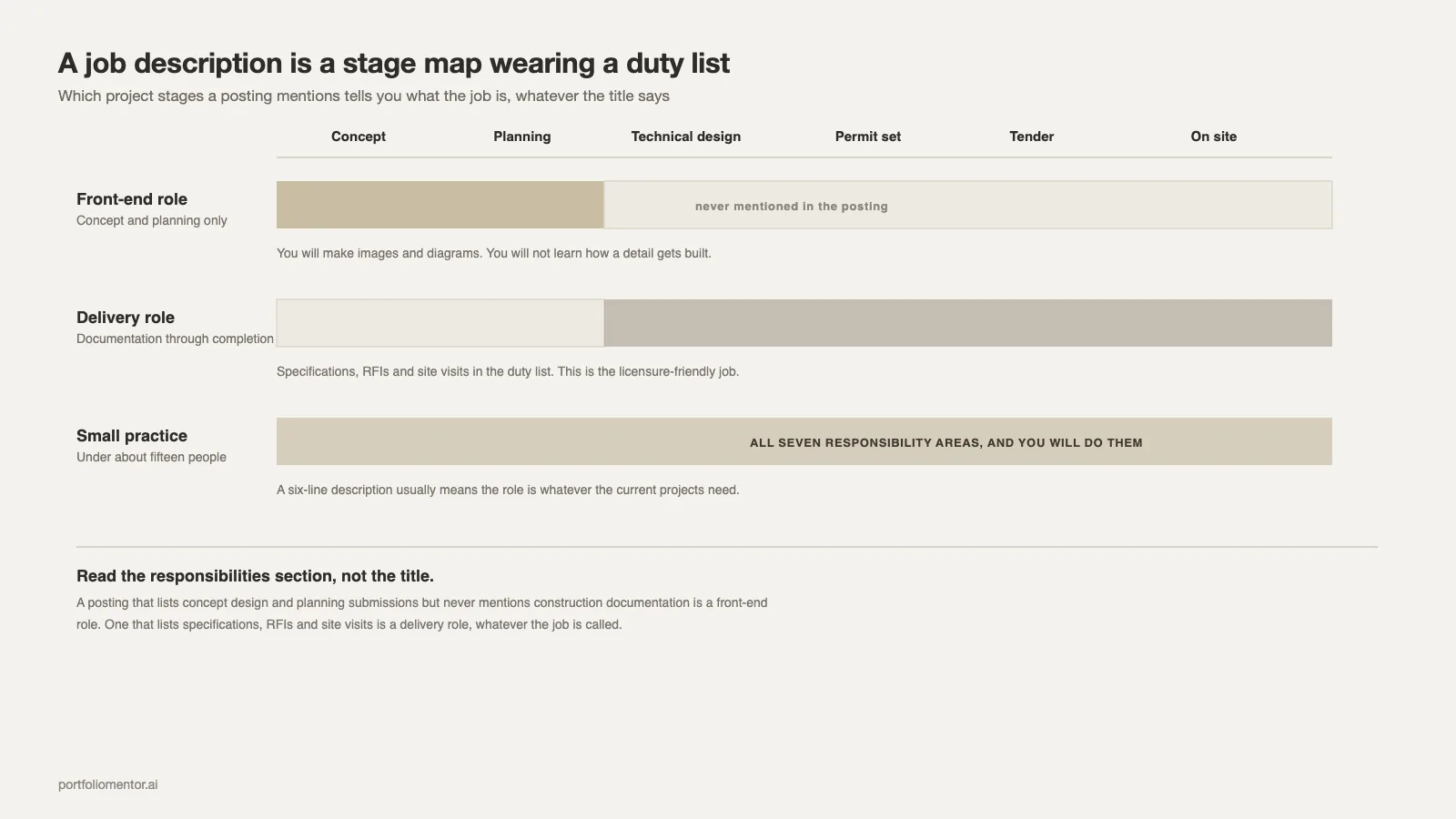
The duty list. Read it for which project stages appear. A posting that lists concept design and planning submissions but never mentions construction documentation is a front-end role. One that lists specifications, RFIs and site visits is a delivery role, regardless of what the title says.
3. Qualifications
Degree, licence status, years of experience. The licence line is the one to read exactly. “Licensed architect” is a hard filter. “On the path to licensure” or “licence preferred” is not.
4. Software and skills
Revit, AutoCAD, Rhino, Adobe suite. The order is usually honest about what the firm runs on. A posting leading with Revit and mentioning Rhino last is a documentation practice, whatever its website shows.
5. Portfolio requirement
Almost always present, almost always with a file size limit. This is where applications fail before the work is read, and the limits are real. Sizing and format for an application file are covered in the architecture portfolio size guide.
⚠️ Common Mistake to Avoid
Reading “5+ years experience” as a wall. In architecture that line is usually calibrated to the project stage, not to a headcount rule, and firms routinely interview candidates two years short when the portfolio shows the right stage of work. What does function as a wall is the licence, because it determines who can stamp drawings. Apply under the years figure; do not apply claiming a licence you do not hold.
Architect, architectural designer and project architect
Three titles appear across postings and they are not interchangeable.
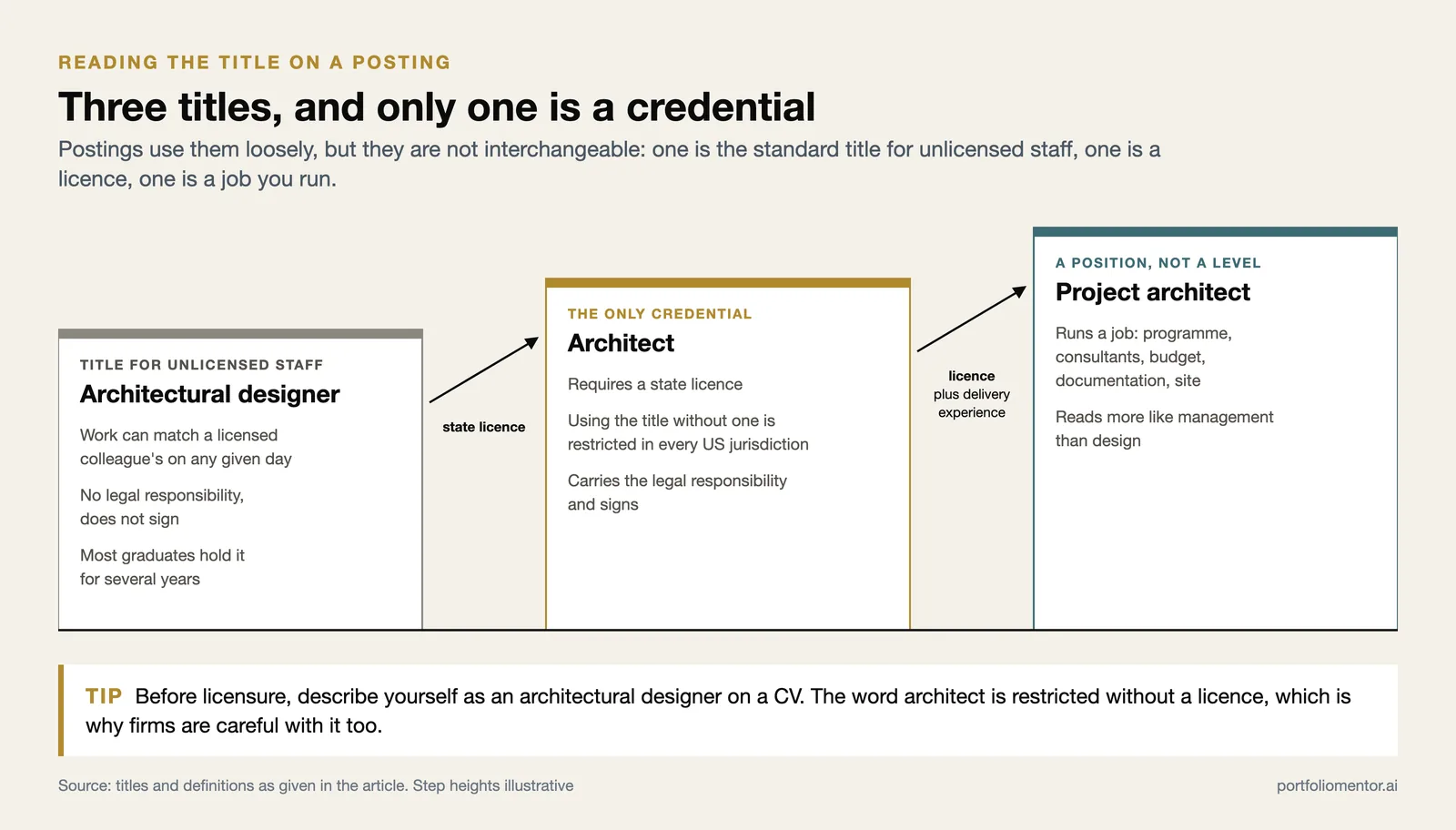
Architectural designer is the standard US title for unlicensed staff. The work can be identical to a licensed colleague’s on any given day; the difference is legal responsibility and who signs. Most graduates hold this title for several years.
Architect requires a state licence. Using the title without one is restricted in every US jurisdiction, which is why firms are careful with the wording and why you should be too on a CV. The conventions for describing pre-licensure status are in the architecture resume guide.
Project architect is a position rather than a credential level. It means running a job: programme, consultants, budget, documentation, site. It arrives after licensure plus delivery experience, and the job description reads noticeably more like management than design.
How these stack into a career, and what each stage pays, is set out in architecture career paths.
A template architect job description
This is the shape most postings take, with the signals annotated.
- Title and level. Architect, Project Architect, Architectural Designer I to III. The roman numeral system is common in large US firms and maps to years and salary bands.
- Summary. Project types, sector, reporting line, office location and any hybrid arrangement.
- Design responsibilities. Concept development, design options, client presentations, 3D studies.
- Technical responsibilities. Construction documents, details, specifications, code review, permit sets.
- Coordination. Structural, mechanical, civil and landscape consultants; clash resolution in the model.
- Construction administration. Site visits, submittal and RFI review, punch lists.
- Requirements. Accredited degree, licence status, years, software, portfolio.
Roles that list all seven areas in a small practice mean you will do all seven. In a large firm the same list usually means you will do two of them and be exposed to the rest.
💡 Pro Tip
Map your portfolio to the responsibilities section rather than to the summary. If the posting spends four bullets on construction documentation, put a detail sheet or a wall section in the first six pages. Books that open with three renders for a documentation role get read as a mismatch even when the candidate can do the work.
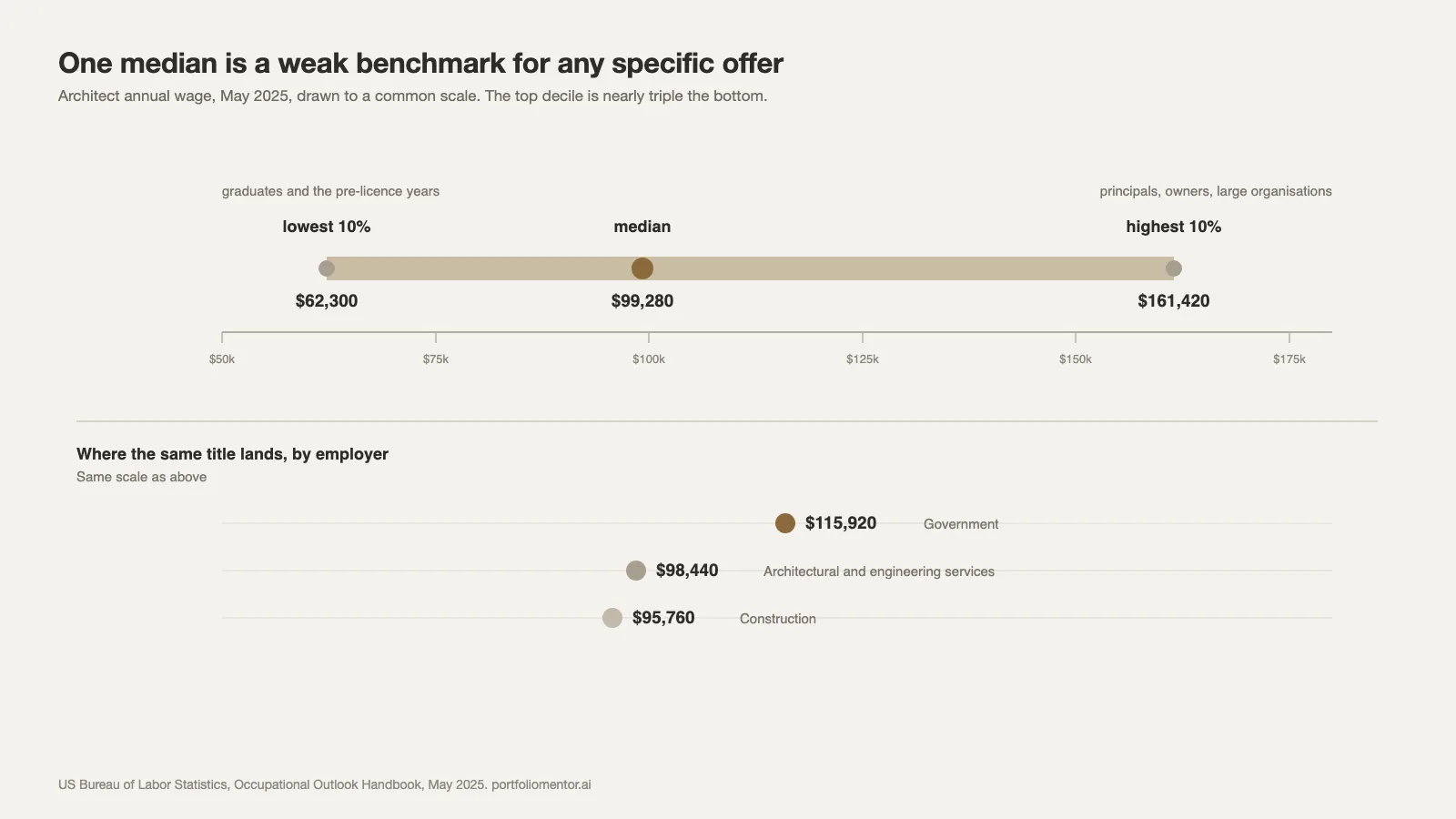
How much does an architect earn against the job description?
The same title pays differently depending on the employer type. BLS reports median wages by industry for May 2025: government at $115,920, architectural and engineering services at $98,440, and construction at $95,760. The spread across the profession is wider still, with the lowest ten percent under $62,300 and the highest ten percent above $161,420.
Two readings matter for a job search. Public sector roles pay above the median at the same title, which contradicts the usual assumption. And the top decile is nearly triple the bottom, so a single national median is a weak benchmark for any specific offer. The architect salary guide breaks the range down by stage, and negotiating an architect salary covers what to do with the figure once an offer arrives.
What a job description tells you about the firm
Three tells are reliable.
Length. A forty-bullet description usually comes from a firm with an HR function and defined bands. A six-line description usually comes from a practice of under fifteen people where the role will be whatever the current projects need.
Specificity of project types. Named sectors and named building types mean a stable pipeline. “A variety of exciting projects” with no sector named often means the pipeline is whatever came in.
Whether construction administration appears at all. Firms that hand off after permit produce architects who have never watched a detail get built, and that gap shows up years later when you try to move to a delivery practice.
📐 Technical Note
Job descriptions in the US frequently reference the six practice areas used by NCARB’s Architectural Experience Program: Practice Management, Project Management, Programming & Analysis, Project Planning & Design, Project Development & Documentation, and Construction & Evaluation. If you are collecting experience hours, check which of the six a role actually covers before accepting it, because a job confined to one area slows licensure.
What the description leaves out
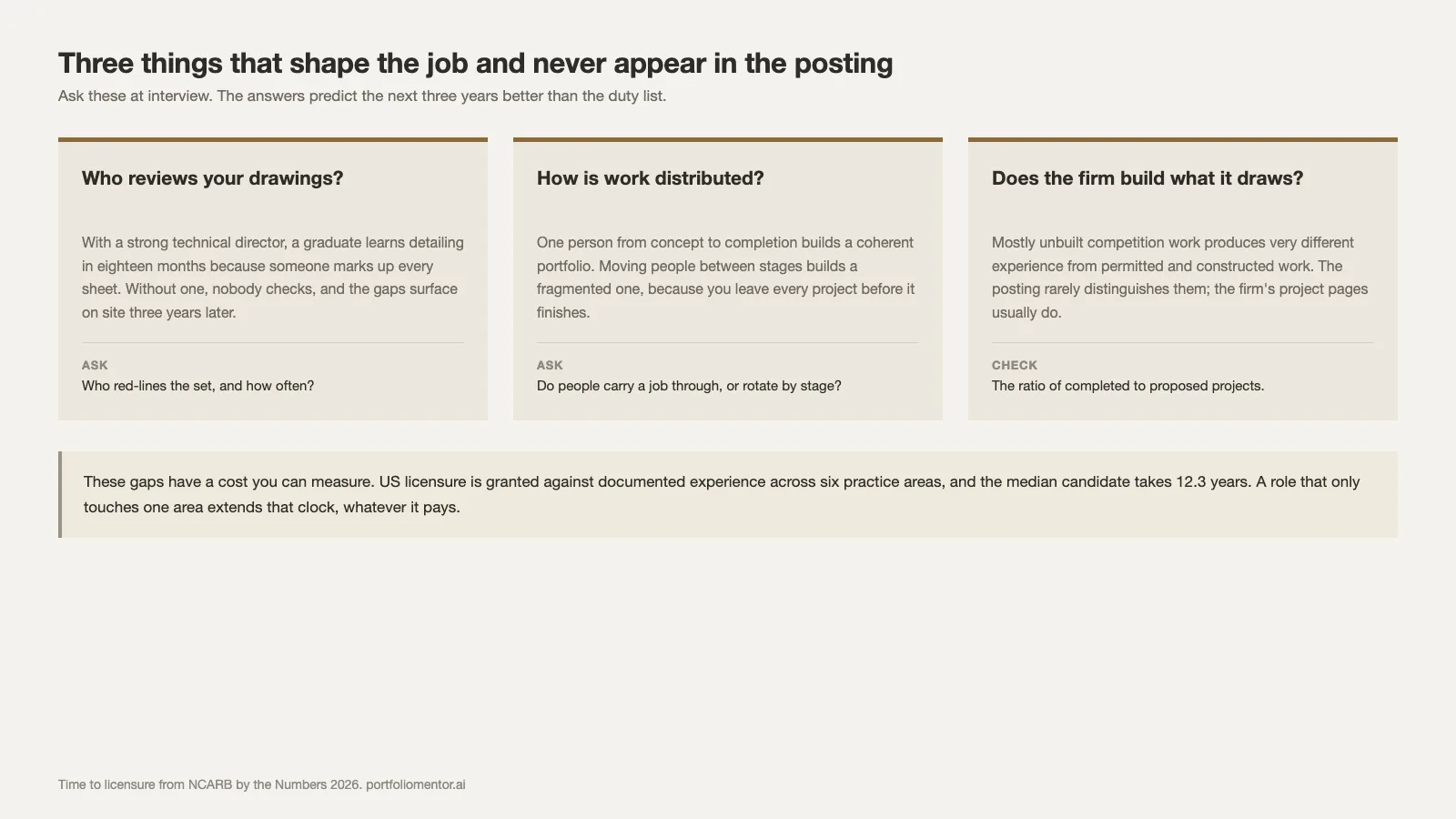
Three things shape the job more than anything printed in the posting, and none of them appear in a standard description.
Who reviews your drawings
In a practice with a strong technical director, a graduate learns detailing in eighteen months because someone marks up every sheet. In a practice without one, the same graduate produces drawings nobody checks and discovers the gaps on site three years later. Ask in the interview who red-lines the set and how often. The answer predicts your rate of learning better than the project list, and it belongs with the other questions worth asking in an architecture interview.
How work is distributed
Some firms staff a project with one person from concept to completion. Others move people between stages, so you spend a year on competitions, then a year on documentation. The first builds a coherent portfolio; the second builds a fragmented one, because you leave every project before it finishes and have nothing complete to show. That fragmentation is one of the recurring portfolio problems in mid-career applications. Neither is wrong, but only one of them makes your next application easy.
Whether the firm builds what it draws
A practice whose output is mostly unbuilt competition work produces very different experience from one whose output is permitted and constructed. The job description rarely distinguishes them. The firm’s own project pages usually do, and the ratio of completed to proposed projects is the quickest check.
These gaps matter because the experience you gather has to satisfy an external requirement as well as your own development. Licensure in the US is granted by state boards against documented experience, and the total median time from the start of that process to a licence was 12.3 years in 2025. A role that only exposes you to one practice area extends that clock, whatever it pays.
Matching your evidence to the posting
The gap between a rejected and an interviewed application is usually not skill. It is that the evidence presented answers a different job than the one advertised.
Take the responsibilities list and write, beside each line, the single piece of work that proves you have done it. Studio projects count. A code review done for a design studio, a set of construction details drawn for a technology module, a consultant coordination exercise from a group project: these map onto real duties even when the project was never built.
Lines with no evidence beside them are the ones to address in the cover letter, briefly and without apology. Lines with evidence should be visible in the first third of the portfolio rather than buried at page thirty, since most first reviews do not reach page thirty. What gets cut to make that possible is covered in the architecture portfolio guide.
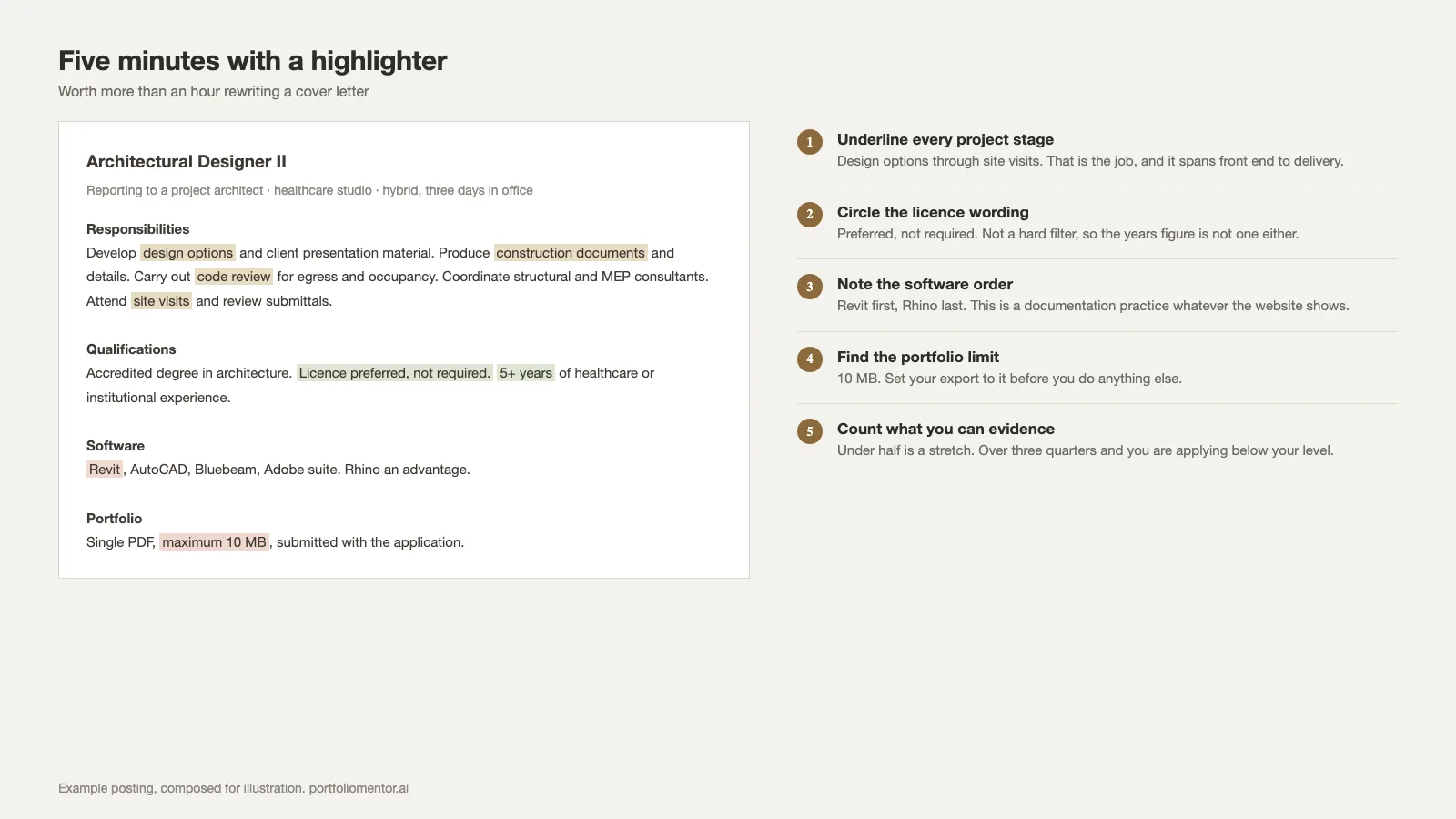
Reading a posting before you apply
Five minutes with a highlighter is worth more than an hour rewriting a cover letter.
- Underline every project stage mentioned. That is the job.
- Circle the licence wording. Hard requirement or preference.
- Note the software order. That is the production environment.
- Find the portfolio limit. Set your export to it before you do anything else.
- Count how many responsibilities you have evidence for. Under half is a stretch application; over three quarters and you are probably applying below your level.
The cover letter then answers the responsibilities section rather than restating your CV, which is the single change that most improves response rates. Structure for that is in the architecture cover letter guide, and the CV that sits beside it in the architecture CV guide.
Career Positioning is one of the ten categories a portfolio review scores, and it is measured exactly here: whether the book answers a specific job description or a general idea of architecture.
If you are writing the description rather than reading it
Small practices hiring their first employee tend to write a list of everything they do. That produces applications from generalists and scares off specialists. Naming the two stages the role genuinely covers, and the one piece of software the office runs on, attracts a narrower and more usable shortlist.
State the licence expectation exactly, give a portfolio file limit, and name a salary range. Postings without a range receive fewer applications from experienced candidates, who read the omission as a negotiation tactic rather than an oversight.
The short version
An architect job description is a stage map wearing a duty list. Read which project stages appear, whether the licence is required or preferred, and what the portfolio limit is. Then build the application around the responsibilities section rather than the title, because the title is the part that varies most between firms and means least.