The types of architects that exist as separate licensed occupations are far fewer than most lists suggest. US labor statistics recognise three: architects, landscape architects, and naval architects. Everything else, from healthcare to conservation, is a specialisation practised under one of those licences rather than a distinct profession.
Search for this question and you will find lists of twelve or fifteen “types”, mixing licensed occupations with job titles, building sectors and software preferences. That confusion matters if you are choosing what to study or deciding which projects belong in your book, because the licence you pursue and the sector you specialise in are two different decisions made at two different times.
This guide separates them. First the occupations that are legally distinct, then the specialisations that sit inside the main architecture licence, then what each one changes about the work you show.
What are the three licensed types of architects?
The US Bureau of Labor Statistics publishes separate wage data and employment counts for architects and landscape architects. Naval architects are counted together with marine engineers (8,400 jobs in 2025) and license as engineers, so the figures below set the two architecture licences against interior design, the neighbouring design occupation with its own state licensure rules.
🔢 Quick Numbers
- Architects: median $99,280 per year, 124,600 jobs, projected 4 percent growth 2025 to 2035 (BLS Occupational Outlook Handbook, May 2025)
- Landscape architects: median $79,870 per year, 23,500 jobs, licensure required in every state (BLS, May 2025)
- Interior designers: median $67,190 per year, 97,100 jobs, licensure rules vary by state (BLS, May 2025)
Architect
The unqualified title covers buildings and their immediate site. It is the licence most people mean, it carries the longest path, and it is the only one of the three that lets you stamp drawings for most occupied buildings. Entry-level education is a bachelor’s degree, and BLS notes that “about two-thirds of states require that architects hold a degree in architecture from an accredited architectural program.”
Landscape architect
A separate licence with a separate exam, covering site design, planting, grading, stormwater and public space. Every state requires it, which is stricter than interior design and comparable to building architecture. The wage sits roughly twenty percent below building architects, but the discipline has its own drawing conventions and its own portfolio expectations, covered in the landscape architecture portfolio guide.
Naval architect
Ship and marine structure design. It is a genuinely separate occupation with an engineering rather than a design education behind it, and it shares almost nothing with building practice beyond the word. It appears on these lists mainly because of the shared title.
⚠️ Common Mistake to Avoid
Treating “interior architect” as a fourth licence. In most US jurisdictions it is not one. Interior design is a separate occupation with its own state-by-state rules, and calling yourself an interior architect without an architecture licence is restricted in several states. If the title matters to you, check your state board before it appears on a business card.
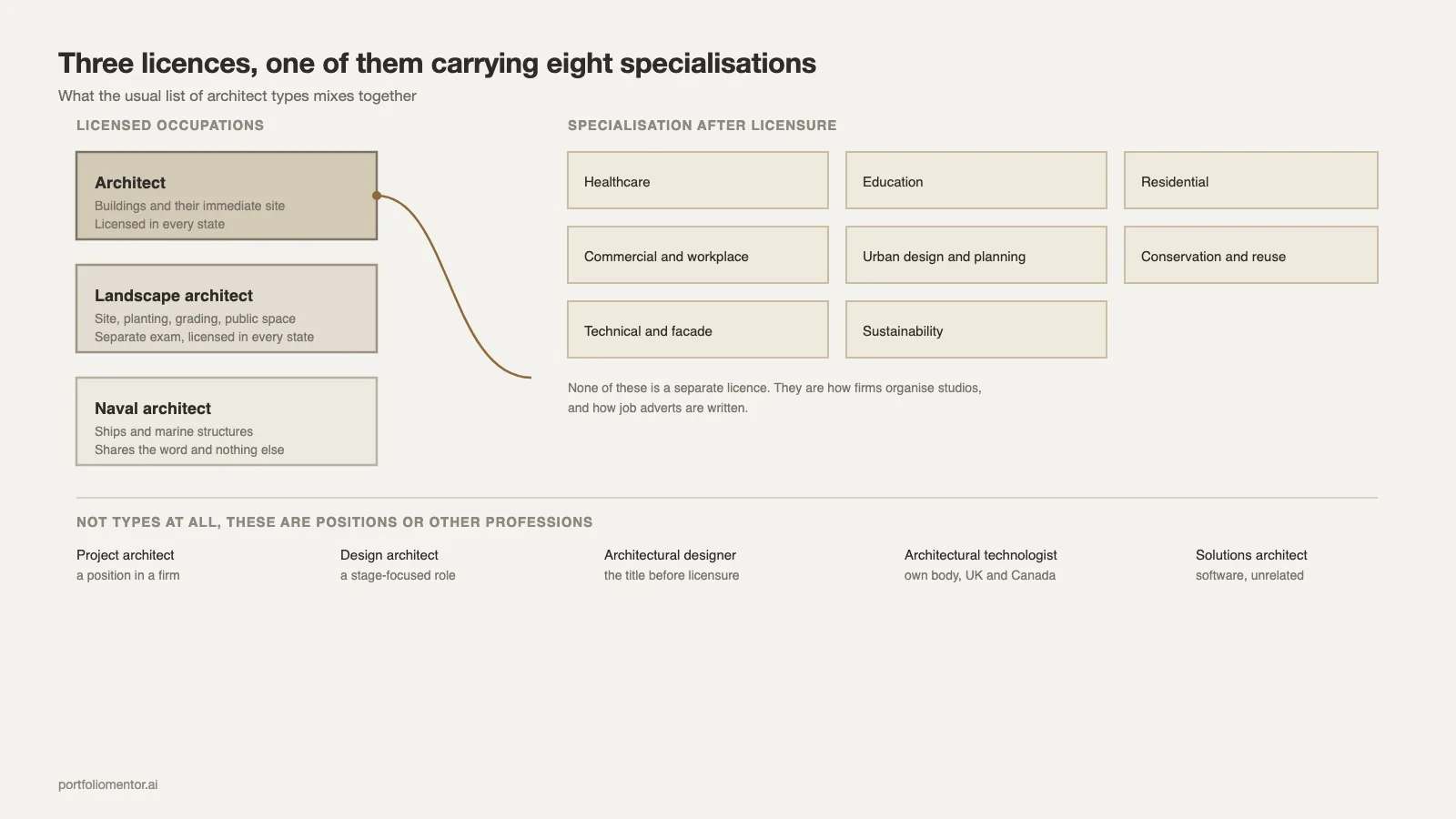
Specialisations inside the architecture licence
Once licensed, architects specialise by building sector rather than by credential. These are not separate types of architects in any legal sense, but they are how firms organise studios and how job postings are written, so they determine what work you should be showing.
Healthcare
Hospitals, clinics and laboratories. Heavily code-driven, long project timelines, and dominated by large firms because of the technical staffing required. Portfolios here are judged on plan logic and infection-control zoning rather than on form.
Education
Schools, university buildings and libraries. Public procurement drives most of it, which means the work is bid rather than won on reputation alone, and firms value candidates who can produce complete documentation.
Residential
Single family and small multifamily. The most common route for architects who eventually start a practice, because project scale allows one person to carry a job. It is also where the lowest fees sit, and the sector where freelance and independent practice is most realistic early.
Commercial, retail and workplace
Offices, fit-outs, mixed use. Fast cycles compared to healthcare or education, which means a junior architect sees a project finish within a year or two rather than waiting five.
Urban design and planning
Masterplans, public realm, zoning studies. Often carried out by architecture-trained staff without a separate licence, though some move into planning accreditation instead.
Conservation and adaptive reuse
Historic fabric, listed buildings, reuse of existing structures. Growing as a share of practice as retrofit displaces new build, and one of the few specialisations where drawing by hand still carries weight in hiring.
Technical and facade specialists
Detailing, envelope performance, construction documentation. Firms hire for this separately, and it is the specialisation least visible in student portfolios, which makes it an opening if your strength is Technical Drawing rather than concept work. A single detail sheet placed early does more for this route than any render, as the portfolio guide sets out.
Sustainability and building performance
Energy modelling, embodied carbon, certification. Ten years ago this sat with consultants; it now sits inside many medium and large practices as a staffed role. It is one of the few specialisations a student can demonstrate before employment, because the analysis tools are available and the outputs are legible on a portfolio page.
A caution on all of these: sector experience is what firms verify, and a single studio project does not constitute it. What a specialisation section in your portfolio establishes is direction, not expertise, and describing it as expertise is the fastest way to lose credibility in an interview. The questions that expose it are the ordinary ones about scope and code, collected in the architecture interview questions.
💡 Pro Tip
If you want to enter a sector you have never studied, do not claim it in a cover letter. Show one project reworked through that sector’s constraints instead. A studio project re-drawn with a healthcare department layout, or a housing scheme re-detailed as a retrofit, proves more than a stated interest and takes a weekend.
Which type of architect earns the most?
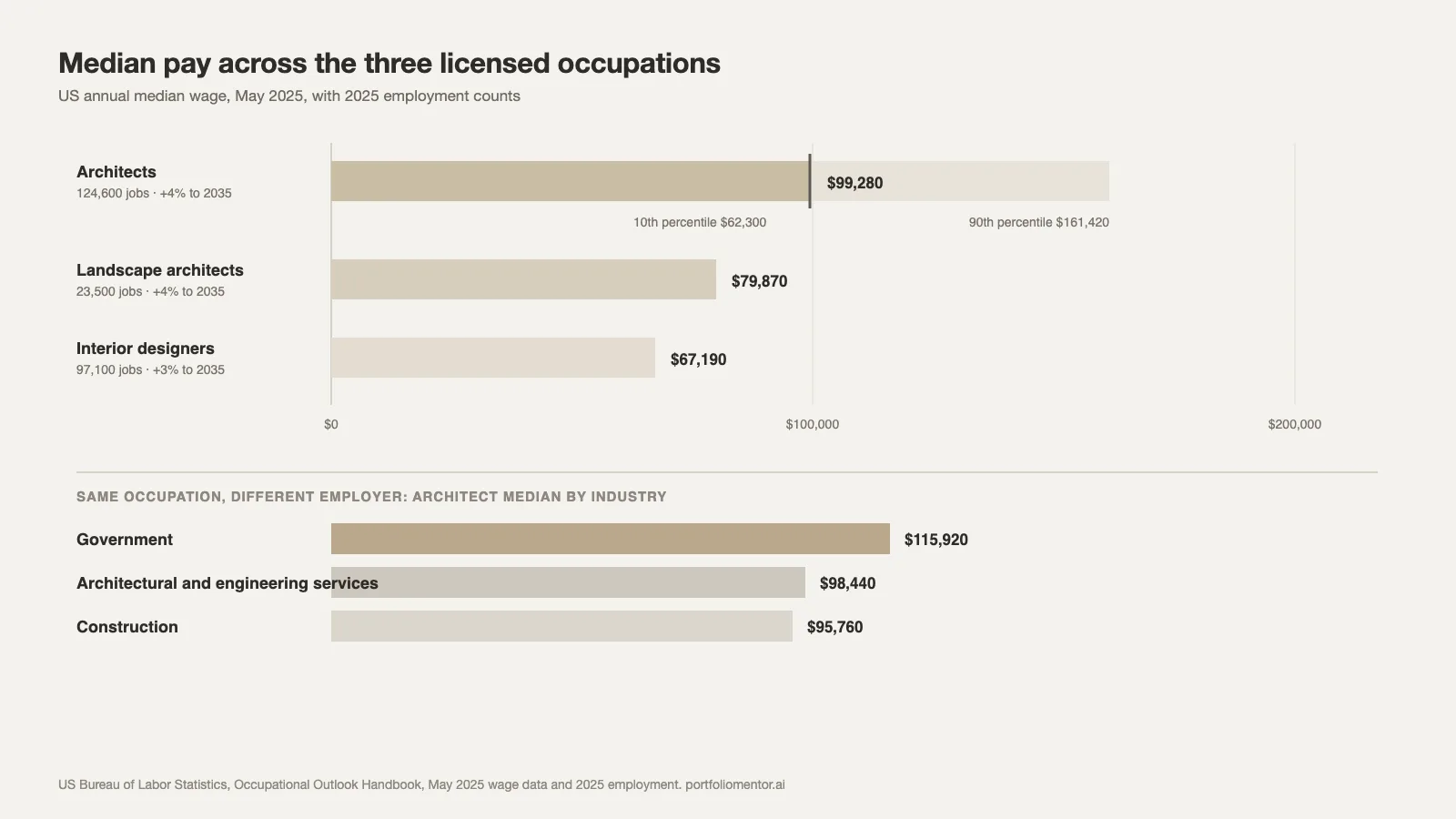
Among the licensed occupations, building architects lead, and the architect salary guide tracks how that figure moves with experience. The BLS figure for May 2025 puts the median at $99,280, with the lowest ten percent under $62,300 and the top ten percent above $161,420. Landscape architects sit at $79,870 and interior designers at $67,190.
Sector matters more than specialisation label. BLS reports median wages by industry: government at $115,920, architectural and engineering services at $98,440, and construction at $95,760. Working in-house for a public client pays more at the median than working in a design practice, which rarely appears in career advice aimed at students.
The spread within the profession is wider than the gap between specialisations, and most of it is explained by experience and location rather than by what you design. What to do with the number once you have an offer is covered in salary negotiation for architects.
The three licensed occupations compared
Set side by side, the differences are clearer than any list of titles.
| Architect | Landscape architect | Interior designer | |
|---|---|---|---|
| Median annual wage (May 2025) | $99,280 | $79,870 | $67,190 |
| Jobs (2025) | 124,600 | 23,500 | 97,100 |
| Projected growth 2025 to 2035 | 4% | 4% | 3% |
| Licence required | All states | All states | Varies by state |
| Typical entry education | Bachelor’s degree | Bachelor’s degree | Bachelor’s degree |
Figures from the BLS Occupational Outlook Handbook, May 2025 wage data and 2025 employment counts.
Two things stand out. Interior design employs almost as many people as architecture at a third lower median wage, and the growth projections are close enough across all three that none of them is a growth argument for choosing one over another. Whatever draws you to a licence, it should not be the forecast.
The employment count is the more useful number for a job search. Landscape architecture is a small profession, roughly a fifth the size of building architecture, which means fewer openings but also fewer applicants per opening and a much smaller pool of people who can draw a planting plan properly.
Roles that are job titles, not types
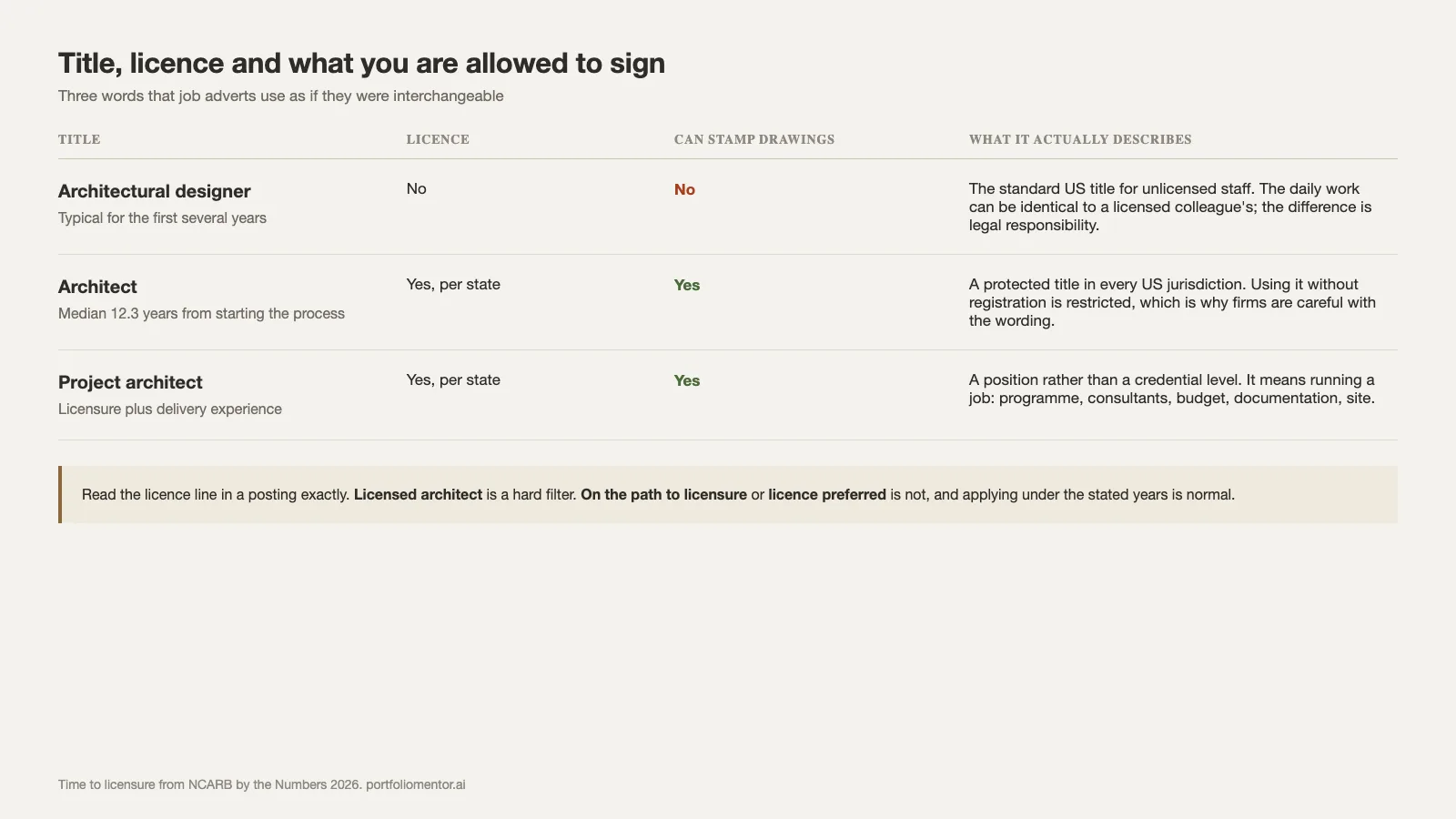
Several entries on the usual lists are stages or positions rather than kinds of architect. Keeping them separate helps when you are reading job adverts.
- Project architect. The person running a job day to day. A position within a firm, reached after licensure and a few years of delivery experience.
- Design architect. A role focused on the early stages, often in a studio that hands off to a delivery team. Rarely an entry point.
- Architectural designer. The standard title for unlicensed staff in the US. It signals stage, not discipline.
- Architectural technologist. Common in the UK and Canada, focused on construction technology and detailing, with its own professional body.
- Solutions or software architect. Unrelated to the built environment. It shares only the metaphor.
The distinction between titles and licences shapes how you describe yourself before you are licensed, which matters on a CV. The wording conventions are handled in the architecture resume guide.
How specialisation changes what belongs in your portfolio
Project Selection is one of the ten categories a portfolio gets scored on, and it is where specialisation shows first. A book aimed at a healthcare studio and a book aimed at a residential practice can contain the same projects and still read differently, depending on which drawings lead.
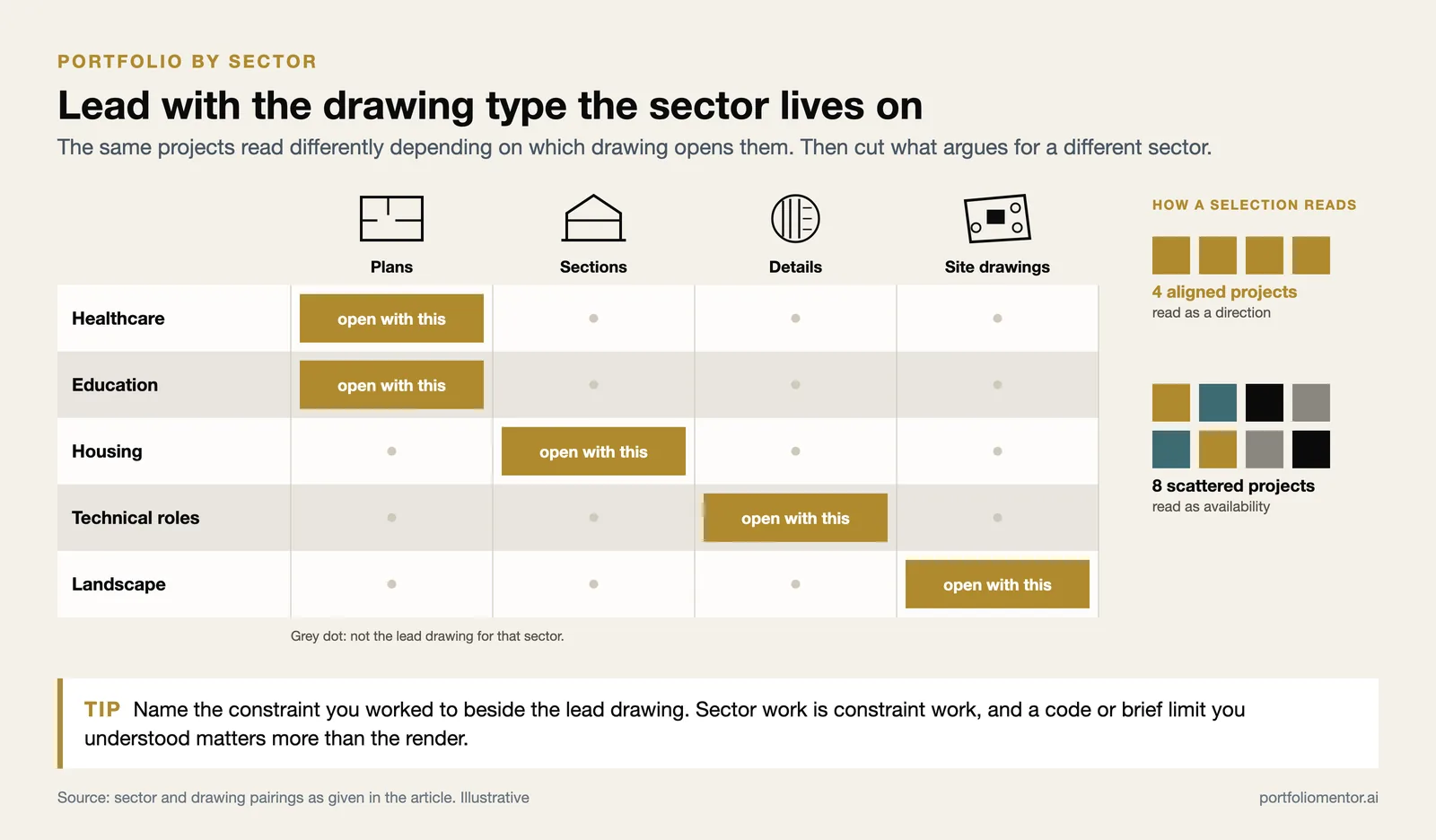
Three adjustments carry most of the difference.
- Lead with the drawing type the sector lives on. Plans for healthcare and education, sections for housing, details for technical roles, site drawings for landscape.
- Cut projects that argue for a different sector. Four aligned projects read as a direction; eight scattered ones read as availability.
- Name the constraint you worked to. Sector work is constraint work, and showing that you understood a code or a brief limit matters more than the render.
Which projects to keep and which to drop is the harder half of this. The portfolio examples collection shows the selection logic, and published portfolio examples show how different directions read side by side.
📐 Technical Note
Licensure is granted by state boards, not nationally. NCARB certification exists to make reciprocity between jurisdictions workable, but it does not replace a state licence. An architect licensed in one state who wants to practise in another applies through that state’s board, usually using the NCARB Record as the evidence file.
Choosing a direction without closing doors
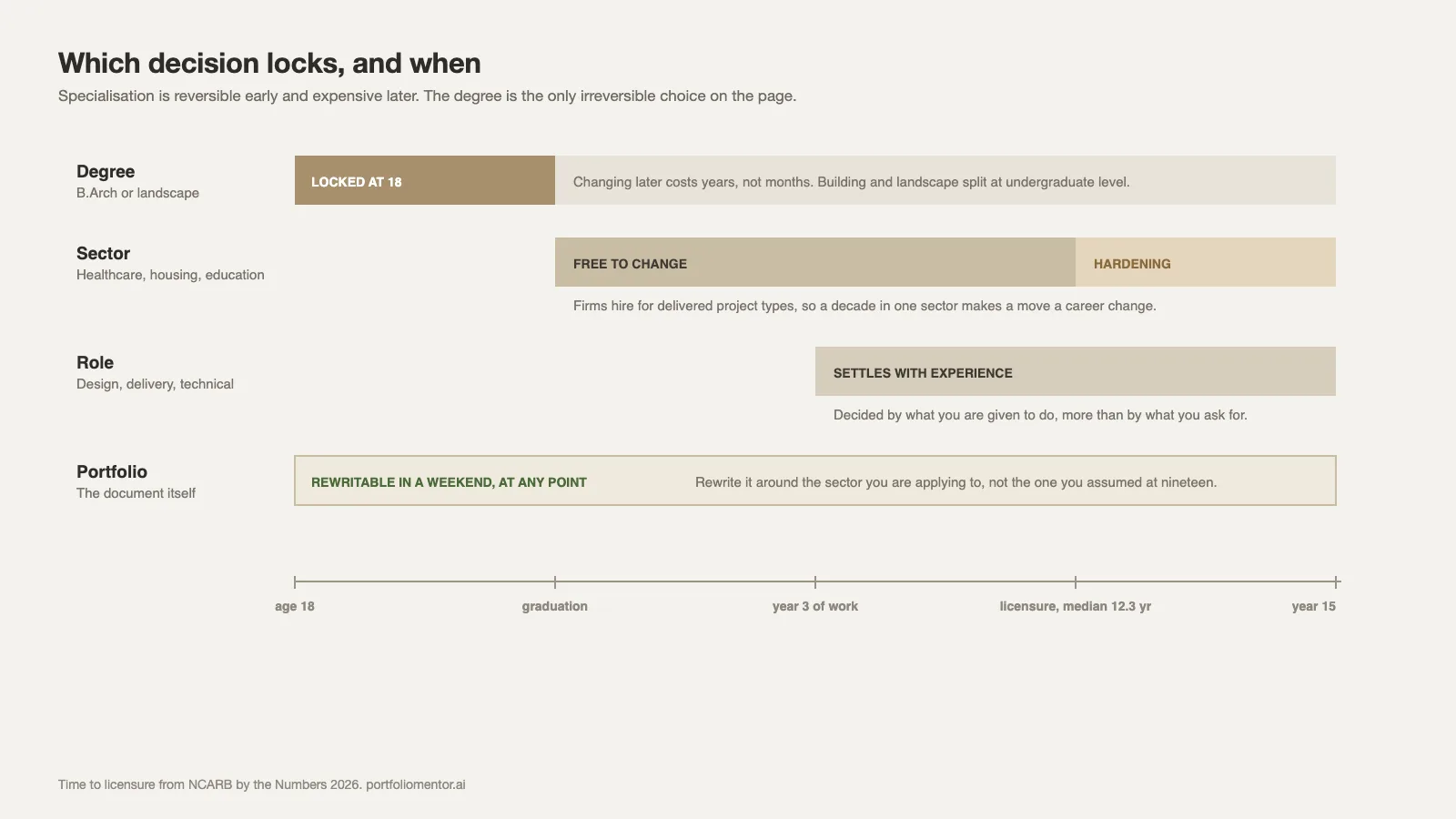
Specialisation is reversible early and expensive later. A first job in healthcare does not prevent a move to housing at year three, but a decade in one sector makes a lateral move a genuine career change, because firms hire for delivered project types.
A practical sequence for students and new graduates:
- Pick the licence first. Building architecture and landscape architecture diverge at degree level, so this decision belongs to your school application rather than your job search.
- Treat the first two jobs as sector sampling. Sector preference formed in studio rarely survives contact with the real programme.
- Let the portfolio follow the evidence. Rewrite it around the sector you are applying to, not the one you assumed you wanted at nineteen.
The route into the licence itself, including the degree and experience requirements that sit underneath all of this, is set out in how to become an architect. If you are still deciding between employment routes rather than sectors, architecture career paths compares them.
The short version
Three licensed occupations, one of which has nothing to do with buildings. Everything else on the usual list is either a sector you specialise into after licensure or a job title that describes your position in a firm. Knowing which is which changes what you study, what you apply for, and which four projects lead your book.
If you are at the start, the only irreversible choice on this page is the degree, because building architecture and landscape architecture split at undergraduate level and moving between them later costs years rather than months. Sector choice can wait until you have seen a real project run, and the portfolio can be rewritten for a new direction in a weekend.
The practical test of whether you have chosen a direction is not what you say in a cover letter. It is whether someone reading your book cold can name the sector you are aiming at from the projects alone, and whether the first four pages support that reading rather than hedging across three sectors at once.