

Becoming a freelance architect means trading the stability of a salaried studio role for control over your projects, rates, and schedule. Most architects can freelance once they understand what work they can legally stamp, how to price their time, and where paid clients actually come from. This guide covers the licensing, rates, and client side in practical detail.
Can architects freelance, and what does it actually involve?

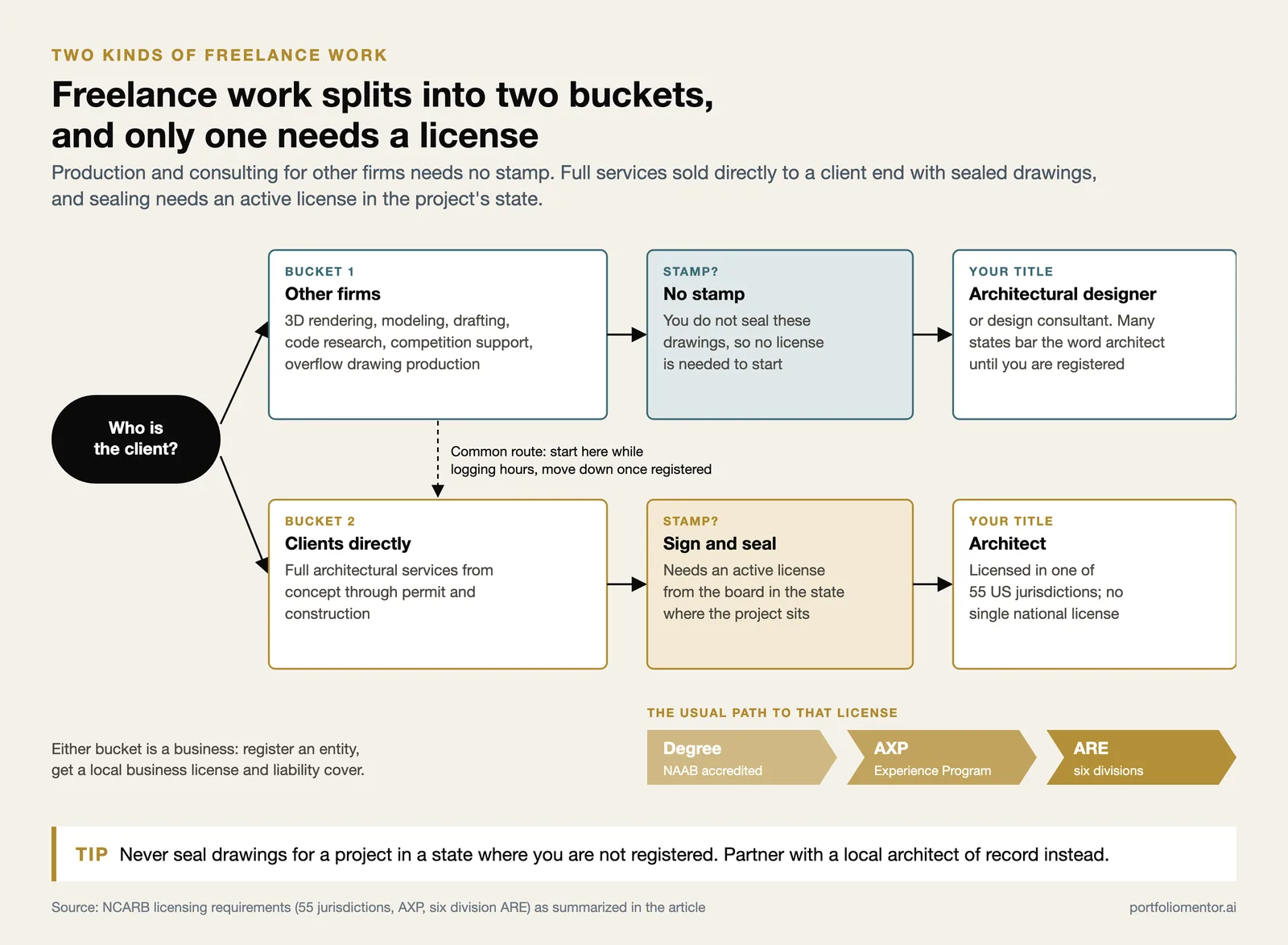
Yes, architects can freelance, and a growing share of the profession works independently in some capacity. A freelance architect takes on project work as an independent contractor rather than as an employee. That work falls into two broad buckets, and the difference matters more than most beginners expect.
The first bucket is production and consulting work for other firms: 3D rendering, modeling, drafting, code research, competition support, and overflow drawing production. You do not stamp these drawings, so you do not need a license to start. The second bucket is full architectural services delivered directly to a client, where you take a project from concept through permit and construction. In most jurisdictions, signing and sealing those documents requires an active license.
Many people start freelancing in the first bucket while still building hours toward licensure, then move into stamped, client-facing work once they are registered. Both are valid. The point is to be honest with yourself and your clients about which services you can legally provide.
🔢 Quick Numbers
- There were 116,005 licensed architects across the 55 U.S. jurisdictions in 2024, per NCARB By the Numbers 2025.
- Roughly two out of three UK architects work as salaried employees, which means a meaningful minority work as sole principals or independents, per the 2025 RIBA Employment and Earnings data.
- The median full-time architect salary in the UK reached £52,000 in 2025, with sole principals’ average earnings rising 6%, per RIBA.
What licensing and credentials do you need to freelance?

To offer full architectural services as a freelance architect in the United States, you need a license from the board in the state where the project sits. There is no single national license. Each of the 55 jurisdictions sets its own rules, but the path almost always combines a degree from a NAAB-accredited program, the Architectural Experience Program (AXP), and the six-division Architect Registration Examination (ARE).
If you only do unstamped production or consulting work, you do not need a license, but you cannot call yourself an “architect” in many states until you are registered. Use “architectural designer” or “design consultant” until your registration comes through. Check your own state through the NCARB Licensing Requirements Tool, since reciprocity and alternative pathways vary widely.
Beyond your professional license, running a freelance practice means setting up a small business. That usually includes a local business license, a registered business entity, professional liability (errors and omissions) insurance, and general liability coverage. The American Institute of Architects keeps an updated set of licensing and practice resources that is worth reading before you take on your first stamped project.
⚠️ Common Mistake to Avoid
Do not stamp drawings for projects in a state where you are not registered, and do not let a client pressure you into sealing work you did not supervise. Board complaints over improper sealing can end a career. If a project sits in a state you are not licensed in, partner with a locally registered architect of record instead.
How much should a freelance architect charge?

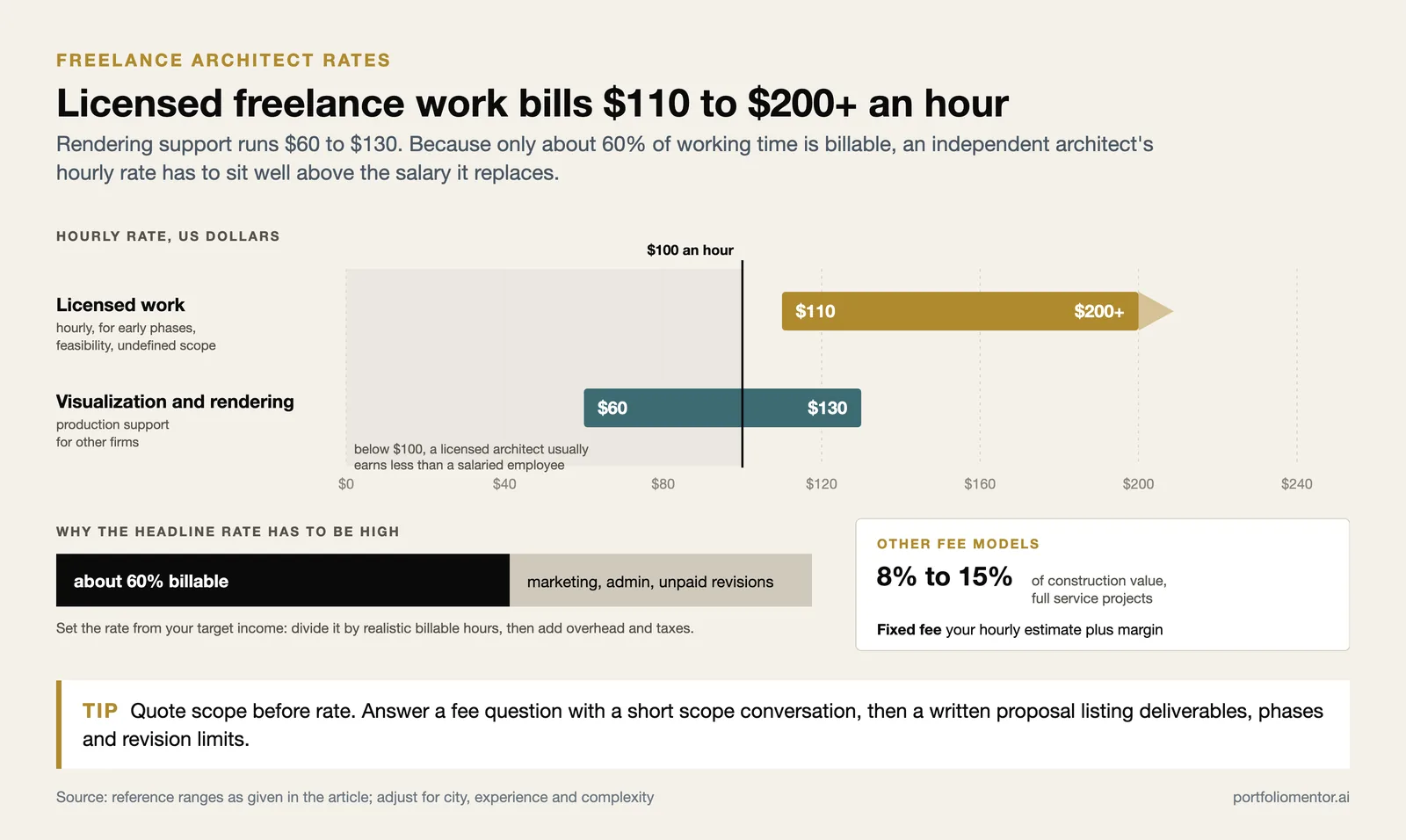
A freelance architect should charge enough to cover non-billable time, overhead, taxes, and benefits, which almost always means a higher headline rate than the equivalent salary suggests. The most common pricing mistake is treating every working hour as billable. In reality, you spend large blocks of time on marketing, admin, and unpaid revisions.
There are three standard fee structures, and most independent architects mix them depending on the phase of work.
Freelance architect rates by service and structure

The table below summarizes typical approaches. Treat the figures as starting reference points and adjust for your city, experience, and the complexity of the work.
| Fee structure | Best for | Typical reference range |
|---|---|---|
| Hourly | Early phases, undefined scope, feasibility | $110 to $200+ per hour for licensed work |
| Percentage of construction cost | Full-service residential and commercial projects | Often 8% to 15% of construction value |
| Fixed fee | Well-defined scope, repeat project types | Priced from your hourly estimate plus margin |
| Visualization / rendering | Production support for other firms | $60 to $130 per hour by complexity |
To set an hourly rate, work backward from your target income. If you assume roughly 60% of your time is billable and you want to earn a specific number after expenses, divide that figure by your realistic billable hours, then add overhead and taxes. A licensed architect charging under $100 per hour is usually earning less than they would as a salaried employee at a small firm, once unpaid hours are counted. Industry resources like Architizer’s Young Architect Guide on hourly rates make the same case: most independents undercharge.
💡 Pro Tip
Quote scope before rate. When a new client asks “what do you charge,” experienced freelancers respond with a short scope conversation first, then a written proposal that lists deliverables, phases, and revision limits. This anchors the discussion on value and protects you from open-ended revisions that quietly destroy your effective hourly rate.
How do you find work and clients as a freelance architect?

Finding clients is the part that separates freelancers who last from those who quietly return to salaried roles. Your first paid jobs almost never come from cold strangers. They come from people who already know your work: former colleagues, professors, contractors, and small firms that need overflow help. Tell that network specifically what you offer and that you are taking on projects.
Once your warm network is active, layer in these channels.
- Subcontracting to firms: Established practices regularly hire independents for production, rendering, and competition work. This is the fastest route to steady, paid hours.
- Freelance and architecture-specific job boards, including Archinect and general platforms like Upwork, where firms post overflow drawing work.
- Contractors and developers who need design and permit sets for small projects and prefer a nimble independent to a large firm.
- Referrals from past clients, which become your most reliable pipeline once you have delivered a few projects well.
- A visible portfolio site and LinkedIn presence so that when someone searches your name, your best work appears first.
Your portfolio does most of the selling before you ever speak to a client. A focused, well-sequenced portfolio that shows the kind of work you want more of will pull in matching projects. If you are still refining yours, our architecture portfolio examples show how strong sequencing and a clear cover project change hiring outcomes, and the Portfolio Mentor review can score your layout against the standards firms actually use.
🏗️ Real-World Example
Elena, residential freelancer to large-firm transition: In one Portfolio Mentor case study, a freelancer who wanted to move from boutique residential work toward larger studios restructured her projects by scale, switched to a large-firm layout, and added a dedicated team-coordination page. Reframing her independent work for a firm audience is exactly the kind of repositioning freelancers need when they pivot between client types.
What does a freelance architect CV and portfolio need?
A freelance CV reads differently from an employee CV. Instead of listing one job title and a list of duties, you present yourself as a service provider: the project types you handle, the software you work in, the deliverables you produce, and the outcomes you have shipped. Lead with capability, not chronology.
Keep these elements tight and client-facing:
- A one-line positioning statement that names your specialty (for example, residential permit sets or competition visualization).
- Selected projects with your specific role and the value you added, since freelancers rarely own a whole building alone.
- A clear software and skills block, because firms hiring overflow help filter on tools first.
- Licensure status and jurisdictions, stated honestly.
- A direct link or QR code to your portfolio, kept short and clean.
Pair the CV with a portfolio that matches the work you want. If you chase commercial subcontracting, your portfolio should not open with a student concept project. You can compare structures and presentation standards on the Portfolio Mentor platform and benchmark your layout before sending it to a paying client.
How do you get started as a freelance architect?
Getting started is less about a dramatic leap and more about a sequence of practical steps you can begin while still employed. The order below keeps you legal, paid, and protected.
- Decide which services you will offer: unstamped production and consulting, full stamped services, or both.
- Confirm your licensure status for stamped work, and pick honest titling for anything you cannot seal yet.
- Register a business entity, get a local business license, and secure professional liability and general liability insurance.
- Build a fee model with at least one hourly rate and one fixed-fee template, sized to cover non-billable time and taxes.
- Tighten your portfolio and freelance CV around the projects you want more of.
- Activate your warm network, then add subcontracting and job-board channels for steady volume.
- Use a simple written proposal and contract for every engagement, including scope, phases, and revision limits.
Frequently asked questions about freelance architecture
Can you freelance as an architect without a license?
You can freelance on unstamped work such as rendering, modeling, drafting, and code research without a license. You cannot sign and seal architectural documents or, in many states, even use the title “architect” until you are registered. Stick to titles like “architectural designer” until your license is active.
How much does a freelance architect make?
Earnings vary widely by location, specialty, and how consistently you fill billable hours. Licensed independents often bill between $110 and $200 per hour, but take-home income depends heavily on overhead, taxes, and how much non-billable time you absorb. Many freelancers underprice early and only reach parity with a salaried role after raising rates.
Is freelancing better than working at a firm?
It depends on what you value. Freelancing offers control over projects, clients, and schedule, but you trade away a steady salary, benefits, and a built-in pipeline. Many architects run a hybrid path, freelancing on the side while salaried, then going fully independent once their client base is stable.
Where to Go From Here
Your Next Step: Before you chase a single client, write down the three project types you most want and rebuild your portfolio’s opening pages around them, so the work you attract matches the work you actually want to do.