
A strong architecture resume is a one-page, keyword-aligned document that maps your design skills, software, and project experience to a specific job posting. It leads with measurable accomplishments, uses standard section headings, and stays readable by both applicant tracking systems and hiring architects who skim in seconds.
Most firms receive far more applications than they can interview, so your architecture resume has two jobs at once. It has to pass automated screening software, then convince a busy principal or HR lead that you are worth a portfolio review. This guide walks through every section, the keywords that matter, formatting that survives parsing, and concrete examples you can adapt. By the end you will know exactly what to keep, what to cut, and how to position your experience for the role you actually want.
What is an architecture resume?

An architecture resume is a focused summary, usually one page, of your education, technical skills, software proficiency, and project work, written to win an interview at a firm or studio. It differs from a generic resume because it pairs design judgment with hard production skills, and it usually sits alongside a portfolio rather than standing alone.
The U.S. Bureau of Labor Statistics reports that architects held about 124,600 jobs in 2025 and earned a median wage well above the average for all occupations, with employment projected to grow around 4 percent through 2035 (BLS Occupational Outlook Handbook). Steady but modest growth means firms can be selective, so a precise resume matters more than a long one. If you are still mapping the wider path from school to license, our guide on how to become an architect covers the timeline, cost, and credentials a resume should reflect.
Resume vs. portfolio: what goes where
Keep the two documents distinct. The resume tells the firm who you are, what you can build, and where you have worked. The portfolio proves it with drawings, models, and built work. Do not paste renderings into your resume or list every studio project. Reference the portfolio link once, near your contact details, and let it carry the visual weight.
📌 Did You Know?
Including the exact job title from the posting in your resume has been linked to roughly 10 times more interview invitations, according to resume-scanning platform Jobscan. For architects, that means writing “Architectural Designer” or “Project Architect” verbatim when the listing uses it, rather than a creative variant.
The essential sections of an architectural resume
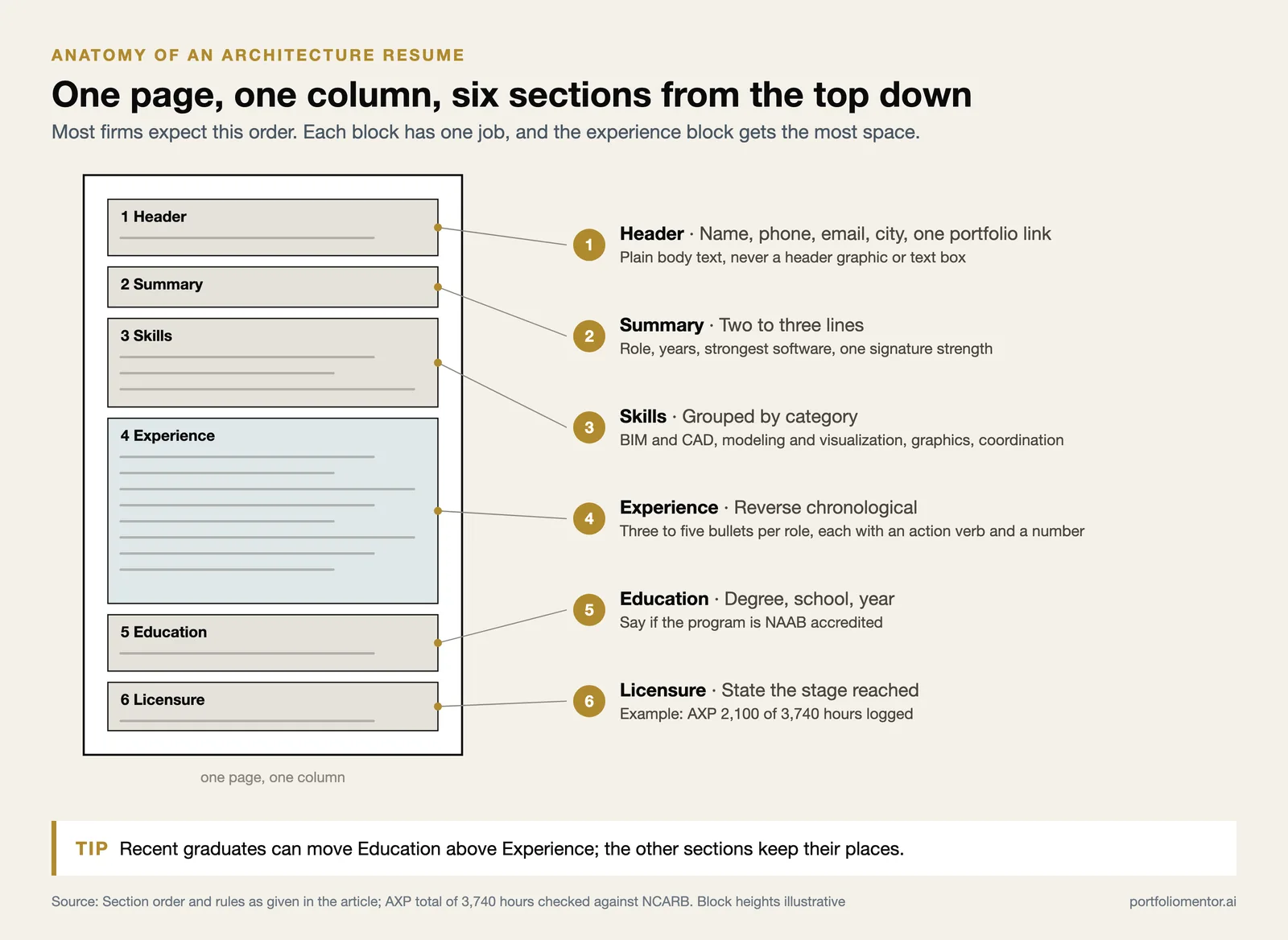
Every effective architectural resume is built from the same core sections, ordered by relevance to the job. Below is the structure most firms expect, from top to bottom.
1. Header and contact block
Put your full name, phone, professional email, city and state, and one portfolio link at the top of the page. Add your LinkedIn URL if it is current. Avoid placing this information inside a design header graphic or a text box, because parsing software often skips those regions entirely and your contact details vanish.
2. Professional summary
Write two to three lines that state your role, years of experience, strongest software, and a signature strength. Example: “Licensed architect with 6 years of experience in mid-rise residential and adaptive reuse, fluent in Revit and Rhino, focused on construction documentation and code compliance.” Skip vague objectives such as “seeking a challenging role.”
3. Technical skills and software

This is the single most scanned section for emerging architects. List software in a clean, comma-separated line under a plain heading. Group by category so a reviewer can scan quickly:
- BIM and CAD: Revit, AutoCAD, ArchiCAD
- Modeling and visualization: Rhino, Grasshopper, SketchUp, Enscape, V-Ray, Lumion
- Graphics and layout: Adobe Photoshop, Illustrator, InDesign
- Coordination: Navisworks, Bluebeam Revu, Microsoft Project
💡 Pro Tip
Mirror the exact software names from the job posting. If a firm writes “Revit” and your resume only says “BIM software,” some screening systems will not register a match. List the named tools first, then any extras you bring.
4. Professional experience
List roles in reverse chronological order with firm name, title, location, and dates. Under each role, write three to five bullet points that start with an action verb and, wherever possible, include a number or measurable result. Tie the work to recognizable phases of practice. The NCARB Architectural Experience Program defines six experience areas, including project planning and design, project development and documentation, and construction and evaluation (NCARB AXP requirements). Framing your bullets around those areas signals that your experience maps to licensure.
Strong bullet examples:
- Produced construction documents for a 42-unit multifamily project, coordinating with structural and MEP consultants across three permit submissions.
- Modeled a 60,000 sq ft office tenant fit-out in Revit, reducing clash-detection issues by 30 percent before the GC review.
- Led schematic design presentations for two retail clients, securing approval to advance to design development.
5. Education
Include degree, institution, graduation year, and whether the program is NAAB-accredited, since accreditation affects your licensure path. List study abroad, design awards, or a high thesis distinction only if they strengthen your case. For recent graduates, education can sit above experience.
6. Licensure, registration, and affiliations

State your status clearly: licensed architect with state, AXP in progress with hours logged, ARE divisions passed, LEED or WELL accreditation, and memberships such as AIA. The American Institute of Architects maintains career resources and an emerging professionals network that many firms value (AIA Emerging Professionals). If you are early in the process, a line like “AXP: 2,100 of 3,740 hours logged” shows momentum.
How to choose architecture resume keywords
The fastest way to choose resume keywords is to read the job posting closely and reuse the exact terms it repeats. Words that appear more than once, especially software names and role titles, are the ones the firm and its screening software weight most heavily.
Architecture resume keywords fall into a few predictable buckets. Pull from each, then match them to the listing:
- Software: Revit, AutoCAD, Rhino, Grasshopper, SketchUp, Enscape, Bluebeam, Navisworks
- Phases and deliverables: schematic design, design development, construction documents, construction administration, redlines, RFIs, submittals
- Project types: multifamily, mixed-use, hospitality, healthcare, adaptive reuse, tenant improvement
- Skills and standards: BIM coordination, code analysis, zoning, ADA compliance, sustainability, LEED
⚠️ Common Mistake to Avoid
Do not stuff keywords into a hidden list or white text to game the system. Modern screening tools flag unnatural repetition, and human reviewers immediately notice keywords with no context behind them. Aim to use each important term two to three times across real bullet points, not in a buried block.
How to make your resume ATS-friendly
To make an architecture resume ATS-friendly, use a single-column layout, standard section headings, a common font, and a .docx or text-based PDF file. Applicant tracking systems parse your content into fields before any keyword matching happens, so a clean structure is what lets your keywords count at all.
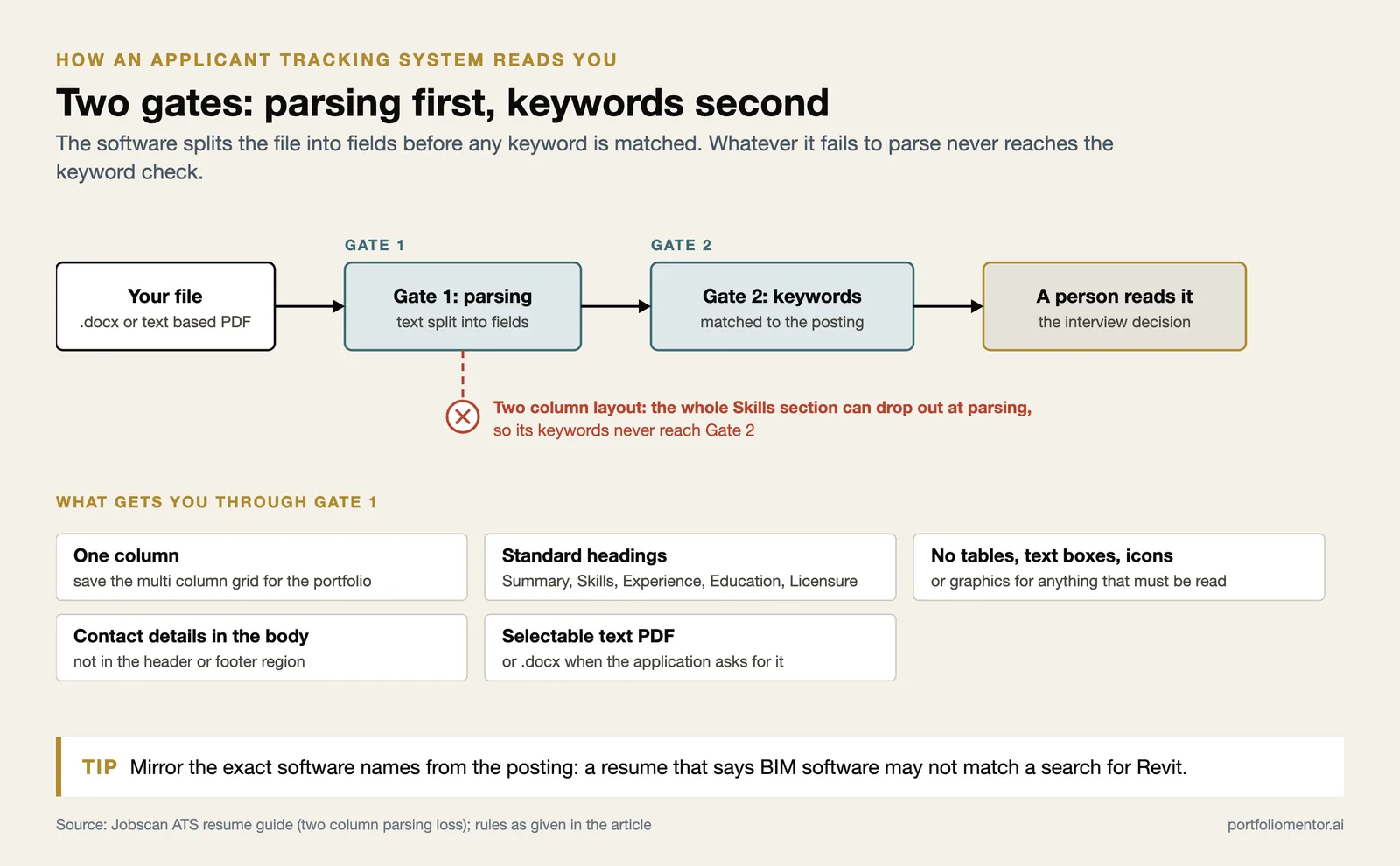
Parsing happens before keyword evaluation, and according to resume-scanning research, a two-column layout can cause an entire skills section to be dropped before keywords are ever read (Jobscan ATS guide). For a profession that loves elaborate layouts, this is the hardest habit to break. Follow these rules:
- Use one column. Save the multi-column grid for your portfolio.
- Use standard headings: Summary, Skills, Experience, Education, Licensure.
- Avoid tables, text boxes, icons, and graphics for any content that must be read.
- Keep contact details in the body, not the header or footer region.
- Export a selectable-text PDF, and submit .docx when the application asks for it.
🔢 Quick Numbers
- About 124,600 architect jobs in the U.S. (2025), with roughly 6,900 openings projected each year (BLS Occupational Outlook Handbook)
- 4 percent projected employment growth for architects, 2025 to 2035 (BLS)
- 3,740 hours across six experience areas required to complete the NCARB AXP (NCARB)
Architecture resume examples by experience level
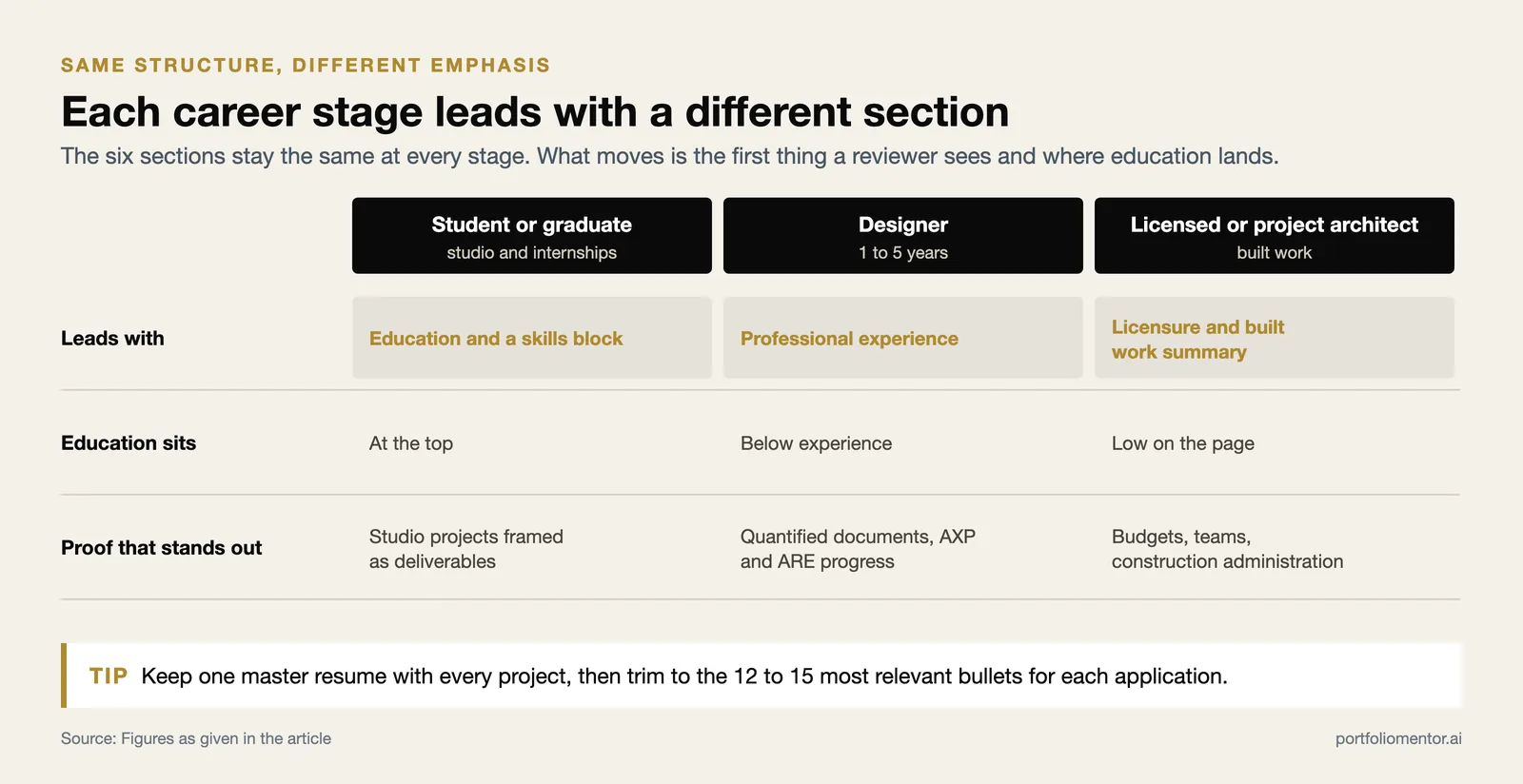
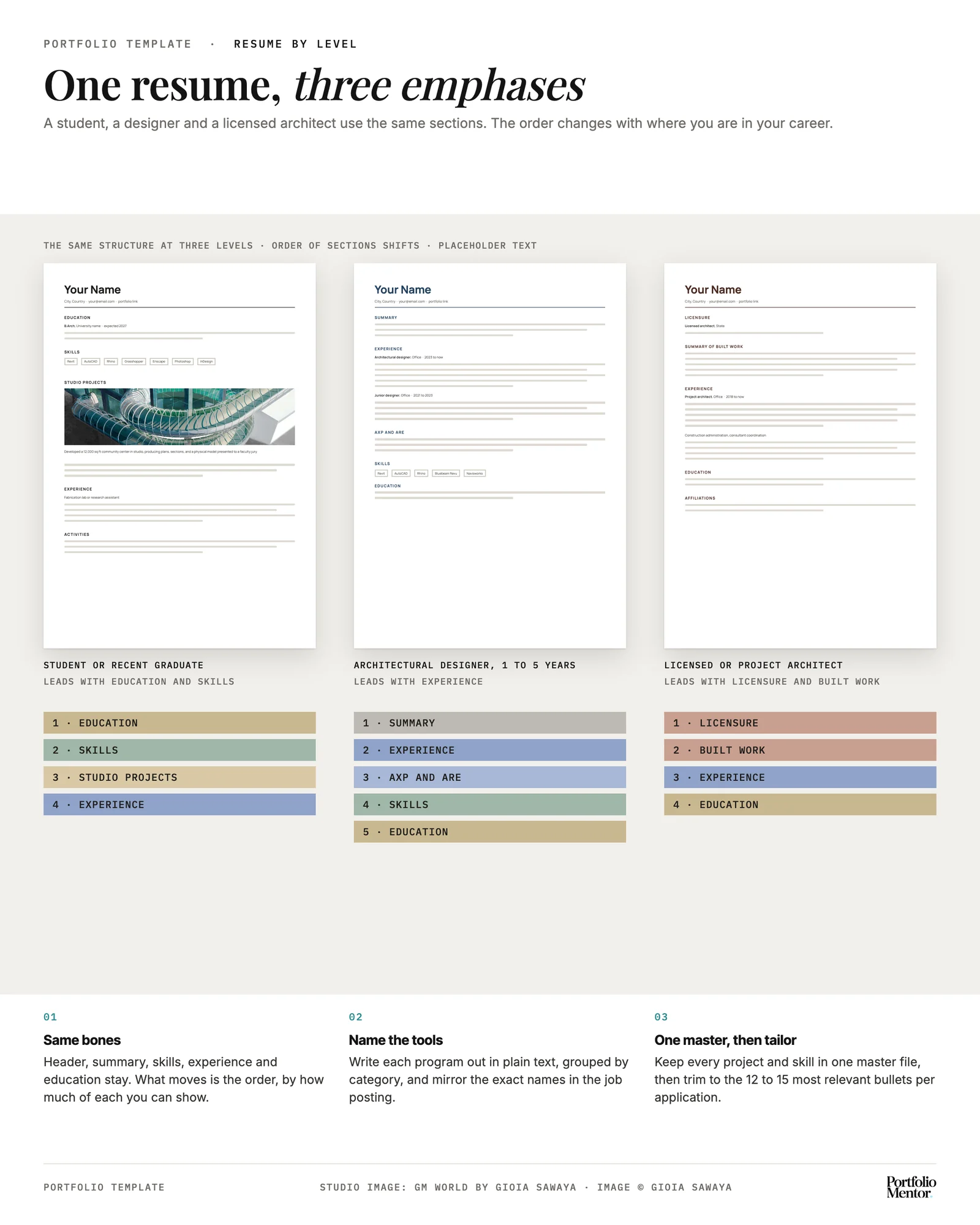
The right architecture resume examples depend on where you are in your career. A student leads with software and studio skills, a designer leads with project deliverables, and a licensed architect leads with leadership and built work. The structure stays the same, but the emphasis shifts.
Student or recent graduate
Lead with education and a skills block, then list studio projects framed as real deliverables. Include any internship, fabrication lab role, or research assistantship. If you are still applying for early roles, our guide to architecture internships explains how to translate coursework into experience a firm recognizes. A sample bullet: “Developed a 12,000 sq ft community center in studio, producing plans, sections, and a physical model presented to a faculty jury.”
Architectural designer (1 to 5 years)
Lead with professional experience and quantify contributions to documents, coordination, and design phases. Show progression from one firm or project to the next. This is where AXP progress and ARE divisions passed belong near the top. For bullets written at this level, these architectural designer resume examples show how designers describe drawing sets, coordination and phase work.
Licensed or project architect
Lead with licensure and a summary of built work, budgets managed, teams led, and client relationships. Move education lower. Emphasize construction administration, consultant coordination, and outcomes such as on-time delivery or value-engineering savings.
💡 Pro Tip
Keep one master resume with every project and skill, then create a tailored version for each application by trimming to the most relevant 12 to 15 bullets. Tailoring takes ten minutes and beats sending the same generic file to every firm.
Pairing your resume with a cover letter and portfolio
A resume rarely travels alone. Firms expect a short cover letter that connects your specific experience to their work, plus a portfolio that proves your design ability. Treat the three as one application: the cover letter sets the narrative, the resume lists the evidence, and the portfolio shows the craft. For help with the letter, see our architecture cover letter examples and templates, which pair naturally with the resume structure above.
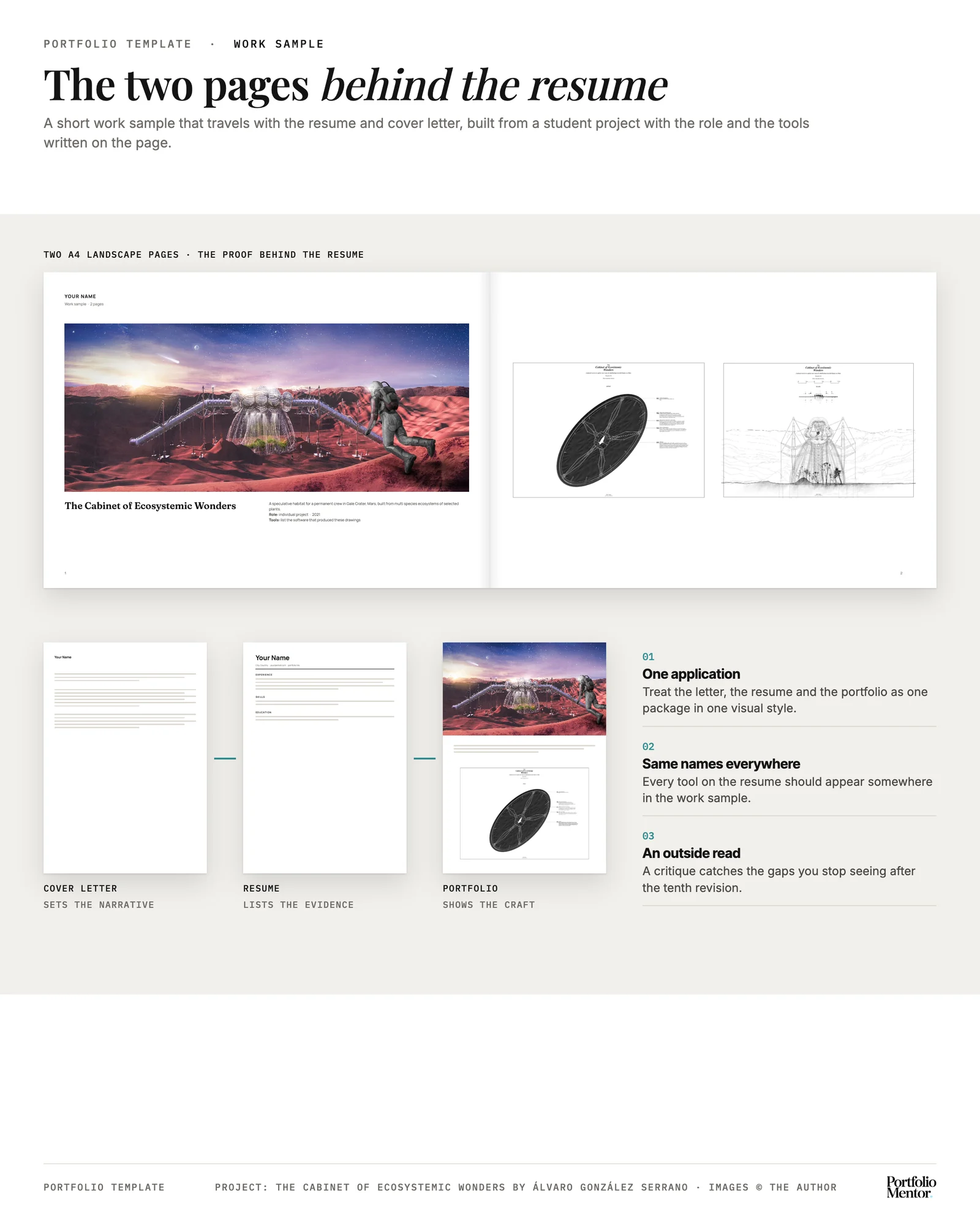
Once your documents are drafted, get an objective read before you submit. You can run your portfolio through our free portfolio checks for feedback, and the 60-second review page explains what the review covers. An outside critique catches the gaps you stop seeing after the tenth revision.
Frequently asked questions
How long should an architecture resume be?
One page for students and designers with fewer than ten years of experience. Licensed architects with extensive built work can justify two pages, but only if every line earns its place. Length is never a substitute for relevance.
Should I include my portfolio in my resume?
No. Include a single portfolio link near your contact details, but keep images out of the resume itself. Renderings inflate file size, break parsing, and dilute a document that should be fast to scan.
What software should an architect list first?
List the tools named in the job posting first, then your strongest additional skills. For most firms that means Revit and AutoCAD near the front, followed by Rhino, Grasshopper, and visualization tools as relevant.
Do I need different resumes for different firms?
You need one master resume and a tailored version per application. Adjust the summary, reorder skills, and swap in the bullets that best match each firm’s project types and named software. A targeted resume consistently outperforms a generic one.
Key Takeaways
- Keep your architecture resume to one page, single-column, with standard headings so it parses cleanly.
- Mirror the exact software and job title from the posting, and use each key term two to three times in real bullets.
- Quantify experience and frame it around recognized phases of practice and AXP experience areas.
- Tailor a master resume per firm, and pair it with a focused cover letter and a reviewed portfolio.