The median architect salary in the United States is $99,280 per year, according to May 2025 data from the U.S. Bureau of Labor Statistics. Most building architects earn between $62,300 and $161,420 annually, with pay rising sharply once you hold a license, take on project leadership, or move into a high-cost metro market.
If you are weighing an architecture career or trying to benchmark your next raise, the word “architect” alone is not enough to predict your pay. This architect salary guide breaks down real numbers by experience, role, and location, separates building and design architects from the IT job titles that share the same word, and shows the concrete levers that raise your offer. Every salary figure here comes from a primary government or professional source, not a crowdsourced estimate.
How much do architects make on average?
Licensed building architects earn a median of $99,280 per year as of May 2025. The lowest-paid 10 percent earned under $62,300, and the highest-paid 10 percent earned more than $161,420, based on the Bureau of Labor Statistics Occupational Outlook Handbook. That spread of roughly $100,000 between the bottom and top is the single most important fact in this guide: your title says far less about your pay than your experience, license status, and market do.
The average architect salary also depends on which kind of architect you mean. The figures above cover building architects, the professionals who design houses, offices, schools, and other structures. Landscape and interior specialists sit on a different scale, and the technology roles that borrow the word “architect” follow an entirely separate market that this guide treats at the end.
🔢 Quick Numbers
- Building architects: $99,280 median annual wage (BLS, May 2025)
- Landscape architects: $79,870 median annual wage (BLS, May 2025)
- Interior designers: $67,190 median annual wage (BLS, May 2025)
- Architect employment is projected to grow 4 percent from 2025 to 2035 (BLS)
Architect salary by experience level
Experience is the clearest predictor of where you land within the BLS range. Pay climbs in distinct stages, and each stage tends to align with a milestone such as graduation, licensure, or moving into project or firm leadership. The bands below describe how the median wage typically distributes across a career, drawing on BLS percentile data and the position-level analysis in the AIA Compensation and Benefits Report.
Entry-level architect salary (0 to 3 years)
Recent graduates working as architectural designers or associates before licensure sit at the bottom of the BLS distribution: the lowest-paid 10 percent of architects earned under $62,300 a year in May 2025, which works out to about $5,192 a month or $29.95 an hour, and that is the band most pre-licensure staff fall into. The AIA reports that architectural associates, meaning non-licensed recent graduates, saw some of the strongest salary growth of any group between 2023 and 2025 at about 7 percent, which has pulled starting offers upward in competitive markets.
Mid-career and licensed architect salary (4 to 9 years)

Passing the Architect Registration Examination and earning a state license is the largest single jump most professionals will see. Licensed architects doing the same work as unlicensed staff typically earn 15 to 20 percent more. This stage usually places professionals around the national median of $99,280, with project architects who run their own projects often reaching into six figures.
📌 Did You Know?
According to NCARB By the Numbers 2025, the average path to licensure now takes just under 13 years from the start of college, and candidates pass all six divisions of the ARE in about 2.3 years on average. Because licensure is the biggest pay lever in the field, every year you shorten that timeline tends to translate into earlier access to the licensed salary band.
Senior and principal architect salary (10+ years)

Senior architects, studio directors, and firm principals occupy the top BLS percentiles, where pay exceeds $161,420 for the highest earners. At this level, compensation increasingly reflects business outcomes such as bringing in clients, managing fee-profitable projects, and leading staff, rather than drafting hours. Equity or profit-sharing in a firm can add substantially beyond base salary and is rarely captured in the published wage tables.
If you are still mapping out how to reach these milestones, our walkthrough of how to become an architect lays out the degree, experience, and exam steps in order, including the timeline that drives the licensed pay jump described above.
Architect salary by role and specialization
Not every “architect” earns the same median, because the specialization changes the underlying market. Below are the main building and design tracks, each with verified BLS figures so you can compare them on equal footing.
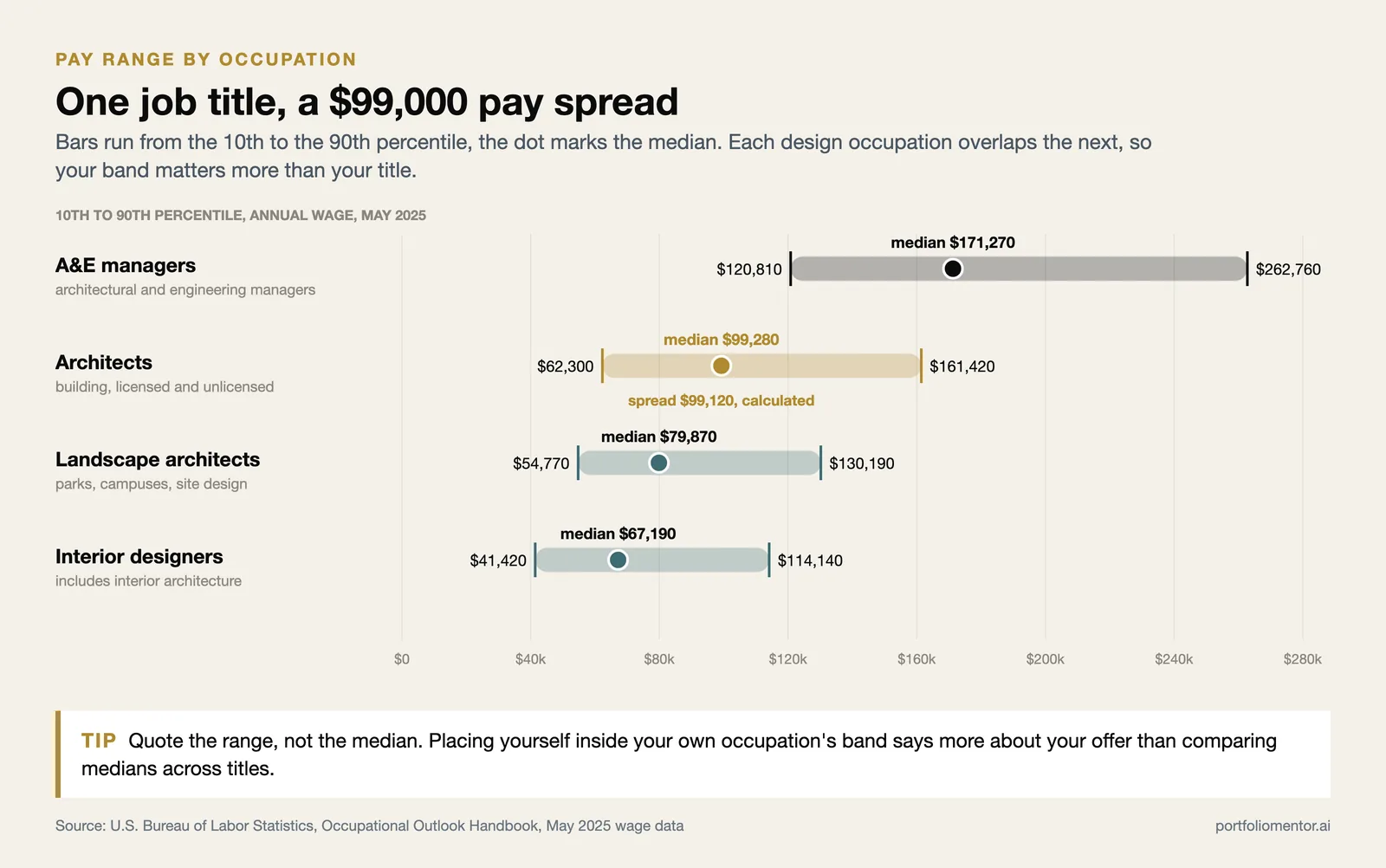
| Role (US occupation) | Median / year | Median / month | Median / hour | 10th–90th percentile |
|---|---|---|---|---|
| Architectural and engineering managers Firm principals, directors of design and practice leaders are counted here. | $171,270 | $14,272 | $82.34 | $120,810 – $262,760 |
| Architects (except landscape and naval) The core building architect occupation, licensed and unlicensed staff combined. | $99,280 | $8,273 | $47.73 | $62,300 – $161,420 |
| Landscape architects Parks, campuses, master plans and site design. | $79,870 | $6,656 | $38.40 | $54,770 – $130,190 |
| Interior designers Where most US interior architecture work is counted. | $67,190 | $5,599 | $32.30 | $41,420 – $114,140 |
Source: U.S. Bureau of Labor Statistics, Occupational Outlook Handbook, May 2025 wage data (published 2026) — Architects, Landscape Architects, Interior Designers, Architectural and Engineering Managers. Figures are United States, all industries, full-time and part-time workers combined. Monthly = annual ÷ 12. Hourly = annual ÷ 2,080, so it can differ by a cent from the hourly median BLS publishes. Checked 9 September 2026.
Read the range, not just the median. The 10th to 90th percentile column is the honest answer to “what is the minimum to maximum salary”: for architects it runs from $62,300 to $161,420, a spread of about $99,000 on the same job title. Architectural and engineering managers are the highest-paid of these occupations at a $171,270 median, which is the ceiling most architects are actually moving toward when they talk about becoming a principal.
Landscape architect salary
Landscape architects, who design parks, campuses, and outdoor environments, earned a median of $79,870 per year in May 2025 according to the BLS landscape architects handbook. The role requires a bachelor’s degree in landscape architecture and a state license in most states, and it sits below building architects partly because firms and project budgets in the field tend to be smaller.
Interior architect and interior designer salary
“Interior architect” is a title used for designers who focus on the structural and spatial planning of building interiors. In the United States, this work is tracked by BLS under interior designers, who earned a median of $67,190 in May 2025, with the top 10 percent above $114,140. Professionals who combine interior work with a building architecture license or who serve commercial clients generally land in the upper half of that range.
⚠️ Common Mistake to Avoid
Do not compare your offer to a “software architect” or “solutions architect” salary you found online. Those technology roles share the word but follow the IT labor market, where six-figure pay is common at junior levels. Benchmarking a building, landscape, or interior design role against them produces unrealistic expectations and can sabotage an otherwise fair negotiation.
Architect pay by employer type
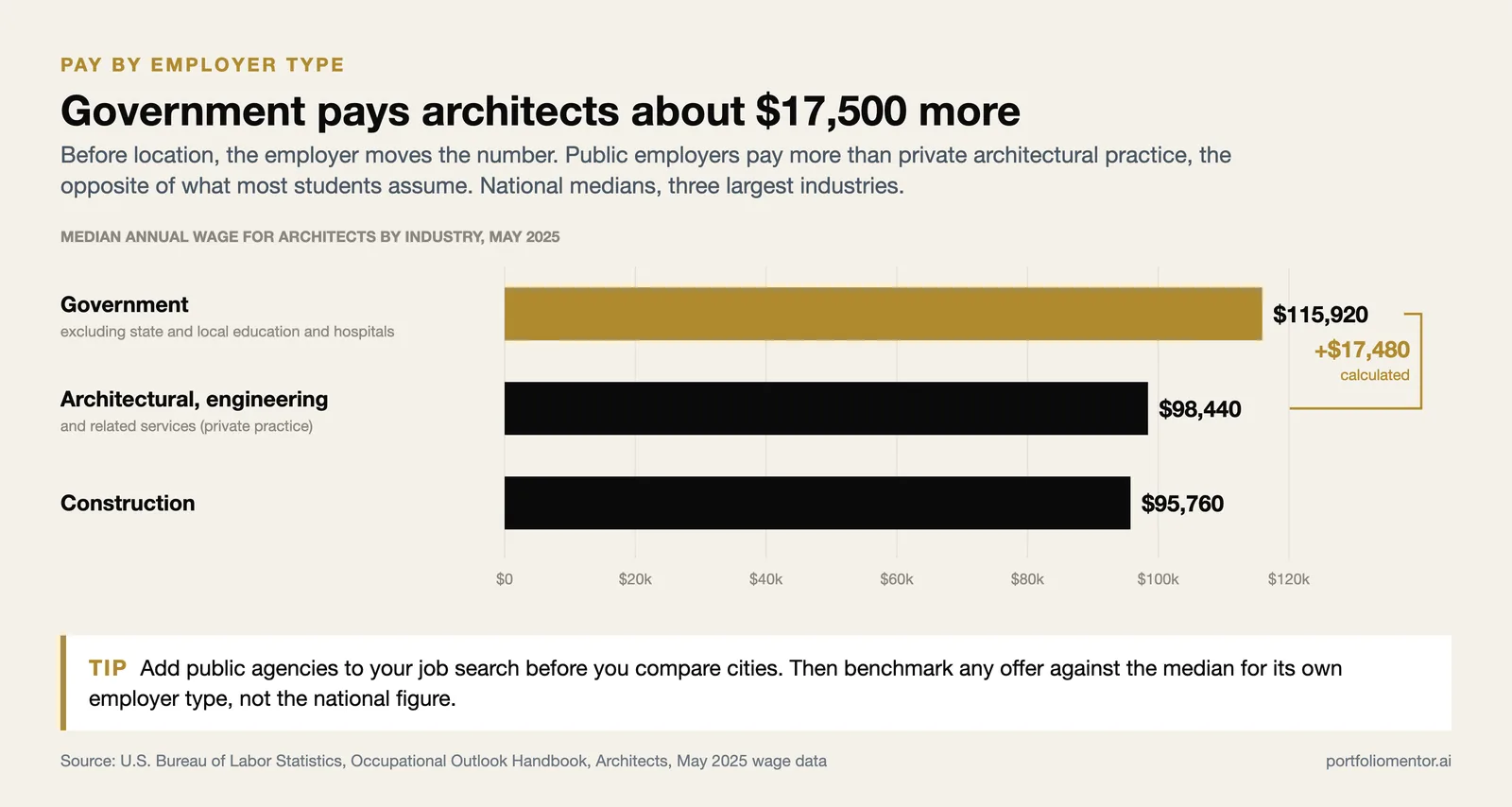
Before location, the employer type moves the number. These are US medians for architects in their three largest industries, from the same May 2025 BLS release.
| Where architects work | Median / year | Median / month | Median / hour |
|---|---|---|---|
| Government (excluding state and local education and hospitals) | $115,920 | $9,660 | $55.73 |
| Architectural, engineering and related services | $98,440 | $8,203 | $47.33 |
| Construction | $95,760 | $7,980 | $46.04 |
Government work pays the highest median of the three, about $17,500 a year more than private architectural practice, which is the opposite of what most students assume.
How does location affect architect salary?
Location can shift an architect salary by tens of thousands of dollars for the same title and experience. The highest wages concentrate in large coastal metros and states with dense commercial construction, such as California, New York, Massachusetts, and Washington, where median pay runs well above the national figure. Lower-cost regions in the South and Midwest often pay closer to or below the national median.
Two adjustments matter when you read a high-metro number. First, cost of living offsets much of the premium, so a $130,000 salary in San Francisco may afford less than $95,000 in a mid-size city. Second, remote and hybrid roles are slowly decoupling pay from location, which can let you keep a high-market salary while living in a cheaper region. Always compare offers on a cost-of-living-adjusted basis rather than headline numbers alone.
Local construction demand drives these gaps. A metro with active commercial, institutional, and large residential pipelines keeps firms competing for staff, which pushes wages up across every experience band. In slower markets, the same title can pay 20 to 30 percent less for identical work. When you evaluate a relocation or a remote offer, weigh both the wage table and how stable the pipeline of work looks in that region over the next few years.
💡 Pro Tip
Before any salary conversation, pull the BLS state and metropolitan wage tables for your exact occupation code and location, then bring the 75th-percentile figure to the table. Anchoring on a sourced government percentile, rather than a national average, gives you a credible number that is hard for an employer to dismiss.
What Do Architects Earn Outside the US?
The UK offers the clearest comparison, because the RIBA runs an annual earnings survey. In the RIBA and Fees Bureau survey published in September 2025, with more than 1,200 chartered architects responding, the median salary for a full-time architect was £52,000 as of April 2025 — a 4 percent rise that exactly matched inflation.
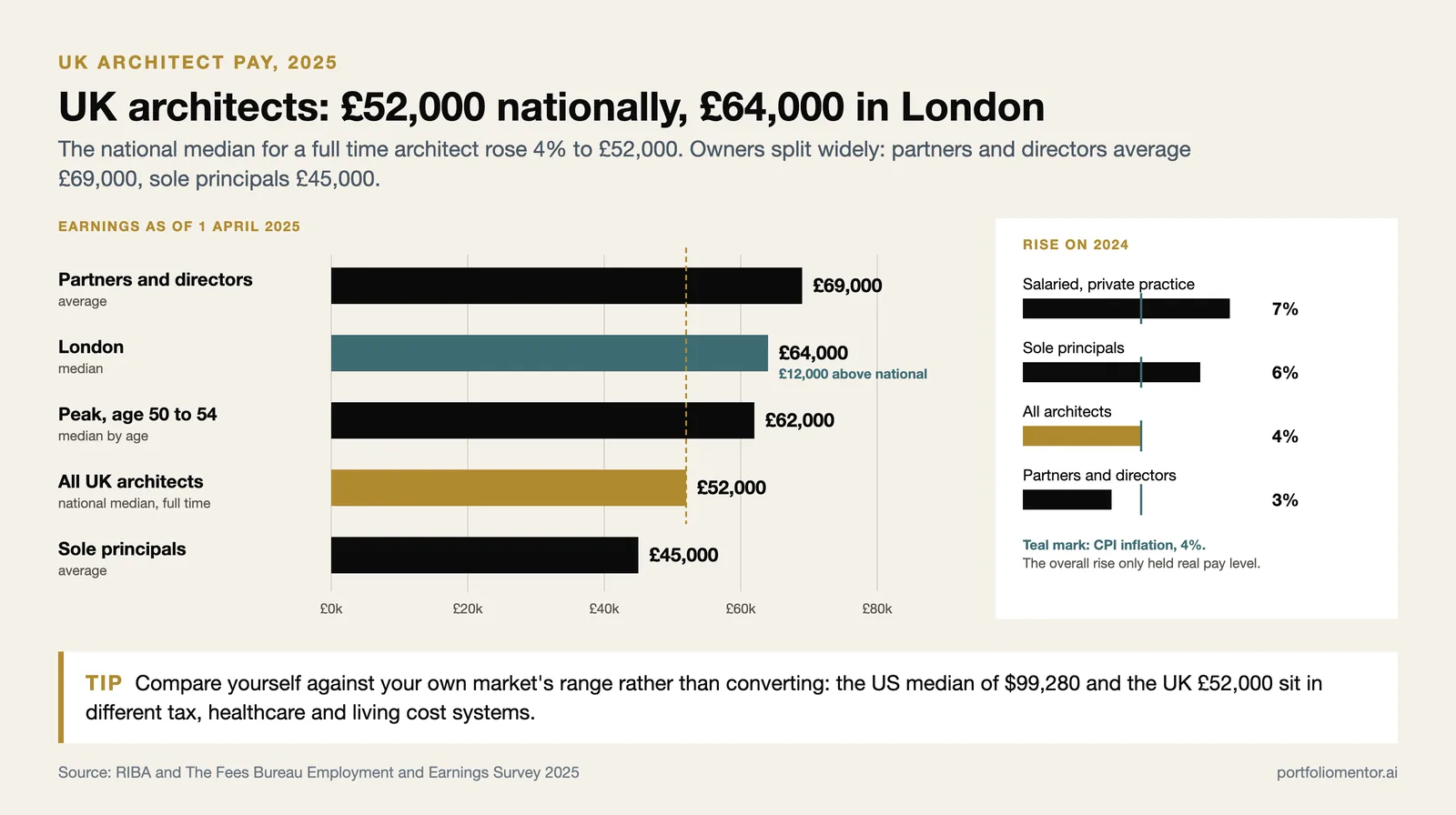
The internal spread follows the same logic as the US data. London architects reported a median of £64,000, some £12,000 above the national figure. Salaried architects in private practice saw the strongest growth at 7 percent, sole principals reported an average of £45,000, and partners and directors averaged £69,000. Earnings tracked with experience and peaked around age 50 to 54 at £62,000, then eased back.
Read the two markets side by side rather than converting one into the other. The US median of $99,280 and the UK median of £52,000 sit in different tax, healthcare and cost-of-living systems, so the useful comparison is where you fall within your own market’s range, not what the exchange rate says.
How to increase your architect salary
Because the BLS range is so wide, most architects have real room to move up within their own experience band. The fastest levers are licensure, specialization, presentation of your work, and disciplined negotiation.
- Finish your license. The 15 to 20 percent premium for licensed architects is the highest-return investment of time in the field. Treat the ARE as a salary project, not just a credential.
- Specialize where budgets are large. Healthcare, data centers, lab, and large commercial work command higher fees, which flows into staff pay. Niche technical skills such as building performance modeling or code consulting also lift your value.
- Document measurable outcomes. Square footage delivered, budgets managed, and projects led give you concrete leverage. A strong portfolio and a results-focused resume turn that work into a higher offer.
- Negotiate with data, not feelings. Counter with a sourced percentile, a competing offer, or a documented scope increase rather than a general request to “earn more.”
Your portfolio is often the deciding factor between two candidates at the same experience level, which means a weak presentation can quietly cost you a salary band. You can run your portfolio through Portfolio Mentor to see how the AI review works and get specific, actionable feedback before an interview, and the full scoring breakdown covers the project storytelling that hiring principals weigh most heavily.
On the application side, the way you frame your experience matters as much as the work itself. Our architecture resume guide with examples shows how to translate project hours into the measurable outcomes that justify a higher number, so your resume and portfolio argue for the same salary.
Moving up a band usually starts with getting the interview, and the portfolio is what decides that. Get yours read page by page before your next application — we score the portfolio, not your salary.
Score my portfolio free →Building architect vs. IT architect salaries
A large share of online “architect salary” data actually describes technology roles, which distorts expectations for design professionals. Computer network architects, software architects, and solutions architects all use the word but work in the IT market, where median pay sits well into six figures and is set by software demand rather than construction fees.
If your goal is building, landscape, or interior design, ignore those numbers entirely when benchmarking. They share a label, not a labor market. The relevant comparison set for a design architect is the BLS architecture and engineering occupations group and the AIA position tables, both used throughout this guide.
Frequently asked questions
What is the starting salary for an architect?
There is no separate BLS figure for entry level, so the honest anchor is the bottom of the architect distribution: the lowest-paid 10 percent earned under $62,300 a year in May 2025, about $5,192 a month or $29.95 an hour. Pre-licensure designers and associates are the group that sits in and just above that band, with higher offers in expensive metros. The exact figure depends on firm size, market, and the strength of your portfolio at the interview.
Do licensed architects earn more than unlicensed staff?
Yes. Licensed architects typically earn 15 to 20 percent more than unlicensed staff doing comparable work, which makes the ARE the most reliable single step for raising your pay within an experience band.
Which architecture specialization pays the most?
Among the BLS-tracked design fields, building architects ($99,280 median) out-earn landscape architects ($79,870) and interior designers ($67,190). Within building architecture, principals and architects working on large commercial, healthcare, and technical projects reach the top of the range.
Is architecture a growing field?
Yes, modestly. BLS projects 4 percent employment growth for architects from 2025 to 2035, about as fast as the average for all occupations, with roughly 124,600 architects employed as of 2025. NCARB also reports near-record numbers of active licensure candidates.
Key Takeaways
- The median architect salary is $99,280, but the realistic range runs from about $62,300 to over $161,420 depending on experience, license, role, and market.
- Licensure is the biggest single lever, typically worth 15 to 20 percent more pay.
- Landscape ($79,870) and interior design ($67,190) follow separate, lower scales, and IT “architect” roles are a different market entirely.
- Location, specialization, a strong portfolio, and data-backed negotiation are the practical ways to move up within your band.
Salary figures in this guide reflect U.S. Bureau of Labor Statistics May 2025 data and the AIA Compensation and Benefits Report. Verify current figures for your specific occupation and location through the BLS Occupational Outlook Handbook before salary discussions.