
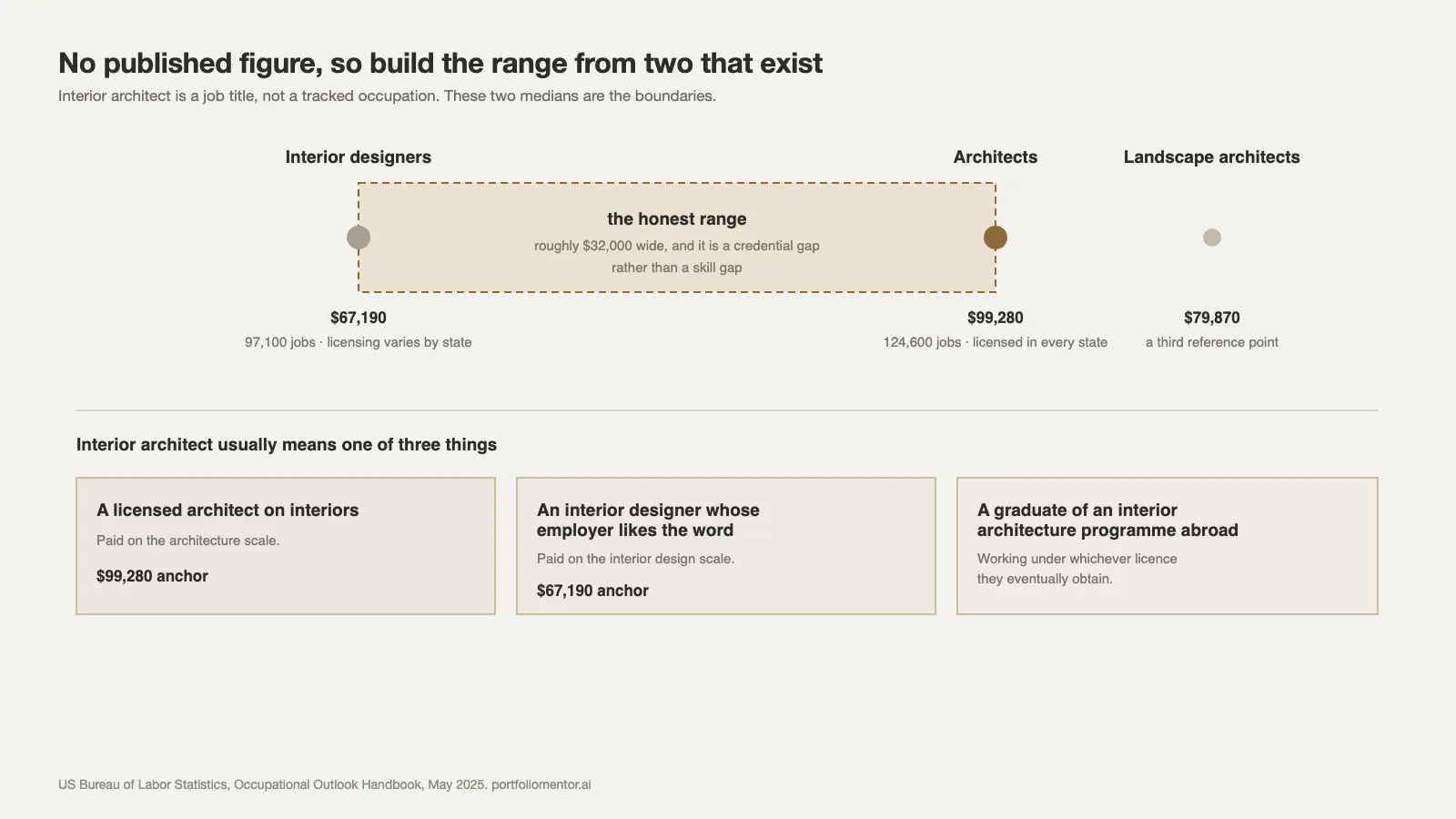
Interior architect salary sits between two tracked occupations rather than inside one. US labor statistics report a median of $67,190 for interior designers and $99,280 for architects as of May 2025. Interior architects are counted under whichever licence they hold, so the honest range spans both figures.
That is an unsatisfying answer and it is the correct one. “Interior architect” is a job title, not a licensed occupation in most US jurisdictions, which means no agency publishes a median for it. Anyone quoting a single precise number for the role is either reproducing a self-reported salary aggregator or quietly substituting the interior designer figure.
What follows is how to build a realistic expectation from the data that does exist, and what moves the number within it.
What does an interior architect earn?
Use the two published medians as the boundaries of a range, then position yourself by credential and employer type.
🔢 Quick Numbers
- Interior designers: median $67,190 per year, $32.31 per hour, 97,100 jobs, 3 percent growth 2025 to 2035 (BLS Occupational Outlook Handbook, May 2025)
- Architects: median $99,280 per year, 124,600 jobs, lowest 10 percent under $62,300 and highest 10 percent above $161,420 (BLS, May 2025)
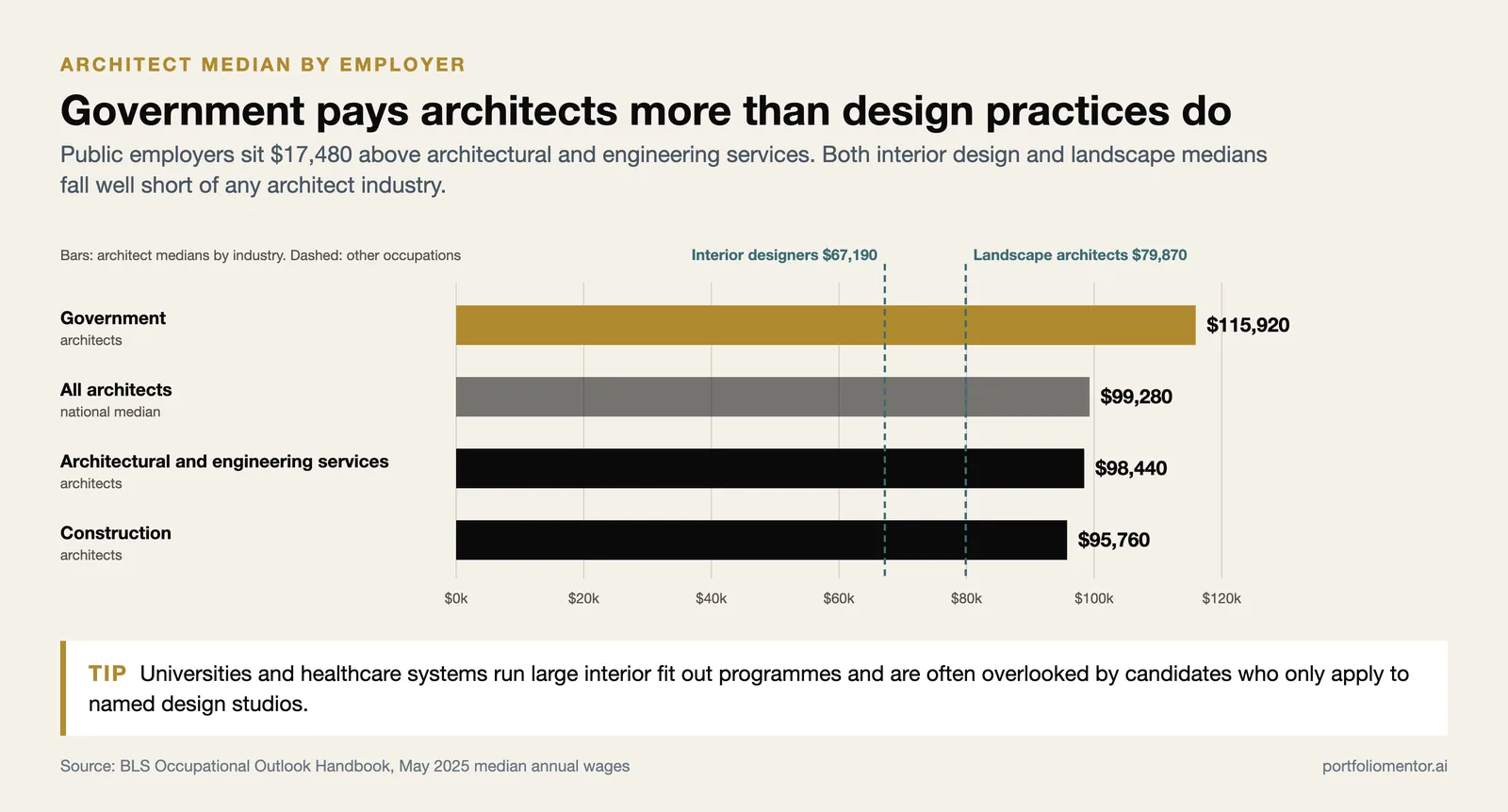
- Architect median by industry: government $115,920, architectural and engineering services $98,440, construction $95,760 (BLS, May 2025)
For a third reference point, landscape architects sit between them at a median of $79,870, with licensure required in every state. The published medians track the strictness of the credential more closely than the complexity of the work.
The gap between the two main medians is roughly $32,000. That is larger than most people assume for roles that often sit at neighbouring desks doing overlapping work. It is a credential gap rather than a skill gap, and closing it means going through the full route to becoming an architect.
Why is there no official interior architect salary?
Because the title is not a protected occupation in most places. BLS tracks interior designers as a distinct occupation and notes that licensing rules “vary significantly by state.” Some states restrict the title “interior designer” to licensed professionals. Others permit licensed and unlicensed practitioners alike to use it.
Where a state does regulate, the route it describes is an interior design credential rather than an architecture one. BLS notes that candidates in restrictive states must pass a state-approved exam. They must also hold “at least a bachelor’s degree in interior design plus 2 years of full-time work experience” to register.
“Interior architect” therefore usually means one of three different things, each paying differently.
- A licensed architect working on interiors, paid on the architecture scale.
- An interior designer whose employer prefers the word architect in job titles, paid on the interior design scale.
- A graduate of a European or Asian interior architecture programme, where the degree title is standard, working in the US under whichever licence they eventually obtain.
⚠️ Common Mistake to Avoid
Putting “interior architect” on a US business card without an architecture licence. Several states restrict the word architect in any job title, and the restriction applies to compound titles. The consequence is rarely dramatic, but it is a board complaint waiting to happen and it is avoidable. Use the title your credential supports and let the portfolio establish the scope of work you do.
What moves the number
Credential
The single largest factor. Holding an architecture licence moves you from one published median to the other, and it does so regardless of whether the projects change. Candidates weighing whether the licence is worth the effort for interiors work should treat that $32,000 gap as the answer.
Employer type
BLS reports architect medians by industry for May 2025, and the ordering is counterintuitive: government at $115,920 pays above architectural and engineering services at $98,440. Public institutions with large interior fit-out programmes, universities and healthcare systems among them, are consistently underestimated by candidates focused on named design studios. The trade-offs between employer types are set out in the firm guide.
Sector
Corporate workplace and healthcare interiors pay above hospitality and residential in most markets, because the budgets and the documentation burden are larger. Hospitality attracts more applicants per role, which suppresses offers.
Location
The spread within the architecture occupation, from under $62,300 to above $161,420, is driven more by metro area and seniority than by discipline. A regional median is a far better benchmark than a national one when you are preparing for an offer conversation.
💡 Pro Tip
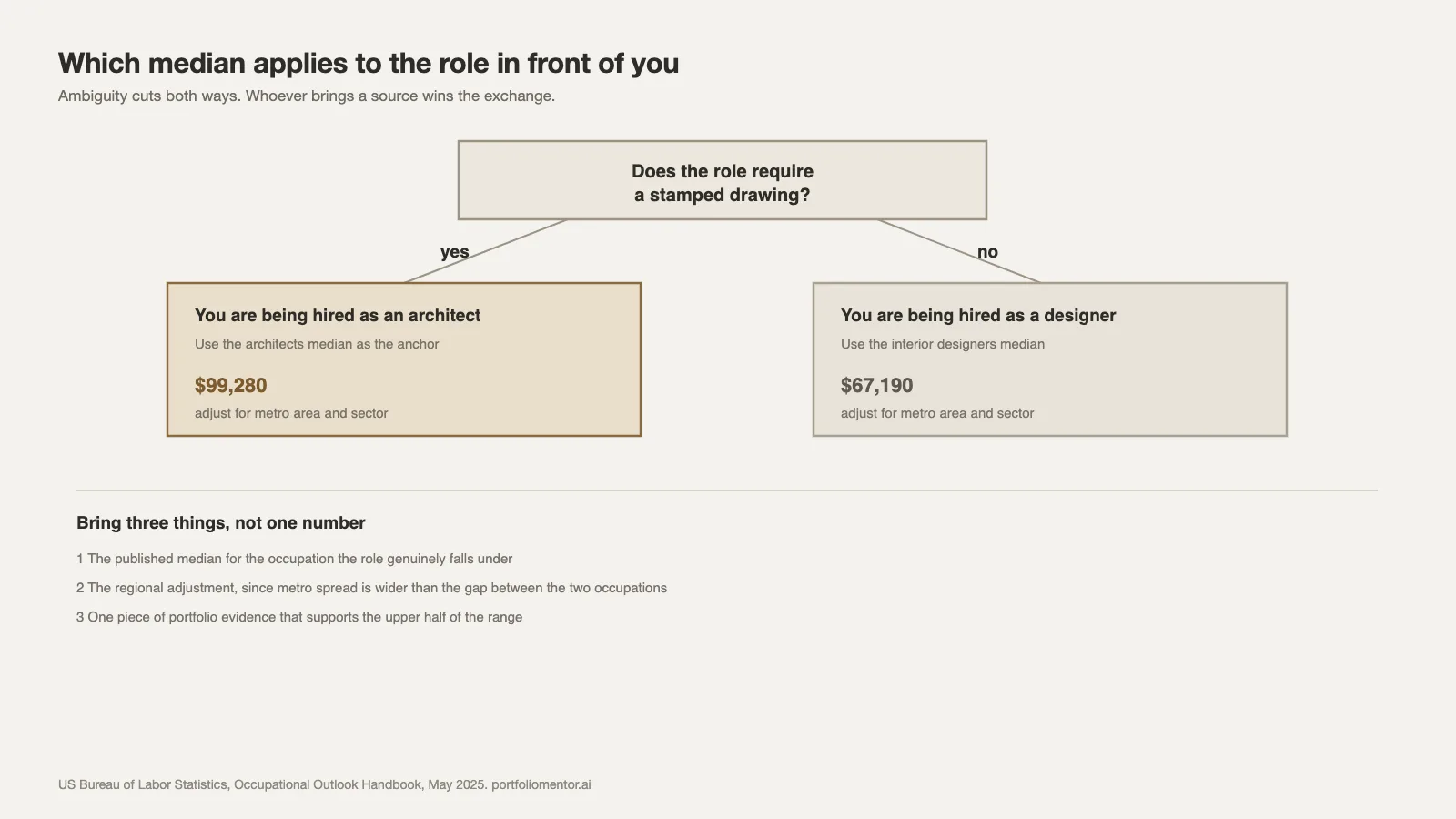
When a recruiter asks for your expectation, answer with the occupation you are being hired under rather than the title on the advert. If the role requires a stamped drawing, you are being hired as an architect and the architecture median is the relevant anchor. If it does not, the interior design median is. Naming which one you are using makes the number defensible instead of arbitrary.
The growth outlook is flat, and that matters
BLS projects 3 percent growth for interior designers and 4 percent for architects between 2025 and 2035. Neither is a shortage. That has a direct consequence for pay negotiation. In a flat market, offers move on demonstrated capability and on competing offers, not on general demand for the profession.
The practical implication is that the portfolio does more work here than in a growing field. A book that proves you can produce a complete interiors package separates you from a much larger pool. Reading several published portfolios side by side makes that visible. That means the unglamorous parts too: reflected ceiling plans and finish schedules, not styled renders.
How the figure moves across a career
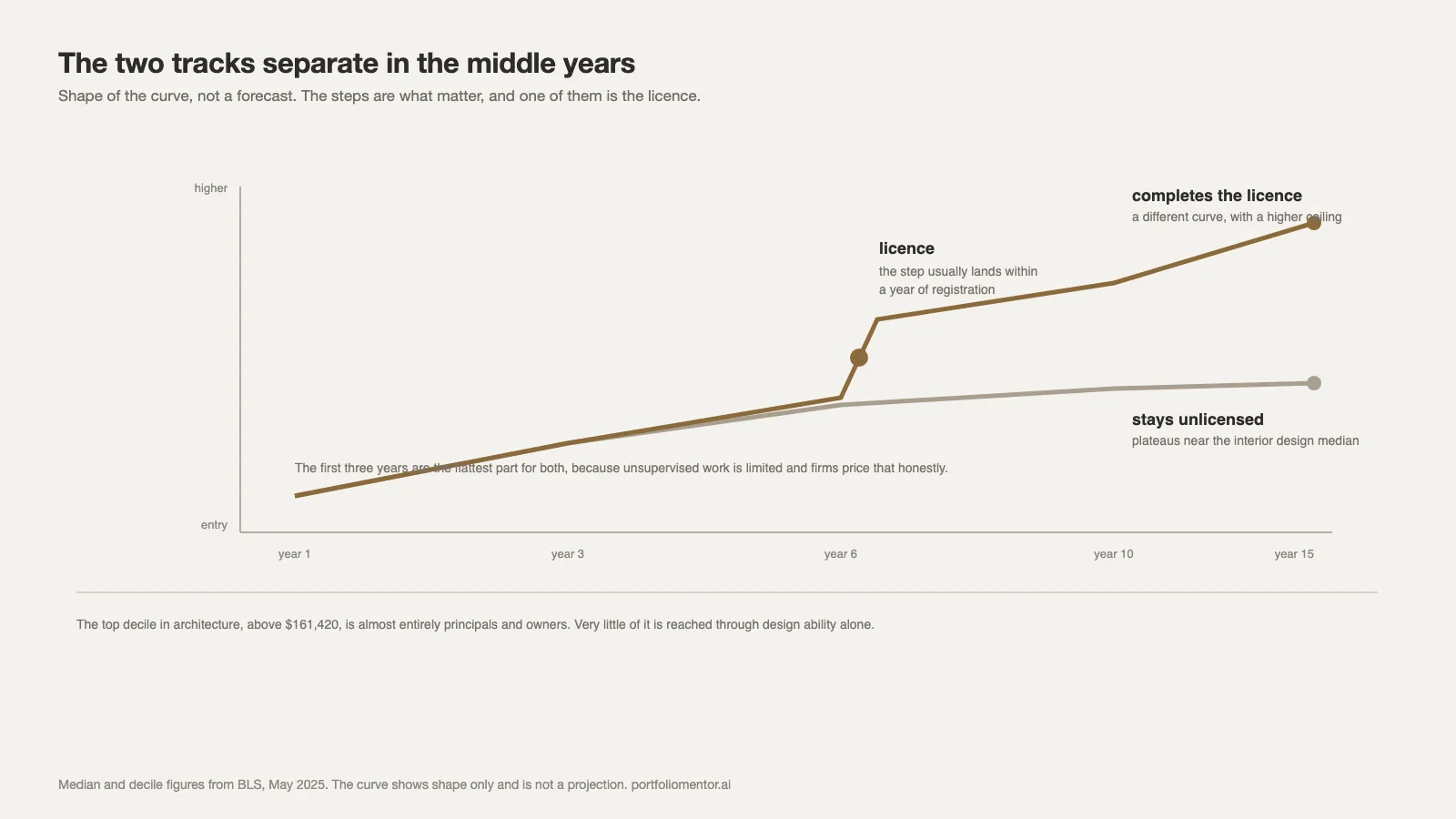
A single median hides the shape of the curve, and the shape is what you are actually planning against.
The first three years are the flattest part. Graduates enter below both medians regardless of which discipline they trained in, because the work they can do unsupervised is limited and firms price that honestly. A documented internship shortens that stretch more than a stronger first offer does. In the architecture occupation this is the band that produces the under $62,300 tenth percentile reported by BLS for May 2025.
The middle years are where the two tracks separate. An interior designer who stays unlicensed tends to plateau near the interior design median unless they move into management or specify for a manufacturer. An interior specialist who completes an architecture licence steps onto a different curve with a higher ceiling. The step usually arrives within a year of registration rather than at the moment of it.
The top decile in architecture, above $161,420, is almost entirely principals, firm owners and senior people in large organisations, or people who left employment for independent practice. Very little of it is reached through design ability alone; it is reached through responsibility for fee, staff and client relationships. That is worth knowing early, because the skills that get you there are not the skills studio rewards.
Where interiors pays better than building work
Two situations reverse the usual ordering. Corporate workplace programmes run by large occupiers pay their in-house interiors staff on corporate rather than practice scales, which are typically higher. And manufacturer-side roles, specifying furniture, systems or finishes for a producer, pay above studio rates because they sit in sales-adjacent structures with commission.
Neither route is visible from school, and both hire people with interiors portfolios rather than building portfolios.
Comparing offers properly
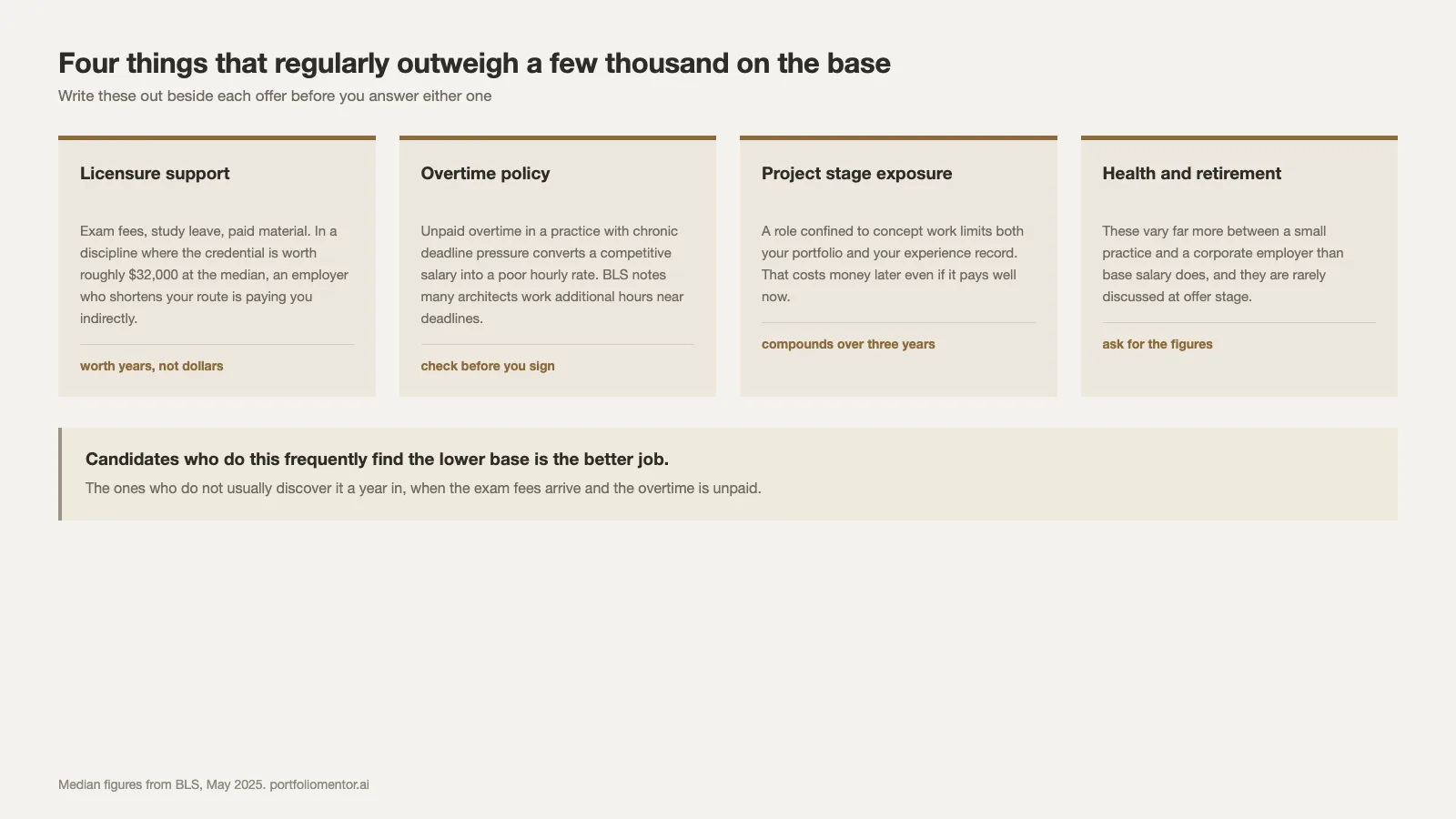
Base salary is the number candidates compare and the weakest basis for a decision. A job title is the next weakest, as any first interview shows. Four other items regularly outweigh a few thousand dollars.
- Whether the firm pays licensure exam fees and gives study time. In a discipline where the credential is worth roughly $32,000 at the median, an employer who shortens your route to it is paying you indirectly.
- Overtime policy. Unpaid overtime in a practice with chronic deadline pressure converts a competitive salary into a poor hourly rate. BLS notes that many architects “work additional hours, especially when facing deadlines.”
- Project stage exposure. A role confined to concept work limits both your portfolio and your experience record, which costs money later even if it pays well now.
- Health and retirement contributions, which vary more between a small practice and a corporate employer than base salary does.
Write the four out beside each offer before you respond to either. Candidates who do this frequently find the lower base is the better job, and the ones who do not usually discover it a year in.
What an interiors portfolio has to prove
Interiors work is judged on different evidence from building design. The difference concentrates in two of the ten categories a portfolio review scores: Technical Drawing and Production Quality.
Three items carry disproportionate weight.
- A complete package, not highlights. Plan, reflected ceiling plan, elevations, a detail and a finish schedule for one project proves more than five projects shown as renders.
- Material decisions with reasons. Naming a finish and the performance or budget constraint behind it reads as practice experience. A moodboard does not.
- At least one built or fabricated thing. Interiors is a sector where clients and employers care whether you have watched something get installed.
How to structure that evidence is covered in the architecture portfolio guide, and the formatting decisions that sit underneath it in portfolio layout and design.
⚖️ Pros & Cons at a Glance
✔️ Pursuing the architecture licence for interiors work: access to the higher published median; the ability to stamp and run your own projects; title protection; a wider employer pool including the public sector.
✖️ Against: a median of 12.3 years to licensure; experience hours that interiors-only roles struggle to fill; years spent on building-scale requirements you may never use.
Negotiating when the title is ambiguous
Ambiguity cuts both ways. It lets an employer anchor on the lower median, and it lets you anchor on the higher one. Whoever brings a source wins that exchange.
Prepare three things before the conversation. The published median for the occupation the role genuinely falls under, the regional adjustment, and one piece of portfolio evidence that supports the upper half of the range. A candidate who says “the national median for this occupation is X, this market runs above it, and here is the documentation set I produced” is negotiating. A candidate who says “I was hoping for more” is not.
Scripts and sequencing for that conversation are in how to negotiate an architect salary. The wider pay curve is mapped in the architect salary guide.
If you are choosing between the two paths
Interior design gives a shorter route to practising, a lower median, and rules that vary by state. Architecture gives a longer and more expensive route, a higher median, and a title that travels. Neither is more creative than the other, and the day-to-day work on a large fit-out looks similar from both sides of the line.
The deciding question is whether you want to be able to run projects independently, because that is what the licence buys and nothing else does. That route, with its stages and timings, was covered above. The broader menu of directions is in architecture career paths.
Checking the number for your own market
National medians are a starting point, not an answer. Three checks take under an hour and produce a figure you can defend.
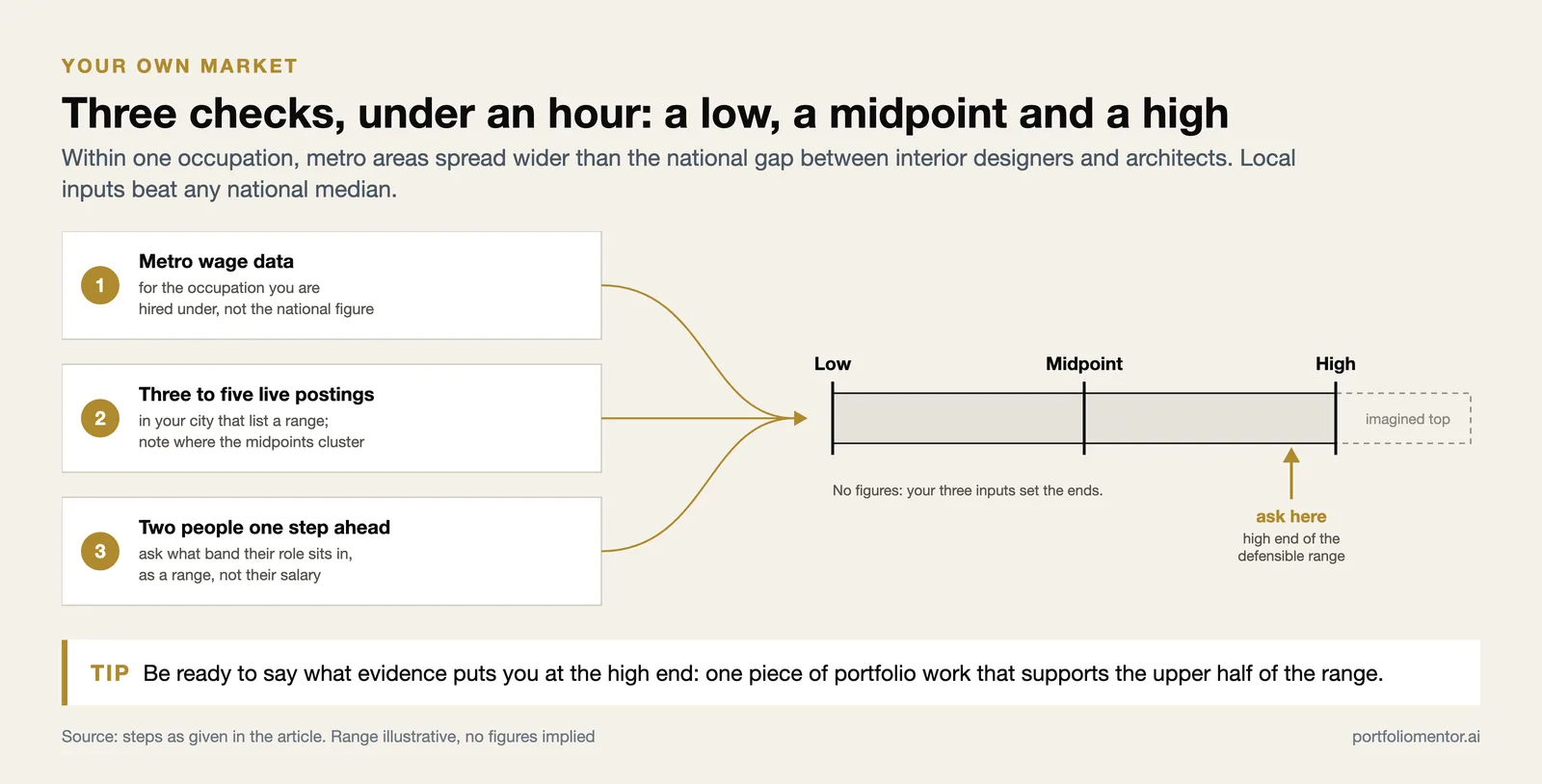
First, pull the metro-level wage data for the occupation you are being hired under rather than the national figure. Within one occupation, the spread between metro areas is wider than the national gap between the two occupations. Second, collect three to five live postings in your city that list a range, and note where the midpoints cluster. Third, ask two people one step ahead of you what band their role sits in. Phrase it as a range rather than a request for their salary; people answer that far more readily.
Those three inputs give you a low, a midpoint and a high. Ask at the high end of the defensible range rather than the top of the imagined one, and be ready to say what evidence puts you there.
The short version
No agency publishes an interior architect salary because the title is not an occupation. Work from $67,190 if you are practising as a designer and $99,280 if you hold an architecture licence. Adjust for metro area and sector, and bring the source to the conversation. The credential, not the job title, is what moves the figure.


