
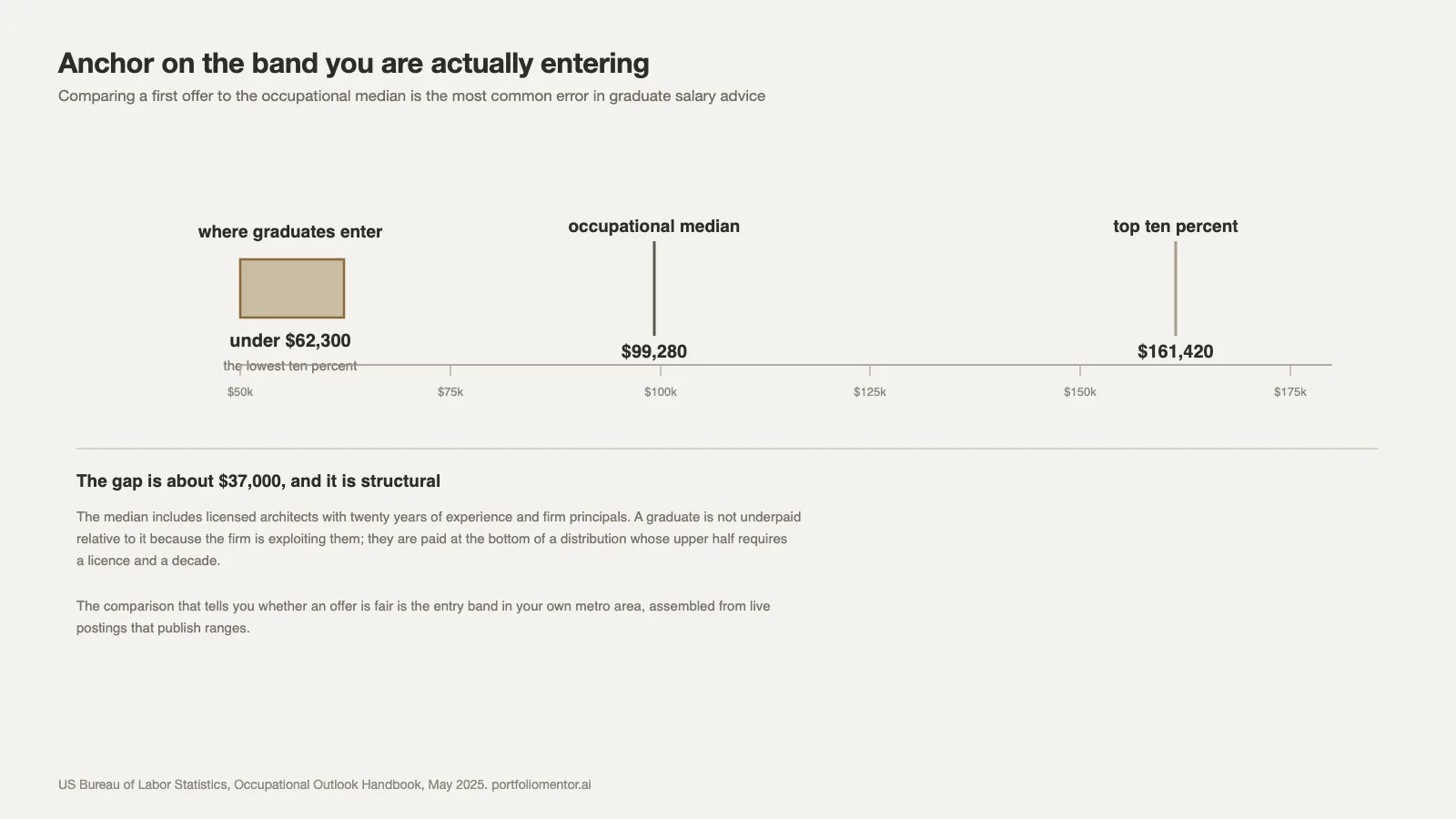
Entry level architect salary in the US sits below the occupational median because most people starting out are not yet licensed. Labor statistics put the lowest ten percent of architects under $62,300 against a median of $99,280 as of May 2025, and graduates typically enter in that lower band as architectural designers.
The confusion in most salary advice for graduates comes from mixing two different figures: what the occupation pays across all experience levels, and what a first job pays. They are roughly $37,000 apart, and quoting the first to a graduate sets an expectation that no firm will meet.
This guide separates them, explains what determines where in the entry band an offer falls, and covers what to do when the number is lower than you hoped.
What is a realistic entry level architect salary?
Use the bottom decile of the occupation as the anchor, not the median.
🔢 Quick Numbers
- Lowest 10 percent of architects earned under $62,300; median $99,280; highest 10 percent above $161,420 (BLS Occupational Outlook Handbook, May 2025)
- Median by industry: government $115,920, architectural and engineering services $98,440, construction $95,760 (BLS, May 2025)
- Median time to licensure: 12.3 years in 2025, meaning most of a graduate’s first decade is spent below the licensed title (NCARB by the Numbers 2026)
The relationship between those numbers is the point. A graduate is not underpaid relative to the median because the firm is exploiting them; they are paid at the bottom of a distribution whose upper half requires a licence and a decade. Knowing that changes how you read an offer and what you negotiate for.
Why the first years pay what they do
Three structural reasons hold the entry level architect salary down, none of them about your ability.
You cannot carry legal responsibility
Until licensed, your drawings are checked and stamped by someone else, which is why the route to registration matters financially as well as professionally. The firm is buying production capacity supervised by a licensed architect, and it prices the supervision into what it can pay you.
The training cost is real
A graduate takes months to become net productive on a live project. Practices know this and absorb it, which shows up in the first-year figure and then corrects sharply once you are useful.
Supply is high at the entry point
Architecture schools produce more graduates than entry-level positions in most markets, and the imbalance is concentrated at the start. A well-edited portfolio moves an entry offer more than confidence does. BLS projects 4 percent growth for architects between 2025 and 2035, which is not a shortage. That is why portfolio quality moves an entry offer more than confidence does.
⚠️ Common Mistake to Avoid
Comparing your offer to the $99,280 median and concluding you are being lowballed. That figure includes licensed architects with twenty years of experience and firm principals. The comparison that tells you whether an offer is fair is the entry band in your own metro area, which you can assemble from live postings that publish ranges.
What moves an entry offer
Employer type, more than anything
The industry medians reported by BLS carry down to entry level in roughly the same order. Government and institutional employers pay above design practices at the same level, and they publish their bands, which removes the negotiation guesswork entirely. The trade-offs between employer types are set out in the firm guide. Graduates who only apply to named design studios are selecting into the lower-paying half of the market without realising it.
Technical capability you can prove
Revit or equivalent documentation skill at a usable level is the single most common differentiator in entry offers, because it shortens the unproductive period. Being able to point at a drawing set you produced, rather than to a course you completed, is what makes the claim credible.
Location
The spread between metro areas within the occupation is wider than most graduates expect and often larger than the difference between two employers in the same city. Adjusting for cost of living usually narrows it, and sometimes reverses it.
Prior experience
Internships that produced real deliverables move the number. Internships that produced nothing showable do not, which is an argument for choosing placements by what you will be allowed to draw rather than by the firm’s reputation. What to look for is covered in the architecture internships guide, and the route in without prior experience in getting an internship with no experience.
💡 Pro Tip
Ask what the band is for the role rather than stating a number first. Most firms above about twenty people have bands, and the question is normal. If the answer is a range, you have learned the ceiling for the position, which tells you whether the job has room to grow into or whether your next raise requires changing employer.
What to negotiate when the salary will not move
Entry bands are often genuinely fixed, particularly in institutional employers. That does not end the conversation; it redirects it to things with real financial value.
- Licensure support. Exam fees, study leave and paid study material. Across six divisions this is a material sum, and it shortens the path to the higher band.
- Experience breadth. Written agreement that you will rotate through construction administration and not stay in one stage. This is worth more over three years than a small salary increase, because it determines when you qualify.
- Review timing. A six-month review instead of twelve, with criteria written down. The first correction upward usually comes when you become productive, and pinning the date captures it.
- Overtime treatment. BLS notes that many architects “work additional hours, especially when facing deadlines.” Whether those hours are paid, banked or absorbed changes your effective rate more than a two percent salary difference does.
The sequencing of these asks, and the wording, is covered in how to negotiate an architect salary. For where the entry band sits inside the whole curve, the architect salary guide covers every stage.
📐 Technical Note
Job titles at entry level in the US are usually “architectural designer” or a numbered variant, not “architect”, because the licensed title is restricted in every jurisdiction. The title is not a comment on your ability and should not be read as one when comparing offers. Compare the band and the scope of work, not the words.
How fast does it rise?
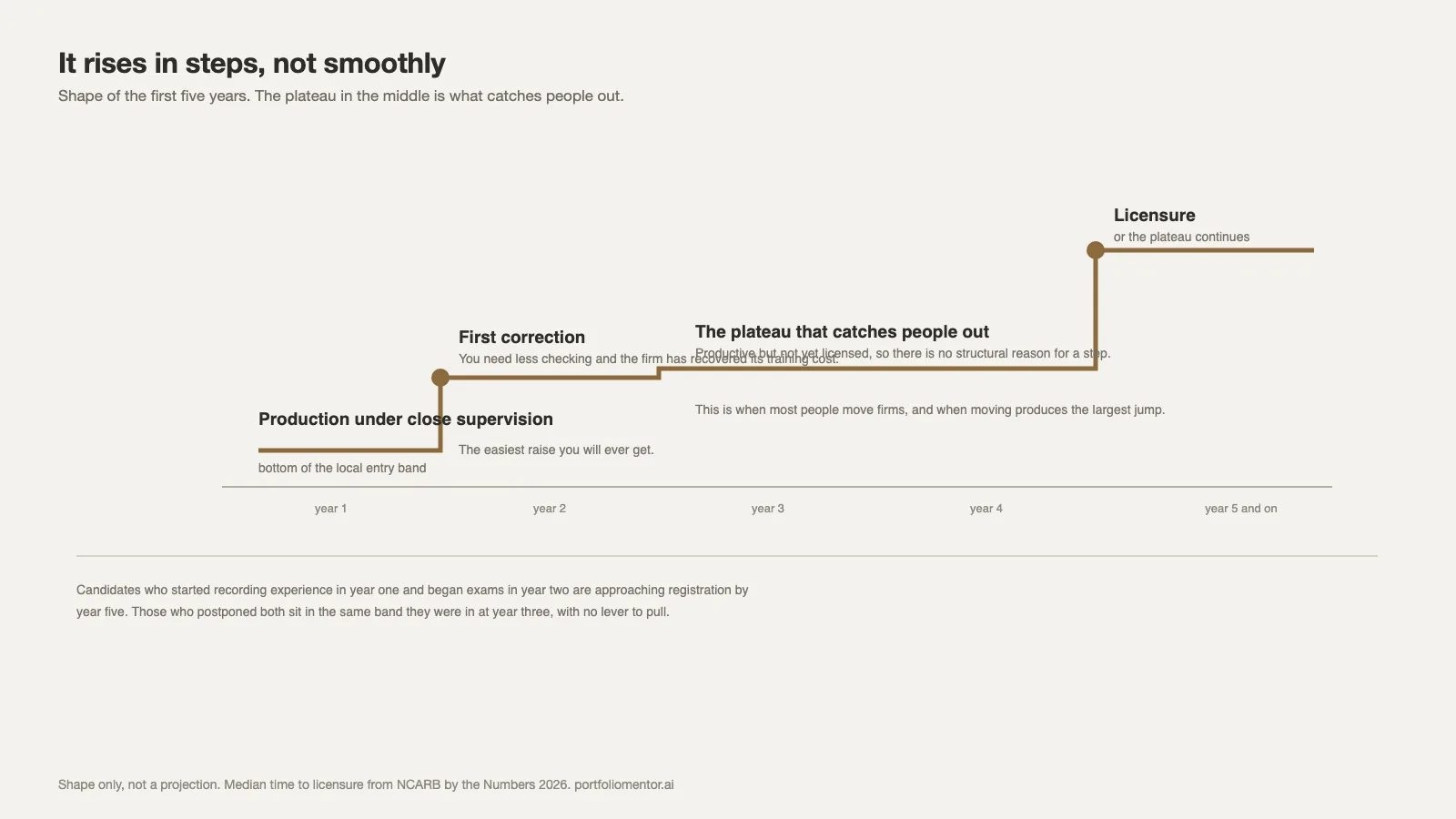
An entry level architect salary rises faster than the first offer suggests, and in steps rather than smoothly.
The first meaningful increase usually arrives when you stop needing close supervision, somewhere between month twelve and month thirty depending on the firm and the project stage you work in. The second arrives with licensure, which NCARB data puts at a median of 12.3 years from the start of the process. Candidates who record experience early and start exams promptly reach it sooner.
Between those two steps, moving employers is historically the fastest way to correct an entry salary that started low. Internal increases are calculated from your existing figure; external offers are calculated from the market.
The first five years, roughly
No two firms run the same ladder, but the shape repeats often enough to plan against.
Year one is production under close supervision. You draw what you are given, your sheets are marked up heavily, and your value to the firm is lower than your salary for the first few months. Pay sits at the bottom of the local entry band.
Year two is where the first correction usually lands. You need less checking, you can take a small scope end to end, and the firm has recovered its training cost. Internal increases at this point are common and are the easiest raise you will ever get, because you are visibly cheaper to employ than a replacement.
Years three and four are the plateau that catches people out. You are productive but not yet licensed, so you sit in the middle of the same band with no structural reason for a step change. This is when most people move firms, and when moving produces the largest single jump.
Year five onward depends entirely on whether the licence is in progress. Candidates who started recording experience in year one and began exams in year two are approaching registration. Those who postponed both sit in the same band they were in at year three, with no lever to pull.
That divergence is the strongest financial argument for treating the experience record as part of your job rather than as paperwork. The six practice areas that have to be filled are listed by NCARB, and a role that only touches two of them extends your plateau by years.

Reading an offer letter properly
Graduates sign the first reasonable offer and read it afterwards. Four clauses deserve attention before you reply.
- Overtime and time off in lieu. Whether additional hours are paid, banked or unrecognised, and whether banked time expires.
- Review cadence, and whether reviews are tied to salary decisions or are purely developmental. Firms often separate the two, which means a good review in month twelve can arrive with no increase attached.
- Professional development allowance, and whether exam fees come from it or from a separate budget. If they come from the same pot, a licence effectively consumes your training budget for two years.
- Any notice period or repayment clause attached to sponsored study. These are reasonable in principle and occasionally onerous in detail.
None of these are unusual requests to ask about. Asking demonstrates that you read the document, which is a mildly useful signal in a profession whose output is documents.
What the portfolio has to do at this stage
At entry level the portfolio is the whole case. There is no track record to point at, so the book has to carry Technical Drawing and Production Quality on its own. Those two categories are where graduate portfolios most often fall short.
Three things raise an entry offer more reliably than anything you say in the interview:
- One complete documentation set, even from a studio project. Plans, sections, a wall detail and a schedule. It proves you can finish, which is the quality firms cannot verify any other way.
- Evidence of coordination. A drawing that responds to a structural or services constraint shows you understand that buildings are designed by more than one party.
- Ruthless editing. Four projects that argue for the sector you are applying to, not eight that cover everything you have ever made. Selection is read as judgement.
What to cut and how to order what remains is covered in the architecture portfolio guide, and the errors that cost graduates interviews are collected in common architecture portfolio mistakes.
Deciding whether to take a low offer
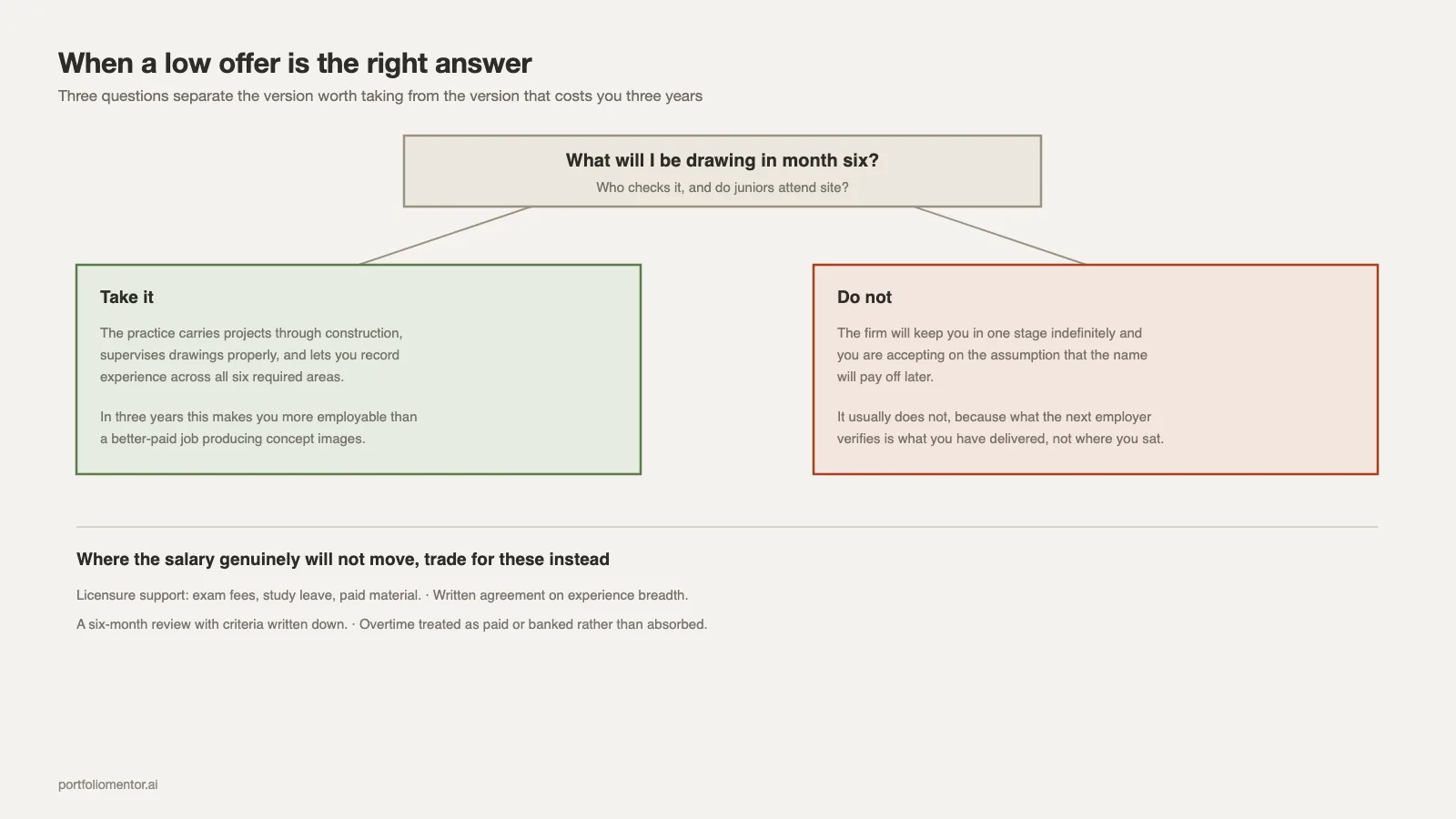
Sometimes the right answer is yes. Take a poorly paid job in a practice that carries projects through construction, supervises drawings properly and fills all six experience areas. In three years it makes you more employable than a better-paid job producing concept images.
The wrong version of the same decision is accepting a low offer from a firm that will keep you in one stage indefinitely, on the assumption that the name will pay off later. It usually does not, because what the next employer verifies is what you have delivered, not where you sat.
Ask what you will be drawing in month six, who checks it, and whether juniors attend site, the way you would in any architecture interview. The answers separate the two cases. Broader routes and where each one leads are compared in architecture career paths.
If no offer has arrived at all
A salary question is premature when the problem is response rate. In a flat market the usual cause is not the quality of the work but that applications are generic. The fastest correction is fewer, targeted applications, with the portfolio reordered for each posting.
The second most common cause is a file that never got opened, because it exceeded the attachment limit or arrived as a link the recipient could not open on their network. That failure is silent and looks identical to rejection.
The short version
Expect the bottom of the band, not the median, and benchmark against entry postings in your own city rather than a national figure. Employer type moves the number more than negotiation does. Where salary is fixed, trade for licensure support and experience breadth, because both convert into money on a shorter timeline than a first-year raise would.