

An architecture cover letter is a one-page document that introduces you to a firm, connects your design experience to a specific role, and signals why you want to work there. A strong one is tailored to each studio, references real projects, and points the reader toward your portfolio and resume rather than repeating them.
Most applicants treat the architecture cover letter as a formality and paste the same generic paragraph into every submission. Hiring managers notice immediately. This guide breaks down the structure that works, gives you copy-and-adapt examples for different career stages, and shows how to tailor each letter to the firm so your application earns a closer look at your portfolio.
What is an architecture cover letter and why does it matter?

An architecture cover letter is a short, personalized letter that accompanies your resume and portfolio when you apply for a design role. It matters because it is the only part of your application written in your own voice, where you can show that you researched the firm and explain the fit a list of skills cannot. In a stack of similar resumes, a tailored letter is often what moves you from the maybe pile to the interview list.
The letter is not a place to restate your work history. Hiring managers at the American Institute of Architects describe the most common error plainly. As one AIA hiring manager, Nancy Horne, notes, applicants often “repeat in their cover letter what’s already on their resume.” Your resume lists what you did. The cover letter explains why those experiences make you the right person for this particular studio.
🎓 Expert Insight
“When people have taken the time to research our firm, look into what we’re about, that effort stands out.”, says Grace Boudewyns, a hiring manager quoted by the American Institute of Architects
Firms read dozens of near-identical applications. Visible, specific research is one of the fastest ways to separate yourself from candidates who sent the same letter everywhere.
A focused letter also does practical work for you. It frames how the reviewer interprets your portfolio, flags transferable experience that might otherwise be missed, and explains gaps or career pivots before they become questions. If you are still mapping out your path into the profession, our guide on how to become an architect covers the education, experience, and licensure timeline that a cover letter often needs to account for.
How to structure an architecture cover letter

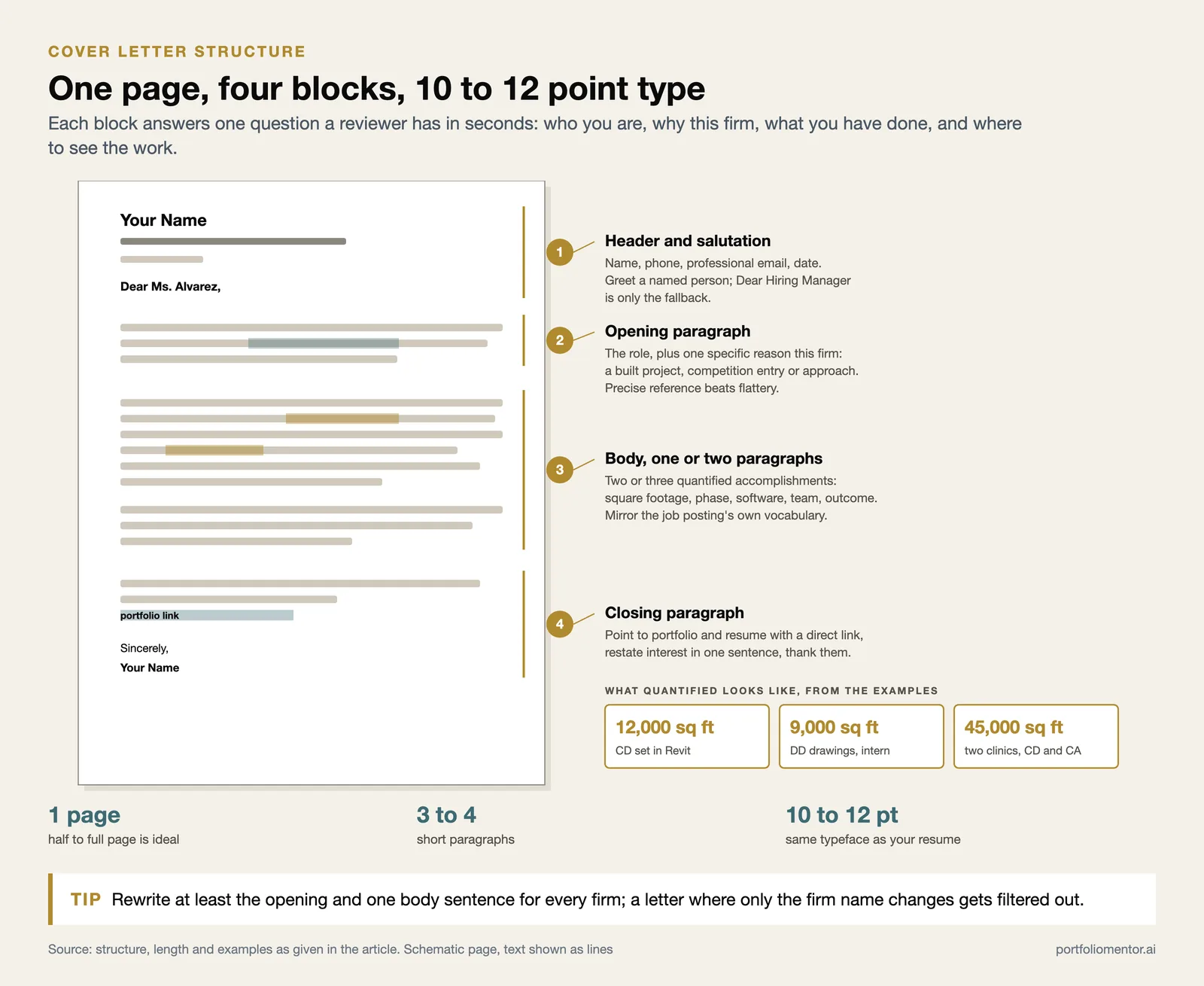
A cover letter follows a predictable structure that lets a busy reader find your contact details, your interest, and your qualifications in seconds. University career centers teach the same five-part format used across professional fields, and it maps cleanly onto an architecture application. Keep the whole document to one page in a 10 to 12 point font that matches your resume.
1. Header and salutation

List your name, phone number, professional email, and the date, then address a named person whenever possible. “Dear Hiring Manager” is acceptable as a fallback, but a firm’s website, LinkedIn, or a quick call to the front desk often reveals who leads recruitment or runs the studio. Spell the name correctly. According to Berkeley Career Engagement, the salutation should greet a specific reader whenever you can identify one.
2. Opening paragraph
State the role you are applying for and one specific reason this firm caught your attention. Reviewers often spend only a few seconds on each application, so the opening has to earn the next paragraph. Name a built project, a competition entry, a material approach, or a design philosophy that genuinely interests you. Vague flattery (“your award-winning firm”) reads as filler; a precise reference reads as research.
3. Body paragraphs

Use one or two short paragraphs to connect your experience to the role. Pick two or three accomplishments and quantify them: square footage, project phase, software, the size of the team, or the outcome. MIT Career Advising and Professional Development recommends backing every claim with a concrete, measurable accomplishment rather than a generic adjective. “Detail-oriented” means little; “produced the construction document set for a 12,000-square-foot adaptive reuse project in Revit” means a great deal.
💡 Pro Tip
Mirror the language of the job posting. If the listing calls for “design development through CA,” use those exact phases in your body paragraph. Recruiters and applicant tracking systems both scan for the firm’s own vocabulary, so matching it shows you understand the role and helps you clear automated filters.
4. Closing paragraph
Point the reader to your portfolio and resume, restate your interest in one sentence, and thank them for their time. Include a direct link to your online portfolio here. Avoid an aggressive call to action; a confident, simple close (“I would welcome the chance to discuss how I can contribute to your team”) works better than “I will call you next week.”
Because your resume and letter should read as one coordinated package, treat them as a pair. Our architecture resume guide with examples covers the layout, font, and content choices that keep the two documents consistent in voice and design.
Architecture cover letter examples
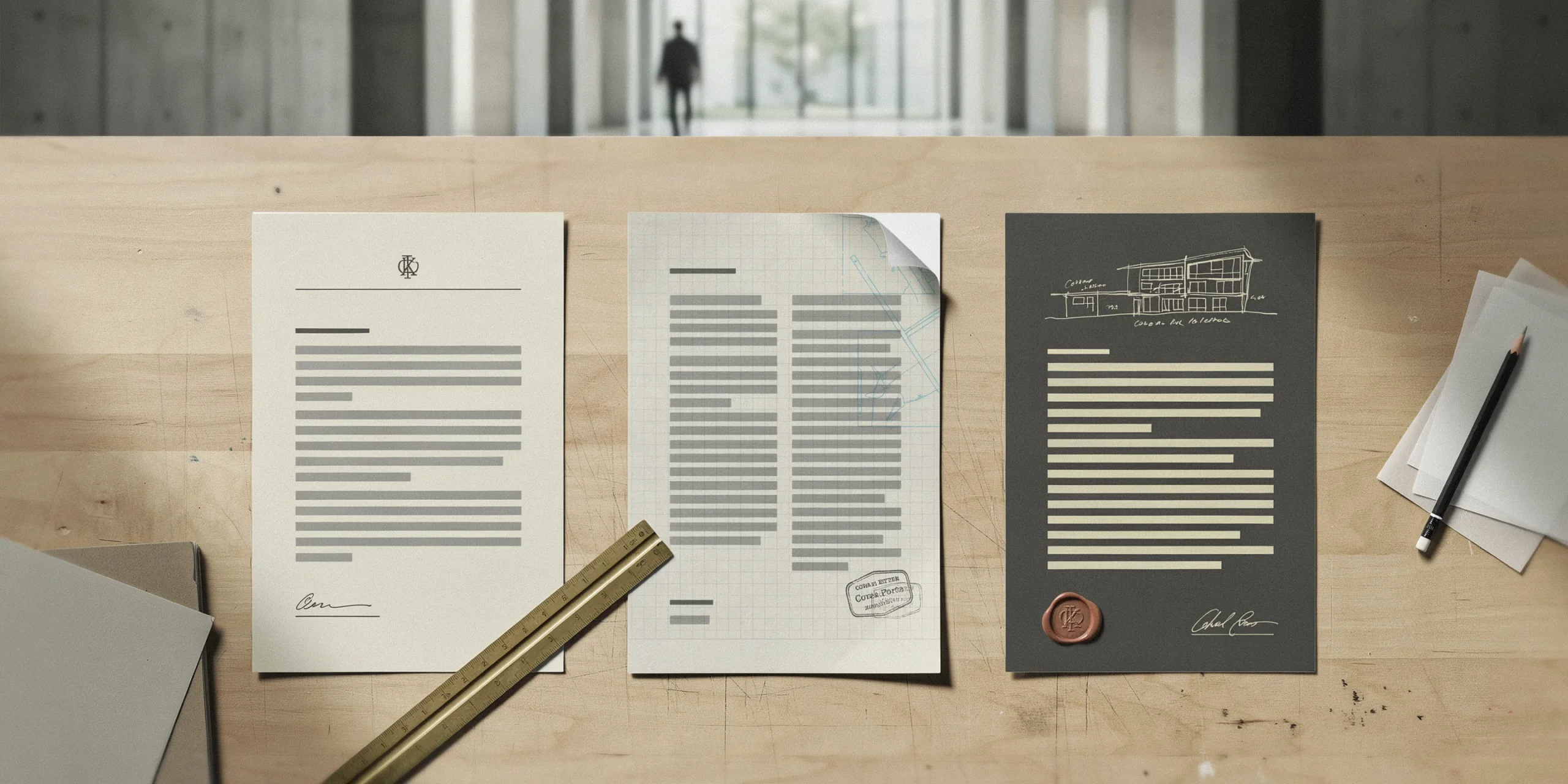
These architecture cover letter examples are written for different career stages. Adapt the specifics to your own projects and the firm you are targeting. Do not copy them verbatim; the firm-specific lines are where the value lives, and reviewers can spot a recycled template.
Example 1: Recent graduate or intern architect
Dear Ms. Alvarez,
I am applying for the Architectural Designer position at Meridian Studio. Your renovation of the Carson Public Library, where you preserved the original 1920s reading room while adding a daylit study wing, is exactly the kind of adaptive reuse work I want to build a career around.
I recently completed my Master of Architecture, where my thesis examined low-carbon retrofits of mid-century civic buildings. During a six-month internship at Hale + Cooper, I produced design development drawings in Revit for a 9,000-square-foot community center and built the physical and digital models the team used in two client presentations. I am fluent in Revit, Rhino, and the Adobe Suite, and comfortable moving between schematic massing and detailed wall sections.
My portfolio is linked below. I would welcome the chance to discuss how my interest in sustainable reuse fits your current work. Thank you for your consideration.
Example 2: Experienced architect changing firms
Dear Mr. Okafor,
I am writing to apply for the Project Architect role at Vellum Architecture. Having followed your healthcare practice since the Riverbend Outpatient Center opened, I am drawn to the way your team integrates evidence-based design with tight construction budgets, a combination I have worked within for the past seven years.
At my current firm, I led the construction documents and construction administration phases for two clinics totaling 45,000 square feet, coordinating consultants across structural, MEP, and medical equipment scopes and keeping both projects within budget. I hold an architecture license in two states and have managed teams of up to five. I am ready to bring that delivery experience to the larger institutional work in your pipeline.
You will find detailed project sheets in my portfolio, linked below. I would be glad to talk through how my healthcare delivery experience supports your goals. Thank you for your time.
⚠️ Common Mistake to Avoid
Sending one master cover letter to every firm is the fastest way to get filtered out. Reviewers can tell when the only thing that changed is the firm name in the address line. Rewrite at least the opening and one body sentence for each application so the research and fit feel genuine rather than swapped in.
Architecture cover letter template
Use this fill-in cover letter template as a starting frame, then replace every bracket with specifics. The brackets you must never leave generic are the firm name, the project you reference, and your quantified accomplishments.
[Your Name]
[Phone] | [Professional Email] | [Portfolio URL]
[Date] Dear [Named Hiring Contact], I am applying for the [exact role title] position at [Firm Name].
[One specific reason this firm interests you: name a built project,
competition, or design approach and why it resonates with you]. [Body 1: Two or three accomplishments tied to this role, each with a
number or concrete outcome (square footage, phase, software, team size,
budget result). Mirror the language used in the job posting]. [Body 2, optional: A second strength, a transferable skill, or a brief,
honest note explaining a gap or career change]. My portfolio is linked above. I would welcome the chance to discuss how
I can contribute to [Firm Name]. Thank you for your consideration. Sincerely,
[Your Name]
Once your draft is written, read it against the job posting one more time and cut any sentence that simply repeats your resume. If you want a second opinion on how your application reads as a whole, you can run your materials through Portfolio Mentor’s scoring rubric for structured feedback before you submit.
How to tailor your cover letter to the firm
Tailoring means spending ten minutes researching a firm and weaving one or two specific findings into your letter. The fastest sources are the firm’s project pages, recent press or award announcements, and the studio’s stated values or design philosophy. Name a real project, connect it to your own interest or experience, and the letter immediately reads as written for them.
Match the substance, not just the surface. If a firm specializes in mass timber, mention your relevant coursework or a timber detail you developed. If it focuses on affordable housing, lead with the community project on your resume rather than the luxury renovation. The portfolio you attach should reinforce the same emphasis, so the letter and your portfolio review tell a consistent story about the kind of work you want to do.
📌 Did You Know?
The U.S. Bureau of Labor Statistics reports that architects held about 124,600 jobs in 2025, with roughly 6,900 openings projected each year through 2035. With a relatively small applicant pool moving between a limited number of firms, a tailored letter referencing the right project can carry real weight when a studio is choosing between similar candidates.
If you are early in your path and your experience is thin, tailor around trajectory instead of titles. Reference your Architectural Experience Program (AXP) progress through NCARB, relevant studio coursework, or the licensure track you are on. Firms hiring junior staff care about direction and reliability as much as a long resume.
Common architecture cover letter mistakes
Beyond the generic-letter trap, a handful of errors repeatedly cost candidates interviews. Avoiding them is often the difference between a letter that helps and one that quietly hurts your application.
- Going over one page. Reviewers scan quickly. A tight half-to-full page beats a dense full page every time.
- Repeating the resume. If a sentence only restates a bullet point, cut it and add fit or context instead.
- Forgetting the portfolio link. The cover letter exists partly to drive the reader to your work. Always include the URL.
- Typos and the wrong firm name. A leftover firm name from a previous draft signals carelessness in a detail-driven profession.
- Empty adjectives. “Passionate” and “hardworking” persuade no one without a project, number, or outcome behind them.
Frequently asked questions
How long should an architecture cover letter be?
Keep it to one page, ideally three to four short paragraphs. Most reviewers spend only seconds on each letter, so a focused half-to-full page in a 10 to 12 point font that matches your resume is the right length.
Do I still need a cover letter if I have a strong portfolio?
Yes. The portfolio shows your work, but the cover letter explains your fit, your motivation for this specific firm, and any context the work cannot convey on its own. Even firms that weigh the portfolio most heavily use the letter to gauge communication and genuine interest.
Should I mention my licensure status?
Mention it when it is relevant. If you are licensed, state it briefly, especially for project architect roles. If you are still completing the AXP or testing, a short note on your progress signals direction and commitment without overexplaining.
Can I use AI to write my architecture cover letter?
AI can help you draft and tighten language, and some hiring managers expect it. The firm-specific research, the real projects you reference, and the honest framing of your experience still have to come from you. Use AI for structure and polish, not to replace genuine tailoring.
Key Takeaways
- An architecture cover letter introduces you and explains your fit; it should never just repeat your resume.
- Follow the five-part structure: header, salutation, opening, body, and a close that links to your portfolio.
- Quantify accomplishments and mirror the job posting’s language to clear both human and automated review.
- Tailor at least the opening and one body line to each firm by referencing a real project or design focus.
- Keep it to one page, fix the firm name and typos, and make sure your portfolio URL is included.
A cover letter will not win the job on its own, but a careless one can quietly close the door before anyone opens your portfolio. Treat each letter as a short, researched argument for why you and this firm fit, keep it tied to real projects and numbers, and let it guide the reader straight to the work you are proud of.