
An architecture portfolio for internships is a curated PDF, usually 15 to 25 pages, that shows a firm your design thinking, software skills, and creative potential rather than completed buildings. Because you have no professional projects yet, it should lead with your strongest studio work, sketches, and process, and be tailored to each firm you apply to.
For most students, the architecture portfolio for internships is the single document that decides whether you get an interview. Hiring managers in design prioritize it over your resume or grades. A polished, well-edited portfolio signals that you can communicate ideas clearly and contribute from your first week, which is exactly what a firm wants from an intern. This guide walks through length, project selection, layout, and the specific things reviewers look for.
What Is an Internship Portfolio and How Is It Different?

An internship portfolio is a student or first-portfolio document built to win a paid position, not to display a career. The difference from a professional portfolio is the focus: instead of finished buildings and construction documentation, you demonstrate how you think, sketch, model, and solve problems. Firms hiring interns assume you will learn their workflow on the job, so they screen for raw ability and communication.
This shapes every decision that follows. A large commercial practice cares about your ability to produce technical drawings and work in BIM software like Revit, while a smaller design studio wants to see conceptual range and hand drawing. Your job is to read what a firm values and present the version of your work that matches. If you are still mapping out the fundamentals, our complete architecture portfolio guide covers the structure that underpins every strong book.
📌 Did You Know?
As of 2023, NCARB allows students to count qualifying experience earned during paid academic internships toward the Architectural Experience Program (AXP), the same way as any other Setting A experience. A good internship is not just a line on your resume; it can be the first of the 3,740 hours you need toward licensure.

How Long Should an Architecture Internship Portfolio Be?

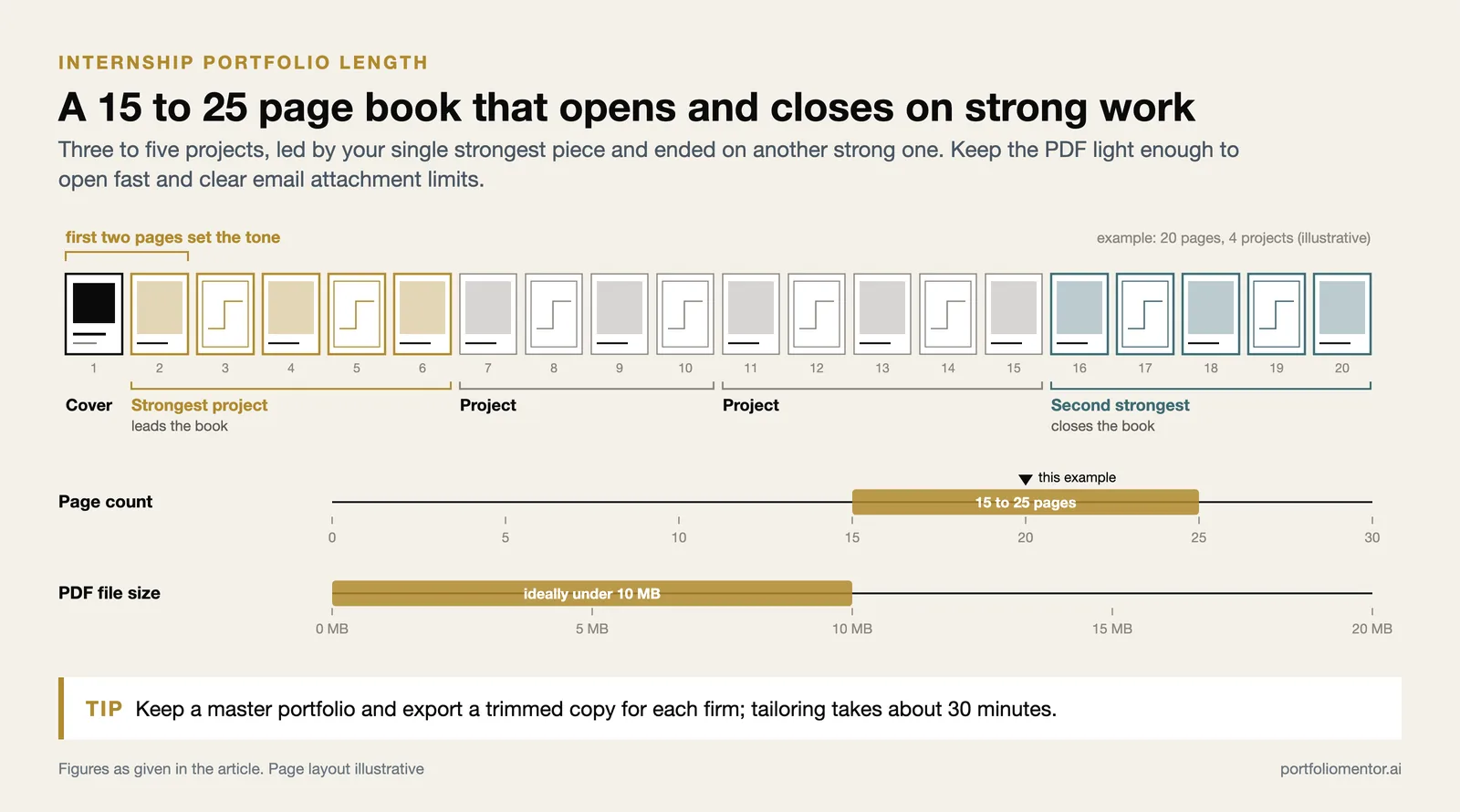
An internship portfolio should be roughly 15 to 25 pages and feature three to five projects. Reviewers often spend only a few minutes per applicant during a hiring round, so a tighter, sharper book beats an exhaustive one. Quality and editing matter far more than volume; one weak project drags down the average impression of every other page.
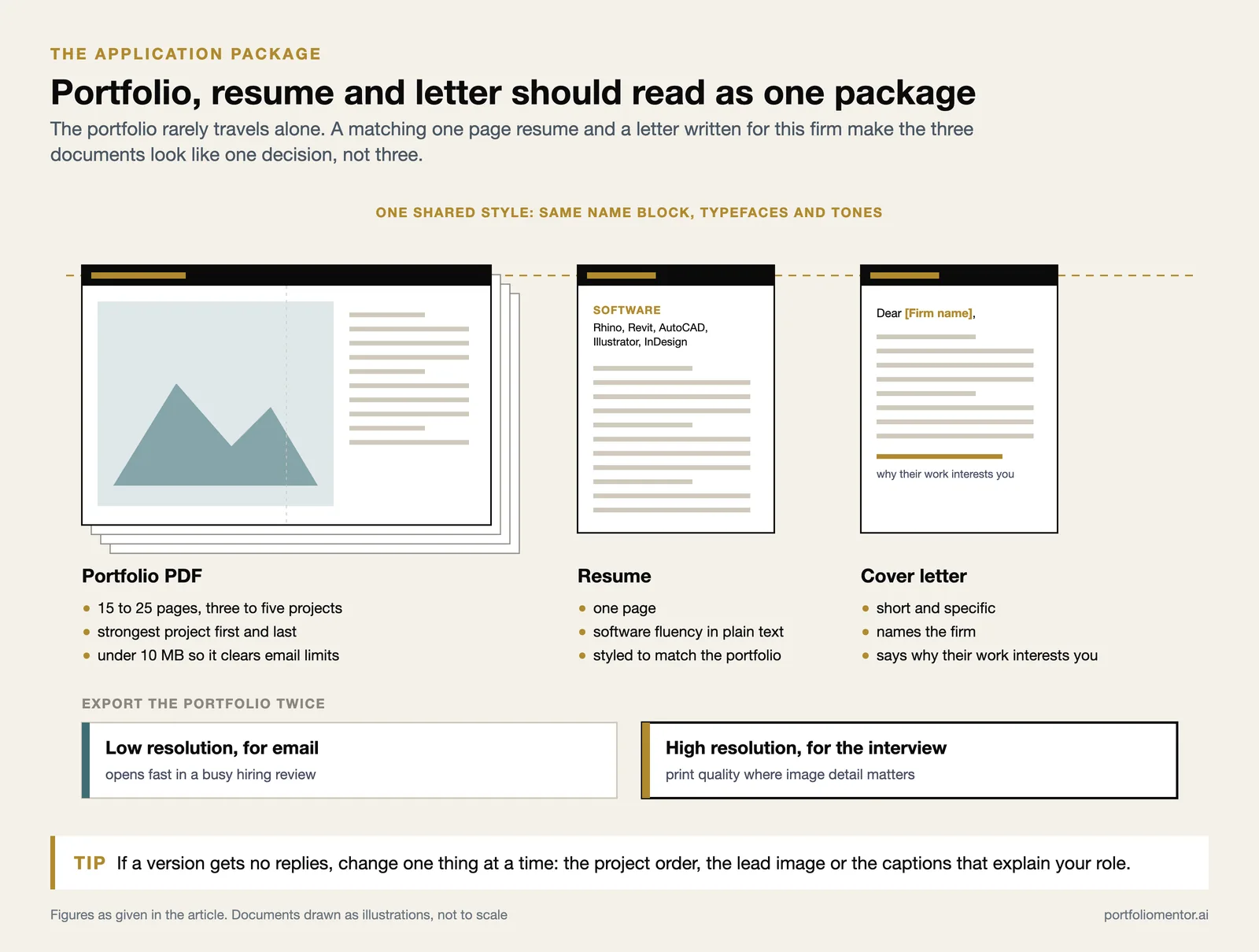
Keep the file size manageable, ideally under 10 MB, so it opens quickly and clears email attachment limits. Lead with your single strongest project, because the first two pages set the tone before a reviewer decides whether to keep reading. Close with another strong piece so the book ends on a high note rather than trailing off.
💡 Pro Tip
Keep a master portfolio with all your work, then export a trimmed version for each application. When a firm specializes in housing, cut the pavilion project and lead with your residential studio. Tailoring takes 30 minutes and signals that you researched the practice instead of mass-applying.
Which Projects Should You Include?

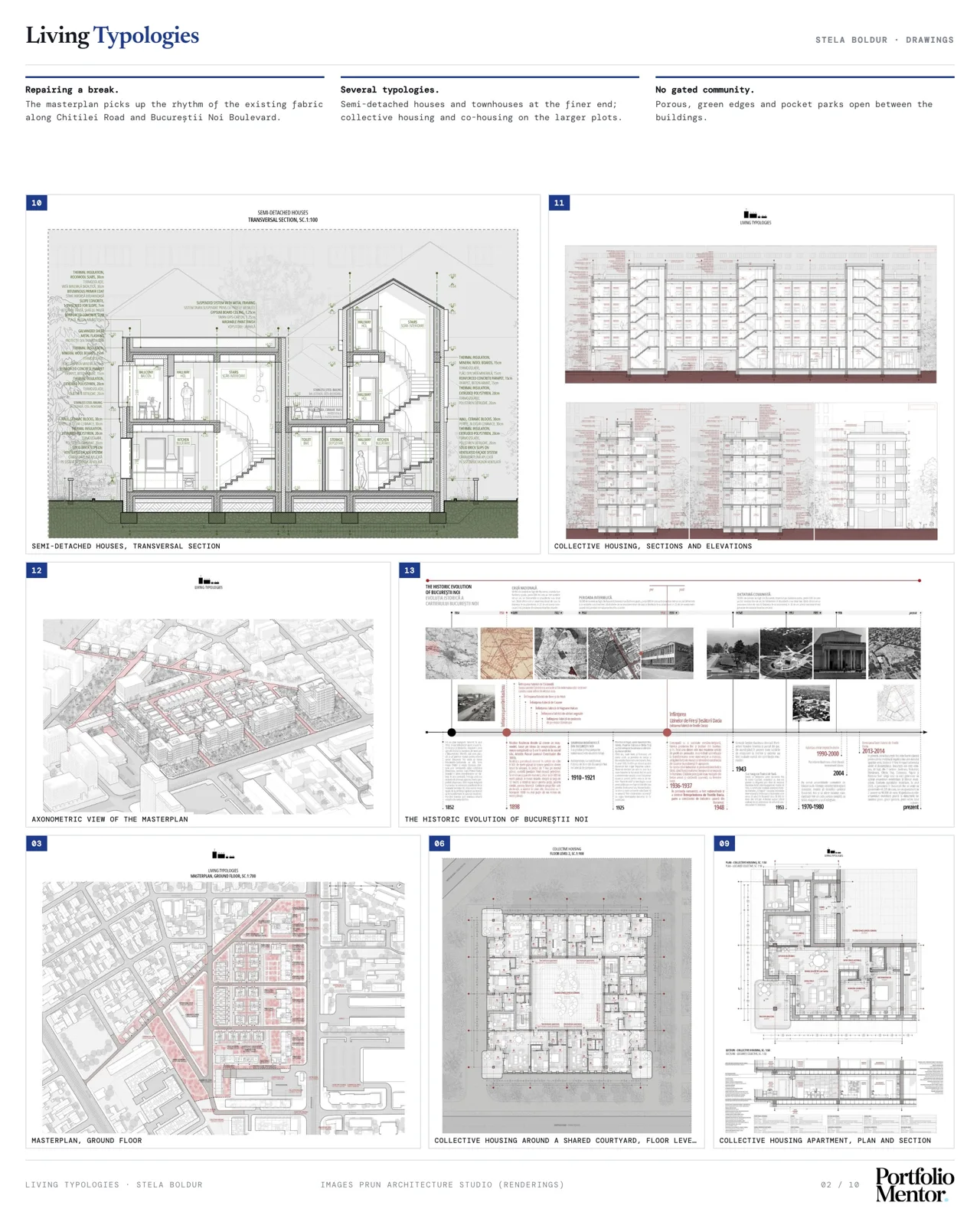
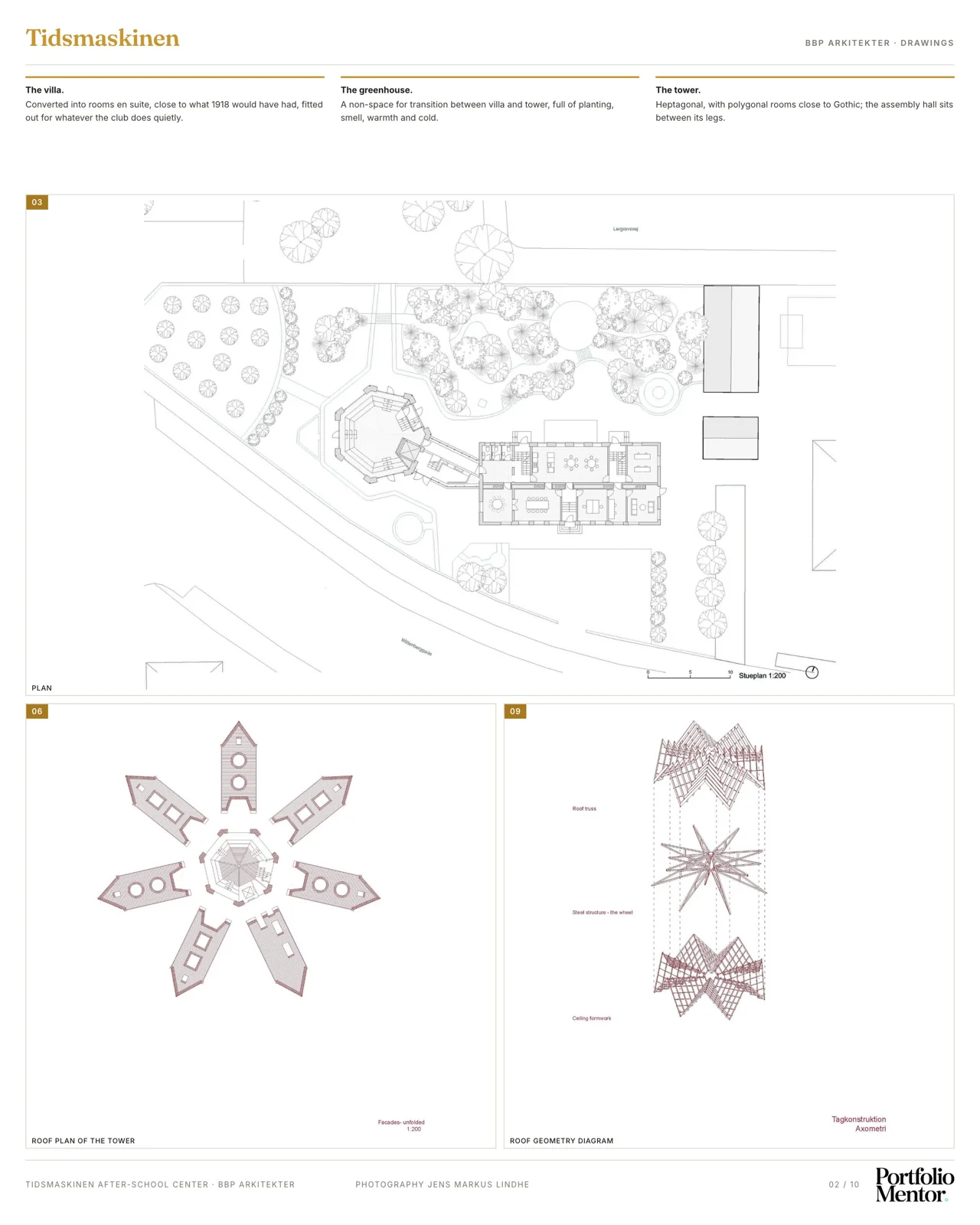
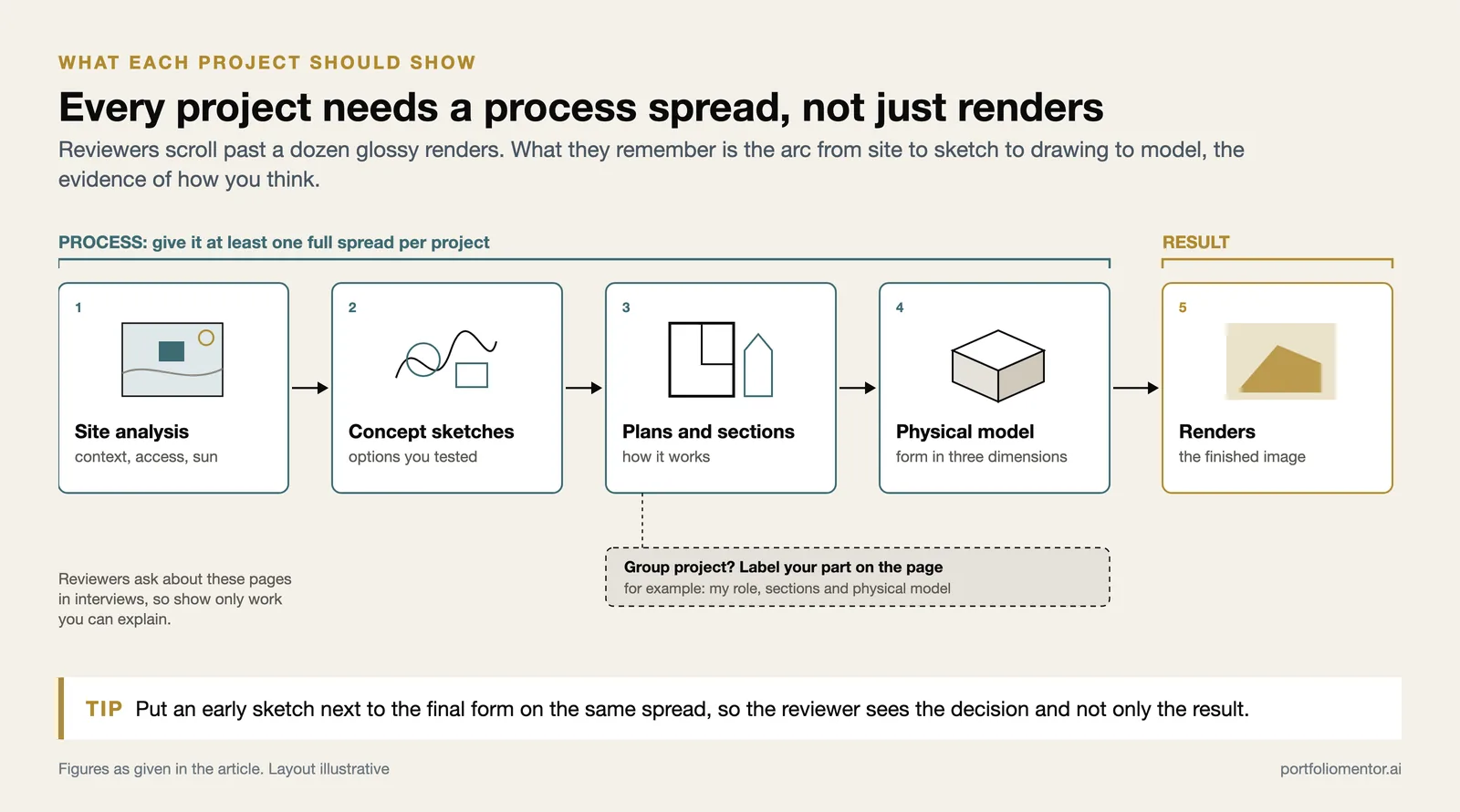
Include your three to five strongest studio projects, prioritizing variety and evidence of process over polish. Firms tend to hire generalists, so a range of project types, scales, and media is more persuasive than five versions of the same building. Show site analysis, concept sketches, plans, sections, physical models, and renders so a reviewer sees the full arc from idea to resolution.
Lead with design thinking, not just renders

After a reviewer scrolls past a dozen glossy renders, the images blur together. What makes a student portfolio memorable is visible problem-solving: a diagram that explains a site decision, an early sketch next to the final form, an iteration that shows you tested and discarded options. Dedicate at least one spread per project to process, not only the finished render.
Show the software firms actually use
Make your technical skills obvious. If you know Revit, AutoCAD, Rhino, Grasshopper, SketchUp, or the Adobe suite, show drawings and outputs that prove it, and write each program name out in full text. Many large firms screen applications through software that cannot read image-based skill icons, so a row of logos can be invisible to the system. Pair tools with results: a clean Revit section communicates more than a list ever will.
🎓 Expert Insight
“One of the biggest mistakes is people gravitate to showing the prettiest images. Make sure your application speaks to the wide variety of things you can do.”, Reinaldo Soto-Santiago, talent lead at Stantec
Speaking to the American Institute of Architects, Soto-Santiago confirms what reviewers repeat across firms: range and capability win interviews more reliably than a single beautiful render.
Group work is fine to include, but label your specific contribution clearly. Reviewers want to know exactly what you drew, modeled, or designed. Honesty here is non-negotiable, because firms ask about portfolio projects in interviews and quickly notice when a candidate cannot explain their own work.
Competition entries, freehand sketchbooks, and personal fabrication or photography projects also belong here when they show range. They demonstrate initiative beyond the required curriculum and give reviewers a sense of the kind of work you pursue on your own. Grace Boudewyns of Lake|Flato Architects has noted that firms tend to hire generalists and like to see a wide span of work, from site strategies and models to renders and photographs, so do not assume only studio projects count.
⚠️ Common Mistake to Avoid
Do not send the same generic portfolio to every firm. The most common reason strong students get ignored is a book that ignores what the practice does. Spend ten minutes on the firm’s website, identify the project types they take on, and reorder your portfolio so the most relevant work appears first.
Layout and Presentation That Reads as Professional
Clean layout is what separates a student book that looks ready for an office from one that looks like a class submission. Use a consistent grid across every spread, limit your palette to two or three tones, and pick one or two typefaces and stick with them. White space is not wasted space; it lets your strongest images breathe and keeps the page from feeling cramped.
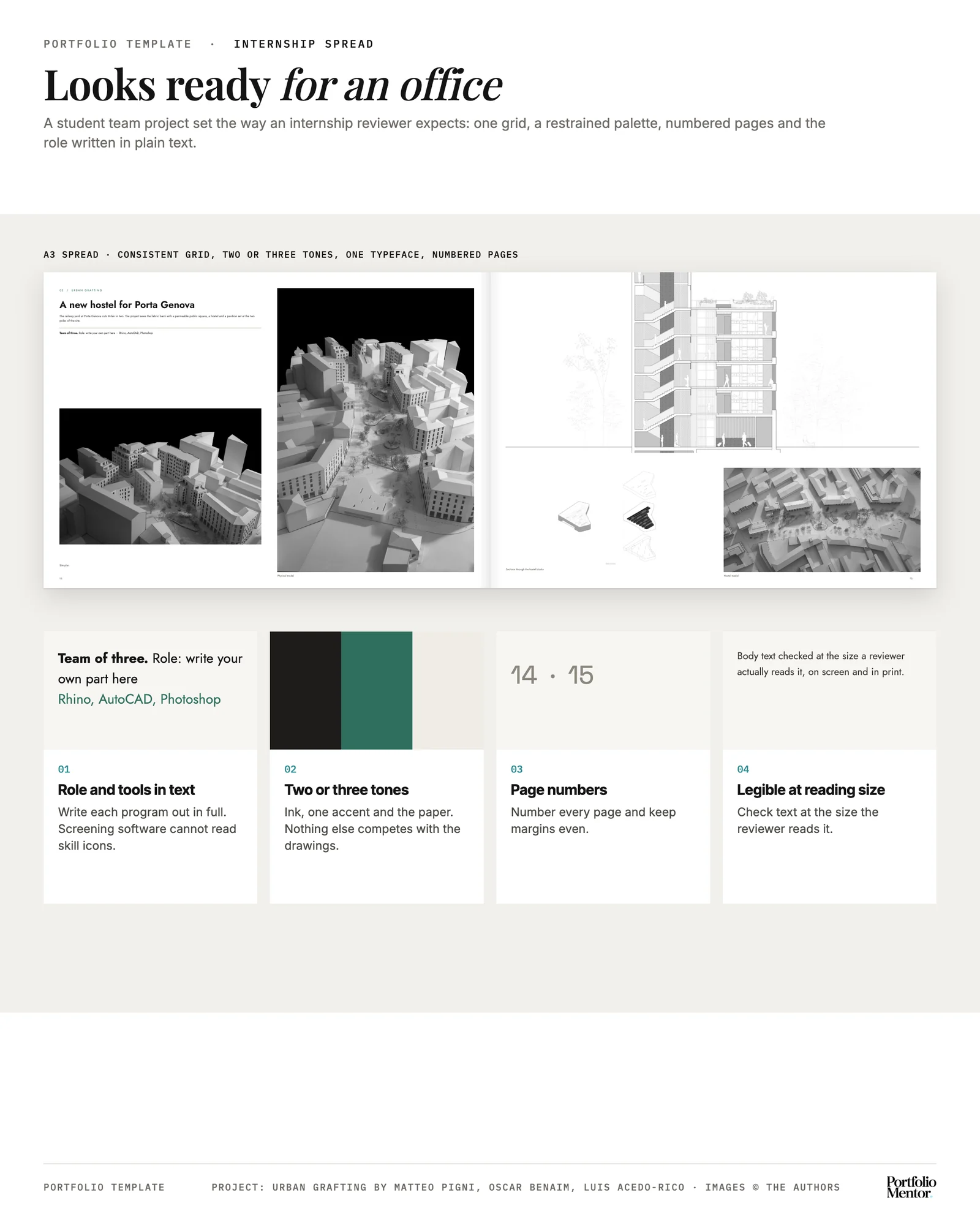
Your cover page should carry your name, one strong hero image, and your contact details, including email and LinkedIn. Number your pages, keep margins even, and make sure text is legible at the size a reviewer actually reads it. Export as a PDF rather than relying only on a website, since a PDF opens instantly, shares easily, and does not depend on a connection during a busy hiring review. Before you send anything, run your draft through an objective check. An AI portfolio review can catch inconsistent grids, weak hierarchy, and pages that dilute your strongest work.
🔢 Quick Numbers
- $99,280: median annual wage for architects in May 2025 (U.S. Bureau of Labor Statistics)
- 4%: projected growth in architect employment, 2025 to 2035 (U.S. Bureau of Labor Statistics)
- 3,740: hours of documented experience required to complete the NCARB AXP (NCARB)
Pairing Your Portfolio With a Strong Application
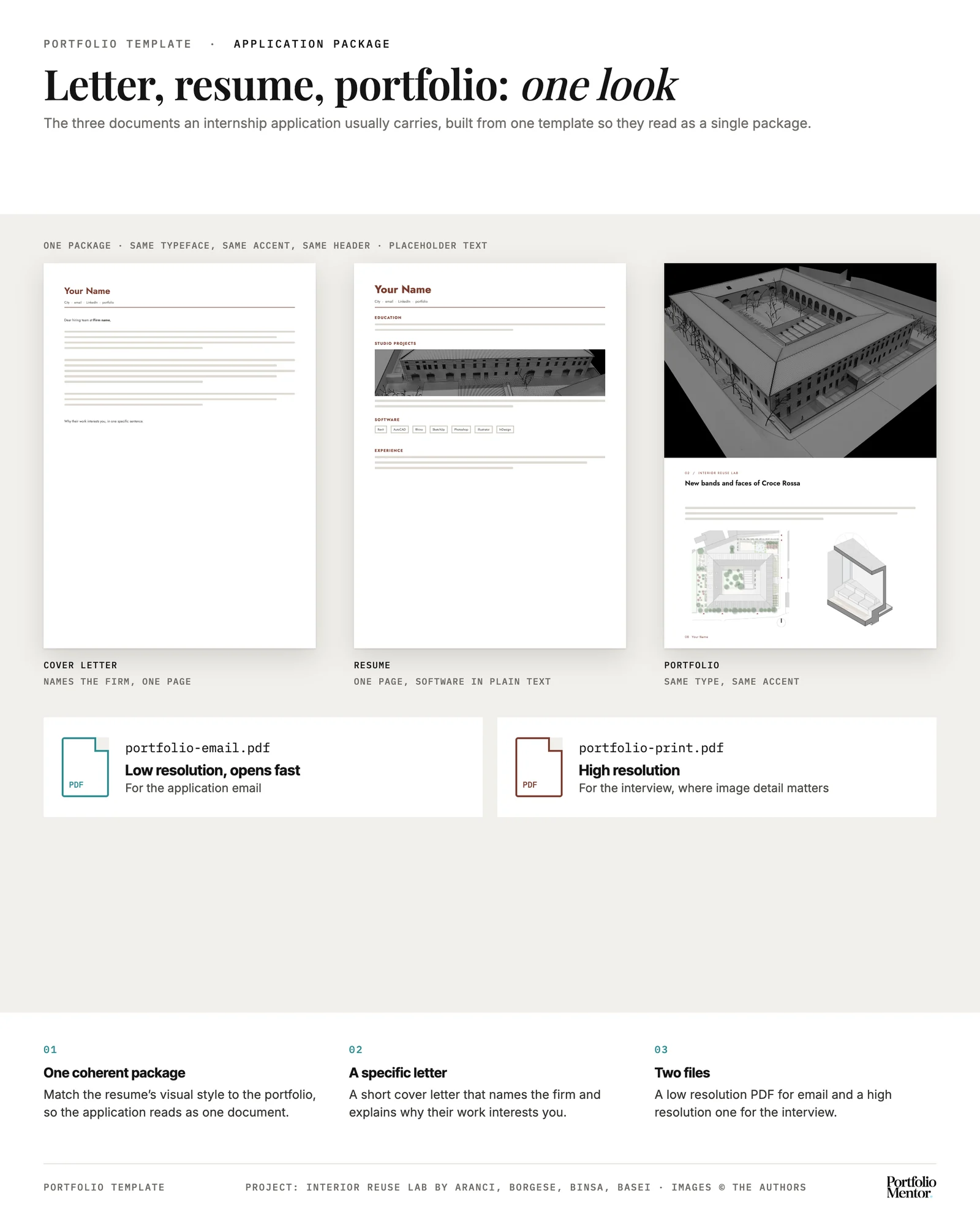
A portfolio rarely travels alone. It usually accompanies a one-page resume and a short, specific cover letter that names the firm and explains why their work interests you. Keep the resume to a single page, list your software fluency in plain text, and make sure the visual style of your resume matches your portfolio so the application reads as one coherent package.
Apply earlier than you think you should, because firms plan summer internships months ahead, and network through programs such as the American Institute of Architecture Students and the National Organization of Minority Architects. Knowing where and when to apply is half the battle, and our guide on how to find and land an architecture internship covers the search strategy that complements a strong portfolio. To compare portfolio formats and references, the free portfolio checklists and templates page collects resources worth bookmarking before you apply.
Treat each rejection as data rather than a verdict. If a portfolio version is not getting responses, change one variable at a time: reorder the projects, swap the lead image, or rewrite the project captions to make your role clearer. Reviewers move fast, and a portfolio that explains its own decisions in a sentence or two performs better than one that leaves them guessing. If you can, ask a practicing architect or a mentor to mark up your draft, since they read these documents the way a hiring panel does and will spot the weak page you have stopped seeing. Once you understand exactly how the document is evaluated, see how a structured review works so each new version improves on measurable feedback rather than guesswork.
💡 Pro Tip
Save a low-resolution version of your portfolio for email and a high-resolution version for interviews. Reviewers value a file that opens fast over one that buffers, and you can always bring the print-quality book to the meeting where image detail matters.
Frequently Asked Questions
Do I need professional work to make an internship portfolio?
No. An internship portfolio is built entirely from academic and personal work. Firms hiring interns expect studio projects, competitions, sketches, and independent work, and they evaluate your thinking and skills rather than completed buildings.
Should I send a PDF or a website link?
Send a PDF as your primary document, and include a website link only as a secondary option. Hiring managers consistently prefer a PDF because it opens instantly, is easy to share internally, and does not depend on an internet connection during review.
How many projects should I include?
Three to five projects is the standard range. Choose work that shows variety in type and media, lead with your strongest piece, and remove anything that does not represent your current ability.
Is group work acceptable in the portfolio?
Yes, as long as you clearly state your specific role. Label what you designed, drew, or modeled so reviewers can credit your contribution accurately and so you can speak to it confidently in an interview.
Key Takeaways
- Keep your architecture portfolio for internships to 15 to 25 pages and three to five projects, edited tightly.
- Lead with design thinking and process, not just polished renders, since that is what reviewers remember.
- Show the software firms use in plain text, and label your role in any group work honestly.
- Use a consistent grid, limited palette, and export a fast-opening PDF for every application.
- Tailor the book to each firm and pair it with a one-page resume and a specific cover letter.
Sources: NCARB Architectural Experience Program, NCARB Tips for Architecture Students, American Institute of Architects, U.S. Bureau of Labor Statistics.