Quick Answer
The most useful architecture books for first year students teach you to see and draw space before they teach theory. Start with Ching’s Architecture: Form, Space, and Order and Unwin’s Analysing Architecture, add Rasmussen’s Experiencing Architecture and Frederick’s 101 Things, then borrow Alexander, Lynch, Zumthor and Pallasmaa from your library.
Every architecture school hands first years a reading list, and most of those lists are too long to finish in a term. Some titles are references you dip into for years; others are short books you can read on a train and remember for a career. Knowing which is which saves you money and time in the weeks when studio deadlines already take most of both.
This list picks eight architecture books for first year students that cover the three things first-year studio actually tests: how to look at buildings, how to describe them in drawings and words, and how to start forming your own view. Each entry gives the author, publisher and edition details we checked against publisher or library pages, what the book does well, and where it falls short.
How to Build a First-Year Reading List on a Student Budget
You do not need to buy all eight. A realistic approach is to own one or two books you will use every week and borrow the rest. The reference books, such as Ching and Unwin, earn their price because you will open them during every project. The essay books, such as Zumthor and Pallasmaa, are short enough to read in a library in an afternoon.
Older editions are usually fine for first year. The core content of Rasmussen, Lynch and Alexander has not changed since first publication, and second-hand copies are common. For reference books with recent editions, check whether your school library holds the current one before buying; course leaders often place copies on short loan for exactly this reason.
💡 Pro Tip
Read with a sketchbook open, not a highlighter. When a book describes a building or a principle, draw a small diagram of it in the margin of your sketchbook. Tutors notice the difference within one crit: students who drew their reading use it in their projects; students who highlighted it quote it.
Architecture Books for First Year Students, Named
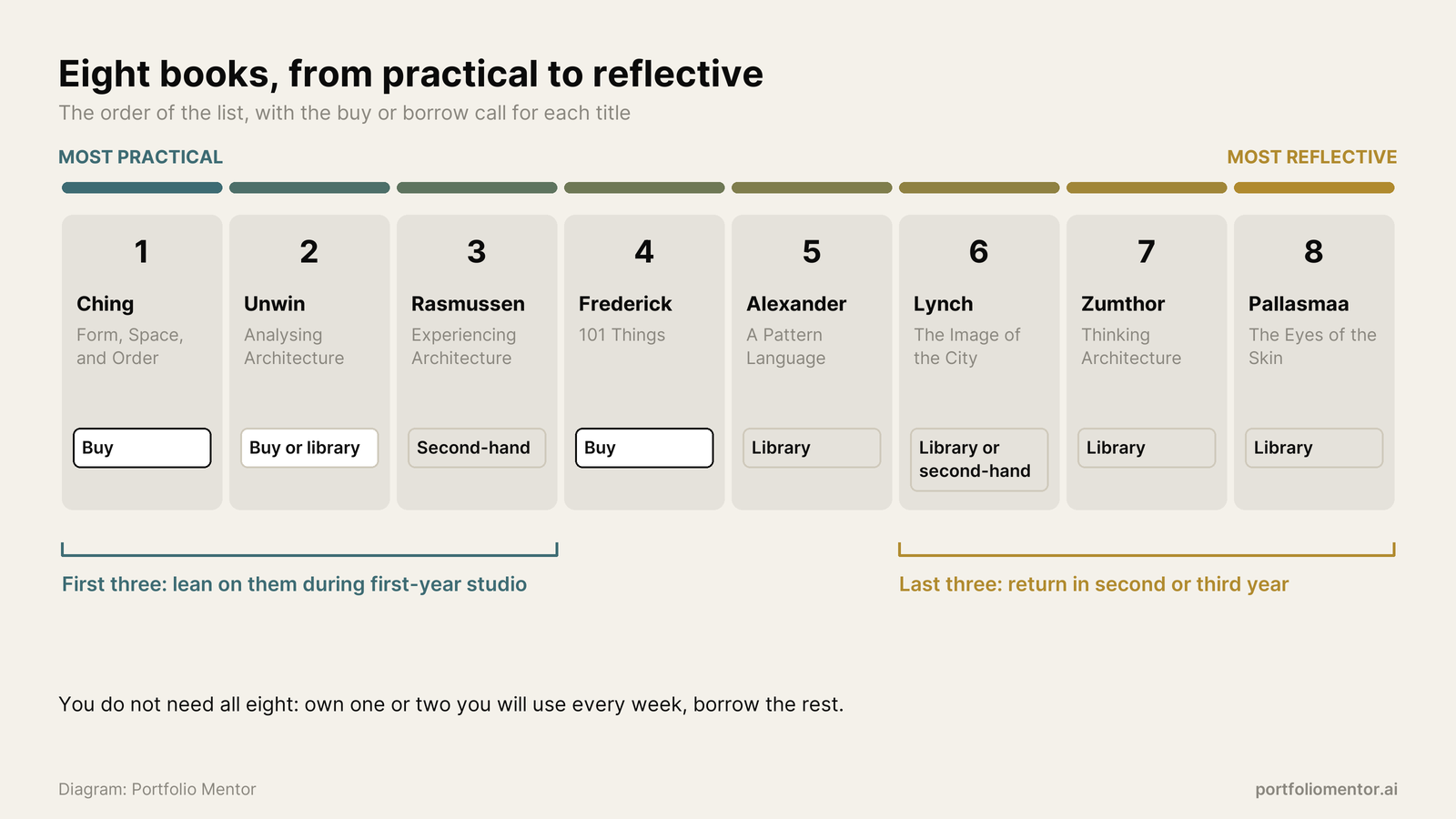
The eight books below are ordered from the most practical to the most reflective. Most first years will lean on the first three during studio and come back to the last three in second or third year. Read the “Watch for” notes before buying; every book on this list has a real limitation.
1. Architecture: Form, Space, and Order by Francis D. K. Ching
Architecture: Form, Space, and Order is published by Wiley and is now in its fifth edition, released in April 2023 at 496 pages. Wiley describes it as the classic introduction to the basic vocabulary of architectural design for more than forty years. Ching, Professor Emeritus at the University of Washington, explains almost every idea with a line drawing rather than a photograph.
The book works through the vocabulary its title promises: how form is made, how space is defined and how both are ordered. For a first year it doubles as a drawing manual, because the pages show how to explain an idea in a few lines. As of November 2026, Wiley lists the paperback at $57.95 and the e-book at $46.00, which makes it the most expensive book here.
Best for: a desk reference you will open during every project.
Watch for: the price, and an approach that catalogues forms without saying much about why a building is good.
2. Analysing Architecture by Simon Unwin
Analysing Architecture, published by Routledge, has been in print since its first edition in 1997 and is now in its fifth edition (copyright 2021), with 336 pages and 951 black and white illustrations, most drawn from the author’s own notebooks. The subtitle, “the universal language of place-making”, sums up its angle.
Where Ching catalogues forms, Unwin explains how architecture identifies place. Chapters such as “Using Things That Are There”, “Parallel Walls”, “In-between” and “Refuge and Prospect” each name one strategy, and a closing chapter, “How Analysis Can Help Design”, turns them into a method. That makes it the best book on this list for learning to write about your own design, because it gives you a vocabulary for what your building does rather than what it looks like. The author is Emeritus Professor of Architecture at the University of Dundee, and the book reads like a teacher’s notebook.
Best for: learning to explain and analyse a design in words and sketches.
Watch for: a dense structure that works better dipped into than read cover to cover.
3. Experiencing Architecture by Steen Eiler Rasmussen
Rasmussen was a Danish architect and urban planner and a professor at the Royal Danish Academy of Fine Arts. Experiencing Architecture was first published in Danish in 1957 and in English in 1959, with MIT Press issuing the long-running American editions. Library records list the 1962 second US edition at 245 pages.
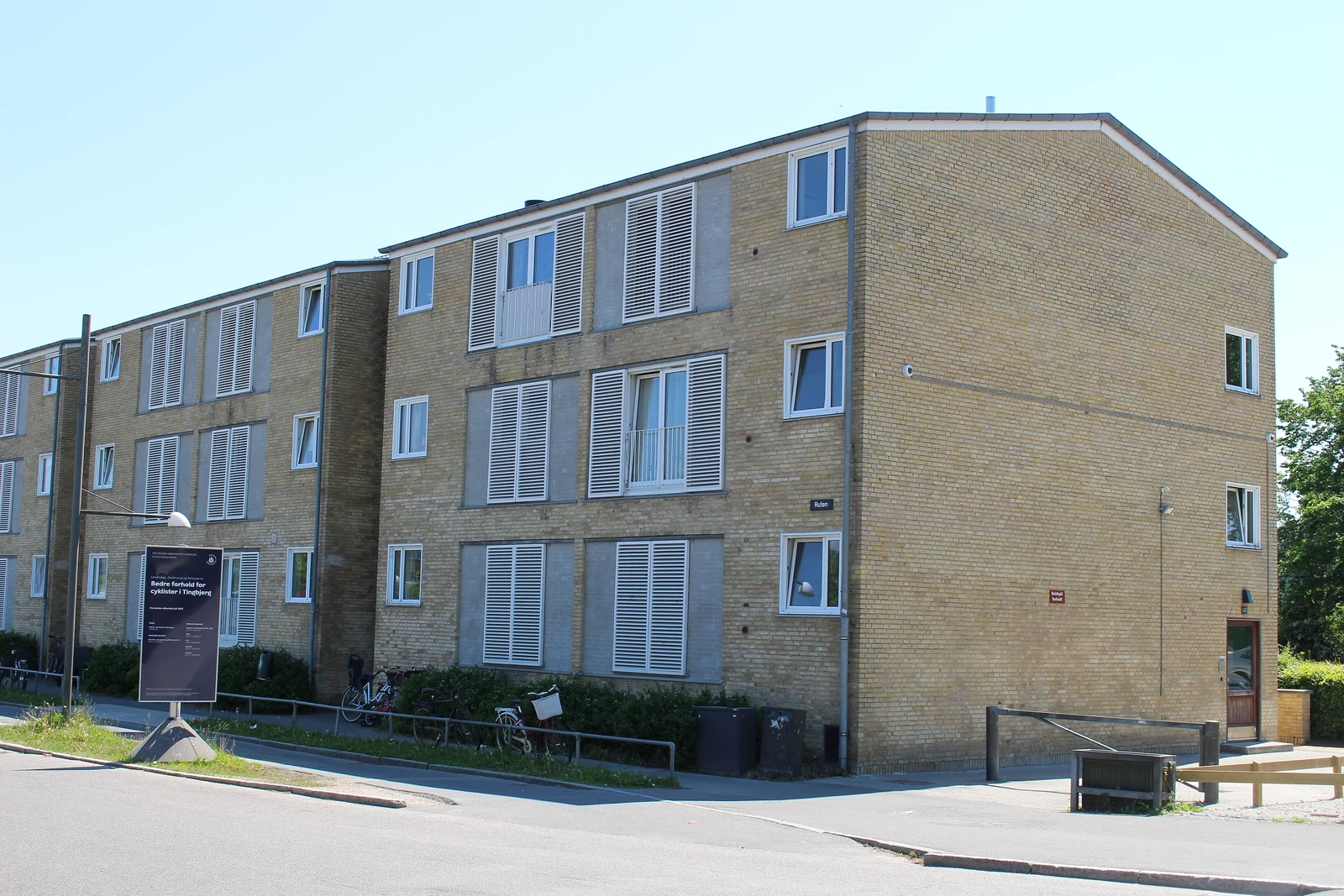
The book argues for first-person, physical experience of buildings: their shape, colour, scale, proportion, rhythm, texture, daylight and sound. Each chapter takes one of those qualities and walks through examples. It is written for a general reader, so a first year with no background can follow it, and it treats sound as a design quality alongside daylight and texture.
Best for: learning to notice what makes a space feel the way it does.
Watch for: examples drawn almost entirely from European and historical buildings.
📌 Did You Know?
Rasmussen taught at the Royal Danish Academy from 1924 and became a professor there in 1936. One of his students was Jørn Utzon, the architect of the Sydney Opera House.
4. 101 Things I Learned in Architecture School by Matthew Frederick
101 Things I Learned in Architecture School was published by MIT Press in 2007. Its author, Matthew Frederick, is an architect, urban designer and design instructor, and the book’s own page describes it as MIT Press’s all-time number one bestseller. The format is one short lesson per spread, each with a drawing on the facing page.
Lessons cover how to draw a line, colour theory, the design process, the purpose of building codes and how to give a presentation. It reads in an evening, and the entries are short enough to reread the night before a crit. The book later grew into a series covering other disciplines, which tells you how well the format works.
Best for: a quick orientation in your first weeks, or a gift for a student about to start.
Watch for: lessons so brief that they introduce ideas without developing them.
5. A Pattern Language by Christopher Alexander and Colleagues
A Pattern Language was published by Oxford University Press in 1977, written by Christopher Alexander with Sara Ishikawa, Murray Silverstein and others. It runs to 1,071 pages and contains 253 patterns, each describing a recurring problem in towns or buildings and offering a solution.
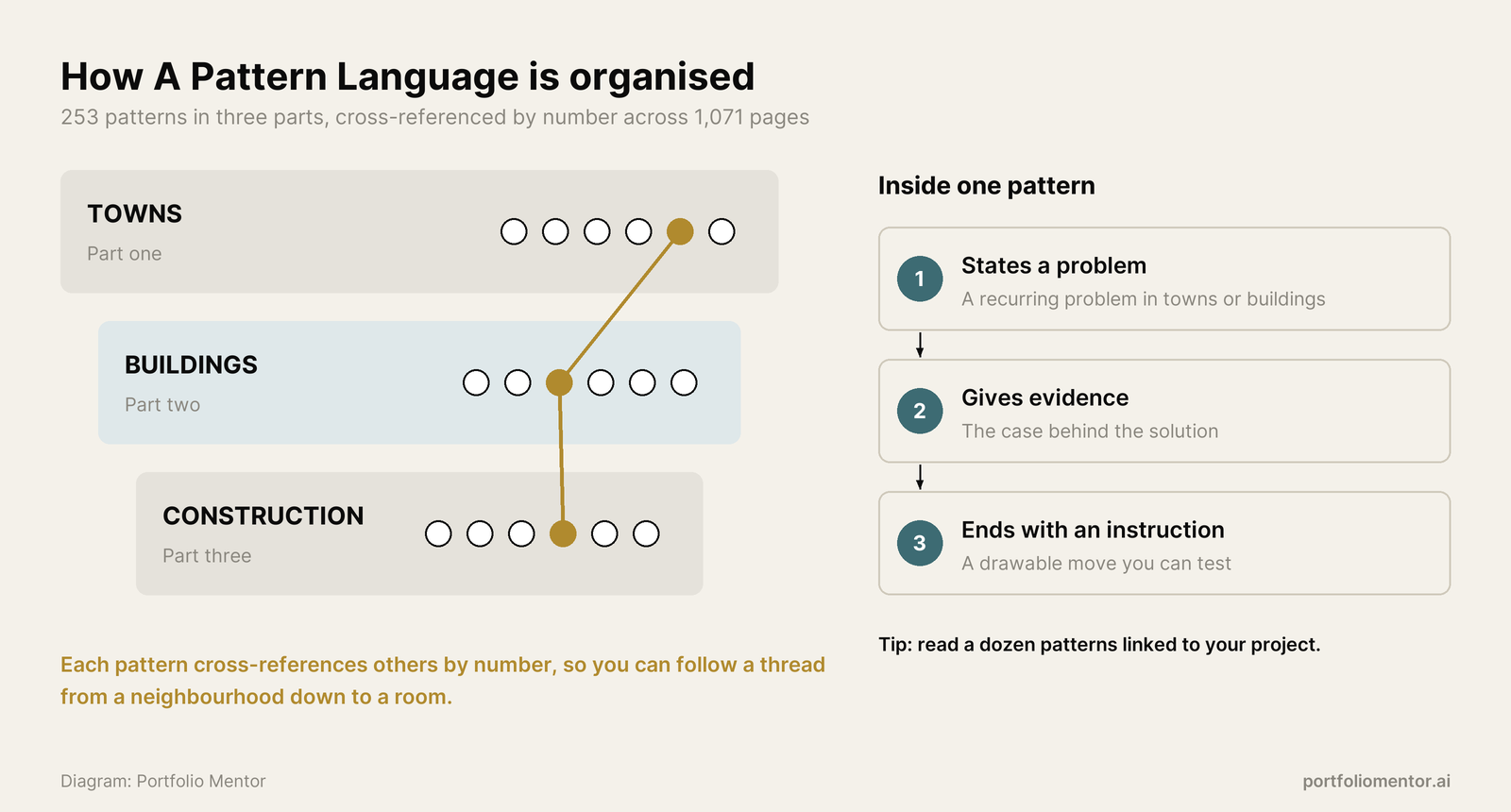
The patterns are grouped into three parts, towns, buildings and construction, and each one cross-references others by number, so you can follow a thread from a neighbourhood down to a room. For a first year, the value is in the format: each pattern states a problem, gives evidence and ends with a drawable instruction. Borrow it, read a dozen patterns related to your current project, and you will have more design moves to test than most precedent boards provide.
Best for: finding specific, human-scale design ideas for housing and small buildings.
Watch for: its length and a tone that presents opinions as rules.
6. The Image of the City by Kevin Lynch
The Image of the City was published by MIT Press in 1960 and runs to 194 pages. It came out of a five-year study of how people in Boston, Jersey City and Los Angeles form mental maps of where they live.
Lynch identifies five elements people use to read a city: paths, edges, districts, nodes and landmarks. Those five words are among the most useful tools a first year can carry into a site visit, because they turn a vague walk around the block into a structured survey. Pair it with our guide to site analysis in architecture and you have the basis of a solid first site study.
Best for: structuring site visits and urban analysis.
Watch for: mid-century American cities as the only case studies.
7. Thinking Architecture by Peter Zumthor
Thinking Architecture was first published by Lars Müller Publishers in 1998, with later expanded editions from Birkhäuser. The publisher notes that the texts are based on lectures and essays Zumthor wrote between 1988 and 1996.
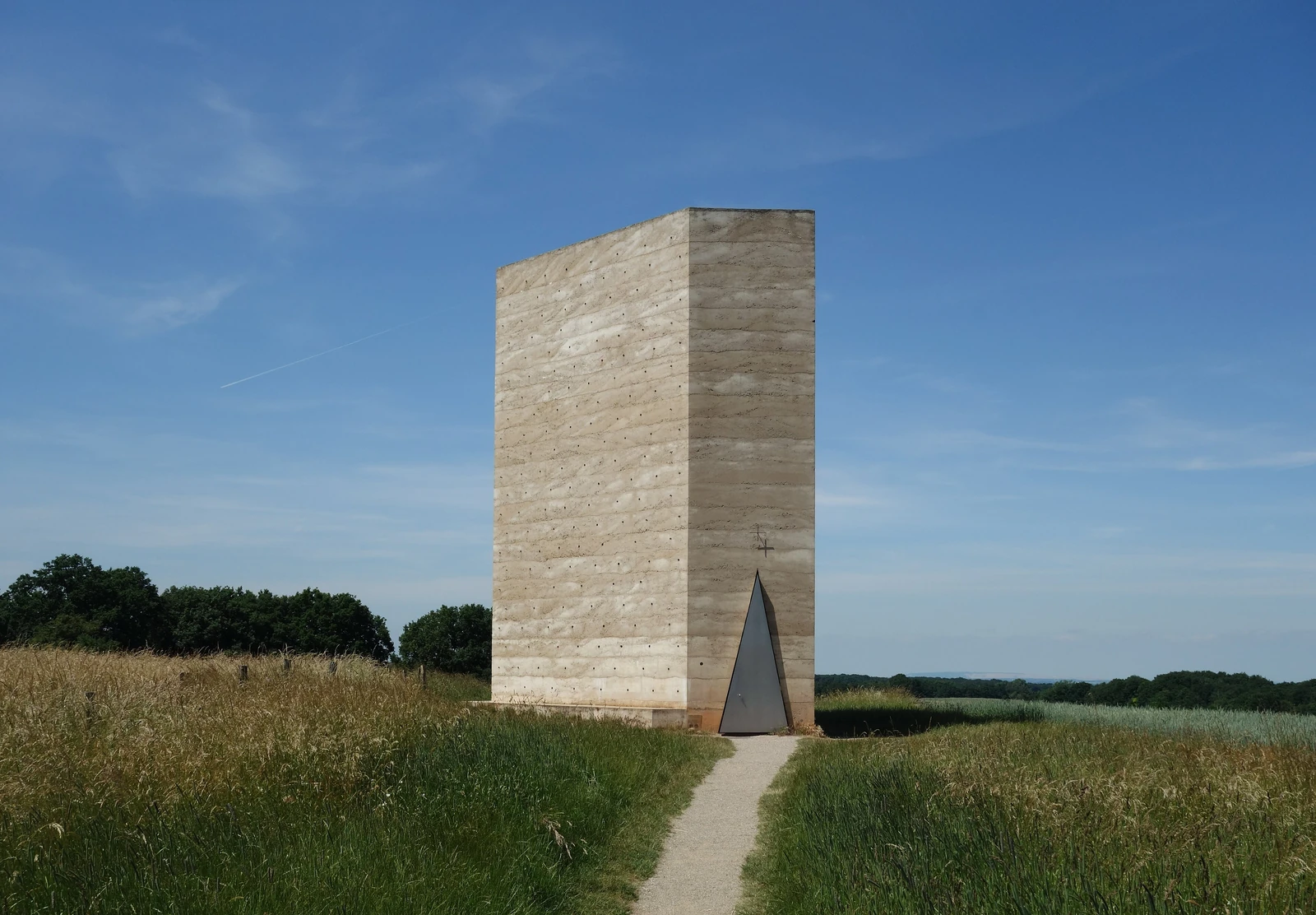
The essays cover memory as a source of architectural mood, the poetic qualities materials can take on, and how architects create atmosphere. They are short and dense, closer to notes than chapters. For a first year, the book is most useful when you are stuck on a material or a mood and need a reminder that those can be the starting point of a design, not decoration added at the end.
Best for: material and atmosphere-led thinking when a project feels abstract.
Watch for: very little practical method; it inspires more than it instructs.
8. The Eyes of the Skin by Juhani Pallasmaa
The Eyes of the Skin was first published in 1996. Wiley released the fourth edition in 2024; the hardcover runs to 112 pages. As of November 2026, Wiley lists the hardcover at $34.95 and the e-book at $28.00.
Pallasmaa asks why sight dominates architectural culture when we have five senses, and argues that suppressing the other four senses has made the built environment poorer. It is the natural follow-on to Rasmussen and a useful counterweight to a first year spent producing images. Read it before you design a project around renders alone.
Best for: questioning an image-first design process.
Watch for: a philosophical register that some first years find hard going.
At a Glance
The table summarises the eight books by what they offer, the edition details we confirmed, and the best way to get hold of each on a student budget.
| Book | What it covers | Edition checked | Buy or borrow |
|---|---|---|---|
| Ching, Form, Space, and Order | Design vocabulary, drawn | Wiley, 5th ed., 2023 | Buy |
| Unwin, Analysing Architecture | Place-making and analysis | Routledge, 5th ed., 2021 | Buy or library |
| Rasmussen, Experiencing Architecture | Perceiving space and material | English ed. 1959 | Second-hand |
| Frederick, 101 Things | Short illustrated lessons | MIT Press, 2007 | Buy |
| Alexander, A Pattern Language | 253 design patterns | Oxford UP, 1977 | Library |
| Lynch, The Image of the City | Reading a city’s structure | MIT Press, 1960 | Library or second-hand |
| Zumthor, Thinking Architecture | Material and atmosphere | Lars Müller, 1998 | Library |
| Pallasmaa, The Eyes of the Skin | The senses in architecture | Wiley, 4th ed., 2024 | Library |
How These Architecture Books Show Up in Your Work
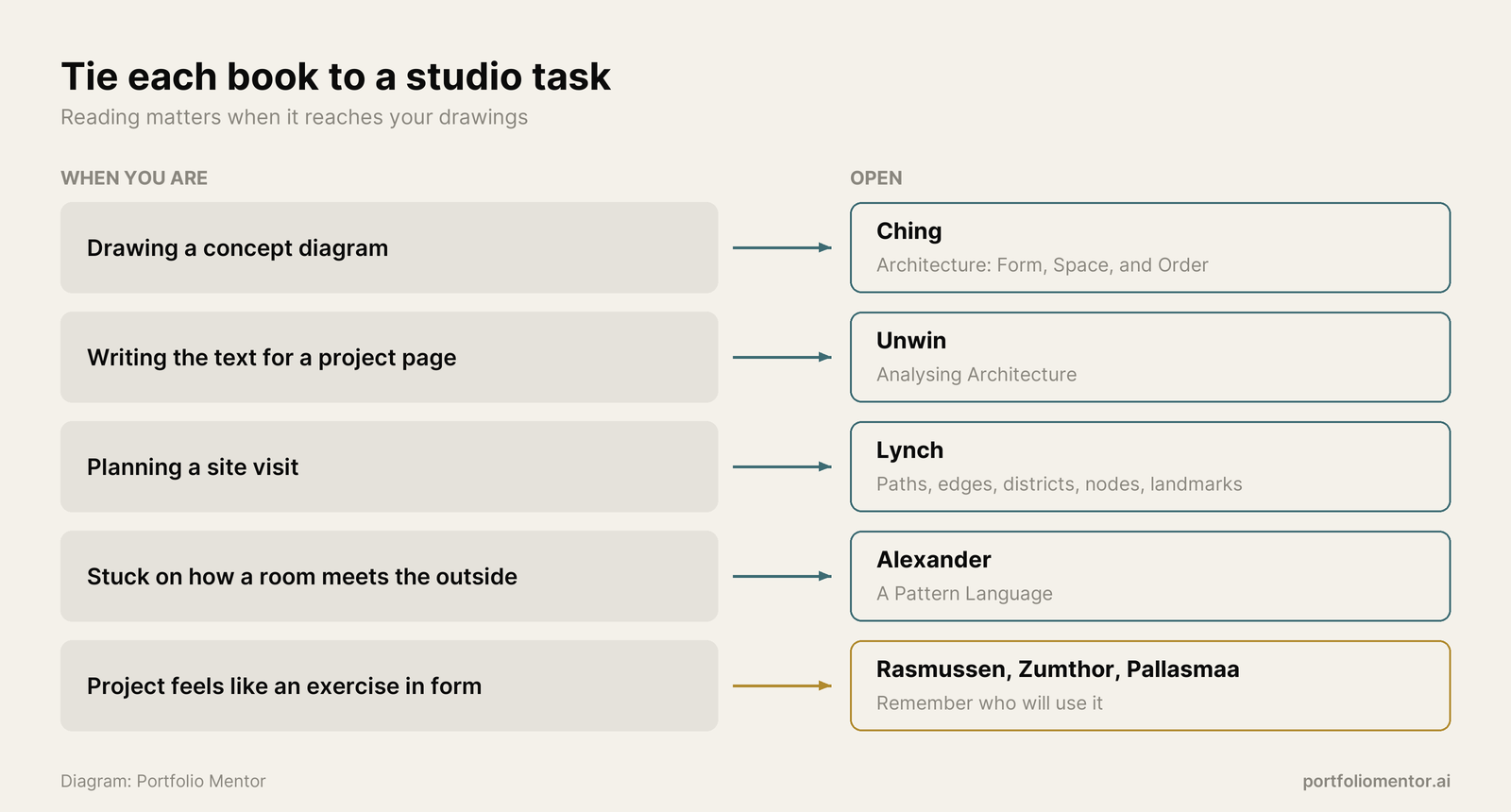
Reading only matters if it reaches your drawings. The quickest way to make that happen is to tie each book to a task. Use Ching when you draw a concept diagram, Unwin when you write the text for a project page, Lynch when you plan a site visit, and Alexander when you are stuck on how a room should meet the outside. Rasmussen, Zumthor and Pallasmaa are best read when a project starts to feel like an exercise in form and you need to remember who will use it.
The reading also shows later, in places you might not expect. A project text that names a principle from Unwin or Lynch and shows it in a drawing is far stronger than one that drops the name of a famous architect, and the same applies when you write about influences in an application. Our guide to the undergraduate architecture portfolio explains how process and reasoning pages fit into an application, and the architecture grad school guide covers how to write about influences in a statement of purpose.
If you are still deciding whether the degree is for you, two other pieces help put first year in context: how long architecture school takes and the wider steps in how to become an architect.
Editions and Theory: Two Practical Calls
Older Editions Are Usually Enough
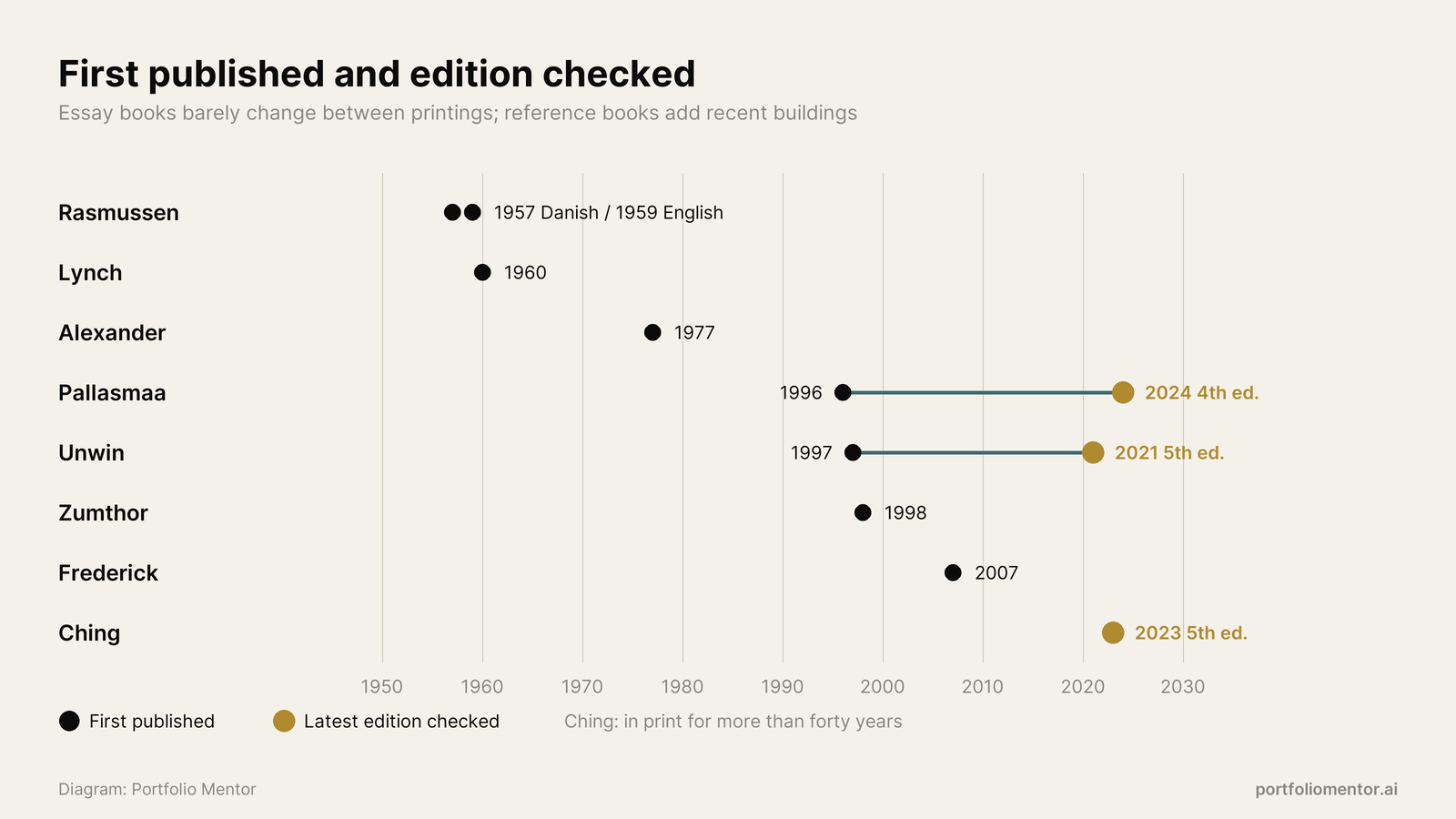
For the essay books, no. Rasmussen, Lynch, Alexander and Zumthor have changed little or not at all between printings. For Ching and Unwin, newer editions add recent buildings and updated drawings, but an earlier edition from a library teaches the same principles. Buy the current edition only if a course reading list cites page numbers from it.
Keep Dense Theory for Later
Read a little, and read it slowly. The books on this list are chosen because they connect ideas to things you can see and draw. Denser theory makes more sense once you have finished one or two full design projects and have your own questions to bring to it.
Final Thoughts
Bottom Line: Own Ching or Unwin, read Rasmussen and Frederick in your first month, and borrow the rest when a project gives you a reason to. The best architecture books for first year students are the ones that end up as sketches in your notebook, not the ones lined up on your shelf.