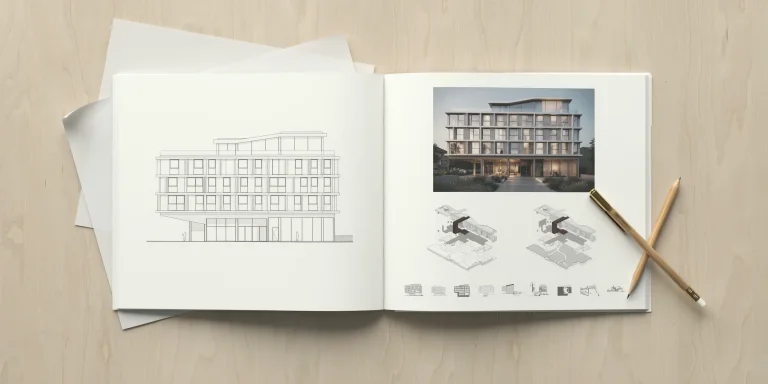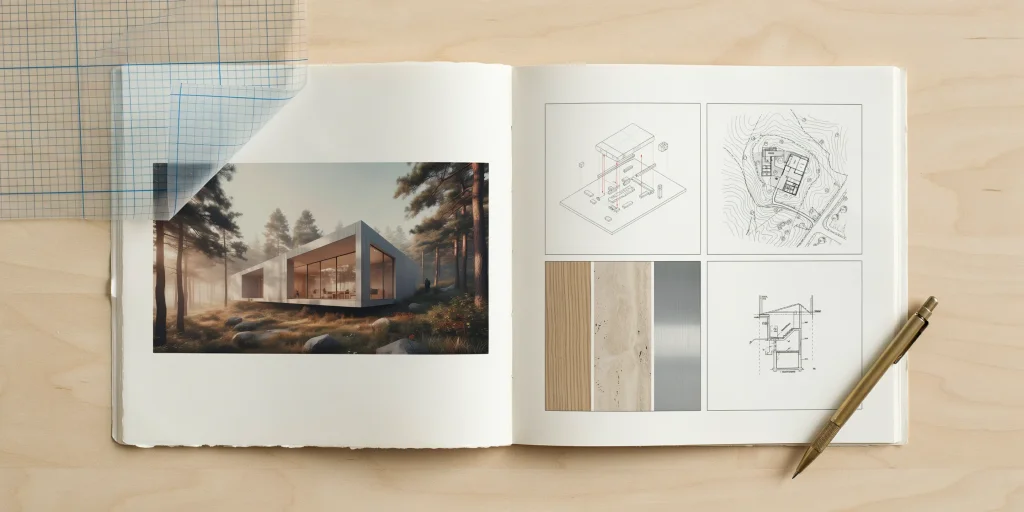
Strong architecture portfolio examples share a clear hierarchy, a tight selection of four to six projects, and a narrative that shows your design thinking rather than just final renders. The portfolios that get you hired prove process, scale range, and authorship within roughly 20 pages, formatted so a busy hiring manager can read them in minutes.
Looking at architecture portfolio examples is useful only when you understand why certain choices work. A beautiful cover means little if the project sequence is confusing or every page screams “final render” with no evidence of how you got there. This guide breaks down the patterns behind portfolios that move applicants from the pile to the interview, with concrete lessons you can apply to your own document today. For the full end-to-end framework, see our complete architecture portfolio guide.
What makes an architecture portfolio example worth studying?

An architecture portfolio example is worth studying when it does three things at once: it curates ruthlessly, it sequences projects to build a story, and it makes your individual contribution unmistakable. Hiring managers spend two to three minutes on a first pass, so the best examples front-load their strongest project and never bury authorship inside a team effort.
The American Institute of Architects interviewed hiring managers and found a consistent theme: firms want generalists who can show a wide range of work, not a stack of repetitive renders. As one recruiter put it, after the tenth glossy render the pages blur together, while sketches, site strategies, and process diagrams reveal how you actually think. That preference shapes every example below. You can read the full discussion in the AIA piece on portfolio tips from hiring managers.
🔢 Quick Numbers
- Median annual wage for architects was $96,690 in May 2024 (U.S. Bureau of Labor Statistics).
- Architects held about 123,600 jobs in 2024, with roughly 7,800 openings projected each year through 2034 (U.S. Bureau of Labor Statistics).
- Career specialists and the AIA recommend a portfolio of 20 pages or fewer (American Institute of Architects).
7 architectural design portfolio examples and why they work

The strongest architectural design portfolio examples are not united by one visual style. They are united by clarity of intent. Below are seven recurring formats you will encounter, each with the specific lesson it teaches.
1. The single-narrative thesis portfolio

This format leads with one ambitious project carried across six to eight pages, from initial site analysis to final section. It works because depth reads as competence. A hiring manager sees a complete design arc, including the messy middle, and trusts that you can carry a real building from concept to documentation. The lesson: pick one anchor project and let it breathe.
2. The range portfolio
Here the applicant shows four projects at deliberately different scales, a pavilion, a housing block, an interior, and an urban study. It works for generalist firms because it signals adaptability. The lesson: variety should feel curated, not scattered. Each project earns its place by demonstrating a different skill.
💡 Pro Tip
When you review portfolios that recruiters praise, count how many pages pass before you reach a finished render. The strongest examples show sketches, diagrams, and physical models first, then deliver the render as a payoff. Lead with process and your work reads as deeper, not less polished.
3. The process-forward portfolio

This example devotes as much space to study models, hand sketches, and iteration diagrams as it does to finished imagery. It works because it answers the question every reviewer asks silently: did this person actually solve the problem, or just decorate it? The lesson: show the decision points, not only the result.
4. The technical documentation portfolio
Aimed at firms that value production skills, this format includes a wall section, a detail callout, and a clearly labeled set of construction drawings. It works for mid-level roles where billable competence matters. The lesson: if you can document a building, prove it with one well-chosen detail rather than claiming it in a bio line.
5. The student architecture portfolio
A strong student architecture portfolio leans into studio work because that is the honest material a student has. It works when it presents three studio projects with confident graphics and clear concept statements, rather than padding with weak side projects. The lesson: for early applicants, hiring managers focus almost entirely on the portfolio, so quality of curation beats quantity every time.
📌 Did You Know?
Some firms specifically request school projects even from experienced applicants. According to AIA hiring managers, professional work often reflects the firm’s direction rather than the individual’s voice, so design-school work can be the clearest evidence of your personal sensibility.
6. The branded portfolio
This example carries one consistent typographic and color system across the cover, project pages, resume, and cover letter. It works because consistency reads as professionalism before a single drawing is judged. The lesson: a coherent graphic identity signals that you understand presentation as part of design.
7. The hybrid web-plus-PDF portfolio
The most flexible applicants maintain a lightweight web portfolio for discovery and a tailored PDF for direct applications. It works because each format serves a different moment in the hiring funnel. The lesson: match the medium to the context, and never rely on a web link when a firm asks for an attachment. We compare both formats in depth in our breakdown of the digital architecture portfolio, web versus PDF.
How to read layout choices in any architecture portfolio
To read layout choices, look at three things in order: the grid, the visual hierarchy on each spread, and the white space. A disciplined grid keeps images and text aligned across every page, hierarchy guides the eye to the single most important drawing first, and generous white space lets each project feel resolved instead of crowded.
When you study architectural portfolio examples that feel effortless, the effort is usually hidden in the grid. Consistent margins, a repeating column structure, and a fixed type scale do the quiet work. If a spread feels chaotic, the cause is almost always a broken grid or competing focal points rather than a weak project. For a deeper walkthrough of spacing, grids, and sequencing, our architecture portfolio layout and design tips cover the mechanics page by page.
⚠️ Common Mistake to Avoid
Do not present team projects without stating your role. Reviewers cannot assume what you did. If you produced the construction set or drove the facade study, say so explicitly on the page. Ambiguous authorship is one of the fastest ways to lose credit for strong work.
How to apply these lessons to your own portfolio
Start by cutting. List every project you have, then keep only the four to six that each demonstrate a distinct strength. Sequence them so your single best project opens the document and a strong, different project closes it. For each one, build a short arc: concept, a key decision, and the resolved result, with process work in between.
Next, unify the graphics. One typeface family, one accent color, consistent margins. Then write a one-line role statement on every project so authorship is never in doubt. Finally, export a clean PDF under roughly 20 pages and proofread it twice, since a single typo can eliminate you when a posting draws hundreds of applicants. If you want objective feedback before you send it, you can run your draft through our portfolio review features and see exactly how the analysis works.
🎓 Expert Insight
“Digital PDF files are the preferred method of showcasing your creativity and project experience, easy to open, review, and share.”, American Institute of Architects, Portfolio Tips
The AIA recommends keeping both a PDF for immediate sending and a physical copy for interviews, so you can flip directly to a relevant example when a question comes up.
If licensure is part of your longer plan, note that documented project work also feeds the professional path. NCARB now allows experienced designers to satisfy parts of the Architectural Experience Program through a documented portfolio of past work, which is one more reason to keep clean records of your contributions.
Frequently asked questions
How many projects should an architecture portfolio include?
Most strong examples include four to six projects across roughly 20 pages or fewer. Fewer, deeper projects almost always outperform a long list of shallow ones, because reviewers judge depth of thinking over volume.
Should a student portfolio look different from a professional one?
Yes. A student architecture portfolio leans on studio work and concept clarity, while a professional portfolio adds technical documentation and explicit role statements. Both should stay tightly curated and graphically consistent.
Is a PDF or a website better for an architecture portfolio?
Use both. A PDF is the format most firms request because it is easy to open and share offline, while a website helps with discovery. When a posting asks for an attachment, always send the PDF.
Do renders or process work matter more?
Process work usually matters more to hiring managers. Renders show the destination, but sketches, diagrams, and models prove the design thinking that got you there, which is what most reviewers are screening for.
Key Takeaways
- The best architecture portfolio examples curate to four to six projects and stay under about 20 pages.
- Lead with process, sketches, and diagrams, then deliver the render as a payoff.
- State your role on every project so authorship is never ambiguous.
- Unify type, color, and grid across portfolio, resume, and cover letter for a branded, professional read.
- Keep a PDF for applications and a web version for discovery, and proofread before sending.