

Personal branding for architects is the deliberate work of defining your niche, design point of view, and visual identity so firms recognize your value before they open your portfolio. A clear brand makes your name, work, and online presence read as one consistent story, which shortens the distance between a recruiter glancing at your profile and inviting you to interview.
See aia.org.
See archdaily.com.
Most early-career architects assume the job market rewards the strongest drawings. It rewards the clearest signal. When a hiring manager scans 200 applicants for one position, they are not reading every page. They are pattern matching: what does this person do, what do they care about, and does it fit our studio? Strong personal branding for architects answers those three questions in seconds, across every place your name appears. This guide breaks down how to define that signal and make it consistent enough to move you to the top of the pile.
What is personal branding for architects?

Personal branding for architects is the intentional process of communicating your skills, values, and design philosophy so others perceive your expertise the way you intend. It is not a logo or a color scheme. It is the sum of what people conclude about you from your portfolio, your LinkedIn profile, your website, and the projects you choose to put forward.
As ArchiPro notes in its overview of branding for design professionals, talent alone is not enough; branding shapes how that talent is read. A brand is the difference between being “an architect who can do anything” and being “the person who designs warm, low-energy timber housing.” The second is memorable. The first disappears in a stack of applications. Specificity is what gets remembered, referred, and hired.
🔢 Quick Numbers
- The total number of U.S. architects fell 4% in 2024 to roughly 116,000, signaling a generational shift as Baby Boomers retire (NCARB By the Numbers 2025).
- Candidates pursuing licensure rose 5% to nearly 40,000 in 2024, the highest figure NCARB has recorded since 2018, meaning more peers competing for entry roles (NCARB By the Numbers 2025).
- In 2024, 42% of new architects identified as women and 33% as people of color, a steadily diversifying field where a distinct voice stands out more (NCARB By the Numbers 2025).
Why does personal branding matter for getting hired?

Branding matters because hiring is a filtering problem before it is a talent problem. A studio principal forms a first impression of you in under a minute, often from a LinkedIn headline or the first two pages of a portfolio. If those moments tell a coherent story, you advance. If they are generic, you are filtered out regardless of skill.
There is also a referral effect. Architecture hiring runs heavily on networks and word of mouth. When your brand is specific, people can describe you to others accurately: “I know someone who is great at adaptive reuse, you should talk to her.” A vague brand cannot be passed along, because there is nothing concrete to repeat. Your work needs to be summarized by someone who is not you, in one sentence, to a person you have never met.
⚠️ Common Mistake to Avoid
Trying to look qualified for every job by showing every type of project. A portfolio with residential, healthcare, parametric pavilions, and interiors signals that you have no center of gravity. Firms hire for fit, so a focused body of work that clearly matches their practice beats a wide one that matches no one in particular.
How to define your architecture niche

Your niche is the intersection of what you are good at, what you care about, and what the market needs. You do not have to commit to it for life. You need a working position for this stage of your career, clear enough to organize your portfolio and your messaging around. Think of it as a hypothesis you can revise, not a permanent label.
Run a quick audit. List every project you have completed, then tag each one by typology, scale, and the skill it best demonstrates. Patterns usually appear: maybe three of your strongest projects involve housing, or you keep returning to environmental performance. That recurring thread is the raw material for your niche. Lead with it. The work that does not fit becomes supporting material or gets cut entirely.
If you are still a student or recent graduate sorting out direction, a structured review of your strongest work helps surface the pattern faster. The AI portfolio review on Portfolio Mentor scores your projects against a hiring rubric and flags which pieces actually carry your application, which is often the first step toward seeing your own niche clearly.
💡 Pro Tip
Write your niche as a single sentence in the form “I design [type] for [context] with a focus on [value].” If you cannot finish that sentence without listing three unrelated things, your brand is still too broad. Tighten it until one project on your desk would obviously belong and another obviously would not.
Building a consistent visual identity

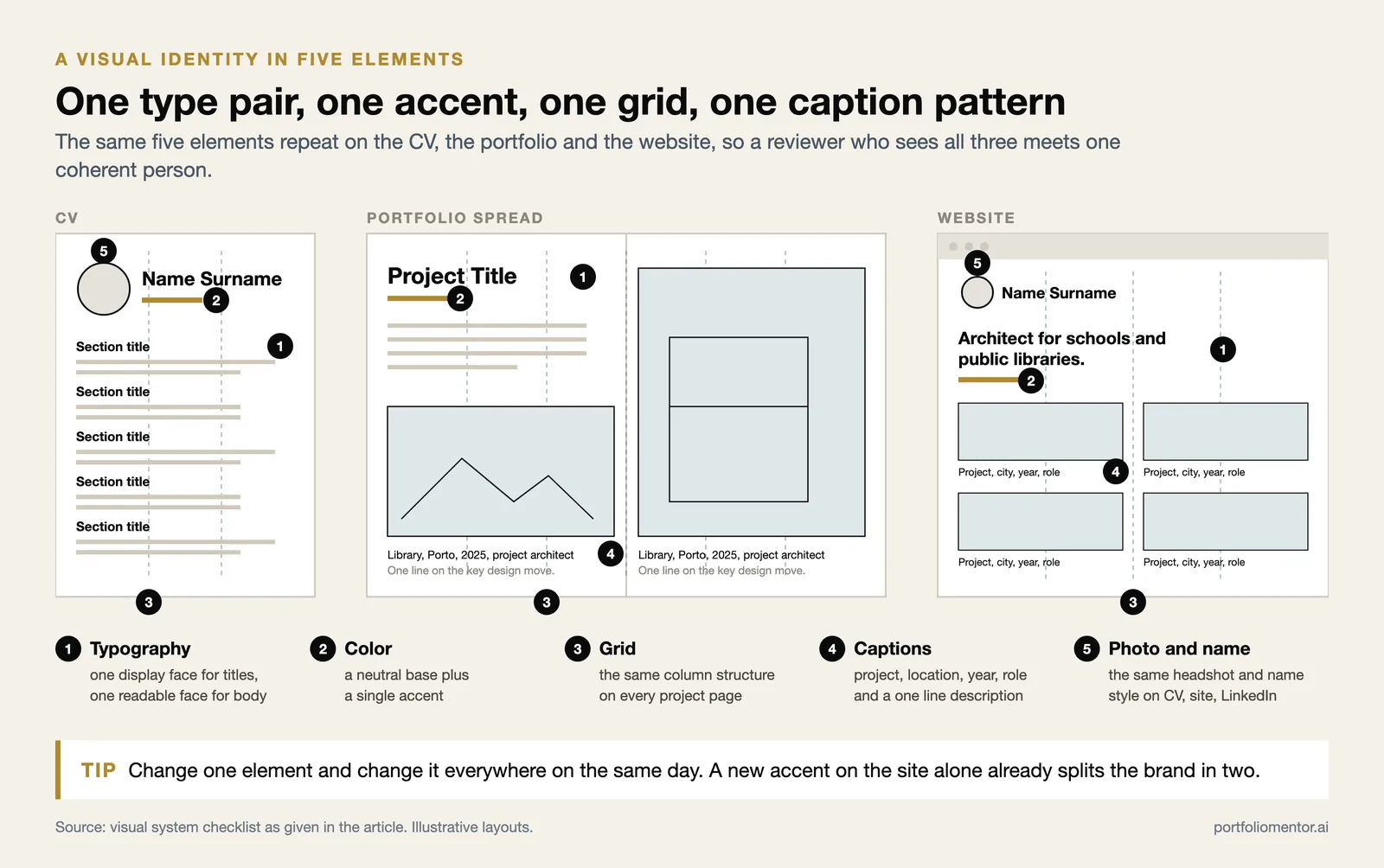
Visual identity is how your brand looks across every surface a firm encounters. The goal is recognition: someone should be able to glance at your resume, then your portfolio, then your website, and feel they are looking at one coherent person. Inconsistency reads as carelessness, which is a hard signal to send when your job is design.
Keep the system small and disciplined. Choose one or two typefaces and use them everywhere. Settle on a restrained palette, usually a neutral base with a single accent. Apply the same caption format and the same grid logic to every project sheet. The point is not decoration; over-styled graphics distract from the architecture and date quickly. Your drawings should be the loudest thing on the page, with the system quietly holding everything together.
A working visual system covers a few specific elements. Use this as a checklist:
- Typography: one display face for titles, one readable face for body text, used consistently across resume, portfolio, and site
- Color: a neutral base plus a single accent, not a rainbow of project-by-project schemes
- Grid: a repeated column structure so every project page feels part of the same document
- Captions: a fixed pattern for project name, location, year, role, and a one-line description
- Profile photo and name treatment: the same headshot and name styling on LinkedIn, your site, and your CV
If building this from scratch feels slow, an architecture-specific template can give you a grid, type system, and caption pattern matched to your specialization. We cover ready-made options in our guide to architecture portfolio templates, which is a faster path to a consistent identity than designing every page yourself.
Where should your personal brand live online?

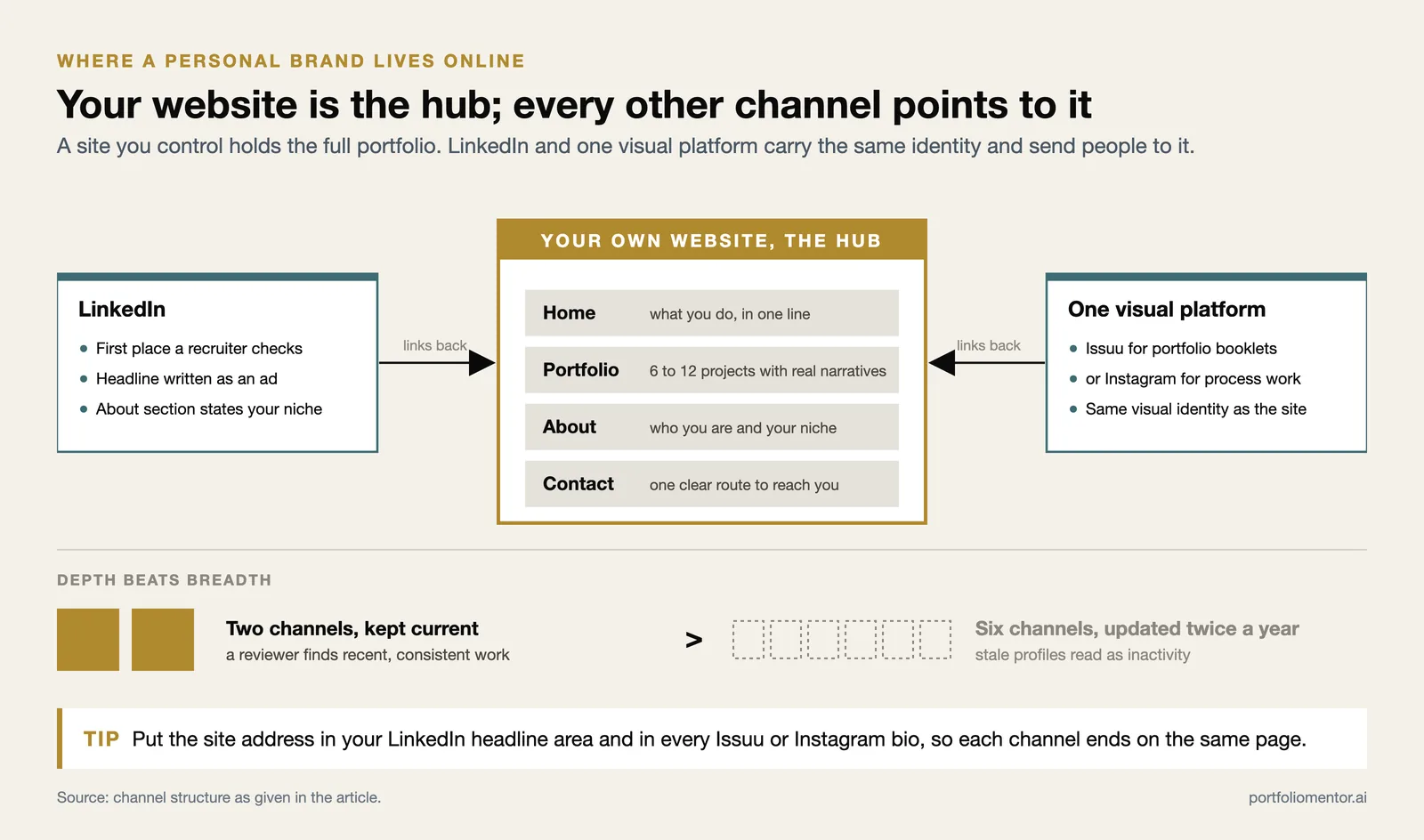
Your brand should live on a small number of channels you can actually maintain, anchored by a website you own. Every other platform points back to that site. Spreading yourself across six networks you update twice a year is worse than running two well. Depth beats breadth, especially early on.
Your own website
A personal site is the only part of your online presence you fully control. Keep the structure tight: a homepage that states what you do in one line, a portfolio of six to twelve projects with real narratives, an about page, and a clear contact route. Search visibility comes from a simple project or writing section, not from elaborate navigation. For a deeper build-out, our architecture portfolio website guide walks through structure and hosting choices step by step.
For most architects seeking employment, LinkedIn is the first place a recruiter checks. Treat your headline as an ad rather than a job title: LinkedIn’s own talent blog advises using the full headline space to describe what you do and why, not just defaulting to your current role. Your About section is the one place you define yourself in your own words, so use it to state your niche and the kind of work you want. We go further in our LinkedIn for architects guide.
A visual platform
One image-driven channel rounds out the set. Many architects publish full portfolio booklets on Issuu or share process work on Instagram. Pick the one that fits your work and your habits, then keep the visual identity identical to your site so the whole presence reads as one brand.
📌 Did You Know?
According to NCARB By the Numbers 2025, candidates earned their license in an average of 12.9 years in 2024, about six months faster than the year before. That long runway means your brand often has to carry you through years of intern and junior roles before “architect” is even on your business card, which makes a clear early identity worth the effort.
How do you keep your brand consistent over time?
Consistency is the part most people underestimate. A strong brand is not built in a launch; it is built by showing up the same way, with the same perspective, for the same audience, over months and years. The architects with the most recognizable names did not post once. They held a position long enough for it to stick.
Practical consistency has two layers. The first is visual and structural: same headshot, same type, same niche statement everywhere, updated together whenever one changes. The second is editorial: a steady, low-volume habit of sharing work, observations, or finished projects. You do not need to produce content constantly. You need to be recognizable and current when someone checks. A portfolio last touched in 2023, paired with a stale LinkedIn, quietly tells a firm you have stopped.
Aligning your resume and cover letter with your brand
Your application documents are part of the brand, not separate from it. The niche you claim online should be visible in the first lines of your resume and echoed in every cover letter. When all three agree, a hiring manager reads one consistent candidate; when they conflict, they read confusion. For wording and structure, see our architecture CV guide, and keep each letter tailored to the studio rather than mass produced.
A practical personal branding checklist for architects
Use this table to audit where your brand stands today and what to fix first.
| Brand Element | What Good Looks Like | Priority |
|---|---|---|
| Niche statement | One sentence naming type, context, and value | High |
| Portfolio focus | 6 to 12 projects that support one clear direction | High |
| Visual identity | Same type, color, grid across all materials | Medium |
| Website | Owned site stating what you do, with contact route | Medium |
| Descriptive headline and About matching your niche | High | |
| Consistency habit | Regular, low-volume updates across channels | Low |
If you want a sense of how the platform thinks about positioning and firm fit, the Portfolio Mentor about page explains the rubric and firm-matching approach that sits behind much of this advice.
Branding is presentation, not production. For the tools that speed up the work behind it, see our guide to AI tools for architects.
Frequently asked questions
Do students need a personal brand, or just graduates?
Students benefit most, because internships and first roles are won on potential and fit rather than a long track record. A clear early niche, even one you later revise, gives reviewers something concrete to respond to and makes your studio work easier to remember.
Will a narrow niche limit my job options?
It rarely does at the application stage. A focused brand makes you the obvious choice for the firms that match it and a clear pass for those that do not, which is more efficient than being a weak maybe everywhere. You can always present a broader story once you are in the room.
How often should I update my brand?
Refresh your portfolio and profiles together whenever you finish significant work or your direction shifts, and at minimum review everything once or twice a year. The goal is that any firm checking you today sees current work and a consistent message across every channel.
Putting It All Together
Bottom Line: Personal branding for architects is not self-promotion; it is making your real strengths legible to busy people in seconds. Pick a niche, build one consistent visual identity, anchor it on a site you own, and keep every channel saying the same thing. Do that, and firms start the conversation already knowing why they want you.