Quick Answer
The architect vs interior designer choice comes down to scope and licensure. Architects design whole buildings and must be licensed in every US jurisdiction after an accredited degree, the AXP and the ARE. Interior designers plan and specify interior space; their licensing varies by state, usually through a CIDA-accredited degree and the NCIDQ exam.
Both professions draw plans, both work inside buildings, and both spend a lot of time on site. From the outside they can look like two names for the same job. From the inside, they diverge on almost every structural point: who signs the drawings, how long it takes to qualify, what the pay looks like, and what a hiring manager expects to see in your portfolio.
This guide works through those points with current figures from the Bureau of Labor Statistics, NCARB, NAAB, CIDA and CIDQ. If you are choosing a degree, thinking about switching, or trying to work out why the same project reads differently in an architecture book and an interior design book, the answer is in the training and licensure structure, not in talent or taste.
Architect vs Interior Designer: The Side-by-Side View
The table sets out the measurable differences. Pay and job figures are from the BLS Occupational Outlook Handbook, using May 2025 wages and 2025 employment.
| Factor | Architect | Interior designer |
|---|---|---|
| Core scope | Whole buildings, structure and systems coordination | Interior layout, finishes, furniture, lighting |
| Accrediting body | NAAB (B.Arch, M.Arch, D.Arch) | CIDA (interior design programs) |
| Experience requirement | AXP, 3,740 hours | Work experience set by CIDQ and states |
| Exam | ARE 5.0, six divisions | NCIDQ, three sections (IDFX, IDPX, IDIX) |
| Licensure | Required in all US jurisdictions | Varies by state, from none to practice laws |
| Median annual wage (May 2025) | $99,280 | $67,190 |
| Jobs (2025) | 124,600 | 97,100 |
| Self-employed share | 14% | 26% |
Two lines in that table drive most of the others. Architecture is a licensed profession everywhere in the US, so its education and experience path is long and standardised. Interior design is regulated unevenly, so its path is shorter and more varied, and pay reflects both the scope and the regulatory weight.
What Each Profession Is Responsible For
The architect’s scope
According to the BLS profile of architects, architects meet clients to set objectives, give preliminary cost and time estimates, prepare specifications and scaled drawings, prepare contract documents and manage construction contracts. Their plans cover the building’s appearance and construction details, including the structural, mechanical, electrical, communications and plumbing systems, and they must follow building codes, zoning laws and fire regulations.
The defining point is responsibility. Licensed architects take the documents that juniors produce, edit them, finalise the plans, and then sign and seal them. That signature is why the licensure path is so long. Our guide to the types of architects explains which titles require that licence and which are just job descriptions.
The interior designer’s scope
The BLS profile of interior designers describes work that starts from how a space will be used and how people move through it: preliminary plans including electrical and partition layouts, specification of lighting, furniture, finishes, flooring and plumbing fixtures, timelines and cost estimates, ordering, and overseeing installation. Interior designers read blueprints, must know building codes and inspection rules, and often use CAD and BIM.
Specialisation is common. BLS lists corporate and healthcare designers among the types, and notes that many designers focus on homes, hospitals or hotels, or on particular rooms such as kitchens and bathrooms.
Where the two overlap
The overlap is real. BLS notes that architects can be commissioned to design anything from a single room to a complex of buildings, and that interior designers work closely with architects, engineers and builders. On a commercial fit-out, the architect may hold the building permit and the interior designer may lead the space plan and finishes. The line is drawn by regulation and liability, not by drawing skill, which is exactly why the training paths look so different.

Training: NAAB Degrees vs CIDA Programs
Architecture school
The National Architectural Accrediting Board lists 180 accredited programs and 10 candidate programs at 152 institutions. It accredits three professional degrees: the five-year Bachelor of Architecture, the Master of Architecture, and the Doctor of Architecture, which only the University of Hawai’i at Mānoa currently offers. An M.Arch usually takes two years after a four-year pre-professional degree in architecture, or three years after a degree in another subject.
The accredited degree matters for licensure. NAAB states that it meets the education requirement in all 55 US jurisdictions and is required in 37. NCARB adds that 17 jurisdictions offer additional pathways for applicants with other degrees or none. For the full timeline from first year to licence, see how long architecture school takes.
Interior design school
BLS notes that interior designers typically need a bachelor’s degree, in any field, with fine arts most common, and that interior design programs exist at associate’s, bachelor’s and master’s level. Applicants to these programs may be asked for sketches and other evidence of artistic ability.
The quality benchmark is the Council for Interior Design Accreditation. CIDA says more than 18,000 students study in over 170 accredited interior design programs worldwide, and that graduates of those programs perform more strongly on the NCIDQ exam. CIDQ, which runs that exam, uses 60 interior design credit hours as its education benchmark when assessing qualifications from outside the US and Canada.
Licensure: ARE and AXP vs NCIDQ
Becoming a licensed architect
Every US jurisdiction requires architects to be licensed, and every one uses the same three components: education, experience and examination. For experience, NCARB’s Architectural Experience Program asks candidates to report 3,740 hours across six experience areas covering 16 competencies. For the exam, candidates must pass all six divisions of ARE 5.0.
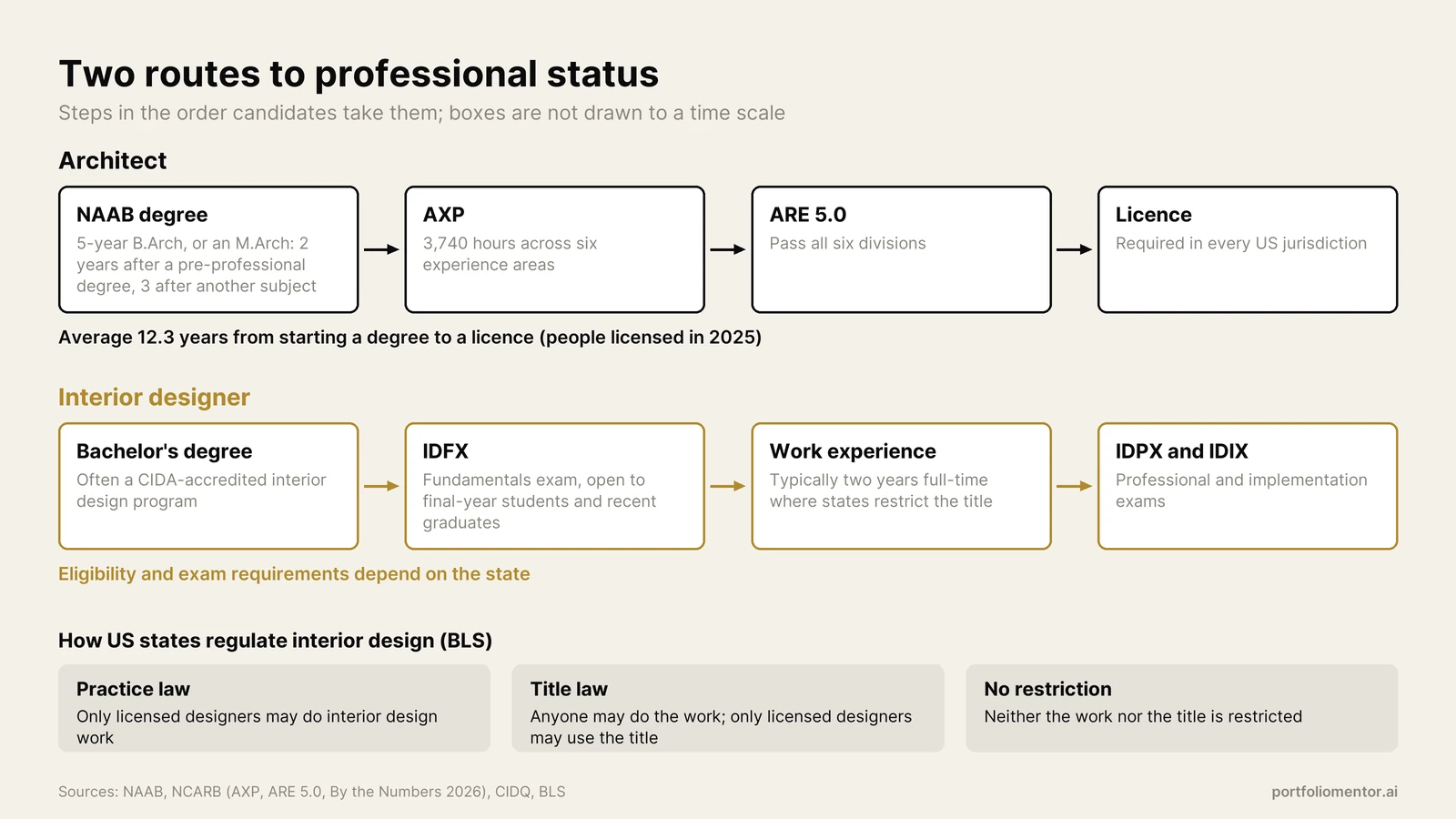
The path is long. NCARB’s 2026 edition of By the Numbers reports that the average person licensed in 2025 took 12.3 years from starting a degree to earning a licence, about four months faster than the year before. Our breakdown of architecture licensure, ARE and AXP covers where those years go.
Becoming a licensed or certified interior designer
Interior design regulation is a patchwork. BLS describes three situations: in some states only licensed designers may do interior design work; in others anyone may do the work but only licensed designers may use the title “interior designer”; and in still others there is no restriction on either. Where title is restricted, candidates must pass a state-approved exam, and eligibility typically includes at least a bachelor’s degree in interior design and two years of full-time work experience.
That exam is usually the NCIDQ, run by the Council for Interior Design Qualification. It has three sections: IDFX, the fundamentals exam, which final-year students and recent graduates can take before finishing their work experience; IDPX, the professional exam; and IDIX, the implementation exam. The last two require both education and work experience. Candidates who take all three together must pass them within 10 exam administrations.
⚠️ Common Mistake to Avoid
Students often assume an interior design degree is a shortcut into architecture licensure. In the 37 jurisdictions that require a NAAB-accredited degree, it is not: you would still need a B.Arch or M.Arch. Check your target state’s rules in NCARB’s licensing requirements before choosing a program, especially if licensure as an architect is the long-term goal.
Pay and the Job Market
The pay gap is wide. BLS reports a May 2025 median of $99,280 for architects against $67,190 for interior designers. Both are projected to grow at about the average rate from 2025 to 2035: 4 percent for architects and 3 percent for interior designers. BLS projects about 6,900 openings a year for architects and about 7,700 for interior designers, many of them created as people retire or move to other occupations.
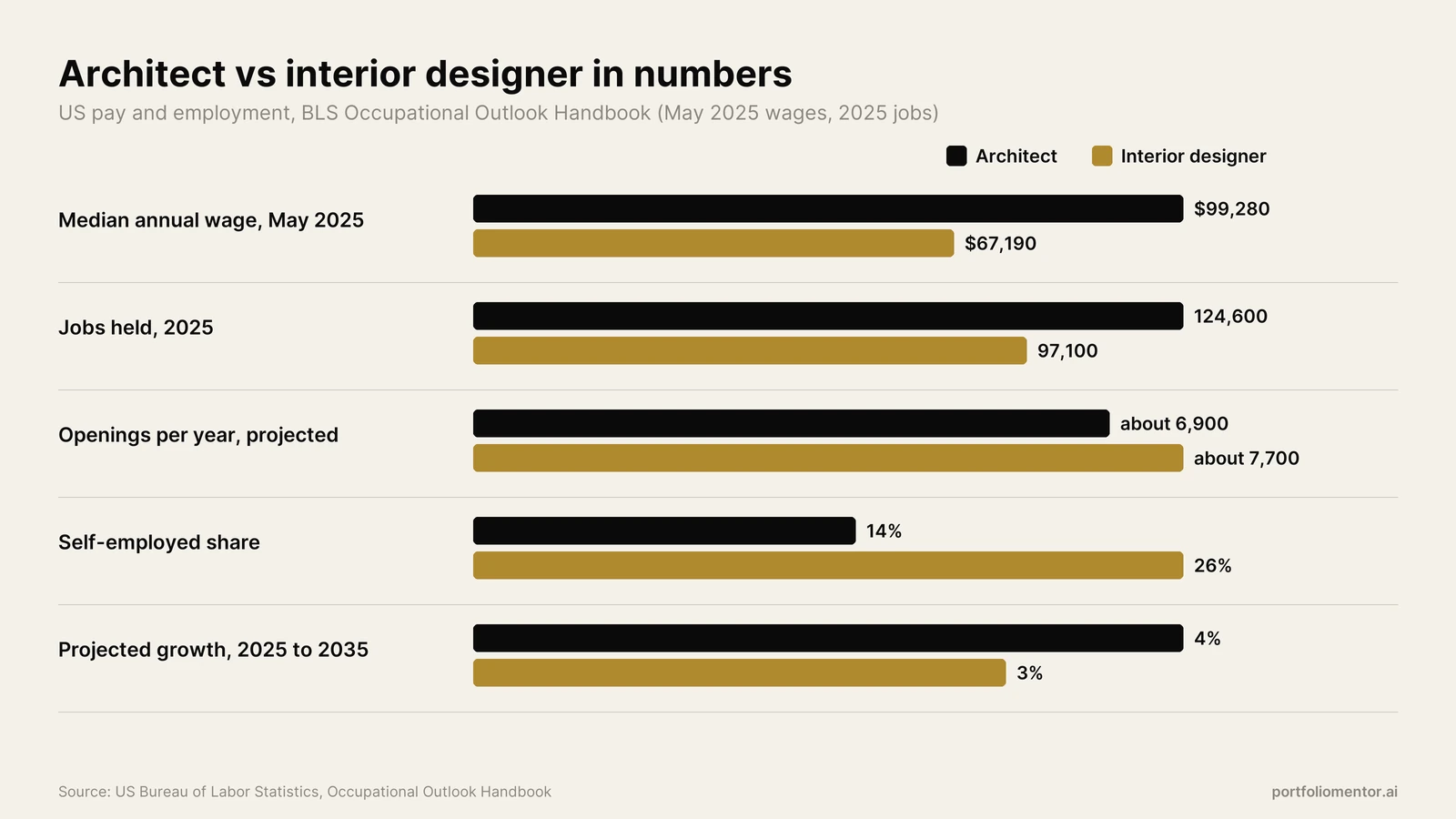
Where people work differs just as much. Among architects, 74 percent work in architectural, engineering and related services and 14 percent are self-employed. Interior designers are spread more widely: 30 percent in specialised design services, 26 percent self-employed, 14 percent in architectural and engineering firms, 12 percent in retail and 6 percent in construction. BLS also notes that interior designers spend much of their time soliciting new clients and new work, so business development is part of the job from early on.
🔢 Quick Numbers
- $99,280 vs $67,190: median annual wage, architects vs interior designers, May 2025 (BLS)
- 124,600 vs 97,100: jobs held in 2025 (BLS)
- 12.3 years: average time to an architecture licence for those licensed in 2025 (NCARB By the Numbers 2026)
- 3,740 hours: AXP experience required before an architecture licence (NCARB)
Medians hide wide variation by employer, region and specialism. Our article on interior architect salary explains why there is no single figure for hybrid roles, and the architect salary guide breaks the architecture median down by career stage.
How the Portfolios Differ
This is where the two professions part company most visibly, and where applicants switching between them most often go wrong. A hiring reader in each field is checking for evidence of the scope they will pay you to handle.

What an architecture portfolio has to prove
Architecture reviewers look for a project argued from site to detail: a concept that explains the form, plans and sections that show how it works, and at least some evidence that you understand structure, envelope and construction. In the terms of the Portfolio Mentor review, the categories that carry most weight here are Concept and Narrative, Technical Drawing and Project Selection. A book that is all interiors, however polished, reads as an incomplete architecture portfolio. Our architecture portfolio guide covers structure and sequencing in detail.
What an interior design portfolio has to prove
Interior design work is judged closer to the occupant. The duties BLS lists translate directly into pages: space planning and circulation, partition and electrical layouts, specified materials and furnishings, lighting, and evidence that you can carry a scheme through ordering and installation. Material and finish boards, furniture plans and reflected ceiling plans carry more weight than site analysis or structural diagrams.
💡 Pro Tip
When you apply across the line, rebuild the book rather than reorder it. An architecture graduate applying to an interior design studio should lead with one project taken down to finishes, lighting and furniture, and cut the site analysis to a single page. An interior designer applying to an architecture firm needs at least one project that shows the building envelope and a section through the whole building, not just the room.
Switching Between the Two Paths
Moving from interior design to architecture is mostly an education question. In most jurisdictions you will need a NAAB-accredited degree; with an unrelated bachelor’s, NAAB notes that a typical M.Arch takes three years. The 17 jurisdictions that NCARB says offer additional pathways are worth checking if a second degree is not realistic, and because the AXP defines which work settings and supervisors count, check how any interior design experience would be recorded before relying on it.
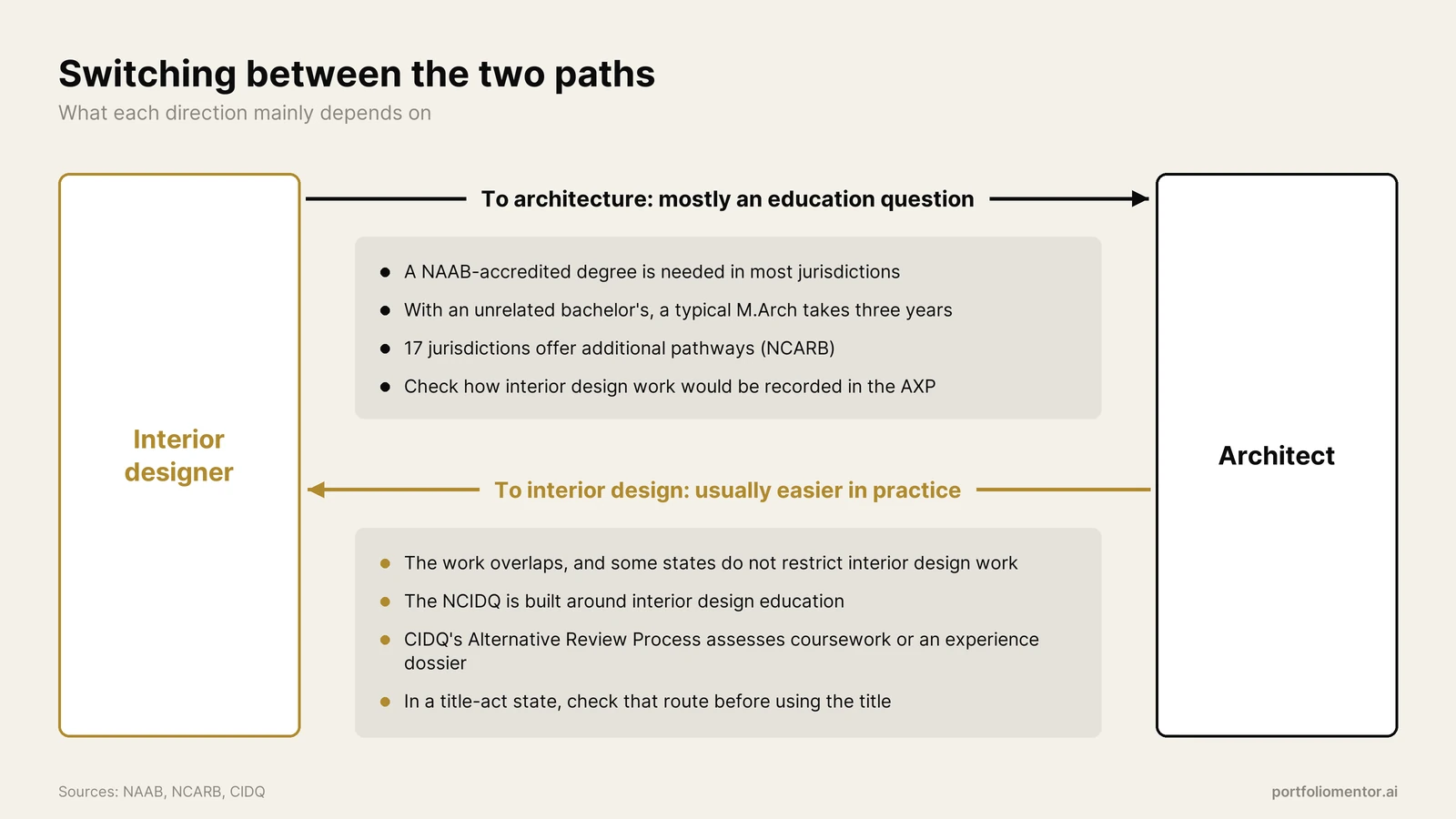
Moving from architecture to interior design is usually easier in practice, because the work overlaps and some states do not restrict interior design work at all. Formal certification is another matter. The NCIDQ is built around interior design education, but CIDQ runs an Alternative Review Process for candidates who cannot document the standard education, assessing either their coursework or a dossier of their experience. An architect who wants the title “interior designer” in a title-act state should check that route before assuming a licence carries over.
For a comparison of architecture with the other profession it is most often confused with, see architect vs engineer.
Which Path Suits How You Work?
Choose architecture if you want responsibility for the whole building, including how it stands, how it meets the street and how its systems fit together, and if you can accept a decade or more of education, logged experience and exams before you can sign drawings. The reward is a regulated title, a higher median wage and a wider range of project types.
Choose interior design if you care most about how people use, furnish and experience a space, and you want to reach professional work sooner. Expect more client-facing selling, a wider spread of employers and self-employment, and state rules that may or may not require you to pass the NCIDQ. The question to ask yourself is not which job is more creative, because both are, but which scale of decision you want your name attached to.